
Atlantic convector versus Norwegian panel heating: which suits you?
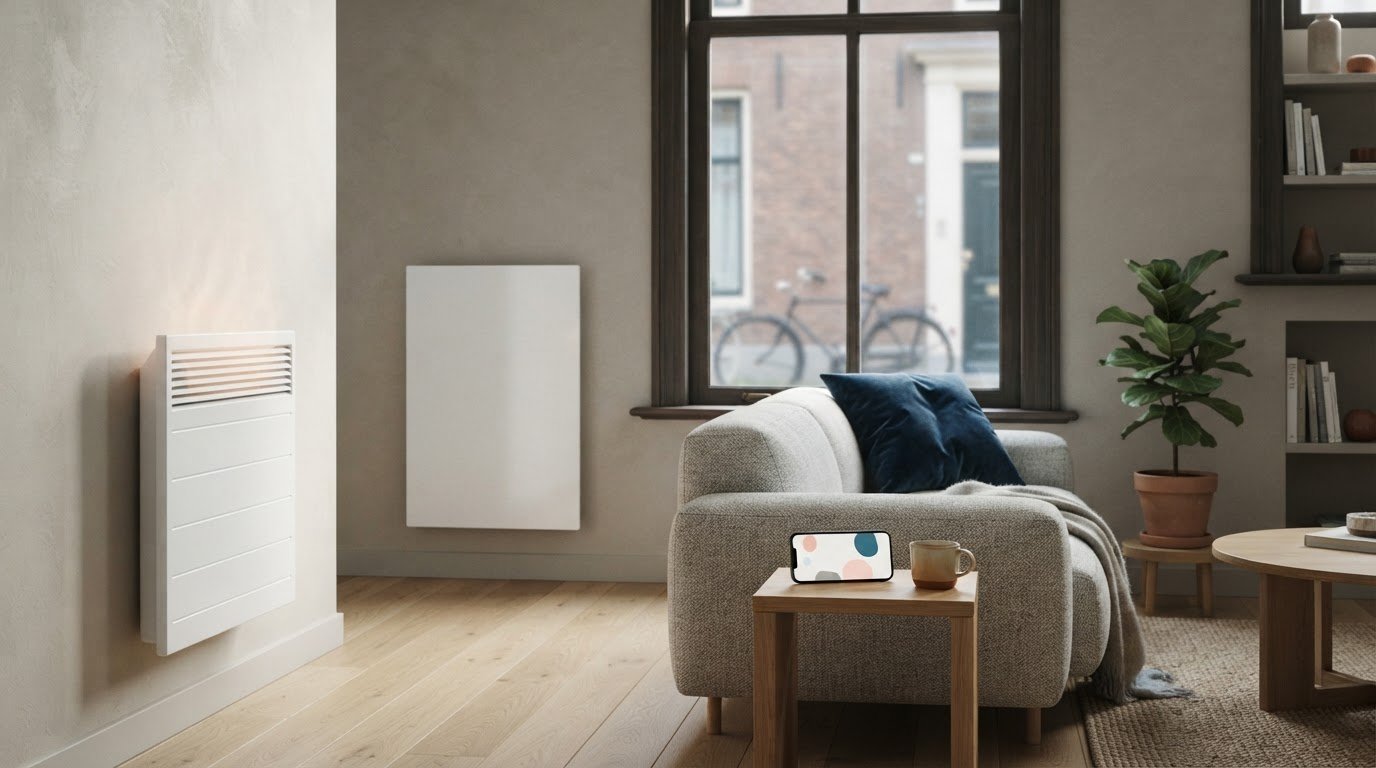
A heater with more features is not automatically the best choice for your home. When comparing Atlantic convectors versus Norwegian panel heating, the practical difference is about more than just the product name: operation, design, and the room in which you use the unit all matter. Product pages are difficult to compare side-by-side if the models have different specifications and controls. Moreover, power output, operation, and front panel do not, in themselves, indicate how a unit aligns with your daily use.
In this comparison, you can see exactly which features you can concretely compare side by side, without inferring savings or performance from a brand name. We discuss the heating principle, control, and installation, and show how to apply this information to your own space. Confirmed features of BEHAmodels are also covered, such as the Wi-Fi control of the PV / LV and PGV / LGV series and the various front panel designs. This allows you to compare Atlantic convectors and Norwegian panel heating at the model level and make a choice that suits your home and needs.
Key Points
- When comparing Atlantic convectors versus Norwegian panel heating, it helps to view the brand, heating type, and operation as separate points of comparison.
- Compare models based on the same specifications: power, control, operation, mounting, and front panel design.
- Match the capacity to the room and the heat demand. A fixed calculation is not suitable for every home.
- Choose a setting that suits your daily use and the way you want to operate the device.
- BEHA offers convectors with a steel, glass, or paintable front. The design and functions vary by series.
Atlantic convector versus Norwegian panel heating: what exactly are you comparing?
Are you looking for a different type of heating, a specific brand, or primarily controls that fit your daily routine? That question lies behind Atlantic convector versus Norwegian panel heating. The terms seem to indicate a direct comparison, but they do not always describe the same thing. A convector refers to the way heat is emitted. Norwegian panel heating, on the other hand, refers more to a product category and origin. For a fair comparison, therefore, you should look at specific models and their features.
A convector heats the ambient air, causing the air to circulate in the room. Air heated by the heating element rises. Cooler air moves downwards and can be reheated there. This creates airflow. The term panel heating does not automatically mean that a device uses a completely different heating principle: electric panel heaters can also emit heat via convection. Further explanation of how convector heaters work helps to view this principle independently of brand names.
What does an Atlantic convector do?
With an Atlantic convector, convection is the basis for heating the room air. The Atlantic F125D is a specific model, but one version does not automatically represent the entire range. Thermostat, power output, and controls can vary by model. Therefore, compare the specifications of the exact version you are considering. The brand name alone does not tell you what control or operation you will get in daily use.
What do people mean by Norwegian panel heating?
When people refer to Norwegian panel heating, they often mean electric panel or convector heating associated with a Norwegian brand or design. The name does not guarantee that all units have the same heat output, control, or operation. Even within a single brand, models differ in terms of front panel, power output, and functions. Therefore, do not compare a general impression of a country or brand, but check the product specifications of individual models.
BEHA builds on a Norwegian design and engineering tradition dating back to 1917. The range includes electric convectors with a steel, glass, or paintable front. The controls are also series-specific: the PV / LV and PGV / LGV series feature Wi-Fi integration. This feature does not automatically apply to every version. For more context on smart controls, you can view the guide on the electric convector with Wi-Fi.
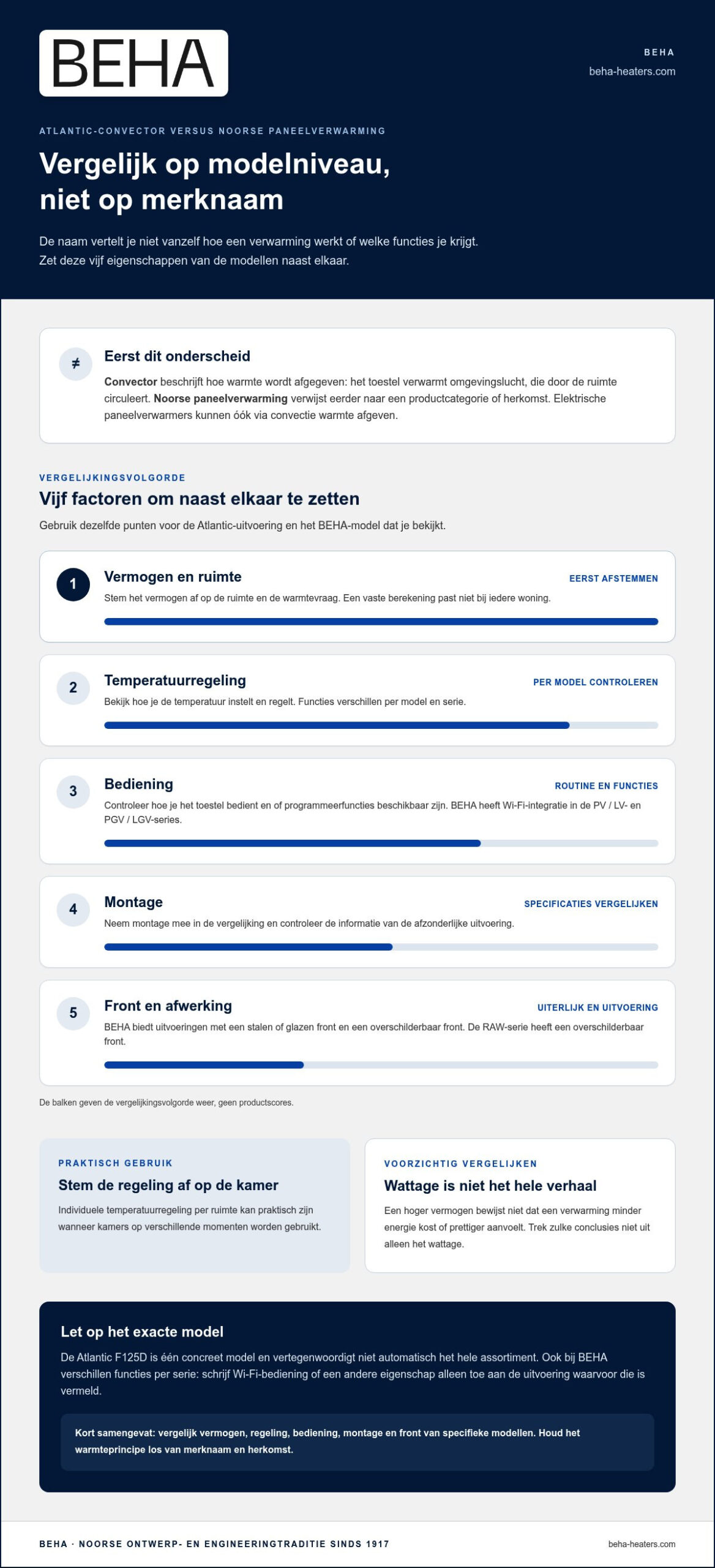
The practical comparison therefore does not begin with the assumption that an Atlantic convector and a Norwegian panel provide a different type of heat. First, distinguish between the general convection principle and the design of the unit. Next, compare the power output, temperature control, operating options, and finish. This prevents a single sample model or generic brand name from being the deciding factor.
How do heat output, control, and operation differ?
When comparing, keep the heating principle separate from features exclusive to specific versions. Electric convectors heat air that circulates through the room. That basic principle does not tell you how precisely you can control the temperature, how to operate the unit, or which front panel is available. The specifications of the individual model determine that.
Heating principle: convection heats the ambient air. That does not automatically make a brand comparison a comparison of different types of heat.
Thermostat: check how to set and control the temperature for each Atlantic model and BEHAseries. Do not assume that the entire range has the same thermostat functions.
Operation: the PV / LV and PGV / LGV series from BEHA feature Wi-Fi integration. The operation and any programming functions of Atlantic vary by version. Compare the information for the specific models.
Front design: BEHA offers convectors with a steel or glass front and a version with a paintable front. Consider both the appearance and the available product specifications.
Additional features: attribute a feature only to the model or series for which it is listed. A feature of one version does not automatically apply to other models of the same brand.
Model specifications reveal more about your daily usage than a general comparison between brands. For example, a higher output does not prove that the heating consumes less energy or feels more comfortable. Output is just one specification. The controls, the room, and how you use the appliance all contribute to how the heating performs in your specific situation. Therefore, do not draw conclusions about consumption or comfort based solely on wattage.
How do you compare a thermostat and temperature control?
Look in the product information for the thermostat control and any programming functions of the version you are considering. Individual temperature control per room can be practical when rooms are used at different times. You can then tailor the temperature setting to the function and usage of the room. At BEHA , Wi-Fi integration has been confirmed for PV / LV and PGV / LGV. Do not automatically attribute this capability to other series.
What role do the front and heat distribution play?
A steel or glass front can complement the look of your interior. A paintable front offers another finishing option. The BEHA RAW series features a paintable front. BEHA describes the heat distribution of its convectors as even. This is a product feature of BEHA, not an independent comparison with Atlantic. Compare the specific model information for both brands and choose the version that suits your space.
If you want to further refine your choice, compare the thermostat, controls, power output, and front panel design of both models side by side. In the BEHArange of electric convectors, you can view the versions based on these characteristics.
Which selection criteria make the comparison fair?
A fair comparison doesn't start with brand preference, but with your space and how you use it. Do you heat a room daily or only occasionally? Do you want to set the temperature on the unit or prefer to control it via Wi-Fi? By answering these questions first, you prevent a striking feature or general product promise from outweighing what you actually need.
Next, use the same checklist for each model. Note what the manufacturer states for that specific version and compare only features that are clear for both models. This way, you turn Atlantic convector versus Norwegian panel heating into an assessment of concrete products, rather than a comparison based on assumptions about brands.
- Space and usage: determine which room you heat and at what times. This allows you to assess the other features in the context of your daily routine.
- Power: Note the specified power exactly. BEHA PV / LV models have a range of 400-2000 W; for PGV / LGV models, this is 600-1250 W. Keep these ranges linked to their respective series.
- Control and operation: note the thermostat, any programming functions, and available control options. Only include a function if it is listed for the specific model.
- Dimensions and installation: compare the specified dimensions and installation method with the location where you intend to use the device. This will help you determine whether the model fits practically in the space.
- Front and product information: place the versions side by side and check whether the manufacturer clearly describes the features that are important to you.
Which specifications do you compare per model?
Use the product page or manual for the exact version. Copy the power, dimensions, and mounting method exactly as specified by the manufacturer. Do not deduce missing information from another version of the same brand. Compare features only when confirmed for the individual models. For additional context regarding a steel version, you can view the explanation of the electric heater with a steel front.
Also distinguish between a measurable specification and a general description. A stated power output is a technical value. Words such as “comfortable” or “economical” do not constitute a direct performance comparison without substantiation. Therefore, do not use them as evidence of lower consumption or better comfort. You can compare the functional characteristics of two appliances without drawing conclusions based on price.
How do you weigh smart features and design?
Ask yourself whether Wi-Fi control supports your routine, for example, because you want to adjust settings remotely. BEHA features Wi-Fi integration with PV / LV and Wi-Fi control with PGV / LGV. Only attribute app or voice assistant functions to a version if the product information confirms this. Also consider the appearance: BEHA offers steel, glass, and paintable fronts. Review the BEHAversions and product information to include these features in your comparison.
Which heating suits your space and daily use?
An appliance suits your situation if the design matches the space and how you use it. Therefore, make your choice step by step. This way, you avoid relying solely on a brand name or a single technical specification.
- Map out your room usage. Note how often and for how long you use the room, what temperature you find comfortable, and what heating is already in place. A room you use daily requires a different usage assessment than a space you only heat occasionally.
- Determine which control system suits your routine. Do you want to set the temperature on the unit, or is control via Wi-Fi useful for you? Consider room-by-room control and any schedules. Check which control options are described for each model.
- Choose a model that suits the room. Take into account the location of the appliance and the look you are going for. A steel, glass, or paintable front is a choice of finish. Appearance alone proves nothing about heat output or performance.
- Compare the model specifications with your space. Review the power output and dimensions provided by the manufacturer and match that information to the room and the intended application. Also determine whether you want to use the unit as primary or supplementary heating. This depends on the home, the existing heating situation, and the heat demand.
How do you determine what your space needs?
Do not judge the capacity in isolation from the room. The size and use of the space, the desired temperature, and the existing heating all play a role. Therefore, a single capacity is not automatically suitable for every room. Use the manufacturer's product information as a starting point and compare it with the room for which you are considering the appliance. Without that context, a wattage does not provide a complete picture.
Do not make calculations based on a general rule of thumb. Instead, note your usage situation and the provided product specifications so that you can assess whether the model suits the intended role. Primary heating and supplementary heating are different applications. Which is suitable depends on the home and the room.
When are smart controls or another front relevant?
Wi-Fi control can be relevant if you want to adjust settings remotely, but the possibilities vary by series and model. At BEHA , Wi-Fi integration is confirmed for PV / LV and Wi-Fi control for PGV / LGV. Do not assume specific schemes or app functions without product-specific information. Choose a front based on your interior preferences. BEHA offers steel, glass, and paintable versions.
If you want the heating to visually blend in with your interior, a paintable radiator can be a suitable option. View the BEHAversions and match your preference to the model details and room usage via the BEHAproduct information.
Norwegian panel heating from BEHA: how to turn the comparison into a choice
The outcome of Atlantic convector versus Norwegian panel heating does not depend on the nationality of a brand, but on the model that suits your space and daily use. Therefore, compare the specifications of individual models: power output, controls, operation, mounting, and front panel. This way, you base your choice on concrete features rather than expectations regarding a brand or product category.
What does BEHA offer within Norwegian panel heating?
BEHA combines a Norwegian design and engineering tradition dating back to 1917 with electric convectors in various finishes. You can choose from a steel front, a glass front, or a paintable front. The RAW series features a paintable front. This allows you to incorporate design into your choice without confusing appearance with technical performance.
Also pay attention to the features per series. The PV / LV series has Wi-Fi integration and a 20-year warranty on the heating elements. The power range of this series is 400-2000 W. PGV / LGV models have a glass front, Wi-Fi control, and a power of 600-1250 W. These models have an IP24 rating, which means they are splash-proof. That is splash water protection, not complete watertightness. Do not automatically attribute these features to other BEHAversions.
This data provides you with concrete points of comparison alongside the features of an Atlantic model. For example, compare the stated output and control options of both specific versions. Higher output is not in itself proof of better heating or lower energy costs. The room, heat demand, and desired control remain important. BEHAproducts comply with EU EcoDesign, but even that information does not replace a comparison of the features relevant to your use.
Those wishing to take into account the experiences of other buyers can use the BEHArating of 9.2 / 10 from 1,247 Kiyoh reviews as an additional point of reference. View a rating as context, not as a guarantee that a specific model will fit every room.
What is a logical next step?
Create a short list of the space you want to heat, the desired controls, the matching front panel, and the model specifications that align with them. Next, select a few specific versions, even if you are comparing them with Atlantic, and verify that the features are listed in the product information for exactly those models. This ensures your assessment remains balanced and prevents a feature from a single series from being perceived as a hallmark of an entire brand.
View the BEHAmodels and use the dealer locator as the next step in your product orientation. View the BEHAheated and compare the versions based on your preferences.
Turn your comparison into a suitable choice
The next step is not to designate a brand as the winner in general, but to choose a specific model for the space you want to heat. Note which feature weighs most heavily for you: the desired operation, the finish, or the product specifications that suit your usage. This way, the choice between an Atlantic convector and Norwegian panel heating becomes a targeted one based on what you need at home.
Compare your shortlist and see which model best fits your daily routine. A clear preference does not have to be based on a single striking feature. The combination of suitable specifications and ease of use guides your choice. Take the time to review the models and base your decision on information relevant to your situation.
's electric heating BEHA and discover which model suits your needs. With a specific room and usage situation in mind, you can make a targeted choice.
Frequently Asked Questions
Is an Atlantic convector the same as Norwegian panel heating?
No, not automatically. Both terms can refer to electric heating products, but they do not automatically imply that the technology, design, or operation is the same. Atlantic models differ from one another, and a Norwegian origin is not a technical product specification. Therefore, when comparing Atlantic convectors versus Norwegian panel heating, it is best to compare specific versions. Place the product data of the models you are considering side by side, rather than comparing only brand names or category designations.
Which heater is more energy-efficient: an Atlantic convector or a BEHApanel heater?
Based on the brand name alone, no reliable winner can be identified. Without comparable measurement data, you cannot promise savings. Consumption depends on factors such as power output, heating duration, the selected temperature, and the room. Ease of use is different from energy consumption: Wi-Fi can make settings more accessible, but it does not in itself prove lower consumption. Therefore, compare the same usage situation with the data from the specific models.
Can I control a BEHAconvector with my smartphone?
Yes, Wi-Fi and control via the BEHA Smart App have been confirmed for the PV / LV and PGV / LGV series. You can control these versions with your smartphone. Do not assume that RAW, classic convectors, or other product lines have the same app control. The features vary by series. Check the model you are considering to see which functions are included, rather than transferring features from one series to another.
Is a BEHAconvector with IP24 completely waterproof?
No. IP24 means splash water protection, not that a device is completely waterproof. The designation does not mean that you can submerge a convector or expose it to water jets. When installing or using it in a damp room, take into account the information for the specific model and the meaning of the IP24 rating. Do not automatically assign this protection rating to other models without the same stated specification.
How do I know what power my electric convector needs?
The required power depends on the room and the heat demand. Therefore, one general calculation does not fit every room. Compare the manufacturer's specifications of the specific model with the room in which you intend to use it. BEHA PV / LV has a range of 400-2000 W; PGV / LGV has 600-1250 W. These are individual series specifications, not recommendations that every model within those ranges is suitable for your room.
Can electric panel heating work with self-generated solar power?
Yes, BEHA indicates that the products can operate directly on self-generated solar electricity. However, this does not automatically mean that you behafixed savings or that solar power covers the entire heating demand. The amount of electricity available depends on how much you generate and when you use it. Take your own generation and heating usage into account when making your choice and avoid making assumptions about the outcome.
Does every BEHAconvector have a 20-year warranty?
No. The 20-year warranty applies exclusively to the heating elements of the PV / LV series. Therefore, this term does not automatically apply to other BEHAseries, the entire unit, or accessories. Please note the difference between the warranty period and exactly what is covered: the confirmed coverage is linked to the PV / LV heating elements. Therefore, do not attribute the term to a longer period than indicated in this product information.