
Beha convector vs Mill Wi-Fi panel heating: which will you choose for your home in 2026?
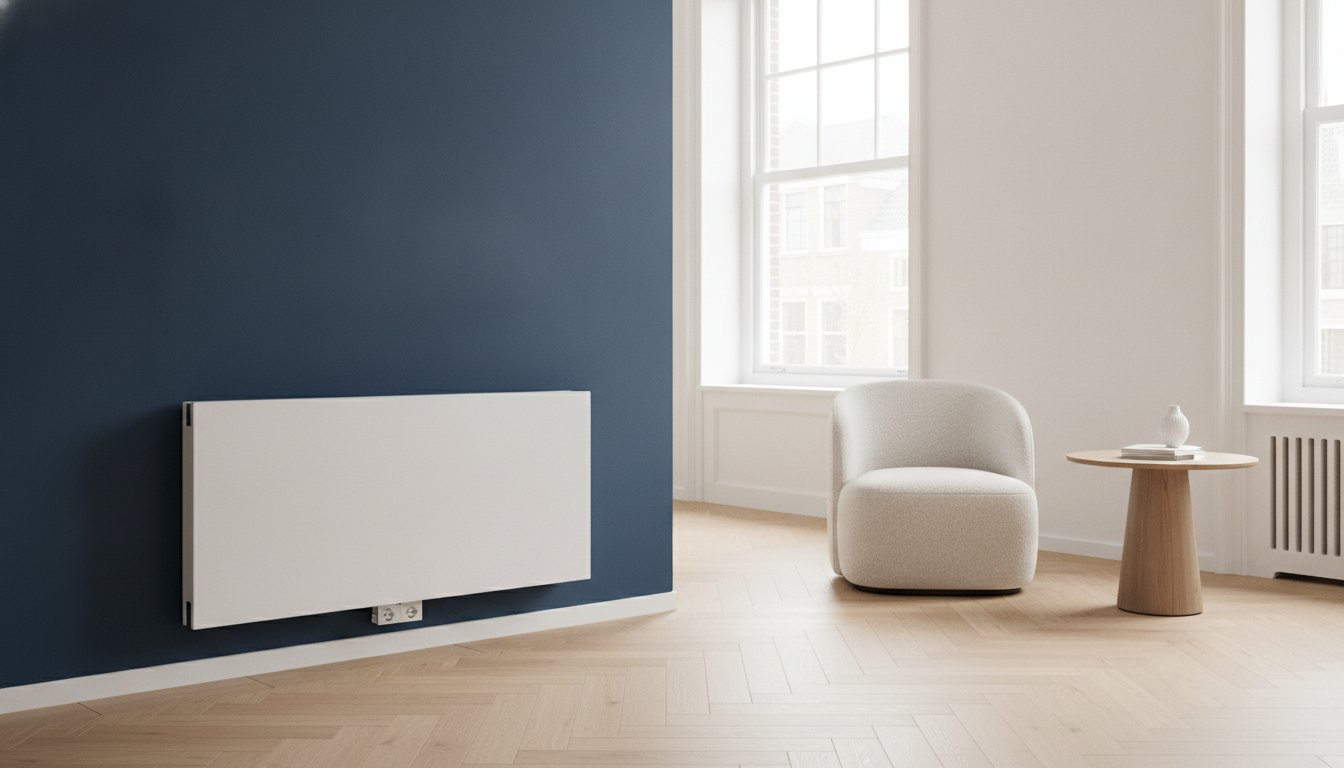
Is that sleek, minimalist heater that caught your eye really the smartest long-term investment? You probably want a home that always behacomfortable, but at the same time, you are worried about unclear apps and rising energy costs. It is perfectly understandable that you have doubts when comparing beha convector vs. Mill Wi-Fi panel heating, as both brands dominate the market with promises of modern design and smart connectivity.
We understand that you are looking for a heating system that is not only technically superior but also blends seamlessly into your carefully designed home. Discover the crucial differences between Beha and Mill so you can make the best choice for a smart, warm, and stylish home in 2026. In this article, we look beyond just the exterior. We analyze the Norwegian reliability, the actual efficiency according to the strictest ecodesign standards, and the innovative features that will finally lower your energy bill. We compare the stability of the Wi-Fi control and show how to choose a heater with a paintable front that becomes almost invisible in the room.
Key Points
- Learn how to make the right decision in the Beha convector vs Mill Wi-Fi panel heating comparison by focusing on technical superiority and sustainability.
- Discover how stable Wi-Fi connectivity and smart app features ensure precise temperature control in any desired zone of your home.
- Understand the benefits of paintable fronts, which allow you to seamlessly and almost invisibly integrate the heating into your personal interior style.
- Find out how strict adherence to Ecodesign standards and smart sensors help prevent unnecessary power consumption and high energy bills.
- Experience the reliability of a heating system built on more than a century of Norwegian expertise and innovative technology.
The battle between Norwegian giants: why you compare these two brands
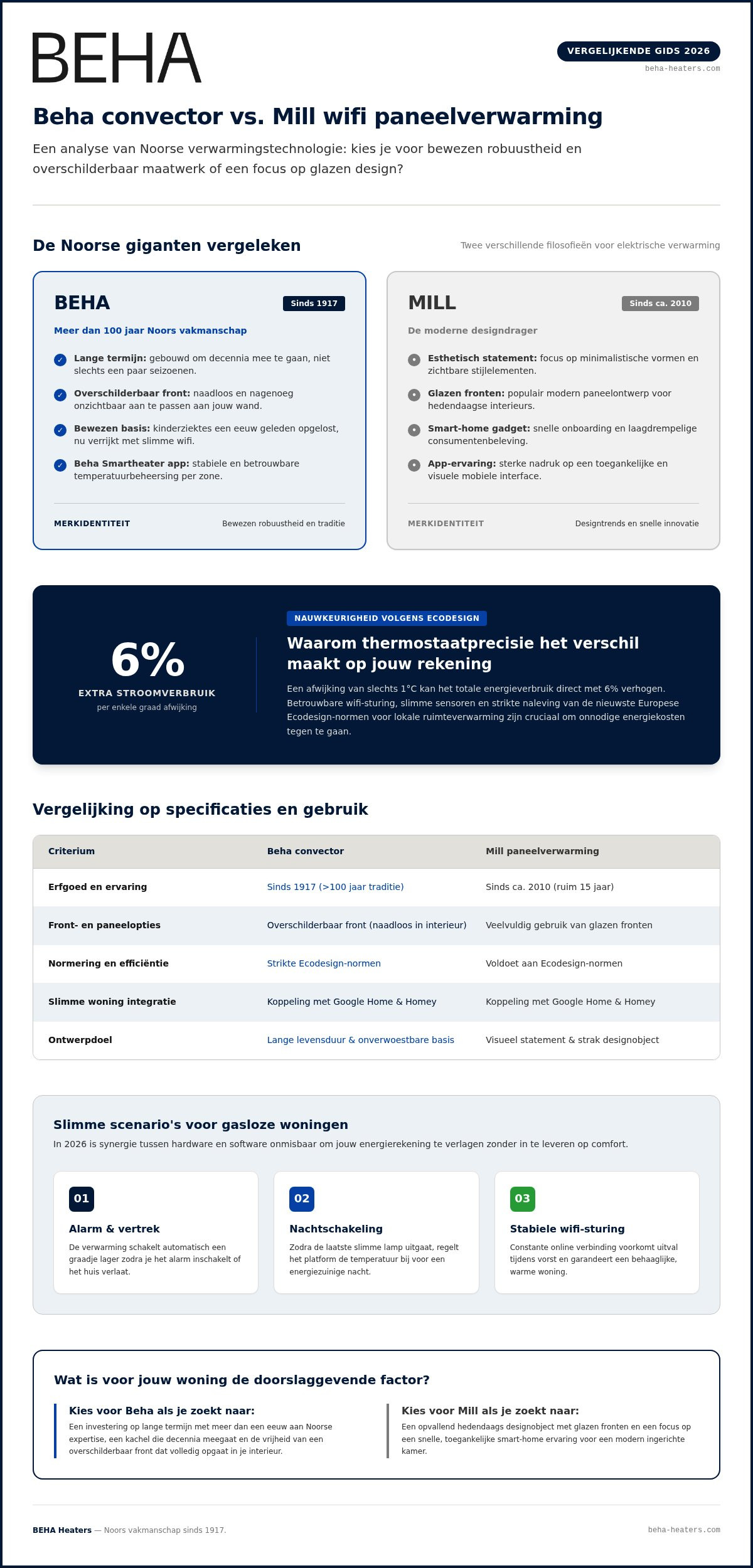
Norway is the undisputed leader when it comes to electric heating. This makes sense, because in a climate where winters are severe and long, reliability is not a luxury but an absolute necessity. In the Netherlands, we see the popularity of these Scandinavian solutions rising rapidly, especially now that we are switching en masse to gas-free homes. The choice between a beha convector and Mill Wi-Fi panel heating is therefore one of the most frequently asked questions by homeowners seeking a smart balance between comfort and technology. While one brand relies on a century of craftsmanship, the other focuses entirely on a modern design and rapid smart-home integration.
In 2026, we look at our devices more critically than ever before. It is no longer just about whether a heater gets warm, but about how efficiently that happens and how stable the connection to your ecosystem remains. Both brands dominate the market, but they do so based on completely different philosophies. The core of this comparison revolves around the question of whether you choose proven robustness or the latest design trends.
The history of Beha: 100 years of Norwegian craftsmanship
Beha is a Norwegian family business that has been setting the industry standard since 1917. This is not a trendy tech start-up, but a manufacturer that has spent generations perfecting how to heat a space safely and efficiently. This brand's focus is always on the long term. When electrical components get hot daily for years, wear and tear occurs. Beha understands the operation of convection heating like no other and builds heaters that last for decades, not just a few seasons. Production still takes place with immense pride in its own standards. By choosing this brand, you are opting for one that solved the teething problems a century ago and now combines modern Wi-Fi technology with an indestructible base.
Mill's philosophy: design and simplicity
Mill is the challenger that shook up the market around 2010. They recognized that traditional radiators were often an eyesore in modern interiors. Their philosophy is simple: heating should blend invisibly into the room or, conversely, be an aesthetic statement. With their minimalist forms and frequent use of glass fronts, they appeal to a target audience that values design just as much as heat output. Mill has grown rapidly by focusing on a highly accessible app experience. They turn a heater into a true smart-home gadget, making installation a breeze for the average consumer. It is a brand that caters to the need for immediate innovation and a sleek, modern look in the living room.
The comparison between a beha convector and Mill Wi-Fi panel heating therefore forces you to consider what you value more: the deep-rooted experience of an established expert or the fresh, design-oriented approach of a modern player. In the following sections, we dive deeper into the technical performance that will make the difference to your energy bill in 2026.
Smart features and the Wi-Fi experience under the microscope
In 2026, connectivity will be the backbone of your home comfort. A smart heater that goes offline the moment frost sets in is a source of frustration. When comparing the beha convector vs. Mill Wi-Fi panel heating, we see that both brands are investing heavily in their digital ecosystem. However, the real gain lies not only in a beautiful interface, but in the stability of the connection and the accuracy of the thermostat. A deviation of just one degree can increase your energy consumption by as much as 6%. That is why these systems comply with the latest Ecodesign standards for local space heating, giving you the assurance of extremely precise temperature control.
Integration with smart home platforms such as Google Home and Homey has now become the standard. This allows you to link your heating to other devices in your home. Think of scenarios where the heater automatically lowers the temperature by a degree as soon as you activate the alarm or turn off your last smart light. This synergy between hardware and software is crucial for a lower energy bill without compromising on comfort.
The Beha Smartheater app: control in your pocket
app Beha is designed with a focus on reliability and logic. Setting up complex weekly schedules is intuitive; you simply divide your home into different zones. Whether you want to heat the bathroom extra before you get up or only want the home office to be at the right temperature during office hours, it is arranged with just a few taps. The remote control function works flawlessly, allowing you to maintain control even when you are on the go. For a deeper insight into this technology, you can consult our guide on the electric convector with Wi-Fi . Beha opts for a robust connection that holds up even in less well-heated corners of the house.
Mill Wi-Fi technology: what are the benefits?
Mill is known for a highly visual app experience. Users often appreciate the graphs that provide insight into energy consumption. The interface looks modern and aligns with the brand's minimalist philosophy. A strong point of Mill is group control, which allows you to adjust all heaters in a specific room simultaneously with a single slider. Although the app's responsiveness is high, some users note that the Wi-Fi module is sometimes more susceptible to interference in the home network than the industrial standards used by Beha . Are you looking for a system that combines proven stability with years of experience? Then check out Beha to see which solution best suits your situation.
Design and interior: from glass fronts to paintable radiators
The days when a radiator was merely a functional, white block on the wall are long gone. When weighing up a beha convector vs. Mill Wi-Fi panel heating, aesthetic integration into your interior plays a decisive role. Where one opts for the modern gleam of a glass front, another prefers the subtle robustness of steel. However, it is crucial to remember that design must never come at the expense of efficiency. After all, all modern appliances must comply with the strict European Ecodesign standards for electric heating, which set requirements for both smart control and thermal performance.
Moreover, the form factor influences how heat distributes throughout the room. A steel front heats up faster and releases heat more directly via natural convection. In terms of maintenance, steel is often the practical winner; it is less prone to fingerprints, and dust is easy to remove with a damp cloth. Glass requires regular polishing to maintain that deep, modern shine, which can mean an extra chore in a busy household.
The unique paintable radiator from Beha
Beha distinguishes itself in the market with an innovation seen in few other brands: the paintable radiator. This offers you the ultimate freedom to have your heating blend completely into the color of your wall. The result is a heating system that becomes almost invisible, which is ideal for minimalist interiors or spaces with pronounced color palettes. For the best results, use a high-quality water-based paint and apply thin coats. This way, you maintain optimal heat efficiency without the paint peeling due to temperature fluctuations of the element.
Mill panel heating: the glass revolution
Mill has taken a prominent position in the smart home world with its glass panels. The sleek, smooth finish lends a luxurious look to a modern living room. The tempered glass is generally safe for households with children or pets, as the surface often feels less directly hot than uninsulated metal radiators. However, there are also limitations. Glass is heavier and more fragile during a move or in the event of hard impacts. In the comparison of beha convector vs. Mill Wi-Fi panel heating, we see that Beha also offers glass options, the focus on steel and paintable fronts offers greater functional versatility for those who wish to regularly change their interior.
Energy efficiency and safety according to Ecodesign standards
Many consumers still fear that electric heating will lead to an unaffordable energy bill. In 2026, that fear will be largely unfounded, provided you choose equipment that complies with the strictest regulations. When weighing up a beha convector versus Mill Wi-Fi panel heating, compliance with Ecodesign standards is a crucial benchmark. These European rules require manufacturers to implement features that prevent waste, such as an accurate electronic thermostat and open window detection. When you open a window for fresh air, a smart convector recognizes the sudden drop in temperature and temporarily switches itself off. This prevents you from literally heating the outside air.
The precision of the thermostat plays a leading role in this. A high-quality sensor measures the temperature with an accuracy of a fraction of a degree. As a result, the heater cycles between on and off less frequently, which not only feels more comfortable but also extends the lifespan of the electronics. Safety is always paramount. Features such as automatic overheating protection and a child lock on the controls will be the standard for every reliable system in 2026.
Why Beha meets the strictest environmental requirements
Beha goes beyond the basic requirements of legislation. The technical construction of their heating elements is designed for maximum heat transfer at a lower surface temperature. A unique advantage of this is the low dust combustion. Because the element does not become extremely hot, dust particles in the air do not burn. This results in significantly better air quality, which is essential for people with allergies or sensitive airways. Furthermore, Beha chooses materials that are almost completely recyclable at the end of their long life cycle, which reduces your home's ecological footprint.
Mill and energy efficiency: the facts
Mill places a strong emphasis on software-based solutions to save energy. Their energy-saving programs in the app are highly detailed and help you map out consumption per room. Although their heaters effectively manage heat loss through good housing insulation, the standby consumption of the Wi-Fi modules is a point of concern. While these modules will be more efficient than before in 2026, Mill performs particularly strongly when compared to Beha 's industry standards in providing visual insight into your savings. This encourages users to be more mindful of their heating habits.
Are you ready to make your home more sustainable with a system that combines proven efficiency with Norwegian craftsmanship? Then take a look at 's Beha and make the right choice for your wallet and the environment. smart convectors
Conclusion: why a Beha convector is the smart investment
After weighing all the technical specifications and aesthetic features in the battle between the beha convector and Mill Wi-Fi panel heater, a clear picture emerges. Mill is an excellent choice for the consumer who views a heater primarily as a modern design object. Their glass panels offer a sophisticated look that fits well in many modern interiors. However, when considering the long term and the demands of 2026, Beha in terms of versatility, healthy air quality, and proven technology.
The unique option to repaint the front ensures that your investment is future-proof. Changing your interior? Then simply paint the heater along with it. With a glass panel, you are stuck with the chosen color. Moreover, the steel construction of the Beha offers a robustness befitting an appliance that needs to last for decades. To determine the correct capacity for your space, you can assume an average of 100 watts per square meter for standard insulated rooms. In a very well-insulated new-build home, this can often be reduced to 60 to 70 watts per square meter.
Your decision guide for 2026
Making the final decision between a beha convector vs. Mill Wi-Fi panel heater becomes easier when you consider your daily needs. Use this short decision tree to confirm your choice:
- Choose Beha if you value 100 years of Norwegian craftsmanship, seamless integration thanks to paintable fronts, and a healthier indoor climate without dust burning.
- Choose Mill if you have a strong preference for glass panels and an interface heavily focused on visual statistics.
- Choose certainty by looking for local support. Beha offers excellent warranty conditions and technical support within the Netherlands, which is essential for a system that heats your entire home.
Are you ready to make a decision? You will find the latest models and great deals directly in the Beha shop.
Ready for a gas-free future?
Switching to electric heating is a major step towards a sustainable, gas-free home. Fortunately, installing a modern convector is very simple; with the included wall bracket, your heater will be mounted within fifteen minutes. As soon as the Wi-Fi connection is activated, you can easily expand your smart heating network by creating zones per room. This way, you never heat an unused room again and maintain full control over your energy consumption.
Would you like to know more about the benefits of sustainable materials and a sleek finish? Then take a look at our full range of electric heaters with steel fronts and discover how tradition and innovation come together in your home.
Choose a warm and future-proof home in 2026
The final decision in the comparison of Beha convector vs. Mill Wi-Fi panel heating depends on your long-term priorities. While Mill distinguishes itself with a minimalist appearance, Beha the reliability of a Norwegian family business with over 100 years of experience in the most challenging climates. With Beha a system that not only strictly complies with all European ecodesign requirements but also offers unprecedented flexibility. The unique paintable fronts ensure that your heating always blends seamlessly with your interior, no matter how often you repaint the walls.
By investing in a solution that combines technical superiority with healthy air quality, you create a living environment ready for the future. A lower energy bill thanks to smart Wi-Fi control and the guarantee of robust craftsmanship form the basis for years of living comfort. Discover the sustainable Beha convectors in our webshop and experience the perfect harmony between tradition and innovation for yourself. Turn your home into a warm place where technology and design go hand in hand.
Frequently asked questions about smart heating
What is the biggest difference between a Beha convector and Mill panel heating?
The main difference lies in the brand philosophy and physical characteristics. Beha is a Norwegian family business with over 100 years of experience, which translates into robust steel convectors that can be repainted. Mill is a more modern player that emphasizes minimalist design with glass fronts. In the comparison of beha convector vs. Mill Wi-Fi panel heating, you can see that Beha opts for timeless durability and interior design freedom, while Mill focuses more on a striking, modern appearance.
Can I really paint over a Beha convector with normal wall paint?
Yes, the paintable fronts from Beha are specifically designed to be behawith a water-based lacquer or wall paint. It is important to lightly sand the surface first and remove dust for good adhesion. By applying thin layers, you ensure that heat conduction remains optimal. As a result, the heater blends seamlessly into your interior without the paint peeling or discolouring due to the heating element's temperature.
Which app is more user-friendly: Beha Smartheater or Mill wifi?
Both apps are designed for optimal ease of use, but they have a different approach. The Beha Smartheater app excels in stability and a logical layout of temperature zones, which is ideal for a reliable weekly schedule. The Mill app focuses more on the visual display of your energy consumption with extensive graphs. For those looking for no-nonsense control that always stays connected, Beha 's technology often offers the most solid experience in a smart home.
Are Norwegian electric heaters more energy-efficient than other brands?
Norwegian heaters, such as those from Beha are designed for extreme cold, making them often more energy-efficient than cheaper alternatives. They strictly adhere to European ecodesign standards, which means they feature functions such as open window detection and a highly accurate thermostat. As a result, you never consume more power than strictly necessary to reach the desired temperature. Years of expertise in the North translate directly into a lower energy bill for your home.
Do I need a dedicated circuit for a 2000-watt panel heater?
In most cases, you do not need a separate circuit for a 2000-watt heater. A standard Dutch circuit can handle up to 3680 watts. However, it is important to check the total load on the circuit. If you also use a kettle or washing machine on the same circuit, the fuse may blow. For the safe operation of your panel heating, it is advisable to distribute high-power consumers across different circuits in your fuse box.
What happens to my settings if the Wi-Fi connection drops?
When the Wi-Fi connection is lost, the heater continues to function based on the last known settings or the manual program. Most smart convectors have internal memory that stores the set weekly program. You can also manually adjust the temperature at any time via the thermostat on the device itself. As soon as the connection is restored, the heater automatically synchronizes with the app on your phone again for full remote control.
Is a Mill glass front dangerous for children?
Mill's glass fronts are made of tempered glass, which is significantly stronger and safer than standard glass. Although the surface does get hot, the risk of direct burns from brief contact is limited. Nevertheless, steel is often preferred in households with young children or pets. A steel front from Beha is less vulnerable to hard impacts from toys and offers a more robust finish that better withstands the dynamics of a busy family life.
How many years of warranty do I get on a Beha convector heater?
's high-quality convectors Beha . This underscores the company's confidence in the durability of their Norwegian manufacture. Because Beha has existed since 1917, you know you are investing in a product from a manufacturer that will still be able to provide support and parts ten years from now. This long warranty period is a significant advantage when choosing between a beha convector and Mill Wi-Fi panel heating for your fixed heating system.