
Best electric heater for the living room: Buying guide
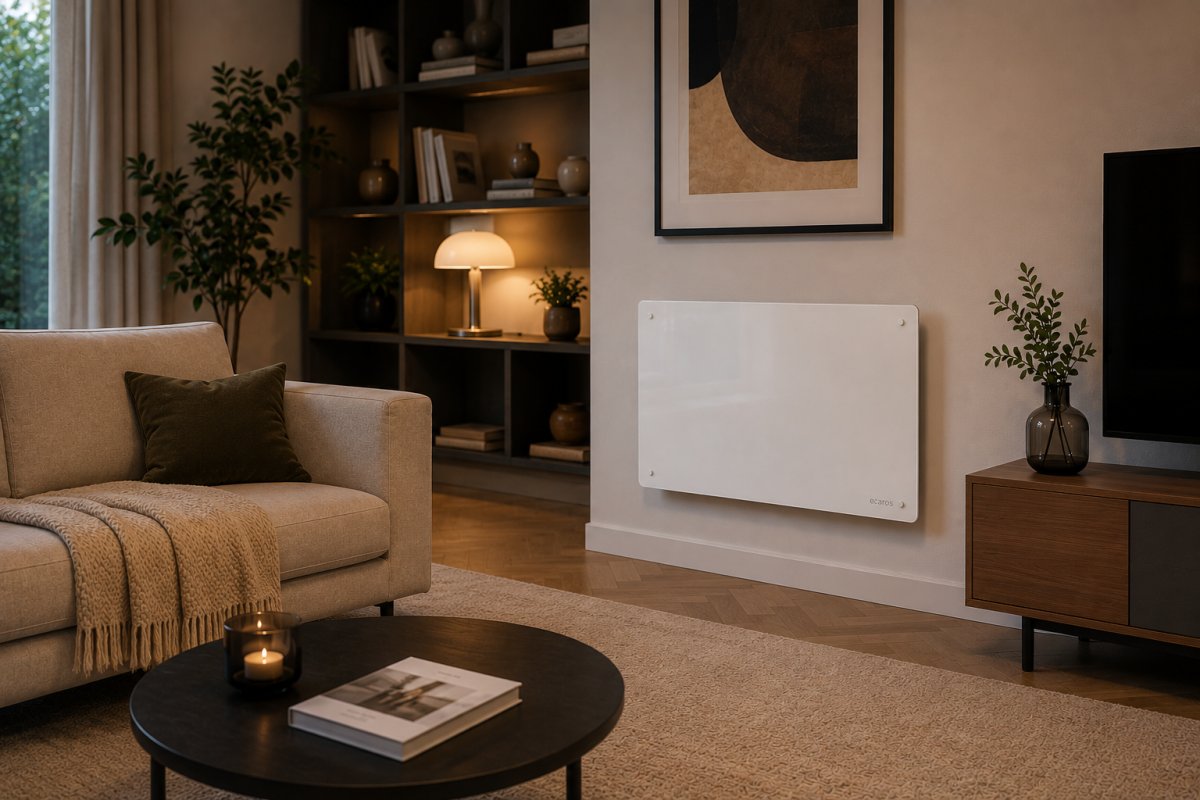
The best electric heater for the living room is not automatically the unit with the highest wattage. For quiet heating of the entire room air, a wall convector is often suitable; for a single seating area, infrared can be more targeted, and for long-term primary heating, a heat pump is usually more efficient. In this buying guide, you compare the options based on comfort, noise, power, consumption, safety, and design for living rooms in Belgium and the Netherlands.
The best choice in one minute
- Silent, complete room heating: choose a fanless electric convector with an electronic thermostat.
- Targeted heat for a single seating area: compare an infrared panel.
- Very rapid, temporary heat: a fan heater responds quickly, but makes noise.
- Daily main heating for many hours: first investigate insulation and a heat pump.
- Calculate the power based on room volume and heat loss, not just on square meters.
When is the best electric heater for the living room a good choice?
The best electric heater for the living room matches the number of hours of use and how you use the space. A direct-electric unit is practical as supplementary heating, for a separate living zone, or when no water pipes are available. Installation is simpler than with a central heating system, and each room can have its own thermostat and program.
If the living room requires primary heating daily from morning to evening, direct electric resistance heaters can consume a relatively large amount of power. A heat pump transfers ambient heat and generally delivers more room heat per kWh of electricity. Therefore, compare not only the purchase price, but also operating hours, insulation, and total costs.
The best electric heater for the living room as supplementary heating
Supplementary heating is beneficial when the central thermostat can be set lower and you maintain only the living room at a comfortable temperature. This only saves energy if other rooms are actually heated less. If an electric heater runs on top of an unchanged central system, total energy consumption actually increases.
Direct electric does not automatically mean cheap
A resistance heater converts virtually all the electricity consumed into heat at the point of use. This does not automatically make a 2,000-watt unit more energy-efficient than another 2,000-watt resistance heater. The real difference lies in thermostat accuracy, operating time, zone heating, and the heating experience that suits your living room. More technical background can be found under electric heating principles.
What is the best electric heater for the living room?
The comparison below makes it clear why a single universal winner does not exist.
| Type | Heat | Strong in the living room | Point of attention |
|---|---|---|---|
| Fanless convector | Natural air circulation | Quiet, fast, and suitable for the entire room air | Small heat buffer after switching off |
| Oil-filled radiator | Convection and radiation with thermal mass | Even heat and slow cooling | Heavier and slower to heat up |
| Infrared panel | Direct radiation | Targeted heat at the sofa, table, or desk | Less comfort outside the radiation zone |
| Ceramic fan heater | Forced warm air | Very fast and portable | Fan noise while watching TV |
| Air-to-air heat pump | Transfers heat via indoor unit | Efficient for long operating hours and can also cool | Installation, outdoor unit and fan noise |
Fanless convector: the silent all-rounder
A wall convector draws in cooler air at the bottom, heats it, and allows the warm air to rise at the top. Without a fan, it operates virtually silently. This is suitable for conversations, music, and television. A well-distributed system heats the room air but requires unobstructed airflow and sufficient power.
Infrared: purposeful for a fixed seating area
Infrared heats people and surfaces directly within the radiation range. This can be pleasant when only one part of a large living room is being used. For a family moving throughout the entire space, localized radiation alone is less practical. A clear explanation of convector and radiant heating helps with that decision.
Fan heater: fast, but audible
A ceramic fan heater can quickly make a cold room behacomfortable. The fan noise and noticeable airflow can be disruptive in the living room. This type is better suited for short-term use than for silent heating throughout an entire evening.
Oil-filled radiator: quiet and even
Thermal oil stores heat, causing the device to heat up more slowly and emit heat for longer after being switched off. This provides a consistent feel, but makes the device heavier and less responsive than a convector. It remains a direct electric resistance device.
Heat pump: for many heating hours
An air-to-air heat pump can efficiently heat and cool a living room. It requires professional installation and uses a fan. With prolonged daily use, the lower power consumption can compensate for the higher investment. Have the capacity, noise level, and position of the indoor and outdoor units assessed in advance.
Smart features and actual energy consumption
The best electric heater for the living room has controls that align with your daily routine. Wi-Fi does not make the heating element itself more efficient, but it can prevent an empty room from staying unnecessarily warm.
Electronic thermostat
A thermostat measures the room temperature and switches off the heating element as soon as the target value is reached. Pay attention to the position of the sensor: direct sunlight, a curtain, or another heat source can affect the measurement. A well-chosen power output and stable control are more important than many separate heating settings.
Weekly program and zoning
Let the living room warm up briefly before use and lower the temperature when everyone is asleep or absent. In an open-plan living room with a kitchen and dining area, multiple appliances can be controlled as a single zone. Check if the app supports group control and local control without internet.
Open window detection
In the event of a rapid temperature drop, the device may temporarily stop so that it does not continue heating at full power while ventilating. This function does not replace deliberate ventilation behavior and only operates when the temperature sensor detects the drop sufficiently quickly.
How much does an electric heater cost per hour?
Use the formula: power in kW × actual duty cycle × your total price per kWh. A 1,500-watt appliance that heats continuously for a full hour uses a maximum of 1.5 kWh. If the element is on for a total of 30 minutes within that hour, the consumption is approximately 0.75 kWh.
| Assets | Maximum consumption per full heating hour | Current at 230 V, approximately |
|---|---|---|
| 1,000 W | 1.0 kWh | 4.3 A |
| 1,500 W | 1.5 kWh | 6.5 A |
| 2,000 W | 2.0 kWh | 8.7 A |
| 2,500 W | 2.5 kWh | 10.9 A |
Use your own current contract rate. Electricity prices, grid rates, and levies differ between Belgium and the Netherlands and change regularly. Solar panels do not automatically cover winter demand, as generation and heating hours often do not coincide.
Calculating the right power for your living room
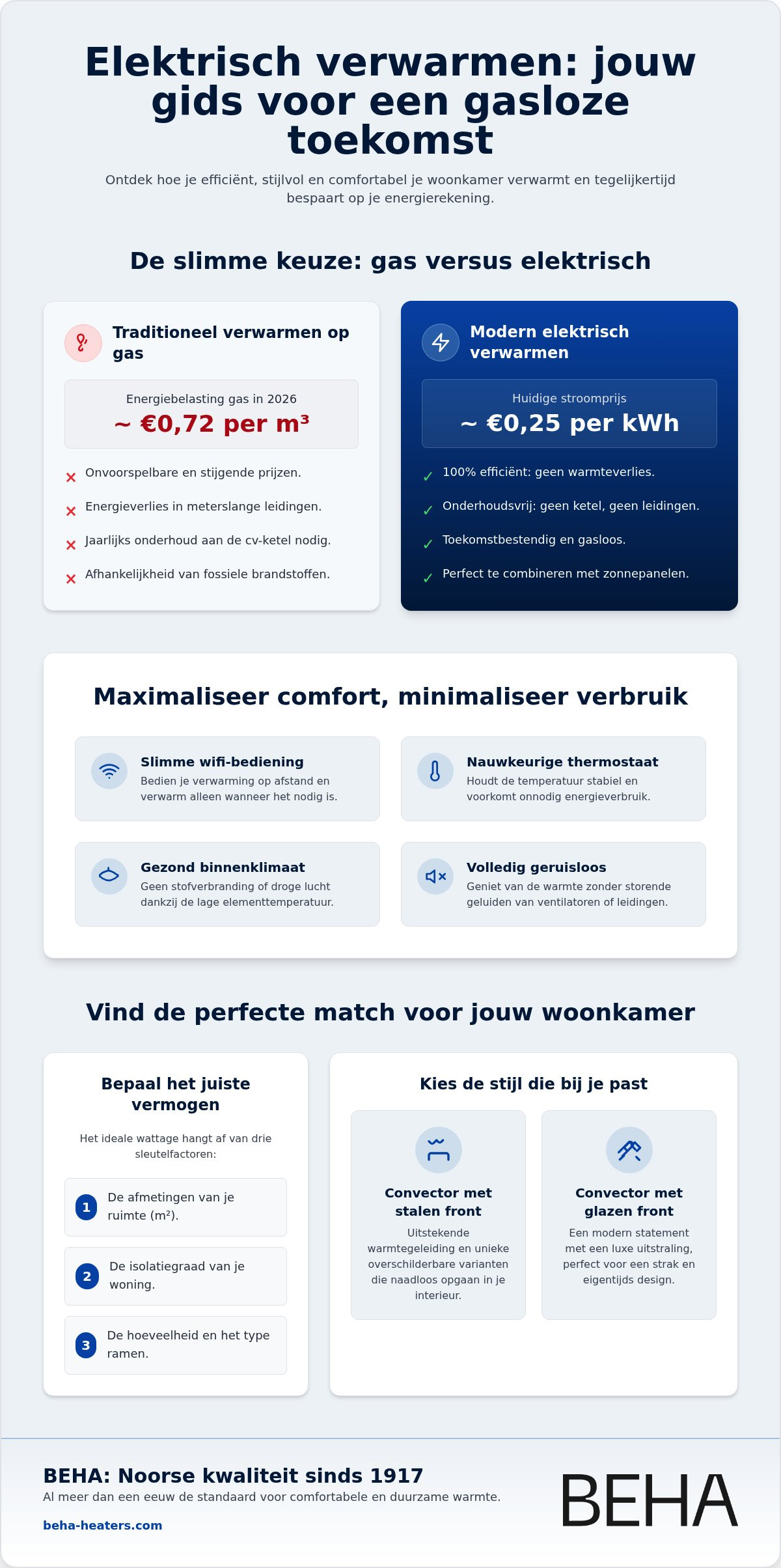
Even the best electric heater for the living room disappoints if the output does not match the heat loss. Floor area alone is insufficient: ceiling height, windows, exterior walls, ventilation, draft sealing, insulation, and the desired temperature all play a role.
Quick indication in watts
For an initial orientation, you can use approximately 25 to 50 watts per cubic meter. The low value applies only to good insulation. Multiply the floor area by the ceiling height and then by an appropriate factor.
| Living room at 2.5 m high | Contents | Indication 25–50 W/m³ |
|---|---|---|
| 20 m² | 50 m³ | 1,250–2,500 W |
| 30 m² | 75 m³ | 1,875–3,750 W |
| 40 m² | 100 m³ | 2,500–5,000 W |
| 50 m² | 125 m³ | 3,125–6,250 W |
These are broad indications, not installation advice. For primary heating or an open living space, have the heat loss calculated professionally. More watts do not make the home better insulated and can place a heavier load on an electrical circuit.
Open living room and kitchen
Measure the entire connected air volume, not just the seating area. An open staircase, void, or kitchen increases the volume to be heated. Cooking heat and occupancy provide temporary assistance but should not be assumed as a permanent heat source in the calculation.
High ceilings
Warm air rises, which can cause temperature differences to occur with a high ceiling. A ceiling fan on a low winter setting can gently mix the air, provided this is done comfortably and safely. Targeted infrared heat can be an alternative for a fixed seating area.
One large or several smaller devices?
In a long or L-shaped living room, multiple correctly distributed convectors often provide a more even result than a single powerful unit in a corner. Add up the power output and the electrical load. Ideally, multiple units should be controllable as a single zone.
Placement and safety in the living room
for the best electric heater for the living room . This influences comfort, measurement, and airflow. Under a window or against an exterior wall, a convector can help limit cold drafts, provided the manufacturer permits that position and distance.
- Keep the air intake at the bottom and the outflow at the top completely clear.
- Do not place a sofa, curtain, or cabinet against the appliance.
- Never cover an electric heater and do not dry textiles on it.
- Use the original wall bracket or approved feet.
- Avoid faulty extension cords and overloaded power strips.
- Check the circuit when multiple powerful devices are operating simultaneously.
- For a freestanding model, choose anti-tip protection and a stable base.
Children and pets
A child lock prevents unintended changes but does not cool a warm surface. Place the device outside walking and play routes, do not put a cable under tension, and observe the prescribed distances. Secure wall mounting reduces the risk of tipping over.
Sound level during television and conversations
A fanless unit is the quietest choice. A fan heater or air-to-air heat pump has a specified noise level that varies by setting. Compare not only the lowest sleep setting, but also the noise at the power required during cold days.
When is a BEHAconvector the best choice?
BEHAconvectors are suitable for living rooms where quiet, fast-responding, and individually adjustable room heating is desired. They do not require a fan for natural convection. View the current models and specifications on BEHA Heaters.
For daily, long-term main heating of an entire home, a heat pump may be more logical. For a single chair or workspace, infrared can be more targeted. An electric convector excels particularly when you want to silently heat the entire room air and control it per zone.
Steel, glass or paintable
An electric heater with a steel front is robust and timeless. Glass provides a smoother, more distinctive design. According to the product instructions, a RAW front can be painted over and visually blend into the wall. Also read our guide on a paintable radiator.
Wi-Fi and app control
With a suitable program, you heat the living room only when necessary. Check the available functions, off-the-internet operation, and app support for each model. The comprehensive guide on an electric convector with Wi-Fi helps with the comparison.
10 points for the best electric heater for the living room
- Determine whether you are looking for supplementary heating, zone heating, or primary heating.
- Note how many hours per day the living room is heated.
- Calculate the total volume, including open kitchen or mezzanine.
- For main heating, let the heat loss be determined.
- Choose convection, radiation, thermal mass, or heat pump.
- Check thermostat, weekly program, and zone control.
- Compare sound to the actual power required.
- Check the socket, circuit, and total concurrent load.
- Measure the installation site and minimum distances to furniture and curtains.
- Compare warranty, service, and support in Belgium and the Netherlands.
Conclusion: choose based on usage, not just wattage
The best electric heater for the living room heats exactly the right zone, at the right times, and without unnecessary disturbance. For quiet room heating, a fanless convector often offers the best balance. Infrared is suitable for localized heat; for many heating hours, a heat pump deserves serious consideration. Always combine your choice with correct sizing, safe installation, and a realistic cost calculation.
Compare current BEHAmodels by power, dimensions, front panel, and controls behavia.
Frequently asked questions about the best electric heater for the living room
Which electric heater is the most energy-efficient in the living room?
For many daily heating hours, a well-designed heat pump typically uses less power. With direct electric heaters, savings are primarily achieved through zone heating, appropriate power output, and fewer heating hours.
Is a convector suitable as primary heating?
This is possible in a well-insulated room provided the calculated capacity and electrical installation are sufficient. For high usage hours, always compare the total costs and a heat pump.
How many watts do I need for 30 m²?
With a ceiling height of 2.5 meters, the volume is 75 m³. A rough indication of 25 to 50 W/m³ translates to 1,875 to 3,750 watts. The exact value depends on insulation, glazing, ventilation, and the desired temperature.
How much does a 2,000-watt heater cost per hour?
At continuous full power, it consumes 2 kWh per hour. Multiply this by your total price per kWh. Due to the thermostat, the actual operating time after heating up is usually shorter.
Can I use two electric heaters on one circuit?
Two 2,000-watt appliances together draw approximately 17.4 amperes at 230 volts. This is too much for a standard 16A circuit when they run at full power simultaneously. Have the installation assessed if in doubt.
Where should I place a convector in the living room?
In a location with free air intake and exhaust. Cold drafts can be limited under a window, but the mounting distances specified in the manual are always the guiding principle.
Does an electric convector make noise?
A fanless model is virtually silent, although materials may sometimes tick softly during heating or cooling. A fan or heat pump model produces audible air and fan noise.
Is Wi-Fi necessary?
No. Wi-Fi is mainly useful for schedules, zones, and remote control. It does not make the element more efficient. Choose a device that can also be controlled locally.
Can I paint over an electric heater?
Only when the specific front is designed for this. Use the official painting instructions and keep air vents, sensors, and controls clear.
Is a portable fan heater suitable for a whole evening?
It can heat the room, but noise and airflow can be disturbing. For prolonged quiet use, a fanless wall convector or oil-filled radiator is often more comfortable.
Are solar panels sufficient to heat the living room?
Not automatically. The greatest heat demand usually occurs during winter hours with limited solar production. Calculate based on actual simultaneous self-consumption and your current feed-in or injection scheme.