
Electric radiator for the bedroom: best buying guide 2026
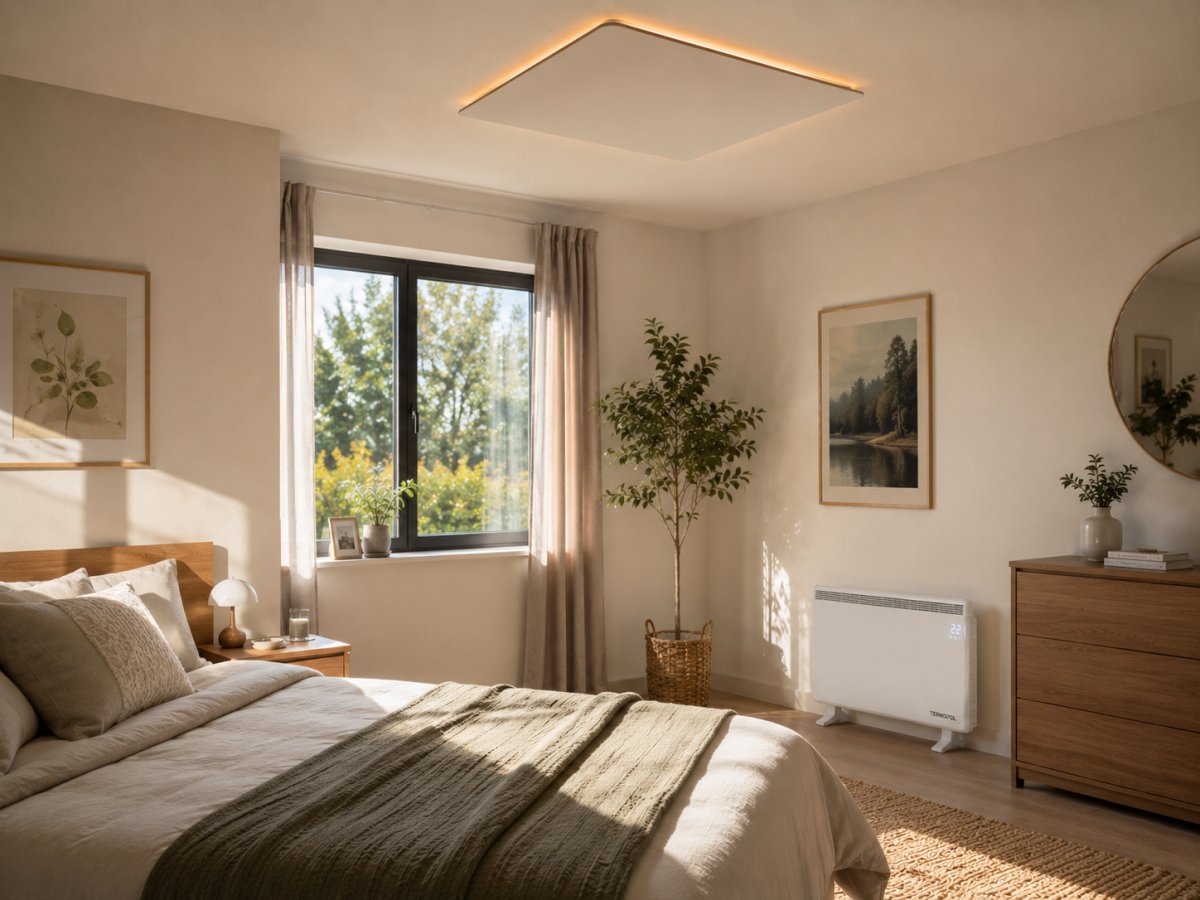
An electric radiator for the bedroom must be quiet, safe, and precisely controllable. The right unit heats only when necessary, keeps the room comfortable without major temperature fluctuations, and matches the insulation and dimensions of the room. In this independent buying guide, you will learn how to evaluate power output, consumption, placement, and operation for a bedroom in Belgium or the Netherlands.
For most adults, a cool bedroom is more pleasant than a warm one. Flanders generally recommends 16 to 18 °C for bedrooms; however, personal preference, age, and health may vary. An electric radiator for the bedroom is particularly interesting as targeted primary or supplementary heating: you control this room independently of the central thermostat and do not need to heat the entire home. Preferably choose a wall-mounted model without a fan, with an electronic thermostat, a weekly program, and overheating protection.
Key points
- Calculate the power using the room volume and insulation; the number of square meters alone is not enough.
- A natural convector without a fan is generally the quietest and most even choice for the night.
- A higher wattage is not automatically more economical: insulation, the set temperature, and the duration of use primarily determine consumption.
- An electronic thermostat, weekly program, and open window detection prevent unnecessary heating.
- Check mounting distances, product certification, and the manual, especially in a baby or children's room.
Why an electric radiator in the bedroom is the ideal choice
Choosing an electric radiator for the bedroom is nowadays much more than a practical solution for a cold attic room; it is a strategic step towards a more sustainable and comfortable home. As we in the Netherlands make the switch to gas-free living en masse, the bedroom often proves to be the most logical place to start this transition. Instead of heating the entire house via central heating for the one room you are spending time in, local heating offers the possibility of bringing only that specific space to the desired temperature. This is not only more efficient but also much more precise for your personal comfort.
To understand the basic principles of this technology, it is useful to look at the technical operation of electric heating. In this system, electrical energy is converted directly into heat without the energy loss that often occurs during transport through long water pipes. This makes the system extremely responsive. When you decide to go to bed in the evening, you don't want to wait an hour for the room behabecome comfortable. Modern convectors have a very short warm-up time, causing the air in the room to start circulating almost immediately and the chill to disappear quickly.
Comfort and health during your sleep
A good night's sleep depends on a stable indoor climate. Your body needs a constant, often slightly lower temperature to optimally go through the deep sleep phases. Large fluctuations in temperature can disrupt your sleep cycle, causing restless dreams or waking up feeling tired. In addition, a constant base temperature helps prevent moisture problems and mold formation. In unheated rooms, moisture from breathing condenses more quickly on cold walls. A smart radiator keeps the temperature at exactly the level needed to keep the walls dry and the air healthy. The psychological peace of mind of knowing that your room is always at the right temperature when you get up contributes directly to your well-being.
The transition to gas-free heating
The bedroom is the easiest room to make sustainable because the heat requirement here is very specific. With an electric radiator for the bedroom, you are no longer dependent on the central thermostat in the living room. Often, the upstairs remains cold because the living room is already at temperature and the boiler switches off. With an individual electric system, you take control. This fits perfectly with the Norwegian vision of living, where people have been accustomed to reliable electric solutions for decades. By heating only where and when it is truly necessary, you reduce the total load on your heating system and prepare your home step by step for a future without natural gas.
The difference between convection and radiation: which is better for your sleep?
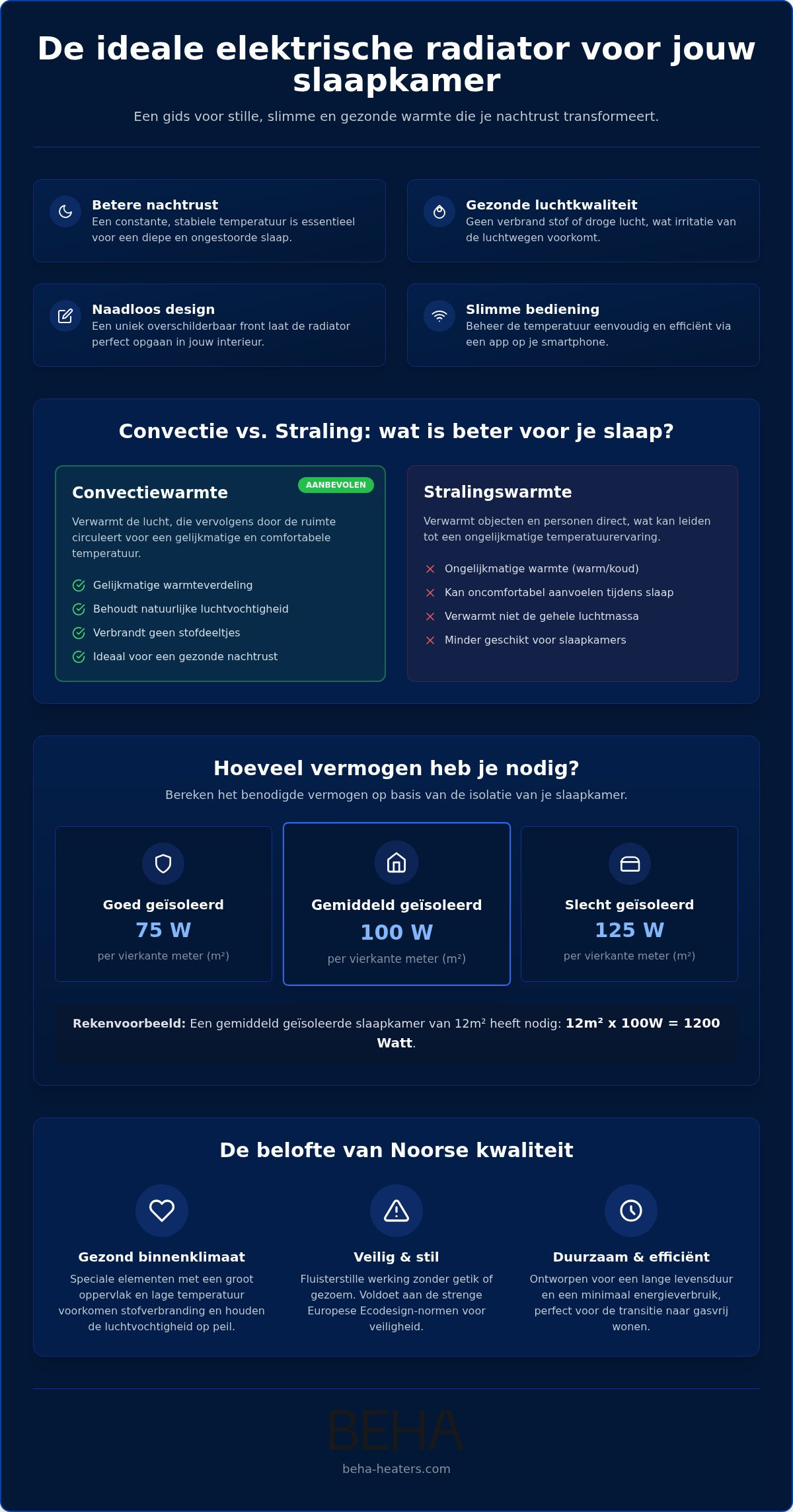
When searching for the ideal electric radiator for the bedroom, you often encounter the debate between radiant heat and convection heat. Infrared panels (radiation) directly heat the objects and people in the room. While this sounds efficient, it can feel uncomfortable in a bedroom; the side of your body facing the panel gets warm, while the other side remains cool. For a healthy night's sleep, convection is therefore often the superior choice. A convection heater draws in cold air, heats it, and distributes the heat evenly throughout the entire room. As a result, no cold spots are created and the temperature around your bed remains completely constant, which is essential for your body to stay in a deep sleep.
A crucial aspect that is often overlooked is the temperature of the heating element. Cheap electric heaters often use small, glowing hot wires that literally burn dust particles. This causes that typical dry smell and can irritate your airways while you sleep. BEHA takes a different approach by using extruded aluminum elements with a large surface area. As a result, the temperature of the element remains low enough to prevent dust burning. Switching to smart electric heating thus offers benefits not only for your wallet but also for your overall health.
Air quality and allergies in the bedroom
For people with asthma or allergies, the bedroom is a critical zone. Heating itself does not remove moisture from the air, but warming reduces relative humidity. An element with a low surface temperature limits dust scorching; adequate ventilation and, if necessary, a hygrometer remain important for a healthy indoor climate. By choosing a system that respects air quality, you invest directly in the quality of your rest. Our smart convectors with steel fronts are specifically designed to maintain this balance without drying out the air.
Silent technology for an undisturbed night
Nothing is as disturbing as the ticking sound of expanding metal or a thermostat switching on and off with a loud click. We use high-quality materials that expand and contract silently. Furthermore, our radiators are equipped with electronic thermostats. Unlike outdated mechanical variants, these operate completely silently. Because they contain no moving parts such as fans, you enjoy completely noiseless heating. This makes a world of difference for light sleepers who want to eliminate any form of nighttime noise.
Which type of electric radiator for the bedroom suits you?
The term electric radiator is used for various devices. They convert virtually all the electricity consumed into heat at the device, but the way in which that heat reaches the room differs. For a bedroom, silence, adjustability, even distribution, and secure fixed mounting are particularly important.
| Type | feeling of warmth | Sound | Best application | Point of attention |
|---|---|---|---|---|
| Wall convector without fan | Heats the room air evenly | Very quiet; no fan | Daily use and precise temperature control | Keep the air vents clear |
| Electric panel radiator | Combination of convection and radiation, depending on the model | Usually quiet | For those who want to combine comfort with a flat design | Compare thermostat and surface temperature |
| Infrared panel | Direct radiant heat on people and surfaces | Quiet | Brief, localized heating | Less uniform outside the radiation zone |
| Mobile oil-filled radiator | Slow, long-lasting heat | Quiet | Temporary supplementary heating | Takes up floor space and heats up slowly |
| Fan heater | Very fast air heating | Clearly audible | Short warm-up while you are awake | Less suitable for a quiet night's sleep |
For most situations, a fixed electric radiator for the bedroom with natural convection offers the best balance. There are no moving parts that constantly make noise, the thermostat can control the temperature per room, and wall mounting keeps the floor clear. An infrared panel can be useful if you only want to heat one zone briefly, but check that the bed and seating area are actually within the radiation zone.
How many watts does an electric radiator for the bedroom need?
Selecting the right wattage for an electric radiator in the bedroom is a balance between comfort and energy consumption. You want to avoid having a heater constantly run at full power to warm the room, but an overpowered model is also a waste of the investment. The goal is a system that quickly reaches the desired temperature and then maintains it with minimal energy pulses. This is not only pleasant for your night's sleep but is also essential to meet modern energy efficiency specifications aimed at reducing unnecessary power consumption.
Many people make the mistake of looking only at the floor area. In the bedroom, however, the total volume of the room (in cubic meters) is the determining factor. After all, a room with a high ceiling requires more energy to heat than a room with a standard height. In addition, the insulation level of your home plays a decisive role. In a modern, well-insulated Dutch house, you need considerably less power than in a charming but drafty property from the 1930s.
A practical calculation for your space
To determine the required power, start with a simple calculation: multiply the length, width, and height of your bedroom. For an initial indication, use approximately 25 to 30 watts per cubic meter for good insulation and 35 to 40 watts per cubic meter for average insulation. For an old, drafty room, a lot of glass, or an unheated space above, a heat loss calculation by a professional is more reliable.
Round the result to the available capacity and, above all, avoid undersizing. A heavier unit does not convert a kilowatt-hour of electricity into heat more efficiently than a lighter resistance unit, but a suitable electric radiator for the bedroom reaches the set temperature quickly. After that, the thermostat temporarily switches off the element.
Power table as a quick indication
The table below assumes a ceiling height of 2.5 meters. The range is a starting point, not a substitute for a heat loss calculation. Choose the upper end of the bandwidth for a corner room, large window, exterior wall, or unheated attic above.
| Surface area | Room volume | Good insulation 25-30 W/m³ |
Average insulation 35-40 W/m³ |
|---|---|---|---|
| 8 m² | 20 m³ | 500-600 W | 700-800 W |
| 10 m² | 25 m³ | 625-750 W | 875-1,000 W |
| 12 m² | 30 m³ | 750-900 W | 1,050-1,200 W |
| 15 m² | 37.5 m³ | 940-1.125 W | 1,310-1,500 W |
| 20 m² | 50 m³ | 1,250-1,500 W | 1,750-2,000 W |
Example: a bedroom of 12 m² with a height of 2.5 meters has a volume of 30 m³. With average insulation, this amounts to approximately 1,050 to 1,200 watts. If you are unsure between two models, first assess the windows, exterior walls, and airtightness instead of automatically choosing the highest wattage.
How much energy does an electric radiator for the bedroom consume?
The nominal wattage is the maximum power, not the continuous consumption. A 1,000-watt appliance consumes 1 kWh if the heating element is active for a total of one hour. As soon as the set temperature is reached, a good electronic thermostat switches the element on and off in cycles.
Calculate the operating costs using this formula: power in kW × actual duty cycle in hours × your electricity rate per kWh. Assuming that a 1 kW radiator heats actively for a total of three hours during an evening and night, and your rate is €0.30 per kWh, the calculation cost is 1 × 3 × €0.30 = €0.90. For a realistic monthly estimate, use your own contract price and measure on a few representative cold days with a suitable energy meter or via available app data.
An electric radiator for the bedroom makes financial sense, especially for zone heating: you heat the bedroom briefly and specifically, while the central heating can be turned down elsewhere. For long-term main heating of a poorly insulated home, a heat pump can use significantly less electricity per amount of heat delivered. Therefore, always compare the entire situation and not just the purchase price.
Six ways to reduce consumption
- Set a modest temperature for sleeping; for many bedrooms, 16 to 18 °C is a useful starting point.
- Allow the program to heat up only shortly before use and lower the temperature when the room is empty.
- Seal gaps and first improve roof, wall, or glass insulation where necessary.
- Do not block the airflow with a bed, wardrobe, curtain, or laundry.
- Use open window detection or temporarily lower the device during intensive ventilation.
- Verify the measured consumption instead of relying on general cost claims.
What should you look out for in Belgium and the Netherlands?
In both countries, standard models operate on 220-240 volts, but home type, insulation level, electricity contract, and heating habits differ significantly. Therefore, consider your own room and tariff. An electric radiator for the bedroom can cover a limited heat demand in a well-insulated new-build home, whereas the same radiator in an uninsulated attic room would have to run much longer.
- Belgium: A digital meter and a contract with variable or dynamic prices make it useful to plan heating outside of expensive hours. When dealing with high simultaneous power consumption, also pay attention to your peak load and other electrical appliances.
- Netherlands: compare the costs with your existing central heating system or heat pump and take into account your current electricity and gas rates. Local electric heating can be attractive if it means you do not have to heat the entire home.
- Solar panels: winter production does not always coincide with heat demand in the evening and night. Program smartly, but do not automatically consider your own solar power as free nighttime energy.
- Plug and circuit: connect the appliance according to the manual. Do not use a coiled cable reel or lightweight extension cable, and avoid overloading the same circuit.
Smart placement for maximum efficiency
The location where you mount the electric radiator for the bedroom is almost as important as the output itself. The classic spot under the window is still the most logical choice. Windows, even with HR++ glass, are often the coldest point in the room. By placing the radiator underneath, you block the so-called cold draft; the cold air sinking at the window is immediately captured and heated by the rising warm air from the convector.
- Free airflow: Ensure at least 10 centimeters of free space at the bottom and top for optimal circulation.
- Wall mounting: For a bedroom, we recommend wall mounting over a freestanding model. It saves space and prevents you from accidentally walking into the heater in the dark.
- Curtains: Ensure that long curtains do not cover the radiator, as this blocks heat output and confuses the thermostat.
By taking these factors into account, you create a system that does its job invisibly and efficiently, exactly as the Norwegian technique from BEHA is intended.
Smart features and design: a radiator that matches your interior
In the bedroom, atmosphere is at least as important as the temperature. Nowadays, an electric radiator for the bedroom no longer needs to be a disruptive element that detracts from your carefully chosen decor. The era of standard white metal cabinets is over. Modern technology and Norwegian design go hand in hand to create heating that either makes a statement or becomes completely invisible. Whether you choose the sleek, glossy look of a glass front or the timeless solidity of steel, the finish determines how the room feels.
Beyond the appearance, smart features make a difference in your daily routine. Saving energy becomes almost effortless thanks to features such as open-window detection. When you air out the room briefly in the morning, the radiator recognizes the sudden drop in temperature and temporarily switches itself off. This prevents you from literally heating the outside air. Combined with precise weekly schedules, this ensures a system that only consumes energy when you really need it.
The paintable radiator as a design object
One of the most appreciated innovations in the bedroom is the convector with a paintable front. While most suppliers stop at black or white, we offer the freedom to give your heater the exact same color as your wall. This allows the radiator to seamlessly blend into the interior, creating a sense of calm and unity. Safely painting such a front is simple; using a water-based metal paint, you maintain optimal heat conduction without releasing harmful fumes. In a children's room, you can even get creative with color accents that match the room's theme, making the heater an integral part of the experience.
The BEHAapp: control over your comfort and costs
True comfort means you never have to get out of a warm bed again to adjust the heating. You control everything from your smartphone via the BEHAapp. Setting a night-time temperature reduction is essential for a healthy sleep environment; a cooler room promotes melatonin production, while the app ensures the room is behaagain the moment your alarm goes off. Furthermore, you get real-time insight into consumption per room, allowing you to see exactly where you can optimize. For a smart home, you can easily connect multiple radiators together, so you can manage the climate throughout the entire house at the touch of a button.
Would you like to experience for yourself how technology and aesthetics come together in your own home? Check out our smart convectors with paintable fronts and give your bedroom the upgrade it deserves.
Why the Norwegian quality of BEHA makes the difference
You may have heard that all electric heaters are the same. That is a misconception often spread on platforms like Reddit, where the focus is on cheap DIY store heaters. However, an electric radiator for the bedroom from BEHA is the result of more than a century of experience in the cold north. Since 1917, we have been perfecting our technology in Norway, a country where electric heating is the standard rather than an alternative. This rich history as a family business means that we do not look at short-term profit, but at products that last for generations.
Our products meet the strictest Ecodesign requirements. This is not an empty marketing term; it means that our radiators are technically optimized to waste as little energy as possible. As a result, an investment in quality pays off immediately. Not only in a lower energy bill, but also in the knowledge that you are choosing an environmentally conscious solution that aligns perfectly with the transition to gas-free living in the Netherlands. The reliability of Norwegian technology ensures that your radiator operates just as quietly and efficiently after ten years as it did on the first day.
Sustainability and Norwegian craftsmanship
We believe in craftsmanship that can take a beating. We use high-quality steel and robust electronics specifically designed to function flawlessly for years. Our radiators are virtually maintenance-free. You do not need to replace filters or bleed pipes. The philosophy behind our products is simple: we want you to forget the radiator is there, because it simply always does what it is supposed to do. This is climate-friendly heating without the hassle, where the long lifespan of the materials used significantly reduces your household's ecological footprint.
Safety in the bedroom
Safety is of the utmost importance in the bedroom. You want to go to sleep with peace of mind while the heating is on. That is why all our models are equipped with advanced overheat protection. Furthermore, the surface temperature of our fronts remains limited, making them extremely child-friendly. Even if your child accidentally touches the electric radiator for the bedroom, there is no risk of burns. For those looking for the ultimate combination of safety and convenience, we have compiled a comprehensive guide. Discover the electric convector with Wi-Fi for your bedroom and experience how modern technology takes your night's rest to the next level.
Buying checklist: electric radiator for the bedroom
Use this checklist to compare models fairly. This way, you avoid relying solely on wattage, price, or Wi-Fi.
- Power: does the wattage match room volume, insulation, and heat loss?
- Thermostat: is it electronic, accurate, and easy to operate manually?
- Programming: are weekly schedule, night setback, and open window detection available?
- Noise: does the device operate without the fan and are there no loud mechanical switches?
- Safety: does the documentation mention overheating protection, double insulation, certifications, and permitted mounting distances?
- Children's room: check child lock, accessibility of controls and cord, surface temperature, and fixed wall mounting.
- Placement: remain clear of the bed, curtains, and furniture?
- Operation without internet: is basic operation still possible if Wi-Fi or the app fails?
- Warranty and service: are the warranty conditions, manual, parts, and Benelux service clear?
- Design: choose between steel, glass, white, black, or a paintable front only after the technical requirements have been met.
BEHA offers, among others, compact Classic models with a built-in weekly program, smart Wi-Fi convectors with a steel front, and RAW models with a paintable front. Compare the output and product-specific safety data within the chosen series. This way, you choose an electric radiator for the bedroom that not only looks good but demonstrably suits the space.
Create the ideal sleep environment today
Choosing the right electric radiator for the bedroom is an investment in your own health and daily living comfort. We have discussed that quiet operation, the prevention of dust accumulation, and precise temperature control form the indispensable basis for an undisturbed night's sleep. By choosing a system with the right output and strategic placement under the window, you enjoy maximum warmth at minimal cost without compromising the air quality in your room.
BEHA offers you the reliability of a Norwegian family business that has been developing high-quality solutions for the most challenging climates since 1917. With our unique paintable fronts, you don't have to compromise on your interior style; the radiator simply blends into your wall. Additionally, advanced Wi-Fi control gives you full control to optimize your energy consumption down to the last detail via your smartphone. It is time to say goodbye to noisy pipes or dry air and choose a sustainable way of heating that lasts for decades.
View our collection of electric radiators for the bedroom and discover how easily you can transform your bedroom into an oasis of peace and comfort.
Frequently asked questions about bedroom heating
Is an electric radiator in the bedroom expensive to use?
No, an electric radiator for the bedroom is not necessarily expensive if you only use it when you are actually in the room. By heating locally instead of your entire home via central heating, you actually save on your total gas consumption. Moreover, thanks to smart Wi-Fi features and weekly schedules, you can set the heating to be at the desired temperature only when you need rest.
Does an electric radiator for the bedroom make noise?
A high-quality fanless electric convector is virtually silent. An electronic thermostat prevents the distinct mechanical click of older controls, although any metal device may occasionally make a soft expansion sound. This makes them ideally suited for light sleepers who wish to avoid any form of nighttime noise for an undisturbed and deep night's sleep in a quiet environment.
Can an electric radiator for the bedroom be left on all night?
This is only possible if the chosen model is suitable for continuous use according to the manufacturer and is mounted correctly. Keep air vents clear, never cover the device, and use a temperature program; overheating protection is an extra layer of safety, not a substitute for the manual. However, it is often more efficient to set a night reduction via the app. This slightly lowers the temperature during your deepest sleep phase, which not only saves energy but also improves the quality of your sleep because your body recovers better in a cooler environment.
How many watts do I need for a 15m² bedroom?
With a ceiling height of 2.5 meters, 15 m² has a volume of 37.5 m³. As an indication, calculate approximately 940 to 1,125 watts with good insulation and 1,310 to 1,500 watts with average insulation. A higher wattage heats up faster but is not more economical per kilowatt-hour; if in doubt, have the heat loss calculated.
Is electric heating bad for the humidity in the bedroom?
Electric heating does not remove water from the air, but heating does lower the relative humidity. A low element temperature can limit dust scorching and odor. Ventilate the bedroom and check the temperature and humidity with a thermo-hygrometer if you experience any symptoms. This prevents you from suffering from dry eyes or a sore throat upon waking, which is essential for a healthy indoor climate and comfortable breathing during your sleep.
Can I really paint the BEHA radiator in any color?
Yes, you can paint our smart convectors with a paintable front the exact same color as your wall for seamless integration. Preferably use a water-based metal paint for this to maintain optimal heat conduction and prevent harmful fumes. This makes the radiator virtually invisible in your interior, ensuring your bedroom retains a calm and harmonious look without conspicuous white appliances hanging on the wall.
What is the advantage of Wi-Fi on a bedroom radiator?
The biggest advantage of Wi-Fi is that you can fully control the temperature without having to get out of your warm bed. Additionally, you can set precise weekly schedules via the app and have real-time insight into your energy consumption per room. If you happen to forget to turn off the heating when leaving, you can easily correct this remotely via your smartphone, which prevents unnecessary costs and increases your comfort.
Is an electric radiator safe for the children's room?
An electric convector is very safe for the children's room due to the low surface temperature of the front and the double insulation. Furthermore, our models are equipped with a child lock via the app, so that curious little hands cannot accidentally change the settings. The automatic shut-off in case of overheating offers an extra layer of security, so that you and your child can sleep soundly in a safe environment.