
Business delivery of electric heating appliances and insight into costs
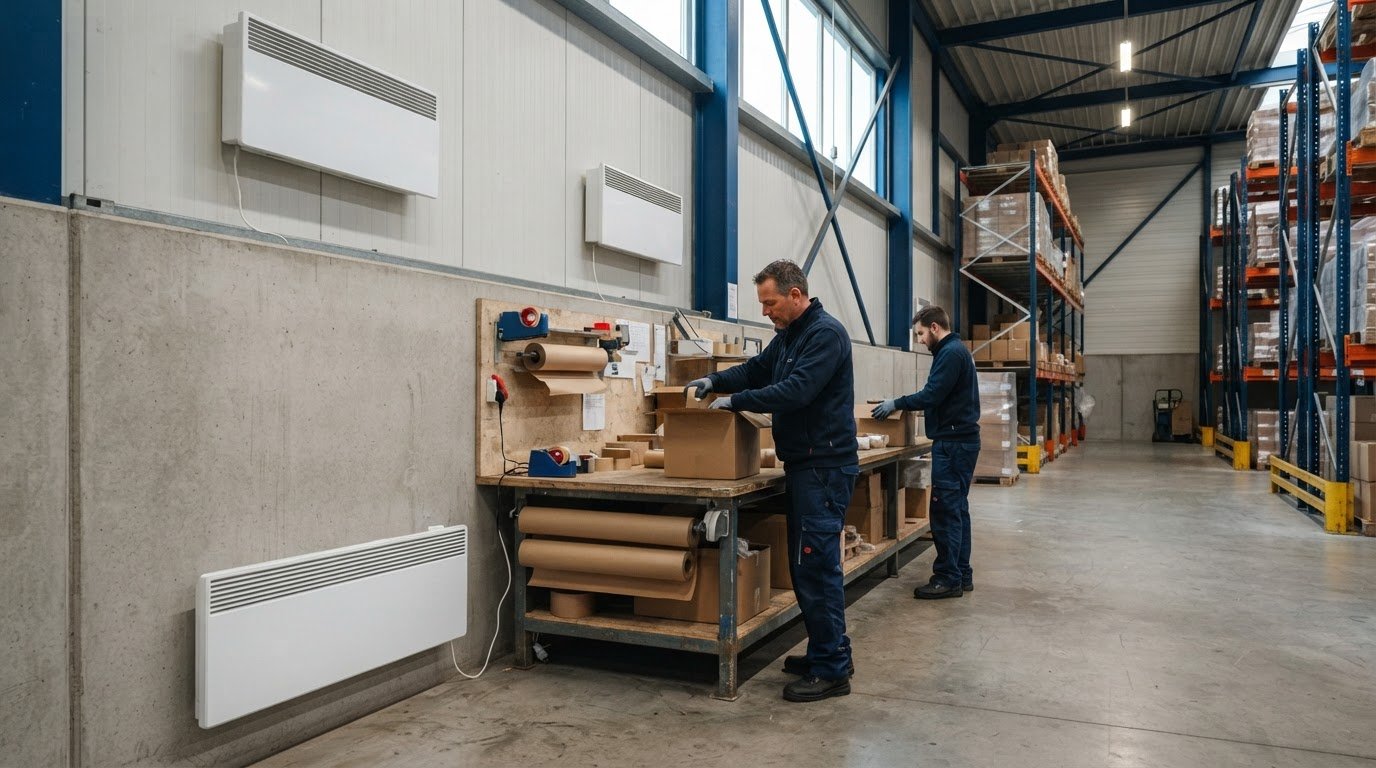
An industrial hall can be heated entirely electrically, but the right approach depends on the usage and the heat demand. Therefore, for the commercial supply of electric heating appliances, a suitable quotation begins with an understanding of the space, the desired temperature, and the areas where heat is required.
Heating a large space requires a different approach than keeping a single workstation or order picking zone comfortable. The capacity of the appliances, their placement, and the duration of use also influence energy consumption and the final costs.
In this article, you will read what information you need for a quote request and which factors determine how much energy electric heating consumes. You will also discover how to heat workspaces specifically and tailor the solution to your company's daily operations.
Key points
- For a quotation, clearly map out the space, usage, and desired heated zones.
- Assess energy consumption based on heat demand, appliance placement, and operating time, not on a fixed expected saving.
- In large halls, primarily heat workspaces and zones where people are active, rather than automatically the entire space.
- Compare the total costs based on device choice, required capacity, and usage; an appropriate amount depends on the situation.
Information for a quotation request
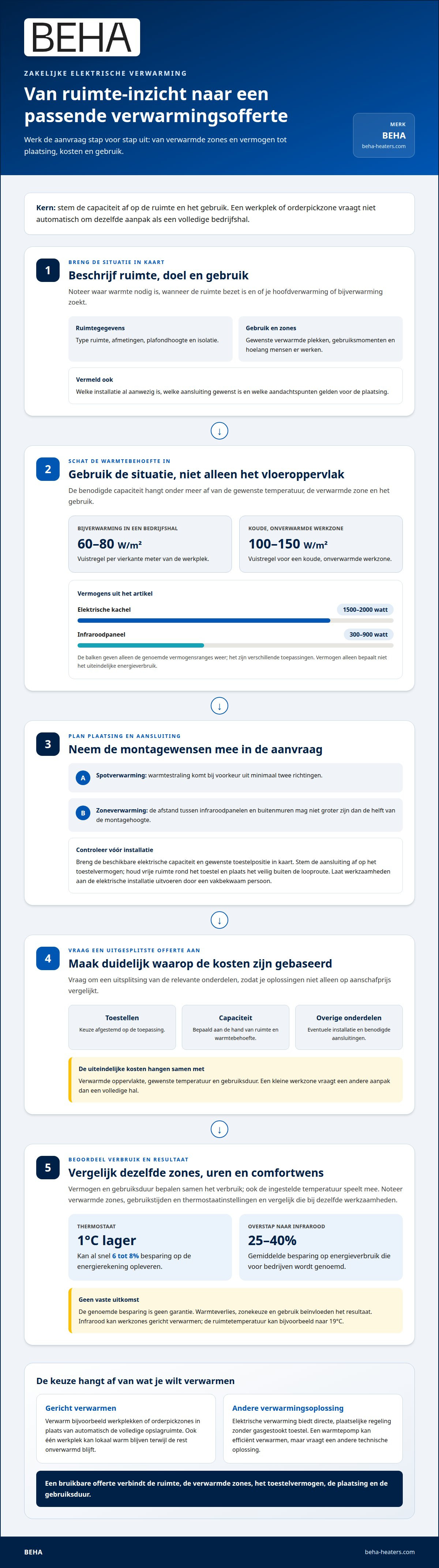
A useful quote starts with a clear picture of the space and its usage. Note which zones require heat and when they are occupied.
Request a quote for heating projects
Describe the project step by step: is it an office, workshop, or industrial hall? State the dimensions, ceiling height, insulation, and desired heated zones. Also indicate how long people work there and what installation is already in place. This allows the required capacity to be tailored to the space, not just the total floor area.
With spot heating, heat radiation preferably comes from at least two directions. With zone heating, the distance between infrared panels and exterior walls must not exceed half the mounting height. Please mention such placement preferences in the request.
Costs of commercial heating appliances
A tailored quotation brings together the choice of appliance, required capacity, and usage situation. Request a breakdown of the relevant components, such as appliances, any installation required, and necessary connections. This way, you can see the basis for the calculation and compare solutions without looking solely at the purchase price.
The final costs depend on the heated surface area, desired temperature, and duration of use. A small work zone requires a different approach than an entire hall. Therefore, please specify when the space is used and whether you require supplementary or primary heating.
Make your application concrete with this information:
- Space and purpose, for example an office or workplace.
- Dimensions, ceiling height, and desired heated zones.
- Usage moments and existing installation.
- Desired connection and points to consider for installation.
For rentals, the process begins with the period, location, and heat requirement. Provide this information so that the request aligns with the intended use. The same preparation helps with the commercial supply of electric heating appliances to evaluate quotations effectively and tailor advice to the project requirements.
Energy consumption and potential savings
Electric heating can heat a commercial building fully or only occupied surfaces. Compared to gas heating, electric heating offers direct, localized control without a gas-fired appliance. A heat pump can heat efficiently but requires a different technical solution. The best choice depends on space utilization, comfort, and energy costs.
First, assess the heat requirement, placement, and operating costs. Fixed savings do not apply to every company. In a warehouse, for example, you can heat workstations and order picking zones instead of the entire storage area. Alternatively, a single workstation can remain warm locally while the rest of the space remains unheated.
Power and operating time together determine consumption. An electric heater often has a power output of 1500-2000 watts. An infrared panel often has a power output of 300-900 watts. These are different applications; power output alone does not tell you how much energy you ultimately use. That also depends on the hours of use and the set temperature.
- For supplementary heating in an industrial hall, 60-80 W/m² of the workplace applies as a rule of thumb.
- For a cold, unheated work zone, 100-150 W/m² applies as a rule of thumb.
- Turning the thermostat down by just one degree can easily result in savings of 6 to 8% on the energy bill.
Infrared heating can heat work zones in a targeted manner. As a result, the room temperature can be raised to 19°C, for example. An average saving of 25 to 40% on energy consumption is cited for companies switching to infrared heating. Do not view this as a fixed outcome: heat loss, zone selection, and usage influence the result.
To do this, make a simple comparison: note heated zones, usage times, and thermostat settings. Then compare the consumption with the same activities and desired comfort. If you want to see how electric heating works, explore the electric heating devices for commercial applications.
Electric heating can heat specific zones and offers direct, localized control without a gas-fired appliance; thus, the entire building does not need to be heated. Consumption and operating costs depend on factors including power output, operating time, and the set temperature. A heat pump can heat efficiently but requires a different technical solution.
Electric heating for business partners
An industrial hall can be heated entirely electrically, but business success begins with the right application. Infrared can heat work zones in a warehouse, while other solutions are suitable for offices, workshops, or larger halls. Choose based on where people work, not just on the building surface area.
For subsidy or tax schemes, assess the current conditions per investment and device. Suitability depends on the scheme and the application. Therefore, only include any potential reimbursement in your budget after you have determined the conditions.
Dutch requirements and quality marks depend on the appliance type and application. When making your choice, review the product documentation, safety information, and applicable conformity markings. Record this information during business purchasing so that it is clear which appliance has been selected for the intended space.
Before installation and connection, first determine the available electrical capacity and the desired appliance position. Match the connection to the appliance power and follow the installation instructions. Also, ensure there is sufficient clearance around the appliance and a safe location off the walking route. Have work on the electrical installation carried out by a qualified professional.
In the Netherlands, you can obtain electric heating from manufacturers, wholesalers, and specialized suppliers. Compare their offerings based on application, product documentation, and support regarding business delivery. For industrial applications, the range includes electric heaters of 18 kW, 42 kW, and 45 kW. Such power outputs are suitable for different heat requirements than localized heating in an office.
Warranty, maintenance, and service conditions are stated in the terms and conditions of purchase. Review the warranty period, any exclusions, and the procedure in the event of a malfunction. Also check whether maintenance is required and what after-delivery support applies. This way, you compare not only the devices but also the associated agreements.
Follow these steps for your project: first determine the work zones, then choose the heating method, and subsequently match the unit capacity and connection. In a workshop with open doors, targeted infrared heat can be more practical than heating the entire space. For a larger hall, a zone plan helps to tailor the solution to daily work activities.
How much do electric heaters for businesses cost in the Netherlands?
The costs consist of more than just the purchase of equipment. Include any adjustments to connections, installation, energy consumption, and maintenance in your business budget. Break down these items. This way, you can see which costs constitute a one-time investment and which recur during use.
Start with the choice of appliance and required capacity. A solution for a single workstation requires a different composition than heating an entire business space. Request a quotation including quantities, capacities, and individual cost items. Then, compare quotations based on the same parameters, such as heated zones and usage times.
A practical estimate of electricity consumption takes into account appliance power, operating time, and electricity tariff. Add up the results per appliance for a complete picture. An appliance that runs longer increases consumption. With targeted operation, you limit usage to the times when heat is needed. This way, the calculation aligns with the company schedule.
Include the connection in your comparison as well. Multiple devices operating simultaneously may place different demands on the available electrical capacity than a single device. Therefore, have it documented which connections are required and which work, if any, is budgeted separately. This prevents the device price from incorrectly appearing to represent the entire project budget.
Next, compare the total costs over the usage period. Consider the purchase price, expected operating hours, energy consumption, and maintenance. A lower purchase price in itself says little about the total expenses. A device that only runs during specific working hours may turn out differently financially than a solution that provides heat for an extended period.
For a fair comparison, create three scenarios: heating a single work zone, multiple zones, and the entire room. For each scenario, note the number of appliances, the planned usage hours, and the applicable energy tariff. Request quotes based on the same data. This way, you assess the total budget rather than just the appliance price independent of the application.
Update your budget as soon as the usage schedule changes. Different occupancy or longer operating hours affect consumption, even if the appliances remain the same. Therefore, establish your baselines, such as operating hours and heated zones. This allows you to better compare future cost estimates.
BEHA: Smart convectors steel front
BEHA offers smart convectors with steel fronts for businesses that want to use electric heating in a targeted manner. The convectors can be controlled via Wi-Fi and an app, allowing you to tailor the heating to the use of an office or workspace.
The various fronts help you match the unit to the room: BEHA also offers smart convectors with glass fronts and smart convectors with paintable fronts. For a classic design, there are Classic convectors. This allows you to consider the appearance alongside the heating requirements.
The convectors meet the ECODESIGN requirements. Choose a type that suits your commercial application, taking into account the space, usage, and desired operation.
Contact BEHA to discuss the heating options for your company.
Take your heating plan to the next step
A workable heating choice starts with your company's daily operations. Determine which spaces are a priority and how employees use them. Then, create a plan that takes comfort, operation, and appearance into account. This way, you link the investment to a concrete need, rather than just looking at the appliance.
For the commercial supply of electric heaters, you can discuss your requirements with BEHA . Consider the function of the room, the desired operation, and a front that complements the interior. The range includes smart convectors with steel, glass, or paintable fronts. This allows you to tailor your product choice to the environment and your heating needs.
Do you want to develop your plans further? Contact BEHA to discuss the possibilities for your company. A clear starting point helps you make the next choice with confidence.
Frequently Asked Questions
Can I heat an industrial hall entirely electrically?
Yes, an industrial hall can be heated entirely electrically if the solution matches the heat demand and available electrical capacity. The approach varies per hall: insulation, ceiling height, usage times, and open doors influence the heat demand. If you primarily heat fixed workstations, zoning can help. When creating a plan for the entire hall, include the less frequently used zones as well.
How many watts in an industrial hall?
The required power depends on the room and the heating objective. For targeted heating of a work zone, a mounting height of 3.5 to 4.5 meters is recommended. For a larger area or higher mounting, 2,400 to 3,600 watts per heater serves as a guideline. Use these values as a starting point and adjust the capacity based on heat loss, placement, and desired comfort zone.
Which electric heater is suitable for an industrial hall?
For a high hall, an industrial electric heater may be suitable, whereas a fan heater actively distributes heat. Industrial electric heaters are available on the market with power outputs of 18 kW, 42 kW, and 45 kW. The choice depends on the space, the available connection, and whether you are heating the entire hall or only work zones. Also consider the placement in relation to workstations.
Which electric heaters are suitable for commercial use?
That depends on the application. BEHA offers smart convectors with steel, glass, or paintable fronts, Classic convectors, fan heaters, and shoe and textile dryers. Smart convectors can be controlled via Wi-Fi and an app. Convectors may be suitable for an office, while fan heaters suit a need for direct heat. Choose by room and intended use.
What is the power consumption and energy cost of electric industrial heating?
Calculate the power consumption by multiplying the power in kilowatts by the number of hours of use. Then multiply the result by your electricity rate per kilowatt-hour for a cost estimate in euros. Add up appliances separately if they run for different times. For example, a 2-kilowatt appliance that runs for 5 hours uses 10 kilowatt-hours. The actual costs are derived from your rate.
How do you request a business quote and what information does the supplier need?
Send a brief project description including the type of room, dimensions, and usage. Include a floor plan showing the work zones, doors, and desired appliance positions. Also describe the desired controls and existing electrical connections. For an office with a few occupied rooms, a usage diagram is useful; for a warehouse, a zone diagram shows where employees require heat.