
Buying a ceramic heater: Efficient and safe heating
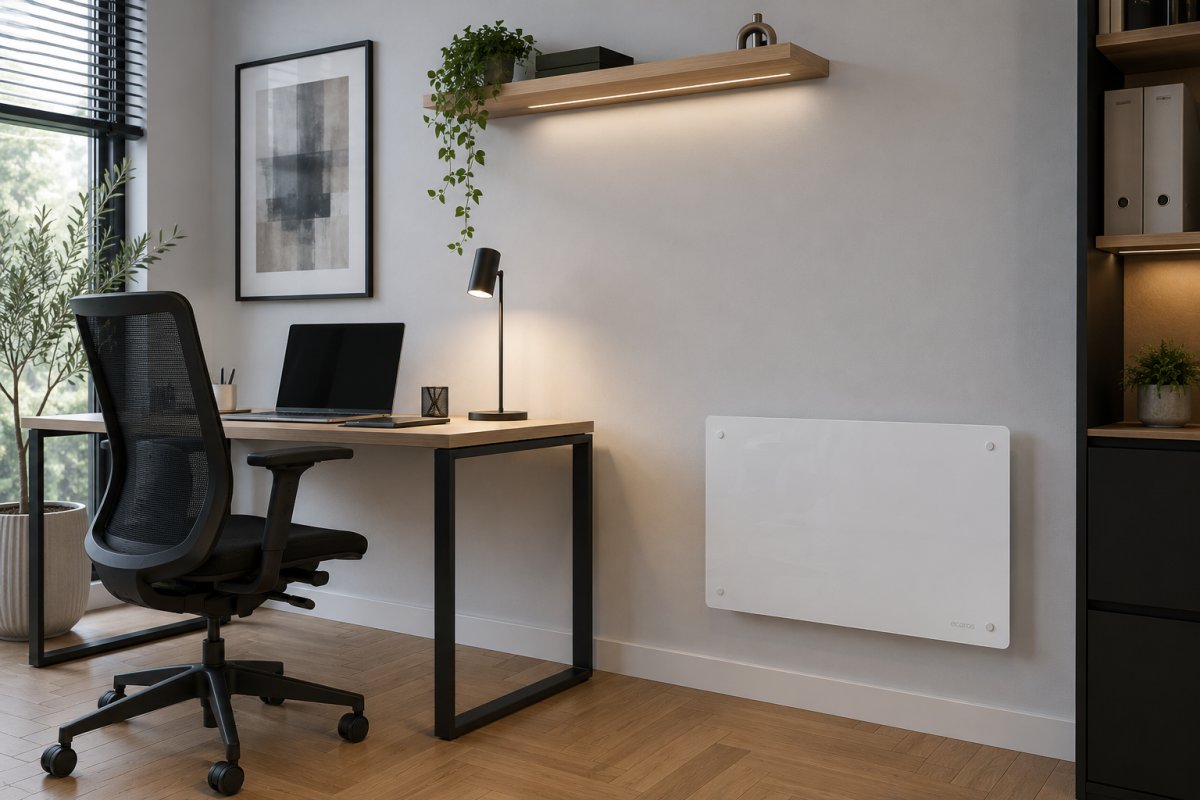
You are sitting in your home office, but the cold is slowly seeping through your socks while the central heating downstairs is blasting away for rooms that are currently unoccupied. Sound familiar? You are certainly not the only one who is shocked by a rising gas bill while specific spots in the house remain unpleasantly cold. Many people therefore consider a ceramic heater to provide targeted and quick supplementary heating without having to overload the entire system. It is a logical step; after all, you want immediate comfort in a safe and affordable way.
In this article, you will discover exactly how a ceramic heater works and when it is the smartest choice for your home. We explain how to create a warm room within minutes, even in an environment with children or pets. Additionally, you will learn how to optimally combine this form of local heating with smart convectors. This way, you transform your home step by step into an energy-efficient place where you maintain full control over both the temperature and the costs.
Key Points
- Learn how the ceramic heating element ensures safer heat transfer and a lower operating temperature compared to traditional filaments.
- Discover why a ceramic heater is the best choice for instant, momentary heat in rooms where you need comfort within minutes.
- Understand the functional differences between radiant heat and convection to determine whether a portable heater or a fixed convector is better suited to your situation.
- Receive practical advice for optimal airflow and the smart use of settings to efficiently manage your energy consumption.
- Learn why BEHA 's Norwegian expertise and the use of sustainable materials such as steel are essential for safe and future-proof heating.
What is a ceramic heater and how exactly does it work?
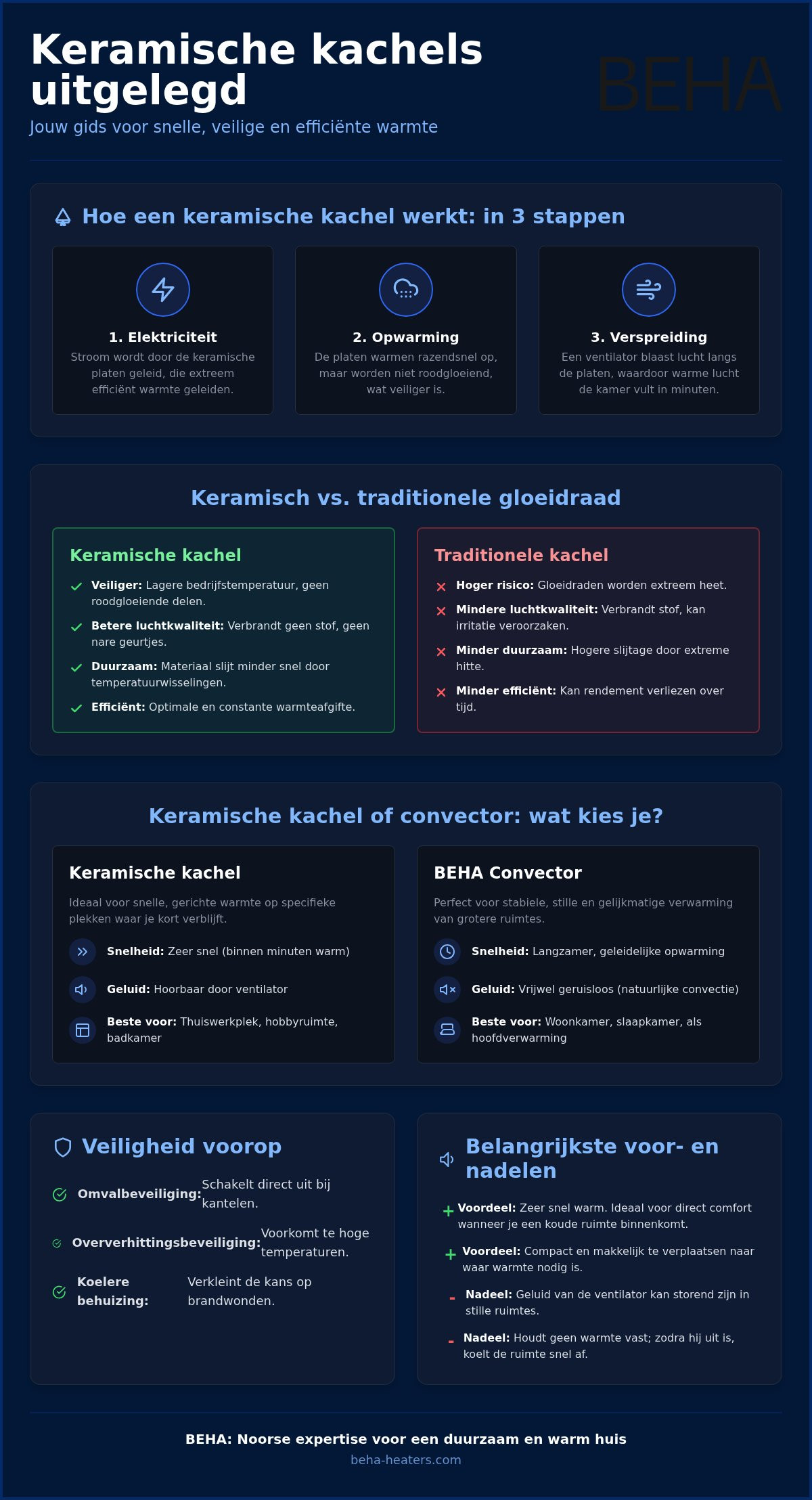
At its core, a ceramic heater is an electric heater that uses ceramic plates instead of the familiar iron heating elements. These plates have a unique property: they conduct heat extremely efficiently and retain it for longer. As soon as electricity flows through the ceramic, the material heats up rapidly. A built-in fan then blows air past these warm plates, causing the temperature in a room to rise noticeably within minutes. It is a compact powerhouse that delivers immediate results.
Safety is a major plus with this type of heating. Because ceramic has a lower operating temperature than metal wiring, the risk of overheating or fire is significantly reduced. The elements get warm enough to heat the air, but they do not become red-hot. This provides peace of mind when using the heater in rooms where children or pets are present. The material is simply more stable under thermal load.
the difference between ceramic and traditional fan heaters
An important advantage of a ceramic heater is the improved air quality. Traditional heaters with heating elements become so hot that they literally burn dust particles in the air. This often causes an unpleasant odor and can irritate the respiratory tract. Ceramic elements remain cooler, virtually eliminating this problem. You will notice that the air stays fresher. Furthermore, ceramic is a durable material that wears out less quickly due to temperature fluctuations. As a result, you enjoy a constant heat output for years without a decrease in efficiency. The energy transfer is simply more optimal.
For which rooms is a ceramic heater most suitable?
This type of heater excels in small to medium-sized rooms where you quickly need comfort. Think of a home office or a hobby room in the attic. Ceramic heaters are also popular in the bathroom, but always pay attention to the IP rating. For damp rooms, a minimum of IP21 (drip-proof) is required, although IP24 (splash-proof) is preferred for maximum safety. Always check this before making a purchase.
Although the heater is powerful, it is less suitable as the primary heating source for a large living room. This is because the fan must run constantly to distribute the heat, which can eventually cause noise and drafts. For larger areas, 's electric heater solutions BEHA a more stable and quieter foundation. You can then use the ceramic variant as the perfect complement for that quick, localized heat boost in places where you only stay briefly. with steel fronts offer
the main advantages and disadvantages of ceramic heating
If you choose a ceramic heater, you are choosing speed first and foremost. Whereas an oil-filled radiator often takes ten to fifteen minutes to heat the internal fluid, ceramics deliver results almost immediately. As soon as you flip the switch, warm air flows into the room. This makes the device ideal for moments when you want quick comfort, such as during a brief stay in a cold utility room or shed. Moreover, thanks to their compact design and light weight, these heaters are very easy to move to the spot where the heat is needed most at that moment.
However, there are also limitations you need to take into account. The biggest disadvantage is the noise. Because the heat is distributed by a fan, you always hear the device humming softly. In a quiet bedroom or during a focused meeting, this can be disruptive. Additionally, ceramic has hardly any thermal mass. This means that the heater does not store heat. If you unplug it, the room cools down almost immediately. The heat is volatile and disappears as soon as the airflow stops.
safety features you must not ignore
Safety is one of the strongest arguments for this type of heater. Most modern models are equipped with tip-over protection. This is a small sensor that immediately interrupts the power supply as soon as the device becomes unstable or tilts. Overheating protection also plays a crucial role; it switches off the heater if the internal temperature rises too high. Because the ceramic element itself does not get as hot as a traditional filament, the outer casing often remains cooler. This significantly reduces the risk of burns, which is reassuring in a household with curious children or pets.
energy consumption and the costs on your monthly bill
The energy consumption of an electric heater is always a point of concern. An average ceramic heater has a power output of 2000 watts. This means that the appliance consumes 2 kWh of electricity per hour. The exact costs depend on your current energy contract, but it is clear that intensive use can quickly drive up the bill. It is therefore essential to choose a model with an accurate thermostat. Without a thermostat, the heater continues to roar unnecessarily, even when the desired temperature has already been reached. For those seeking a quieter and more consistent solution for daily use, 's smart convectors BEHA a more efficient alternative that aligns better with a long-term vision of gas-free living.
ceramic heater or convector: the best choice for your space
When making an informed choice between a ceramic heater and a convector, it is essential to consider the method of heat output. A ceramic heater works with an active fan that forcefully blows air past a heating element. This results in a direct flow of warm air that you feel immediately on your body. We call this spot heating. A convector, on the other hand, heats the air in the entire room through natural air circulation. This process is much quieter and ensures an even temperature distribution without a constant, sometimes bothersome, airflow being felt.
In rooms where peace and consistency are important, such as the bedroom or a study, the convector almost always wins out over fan heating. The absence of mechanical noise means you can sleep or work undisturbed in a room that maintains a constant temperature. The differences are also significant on an aesthetic level. While a freestanding heater often has a functional appearance and stands in the middle of a high-traffic area, a fixed installation offers more tranquility in your interior. For example, you can choose a paintable radiator that blends seamlessly with the color of your wall. This is an investment in both comfort and design that lasts for decades, whereas a portable heater often has a shorter lifespan due to moving parts.
When do you choose a ceramic heater?
There are specific scenarios where the ceramic variant is preferred over a fixed installation. Do you have an uninsulated garage or a shed where you only occasionally work for an hour or so? Then the direct heat from a ceramic heater is ideal. You don't have to heat the entire space; the heater directs its energy directly to the spot where you are working. This is also a practical entry point for people on a limited budget looking for a quick solution for a temporarily cold spot. It is the 'first aid kit' of heating solutions: quick to deploy, but not designed as the basis of your heating plan.
When is a smart convector from BEHA the winner?
’s expertise BEHA, rooted in over 100 years of Norwegian winter experience, is reflected here. If you are looking for an electric convector with Wi-Fi, you are choosing a system that adapts to your lifestyle. Using a user-friendly app, you can set precise weekly schedules, ensuring the heater only consumes energy when you are actually in the room. This prevents the unnecessarily high electricity costs often incurred when manually operating a simple heater. For a sustainable and gas-free home, a fixed convector is the sensible choice that seamlessly combines daily comfort and energy savings.
tips for using your electric heater safely and economically
Placement is the first step towards a lower energy bill. A ceramic heater performs best when air can circulate freely. Never place the appliance directly behind a sofa or under a desk with a solid back. After all, you want the warm air to be blown into the room, not for the furniture to absorb the heat. Maintain at least 50 centimeters of free space around the heater. This is not only more efficient but also prevents the housing from becoming unnecessarily hot due to a lack of ventilation.
In addition, maintenance is crucial for preserving efficiency. Because this type of heater draws in air, dust accumulates on the ceramic element and the grate over time. This obstructs airflow, causing the motor to work harder and consume more power. Clean the grate and any dust filter every two to four weeks using the soft brush attachment of your vacuum cleaner. Always do this when the plug is disconnected and the appliance has completely cooled down. A clean heater heats up faster and more safely.
Zone control is the secret weapon for those looking to save gas. Instead of setting the central heating for the entire house to 20 degrees, keep the base heating low and use the ceramic heater as a local heat source. Heat only the place where you are actually present, such as your workspace or the seating area. Use the eco mode for this. This mode limits the wattage, causing the heater to draw less peak current and maintain the temperature more evenly.
understanding the ecodesign guidelines
Since the introduction of the Lot 20 regulations, electric heaters must meet strict energy efficiency requirements. This means that modern appliances are required to be equipped with features such as an electronic thermostat and a weekly timer. These rules are in place to protect your wallet; they prevent a heater from remaining on unnecessarily. ’s BEHA goes a step further by integrating these technologies into a sustainable design that meets the strictest ecodesign requirements. maintenance-free electric heating
smart control and automation
You gain maximum control by automating your heating. If possible, connect your heater to a smart home system or use the built-in Wi-Fi functions. Set timers so the heater never accidentally stays on at night. Many advanced models feature open window sensors; as soon as a sudden temperature drop is detected, the heater temporarily switches off to prevent energy waste. Do you want to start heating smarter immediately and reduce your gas consumption? Check out our range of smart convectors for an efficient solution in every room.
why BEHA is the smart choice for your electric heating
When considering purchasing a ceramic heater, you are often looking for a quick solution to an immediate problem. At BEHA however, we look beyond just that temporary heat boost. With over 100 years of Norwegian experience, we understand better than anyone what is needed to keep a home comfortable during the harshest winters. Since 1917, we have been developing heating solutions that are not only functional but also last a lifetime. This history forms the basis of our technological superiority; we know what works when the temperature outside really drops.
The choice of materials is one of the key points that sets us apart. While a standard ceramic heater is often made of plastic, which can discolour or become brittle due to the heat over time, we opt for robustness. An electric heater with a steel front from BEHA offers a durability that you simply won't find in cheap plastic alternatives. Steel not only conducts heat excellently, but it also retains its sleek design, no matter how often you use the heater.
Our philosophy revolves around harmony in your home. That is why we have developed unique paintable fronts. You don't have to adapt your interior to the heating; the heating adapts to you. Whether you choose a bold color or a muted shade, the heater blends seamlessly into your walls. Combined with the BEHA app, you also have a powerful dashboard at your fingertips. You can see exactly what you are consuming and control the temperature per room, which is essential for keeping that monthly energy bill under control.
quality that lasts for generations
As a European family business, we stand for a personal approach and a finish that meets the highest standards. We use high-quality steel and tempered glass, materials that retain their shape and efficiency, even after years of intensive use. This timeless design ensures that our convectors are not susceptible to trends. You are investing in a device that does not need to be replaced after a few seasons, backed by the warranty and service you can expect from a renowned expert. It is the down-to-earth, solid quality that we have been proud of for decades.
switch to the future of heating
The switch to a gas-free home sometimes seems like a huge undertaking, but with the right partner, it is a logical and feasible process. BEHA supports both professionals and private individuals in making the right choices for every specific room. Whether you start with the home office or want to tackle your entire home, we offer the technological foundation needed for a responsible lifestyle. Are you ready to take back control of your own living comfort and save structurally? View our full range and discover the ideal electric solution for your situation.
make the switch to smart and responsible comfort
You now know that a ceramic heater is the ideal partner for fast, targeted heat in that one cold spot in the house. It is the perfect solution for moments when you want to see immediate results without turning up the central heating. By finding the right balance between local supplementary heating and a smart basic installation, you create a home that is both warm and energy-efficient.
At BEHA we believe in quality that lasts for generations. Our products meet the strictest ecodesign requirements and offer unprecedented ease of use thanks to the user-friendly BEHA app. With over 100 years of experience in the cold north, we know exactly how to combine technology and tradition for your well-being. Are you ready to heat your home in a future-proof way? 's smart heating solutions BEHA and experience the difference of Norwegian craftsmanship for yourself. You deserve a home that always feels comfortable.
frequently asked questions about ceramic heaters
How much electricity does a ceramic heater consume per hour?
The power consumption of a ceramic heater is directly related to the appliance's set power. A heater with a power of 2000 watts consumes exactly 2 kilowatt-hours (kWh) of electricity per hour when running continuously at full power. For a 1500-watt model, this consumption is 1.5 kWh per hour. By using the thermostat smartly and switching off the heater as soon as the room reaches the desired temperature, you can significantly reduce the final consumption on your bill.
Is a ceramic heater safer than a radiant heater?
Yes, a ceramic heater is generally considered safer than a traditional radiant heater due to the lower operating temperature. The ceramic element has a larger surface area and does not get as hot as the thin, red-hot wires in a radiant heater. As a result, the risk of fire from dust particles or burns from accidental contact is much lower. Furthermore, modern ceramic models are almost always equipped with tip-over protection and overheat protection for extra safety in the home.
Can I leave a ceramic heater on all night?
We advise against leaving a portable heater on unattended all night while you sleep. Although the built-in safety features reduce the risk, these devices are primarily designed for short-term supplementary heating under supervision. Furthermore, the fan can dry out the air in the bedroom or stir up dust, which is detrimental to your night's rest. For permanent night heating, BEHA 's fixed, smart convectors are a safer and quieter choice, specifically designed for long-term use.
What is the difference between a ceramic heater and an infrared panel?
The main difference lies in the way heat is transferred to the environment. A ceramic heater heats the air and distributes it throughout the room with a fan, resulting in a rapid rise in air temperature. An infrared panel does not heat the air but radiates heat directly onto objects and people, similar to the sun's rays. Infrared is pleasant for targeted radiant heat, whereas a ceramic version is more effective if you want to quickly heat up a small room as a whole.
Does a ceramic heater make a lot of noise?
A ceramic heater always produces a soft hissing sound because the built-in fan must run continuously to circulate the warm air. Most users perceive this as a monotonous background noise that is not immediately disruptive during daily activities. However, the noise level can vary by model. If you are looking for a completely silent solution for a bedroom or a quiet workspace, a fanless convector is a more pleasant alternative for prolonged use.
Is a ceramic heater suitable for the bathroom?
That depends entirely on the IP rating of the specific model you have in mind. A heater may only be used in the bathroom if it has at least an IP21 certification (drip-proof), although an IP24 certification (splash-proof) is preferred for maximum safety. Never place the device directly next to the shower or bath and ensure sufficient distance from water sources. Always check the manufacturer's manual to verify whether the model is suitable for damp areas.
Why does my new ceramic heater smell when I turn it on for the first time?
It is perfectly normal for a new heater to emit a slight, specific odor during the first few hours. This is caused by a thin layer of protective oil or coating applied to the heating elements during the manufacturing process. As soon as the element heats up for the first time, this layer evaporates. It is best to run the heater at full power for an hour in a well-ventilated room the first time. The odor will then disappear completely and will not return.
How big does a ceramic heater need to be for my room?
For an average room with a standard ceiling height, you can assume a required power output of approximately 100 watts per square meter. A 20-square-meter room therefore requires a 2000-watt heater to heat the space effectively and quickly. In a very well-insulated home, this power output may be somewhat lower. Because ceramic heaters are often used as supplementary heating for specific areas, a model of 1500 to 2000 watts is usually more than sufficient for most standard rooms.