
Buying a convection heater: Everything about operation and benefits
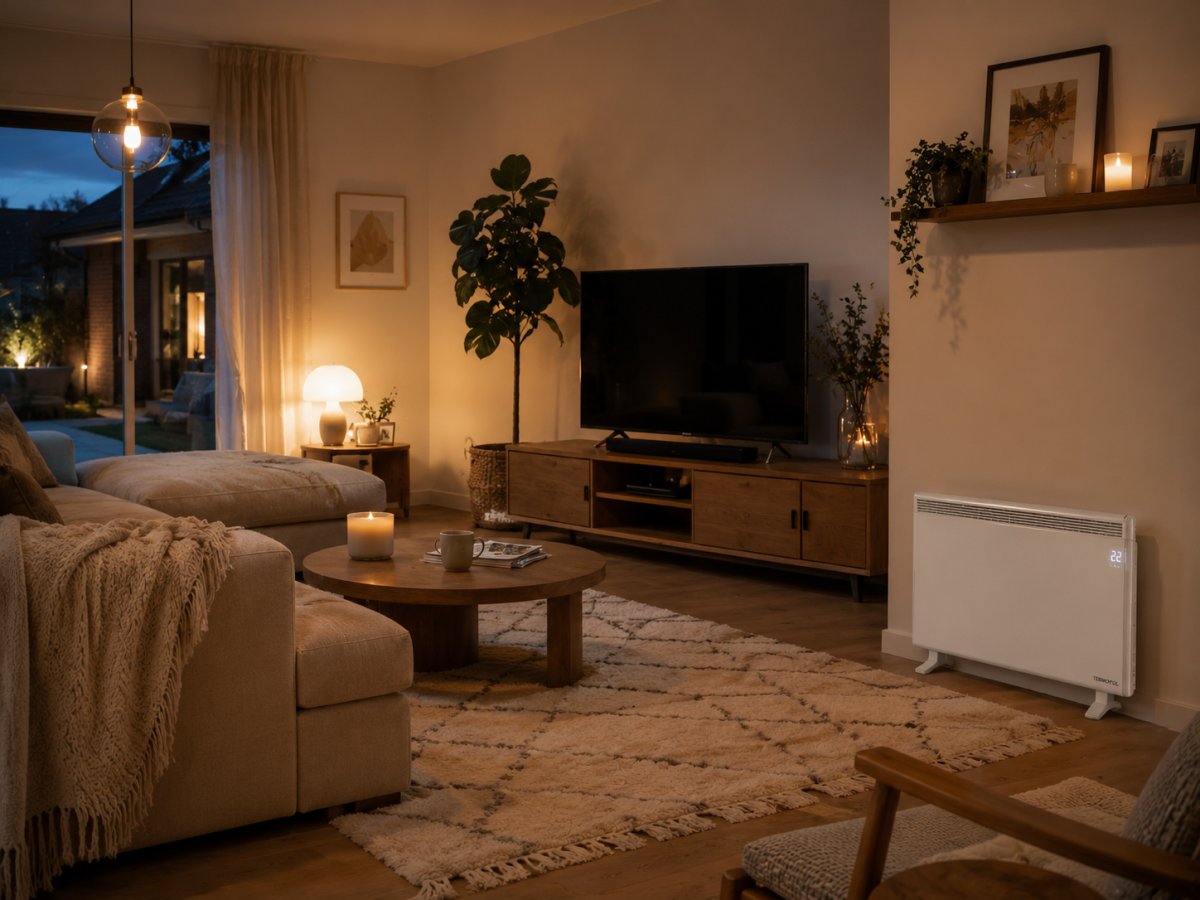
Looking to buy a convector heater for your living room, bedroom, home office, or holiday home? Then look beyond just the maximum wattage. The suitable model depends on heat loss, operating time, desired heating speed, installation, and controls. A simple freestanding heater may suffice for temporary supplementary heating; for quiet daily comfort, a wall-mounted convector with an electronic thermostat and weekly program is usually more practical.
This buying guide is tailored to both Belgium and the Netherlands. You will learn how natural convection works, how much power you actually need, and what a unit can cost per hour. Additionally, you will compare wall-mounted and freestanding models, steel and glass fronts, and controls with or without Wi-Fi. Do you want to buy a convector heater as your primary heating source? Then you will read why a heat loss calculation, an inspection of the electrical installation, and a comparison with a heat pump are necessary.
Key points
- Buying a convection heater starts with the choice between temporary supplementary heating and daily primary heating.
- Natural convection primarily heats the room air and operates silently without a fan.
- Calculate power based on heat loss; a watt-per-m² rule is only a first indication.
- Operating costs = power in kW × active heating hours × your own all-in electricity price.
- Thermostat, timer, and weekly schedule limit unnecessary heating hours, but do not change the conversion principle.
- For bathrooms, check the IP rating, mounting zone, and national installation regulations.
What is a convection heater and how does it work?
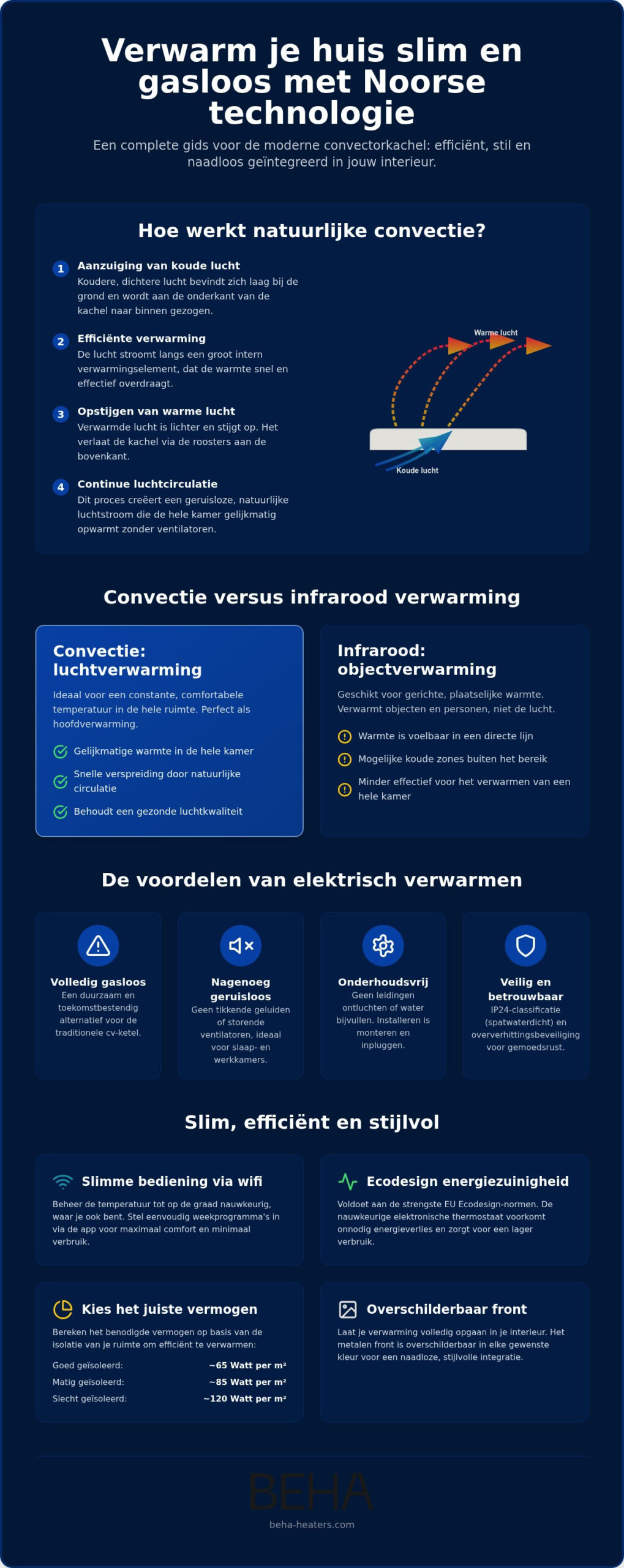
A convection heater heats the air flowing through the unit. Cooler air enters at the bottom, passes the electric element, and rises through the top after heating. This creates natural air circulation without the need for a fan. The thermostat switches the element off when the set temperature is reached and back on when heat loss needs to be replenished.
Anyone buy a convection heater for a quiet room should preferably choose a model without a turbo fan. Some units marketed as convection heaters do have an extra fan setting. This can accelerate the initial heating, but it causes noise and air movement. Therefore, check the product specifications instead of relying solely on the category name.
Natural convection step by step
- Cooler room air sinks and reaches the air intake at the bottom.
- The heating element transfers heat to the passing air.
- The warmer air rises and spreads through the room.
- After cooling, the air descends and the cycle repeats itself.
The system primarily heats the air mass. Comfort therefore depends on room size, ceiling height, insulation, and airflow. Large open spaces, stairwells, and strong drafts require more power and careful positioning than a compact, well-insulated bedroom.
Convection, fan heat, and infrared compared
| Technology | feeling of warmth | Best application | Point of attention |
|---|---|---|---|
| Natural convection | Even room air | Living room, bedroom, and study | Free air circulation required |
| Fan heater | Fast and local | Short-term heat demand | Fan noise and airflow |
| Infra-red | Direct radiation on persons and surfaces | Targeted seating or work zone | Positioning and line of sight are important |
| Oil-filled radiator | Smooth, slower release | Longer heating period | Heavier and slower warming |
Buying a convection heater makes the most sense when you want to heat an entire room quietly and with adjustable control. For a workspace where you only stay for twenty minutes, direct radiant or fan heat may be more efficient.
Supplementary heating or primary heating?
As supplementary heating, you can make one occupied room warmer while other zones remain cooler. The benefit only arises when you actually turn down the central installation or do not heat all rooms simultaneously. As primary heating, direct electric convection may be suitable for a compact, very well-insulated home, but in a home with significant heat loss, power consumption can become high.
If you want to buy a convector heater for daily main heating, also compare it with an air-to-air or other heat pump. A heat pump moves heat and can therefore deliver more heat per kWh of electricity. A convector, on the other hand, has a lower purchase cost, simple zone control, and low technical maintenance.
Advantages and limitations of an electric convection heater
An overview of local electric heating shows that separate room heaters are particularly useful for local or temporary heat. Purchase and installation are generally simpler than with a water-based system. Because no combustion takes place, no flue gas exhaust or boiler maintenance is required.
Anyone to purchase a convection heater must also be aware of its limitations. The maximum electrical consumption follows directly from the power output. A 2,000-watt unit consumes 2 kWh per hour at full power. The thermostat shortens the operating time after the room has been heated, but does not generate more heat from the same kWh of electricity.
The main benefits
- quiet operation on models without a fan;
- rapid and even heating of the room air;
- arrangement per separate room;
- no central heating pipes or flue gas discharge;
- choice of freestanding and wall-mounted models;
- Electronic thermostat, timer or weekly program possible.
The main limitations
- operating costs can be high with prolonged heat demand;
- a poorly insulated home requires a lot of power;
- multiple heavy appliances can load the electrical connection;
- Convection provides less direct radiant heat than infrared;
- Products with a fan are not completely silent.
Ecodesign and smart control
European Ecodesign requirements encourage features that limit unnecessary use, such as electronic temperature control, weekly schedules, and detection of sudden temperature drops. Savings result from fewer heating hours or a lower set temperature. A good thermostat prevents large fluctuations, but the actual gain remains dependent on insulation and usage.
On BEHA Heaters, you can compare models based on power, control, and design. Check the product sheet and manual for each model; general sales texts do not replace technical specifications.
Bathroom and safety
An IP rating must always be assessed in conjunction with the mounting zone and local installation regulations. “IP24” does not mean that an appliance may be placed or hung anywhere in a bathroom. Permanent connection, a new circuit, or installation in a damp zone requires the assistance of a qualified electrician. Keep air vents clear, never cover the heater, and do not use an unsuitable extension cord.
Buying a convection heater: how to choose the right model
Buying a convection heater based solely on a specified number of square meters can lead to disappointment. The required power is determined by the heat the room loses on a cold day. Surface area, ceiling height, exterior walls, windows, ventilation, adjacent rooms, and insulation all play a role in this.
Determining assets without false certainty
Webshops often use watts per m² or m³ as a quick selection method. Such a range can be useful for an initial selection of supplementary heating, but it is no guarantee. For primary heating, high ceilings, large glass surfaces, or renovation, a heat loss calculation per room is the reliable approach.
Anyone to purchase a convection heater for a 20 m² room cannot automatically conclude that 2,000 watts is always the right size. A well-insulated intermediate room has a different heat requirement than a freestanding veranda with a lot of glass. An undersized unit remains active for a long time and may not reach the desired temperature; a correctly sized unit heats up and then switches off thermostatically.
Wall-mounted or freestanding stove?
| Execution | Advantage | Point of attention |
|---|---|---|
| Wall model | Space-saving and fixed position | Correct bracket, distances, and socket location |
| Detached | Flexible between rooms | Risk of tipping over, clearance and cable routing |
| Wall and feet | Freedom of choice upon initial placement | Check if both mountings are permitted by the manufacturer |
Install a convector where air can flow freely below and above the unit. A position near a cold window surface can help counteract cold drafts, but always follow the minimum distances specified in the manual. Curtains, furniture, and laundry must not block the air vents.
Steel, glass, or paintable front?
The front material primarily influences appearance, weight, maintenance, and installation. A steel front is robust and timeless. Glass has a sleek appearance but requires extra attention during transport and installation. For a device that needs to visually disappear into the wall, a paintable heating front be suitable. Use only paint and methods permitted by the manufacturer; never paint air vents, the thermostat, or controls.
Seven pre-purchase checkpoints
- Determine whether the heater will be used for primary, supplementary, or frost heating.
- Calculate or substantiate the heat loss of the room.
- Check the available connection capacity, the circuit or group, and the socket.
- Choose between quiet natural convection and a model with a turbo fan.
- Compare thermostat, timer, weekly program, child lock, and frost setting.
- Check IP class, mounting method, minimum distances, and warranty.
- Calculate usage costs using your own electricity rate and active hours.
With this checklist, buying a convection heater an informed decision, not just a choice based on price, appearance, or an optimistically stated room size.
Smart control and energy saving with Wi-Fi
The integration of digital technology has transformed traditional heating into an intelligent system that proactively anticipates your daily rhythm. Nowadays, a modern convector heater is much more than a metal casing with a heating element. With the addition of Wi-Fi functionality, you gain complete control over both your energy consumption and your living comfort. The biggest advantage of an electric convector with Wi-Fi is the ability to limit waste to an absolute minimum. Instead of a heater that stays on a fixed setting all day, you only heat the rooms you actually use. With current electricity prices of €0.27 per kWh, every minute you don't heat unnecessarily translates directly into a lower monthly bill.
Via a central interface, you effortlessly manage multiple heaters in different rooms. You see the current temperature in the living room, bedroom, and bathroom at a glance. This insight is crucial for using energy more consciously. For example, you can see if a room remains unnecessarily warm while no one is present. This data-driven approach to heating fits perfectly with the modern, sustainable lifestyle that will have become the norm in Belgium and the Netherlands by 2026.
Remote heating with the app
Connecting your heater to your home network is a matter of just a few minutes these days. As soon as the connection is established, you can control the temperature from anywhere in the world. Imagine leaving for home after a cold day at the office. You activate the heating via the app, so that the house already behacomfortable the moment you open the front door. This remote control is not just a luxury; it is also a safety feature. You can always check if the heaters are switched off when you have left home in a hurry. The encrypted connection ensures that your smart home environment remains optimally secured against unauthorized access.
Save with smart schedules
You achieve real financial gains by setting precise weekly schedules. You program the heater to automatically switch to a lower temperature at night and only heat up again just before you get up. During working hours, when the house is empty, the system remains in economy mode. Another essential function for energy conservation is 'open window' detection. When the heater detects a sudden drop in temperature, such as when airing out a room, the system temporarily switches itself off. This prevents you from literally heating the outside air. By combining these techniques, smart heating in the living room ensures an optimal climate with a minimal ecological footprint.
Are you ready to switch to an intelligent and energy-efficient heating system? View our range of smart convectors and experience the comfort of top Norwegian technology in your own home.
Consumption and costs before you buy a convection heater
Formula: power in kW × active heating hours × all-in electricity price = operating costs. A 1,500-watt model that actually heats for three hours uses 4.5 kWh. Multiply that by your own contract price; online sample rates are not a reliable predictor of your bill.
If you want to buy a convection heater to save money, compare scenarios. Three hours of zone heating in a home office can be more economical than heating the entire home. Conversely, the same appliance heating a poorly insulated living room for extended periods daily may actually consume a lot of electricity.
Belgium and the Netherlands: connection and peak power
Multiple 2,000-watt convectors can together constitute a significant electrical load. In Belgium, simultaneous peak power can be relevant to grid costs; in the Netherlands, the distribution board, circuit, and sockets must have sufficient capacity. Have fixed connections, new circuits or groups, and bathroom installations carried out by a qualified electrician.
Buying a convection heater with Wi-Fi is particularly sensible for varying routines, multiple rooms, or remote control. Wi-Fi itself does not save anything. It is the weekly program, lower absence temperature, and zone heating that make the potential difference.
Why the Norwegian quality of BEHA makes the difference
BEHA is not just any manufacturer; it is a Norwegian family business with a history dating back to 1917. In a country where winters are long and unforgiving, reliable heating is not a luxury but a bitter necessity. This Norwegian down-to-earthness is reflected in every detail of the convection heater. While many modern appliances are designed for a limited lifespan, BEHA opts for materials and constructions that last for decades. This aligns perfectly with the growing demand for sustainable products that do not end up in the landfill after just a few years.
The focus on a long lifespan means you are investing in a product that proves its value over the years. The housing, electronics, and heating element are coordinated in such a way that they maintain their efficiency even with intensive use. For the Belgian and Dutch markets, this offers the assurance of a maintenance-free system that is always ready for the first autumn chill or an unexpected frost period.
Innovation rooted in tradition
For over a century BEHA has set the standard for electric heating by continuously innovating without losing sight of classic reliability. Every convection heater leaving the factory is the result of rigorous quality controls and tests in the cold climate of Norway. The brand understands that technology should serve, not hinder. That is why the latest smart technology is logically integrated into a robust housing. So, you are not just buying a modern device with app control, but also a piece of Norwegian craftsmanship rooted in generations of expertise.
A stove that suits your lifestyle
Whether you want to heat a small bathroom or a large office, the range offers a suitable solution for every situation. The versatility of the various fronts ensures that the technology adapts to your interior, rather than the other way around. For the commercial market, this reliability is essential to keep operational costs low and guarantee a comfortable working environment. For this reason, many professionals choose commercial BEHA. electric heating
Moreover, the installation is designed so that you do not need an expensive installer. With the included wall brackets, the heater hangs securely on the wall in just a few minutes. It is simply a matter of attaching the bracket, clicking the heater into place, and plugging it into the socket. This simplicity, combined with local support for the Benelux, makes BEHA a reliable partner for anyone serious about sustainable and comfortable heating.
Choose the future of electric heating
Heating your home in 2026 requires smart choices that protect both your comfort and your wallet. You have discovered how a modern convection heater , thanks to natural air circulation and highly precise thermostats, offers a full-fledged, gas-free alternative to the traditional central heating system. By choosing the Norwegian quality of BEHA , you benefit from over 100 years of expertise and products that are fully Ecodesign-compliant for maximum savings on your energy bill.
Whether you choose the minimalist look of glass or our unique paintable models that seamlessly blend into your specific interior, you are investing in a sustainable solution that lasts for generations. Moreover, with intuitive Wi-Fi control, you always maintain full control over your consumption, wherever you are. It is time to say goodbye to bulky radiators and enjoy a silent, stylish, and smartly heated home.
View our full range of smart convection heaters and experience for yourself how Norwegian innovation elevates your living comfort. Take the step towards an energy-efficient future today.
Frequently asked questions about buying a convection heater
Is a convection heater energy-efficient?
Direct electric heaters convert consumed electricity almost entirely into heat on-site. Consumption is primarily determined by heat demand, power output, operating time, and controls. For long-term main heating, a heat pump can deliver more heat per kWh of electricity.
How many watts do I need?
This follows from the heat loss of the room. Surface area alone is insufficient: insulation, ceiling height, windows, ventilation, and outside temperature also play a role. Use watts per m² only for an initial selection and have the main heating system calculated.
Is a convection heater suitable for the bedroom?
A model without a fan operates quietly and may be suitable if assembled correctly according to the manual. Choose a low night setting, keep air vents clear, and do not use an unsuitable extension cord.
Is a convection heater allowed in the bathroom?
Only if the IP rating, connection, and mounting location are suitable for the relevant bathroom zone. Follow national installation regulations and have the installation assessed by an electrician if in doubt.
Can I use a convection heater all night?
Use only a device intended by the manufacturer for continuous thermostatic use. Check the cable, plug, mounting, and clearances. Never cover the device. A lower programmed temperature limits unnecessary consumption.
Does a convection heater make noise?
Natural convection requires no fan and is therefore very quiet. The expansion and heating of materials can sometimes produce slight ticking noises. A model with a turbo fan produces audible fan noise.
Convector or infrared?
A convector primarily heats the room air and provides an even temperature. Infrared heats people and surfaces within the radiation zone and can be suitable for targeted heat. The best choice depends on usage and layout.
Do I need a special connection?
That depends on the power rating, the number of appliances, and the existing installation. A single plug-in model can often be connected to a suitable grounded outlet according to the manual. Have multiple heavy-duty appliances or a fixed connection assessed beforehand.
When is it better not to buy a convection heater?
With long-term primary heating in a large, poorly insulated home, operating costs can be high. Improve insulation first and compare a heat pump or hybrid system. A convector excels particularly in fast control, low installation complexity, and zone heating.
What should I look for when comparing online?
Check the product sheet, manual, power output, thermostat, installation, IP rating, warranty, and safety features. Anyone buy a convection heater does not just look at discounts or maximum coverage area, but at heat loss, operating hours, and total cost of ownership.