
Buying an electric heater: 7 smart choices
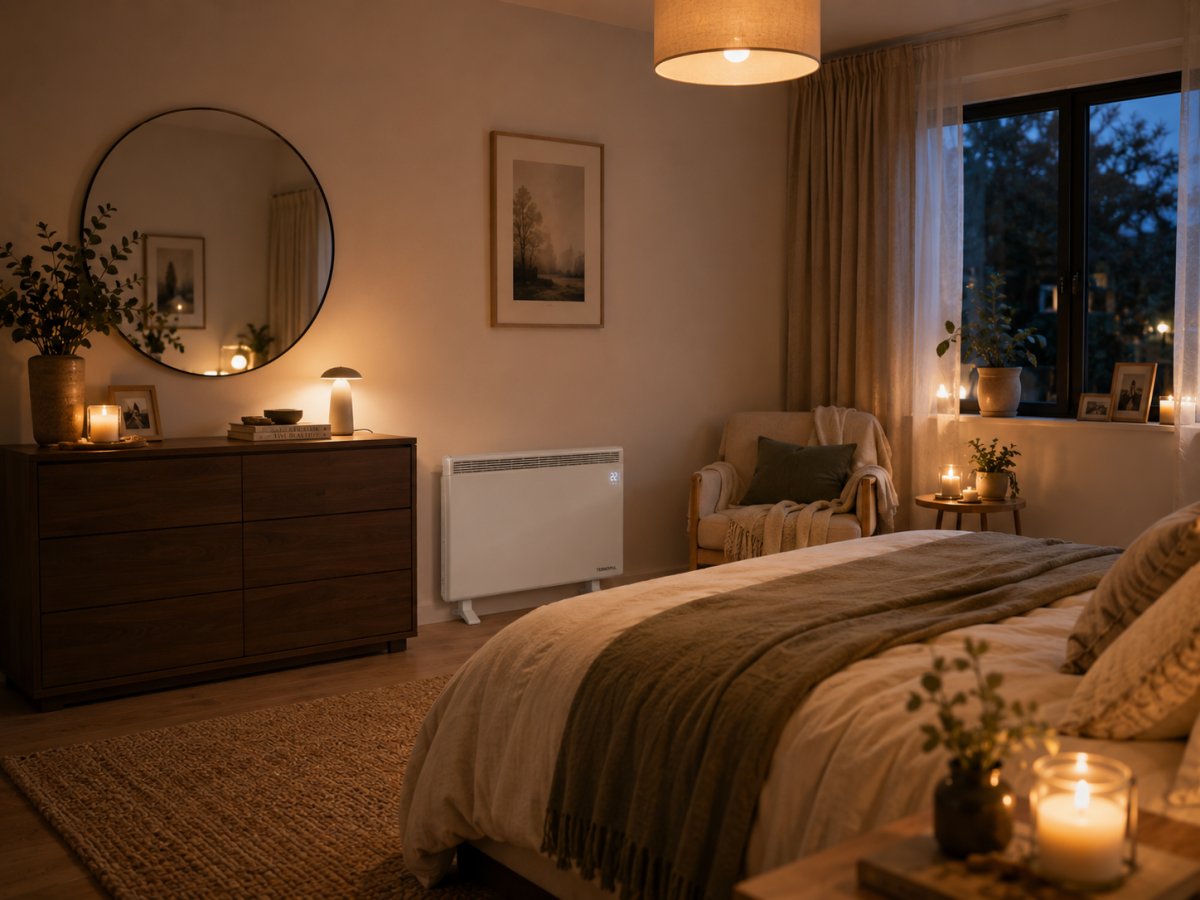
Looking to buy an electric heater for a home office, bedroom, living room, or vacation home? Then look beyond just wattage and price. The suitable type depends on how quickly you want heat, how long the room is used daily, the insulation, placement, and desired operation. A fan heater provides quick, localized heat; a quiet convector is generally more suitable for maintaining a room at an even temperature.
This buying guide is written for households in Belgium and the Netherlands. You compare convectors, ceramic models, oil-filled radiators, and infrared, calculate power consumption yourself, and check which safety features are truly important. Do you want to buy an electric heater as your primary heating source? Then we also explain why a heat loss calculation and a comparison with a heat pump are necessary. This way, you choose based on usage and total costs, not on marketing claims.
Key points
- Buying an electric heater starts with the question: temporary supplementary heating or daily primary heating?
- Compare heater types based on heat output, noise, controls, placement, and active operating hours.
- Calculate costs using: power in kW × active heating hours × your own all-in electricity price.
- Select power based on heat loss; a watt-per-m² rule is only a first indication.
- For bathrooms, product and installation requirements apply regarding IP classification and electrical zones.
- Thermostat, timer, and weekly program limit waste, but do not generate more heat from the same kWh.
What is an electric heater and which type suits you?
A direct electric heater converts the current drawn in the room almost entirely into heat. This applies to a convector, ceramic fan heater, oil-filled radiator, and infrared panel. The devices differ mainly in the way they distribute that heat, how quickly you feel it, and how precisely they are controlled. The explanation of electric heating helps to distinguish resistance heating from a heat pump, which moves heat and can therefore typically deliver more heat per kWh of electricity.
If you want to buy an electric heater, first determine whether you are looking for quick, localized heat or a stable room temperature. For a few minutes at a workbench, a fan model might make sense. For hours of quiet comfort in a study or bedroom, a convector heater is often a better fit. Infrared is interesting when people or surfaces need to be heated within a targeted radiation zone.
Four types of electric heaters compared
Buying an electric heater for daily comfort requires a comparison of heat output, controls, noise, and active usage hours.
| Type | Suitable for | Advantages | Points of attention |
|---|---|---|---|
| Convector | Living room, bedroom, office and zone heating | Quiet, fast air heating, precisely adjustable | Free air circulation and correct power required |
| Ceramic fan heater | Short, local heat demand | Quickly noticeable warmth and compact | Fan noise and less suitable for continuous bedroom use |
| Oil-filled radiator | Longer, quiet heating periods | Quiet and continues to emit heat after being switched off | Slower warm-up, heavier and less flexible |
| Infra-red | Targeted seating, working, or radiation zone | Instantly palpable radiant heat | Positioning and unobstructed radiation path determine comfort |
Anyone buy an electric heater for daily primary heating must also compare air-to-air or other heat pumps. A direct heater usually has lower purchase and installation costs, but under suitable conditions, a heat pump can use much less electricity per unit of heat delivered.
Why choose an electric convector?
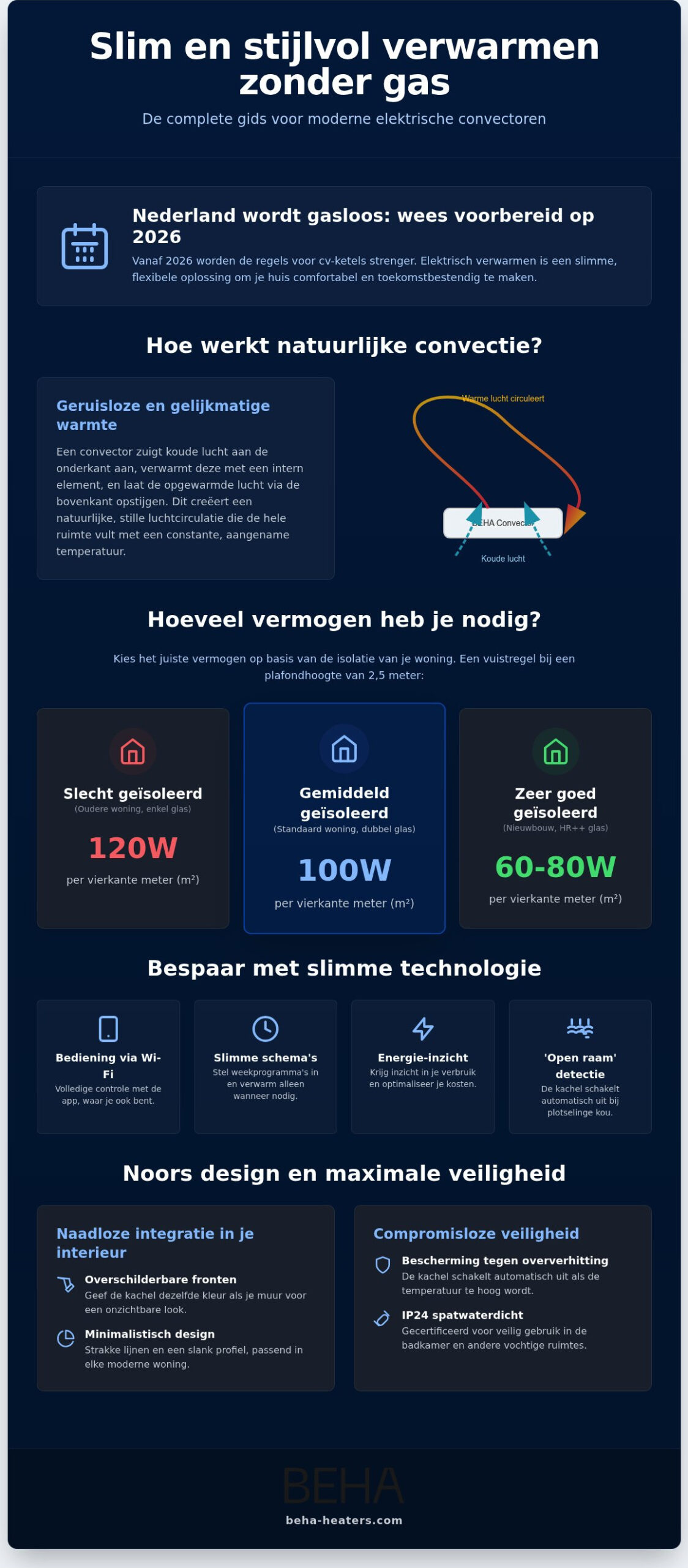
A convector draws in cooler room air from the bottom. This air flows past the element, heats up, and rises through the top. In a model without a fan, this happens silently through natural convection. This makes a convector suitable for rooms where an even temperature and low noise are important. An electronic thermostat switches the element off as soon as the set temperature is reached and switches it back on when heat loss needs to be replenished.
a electric heater can save space. Check the minimum distances, wall load capacity, and instructions in the manual beforehand. A plug-in unit requires a suitable grounded socket; permanent connection or a new circuit must be installed by a qualified electrician.
Supplementary heating or primary heating?
As supplementary heating, you can heat a single occupied room while the central heating system is set to a lower level. The benefit only arises when other zones actually require less heat. For primary heating, the total design heat loss of the home must be covered. In a compact, well-insulated apartment, this may be feasible; in a poorly insulated home, power consumption can turn out to be high.
Therefore, the same principle applies to Belgium as well as the Netherlands: first improve draft sealing and insulation, then determine the power per room, and finally check the electrical connection capacity. Multiple 2,000-watt appliances can together constitute a significant load. Have the distribution across groups or circuits checked before using multiple appliances simultaneously.
Buying an electric heater: how to choose power and placement
an electric heater based solely on square meters is risky. The actual heat demand also depends on ceiling height, windows, ventilation, exterior walls, adjacent rooms, and insulation level. A model with insufficient power remains active for a long time and may not reach the desired temperature. A generously sized unit heats up faster, but still requires proper regulation and safe electrical connection.
First calculate the heat loss
Webshops often use bandwidths per m² or m³. These are useful for an initial comparison, but not a guarantee. For a room used only occasionally, you can use them to make a preliminary selection. If you want to buy an electric heater for primary heating, have a heat loss calculation performed for each room. This prevents both under-dimensioning and unnecessarily high installed capacity.
- Living room: look at large windows, open connections, and the desired constant temperature.
- Bedroom: choose quiet operation, a low night setting, and precise thermostat.
- Home office: quick warm-up and a daily schedule are usually more important than maximum capacity.
- Bathroom: check IP rating, permitted zone, and installation instructions.
- Holiday home: frost protection and remote control can be practical.
Next, view the available electric heaters with Wi-Fi and compare not only the nominal power, but also the thermostat, programs, mounting method, and product documentation.
On BEHA Heaters, you will find additional product information to compare power, operation, and design side by side.
Installation and assembly
For convection, air must be able to flow freely below and above the unit. A position below or near a cold window surface can help counteract cold drafts, but is not mandatory or possible in every layout. Always follow the minimum distances specified in the manual. Do not place curtains, furniture, or laundry against the air vents, and never cover the heater.
Are you looking to buy an electric heater for a bathroom? The “splash-proof” label alone is insufficient. The required IP rating depends on the installation zone and national installation regulations. If in doubt, have an electrician determine where and how the appliance may be connected.
Seven pre-purchase checkpoints
Looking to buy an electric heater for supplementary heating? Go through these seven points first to ensure the power and usage suit the room.
- Determine whether the heater will be used for primary, supplementary, or frost heating.
- Estimate or calculate the heat loss of the room.
- Check the socket, circuit or group, and total connected load.
- Choose the type of heat: air circulation, fan heat, or radiation.
- Compare thermostat accuracy, timer, and weekly program.
- Check safety features, certifications, IP rating, and manual.
- Calculate usage costs using your own electricity rate and expected active hours.
With this checklist, buying an electric heater an informed choice instead of a gamble based on a product photo or a maximum number of square meters.
save on heating costs with smart technology and Wi-Fi
Saving on your energy bill is more important than ever in Belgium and the Netherlands. With fluctuating electricity prices, which can vary significantly throughout the day, it is essential to accurately manage your consumption. A modern electric heater with Wi-Fi functionality is your best ally in this regard. Instead of a heater that roars on a fixed setting all day, choose a system that only provides heat when and where it is actually needed. This is not an unnecessary luxury, but a necessary tool to keep your monthly expenses under control.
The biggest advantage of a smart thermostat is the elimination of unnecessary consumption. We all sometimes forget to turn down the heating when we leave the house. With a connected system, you can adjust this at the touch of a button via your smartphone, or let the system automatically respond to your daily routine. By dividing your home into zones, you heat the home office during office hours and the living room only in the late afternoon. This prevents you from paying unnecessarily for heat in empty rooms, which is immediately visible on your annual bill.
the power of the BEHA smart app
The BEHA smart app acts as the central brain of your heating system. You control your heaters from anywhere in the world, which is ideal if you arrive home unexpectedly late or want to enjoy a warm home sooner. The app provides immediate insight into consumption per room. Do you see that a particular room is consuming more energy than expected? Then you can adjust the schedule immediately. You can easily create groups, allowing you to switch all heaters on the upper floor to economy mode at once, for example, when the children are at school.
ecodesign and energy efficiency
The European Ecodesign guidelines are strict, and that is good news for your wallet. A modern electric heater must be equipped as standard with features that prevent waste. One of the most effective features is open-window detection. As soon as the heater detects a sudden drop in temperature, for example because a window is open for ventilation, the heating element switches off temporarily. This way, you are not heating the outside air.
In addition, the accuracy of the thermostat plays a crucial role. Old heaters often fluctuate by several degrees around the set temperature, which consumes a lot of energy when reheating repeatedly. Modern convectors keep the temperature stable within a fraction of a degree. This constant climate not only increases your living comfort but also ensures that the heater operates much more efficiently. Smart technology and sustainability seamlessly merge here.
Consumption and costs before you buy an electric heater
The maximum consumption per hour is simple: 1,000 watts is 1 kW and consumes 1 kWh per hour at full power. A 1,500-watt heater consumes 4.5 kWh during three active heating hours. Multiply that by your own all-in price per kWh. At €0.30 per kWh, this example calculation costs €1.35; this is not a current rate or price promise.
Formula: power (kW) × active heating hours × electricity price = operating costs. The thermostat ensures that the element does not need to be continuously active after heating up. For a realistic calculation, use measured kWh or an energy meter suitable for the power output.
If you buy an electric heater to reduce costs, compare scenarios. Three hours of targeted heat in an office can be cheaper than heating the entire home. The same heater heating a poorly insulated living room for many hours daily can actually consume a lot of electricity. Smart control only saves energy when the program prevents unnecessary heating hours or excessive temperatures.
Belgium and the Netherlands: which differences count?
Product choice and heat demand are comparable, but electricity contracts, grid costs, and electrical installation regulations differ. Therefore, use your own all-in tariff and have the connection carried out according to local regulations. In Belgium, simultaneous peak power can be relevant to grid costs; in the Netherlands, the distribution board must have sufficient capacity for the chosen appliances. In both countries, spreading by zone is wiser than switching on many heavy heaters simultaneously without a power plan.
safety and maintenance of electric heating
Safety is the most important consideration for many households when purchasing an electric heater. Fortunately, the days of unsafe radiant heaters with exposed, red-hot coils are long behind us. Modern convectors are designed with the strictest European safety standards in mind. They use enclosed heating elements that heat the air without becoming extremely hot on the outside themselves. This significantly reduces the risk of burns and makes them a reliable partner in every room of the house.
An essential part of this safety is the built-in overheat protection. Should the airflow become blocked, the heater switches itself off immediately. Tip-over protection is also standard on many models, which is crucial for freestanding heaters in a busy household. In addition, these heaters contribute to healthy air quality. Because the heating element does not glow, no dust combustion takes place. This prevents that typical burnt smell and is a relief for people with sensitive airways or allergies.
Safe heating in every room
In a home where children or pets roam, extra caution is required. Many of our models are equipped with child-safe settings, such as a lockable control panel, so that curious little hands cannot simply change the temperature. As mentioned earlier, a splash-proof IP24 rating is required for the bathroom. A golden rule that applies to every room: never cover a heater with clothing or towels. Although the heater is protected, this hinders natural convection and forces the heater to work unnecessarily hard.
tips for a long lifespan
One of the biggest advantages of a convector is that it requires virtually no maintenance. There are no moving parts that need lubrication and no water-side system that needs to be vented. Nevertheless, you can do a few small things yourself to keep efficiency optimal. Occasionally use a vacuum cleaner with a soft brush to clear the air grilles on the bottom and top of dust. After all, a free airflow is the basis for efficient operation.
Additionally, periodically check the plug and cord for any damage or wear. By performing these simple actions, you ensure that your heater lasts for years without problems. It is simply a fact that a maintenance-free electric heater is the most cost-effective investment for your home in the long run. You not only save on repair costs but also enjoy carefree warmth every winter.
Do you want to take the step towards safe and sustainable heating immediately? Discover the possibilities and order your smart convector today for a comfortable home.
Norwegian design: an electric heater that fits into your interior
Heating is often seen as a necessary evil in interior design; large, white blocks that disrupt the carefully chosen style of your living room. It doesn't have to be that way. Norwegian design is known worldwide for its minimalist aesthetic and functional beauty. A BEHA electric heater is designed to either blend completely into its surroundings or make a subtle design statement. You have a choice of various finishes, each adding its own character to a room.
The choice between a steel front or a luxurious glass finish depends on your personal taste. Steel offers a timeless, robust look that fits into almost any interior. Glass, on the other hand, instantly gives a room a modern, almost futuristic touch. It is no longer just an appliance that emits heat; it becomes an integral part of your home styling. Thanks to the clean lines and the absence of unnecessary details, these stoves exude a tranquility that perfectly suits a modern household.
the paintable radiator from BEHA
One of the most innovative solutions for those striving for a seamless interior is the paintable radiator. While traditional heaters often clash with a specific wall color, BEHA offers you the freedom to give the heater the exact same color as the background. This makes the electric heater virtually invisible, allowing the focus to remain on your furniture and decor.
To achieve a perfect and heat-resistant result, it is important to follow the correct steps. Always use a water-based paint specifically suitable for radiators. This paint does not yellow and is resistant to the constant temperature fluctuations of the convector. First, thoroughly clean and degrease the front, lightly sand it with fine grit, and apply the paint in thin, even layers. This creates a result that looks as if it came straight from the factory, but in your unique color.
luxurious appearance with glass
For those who appreciate a sleek and luxurious finish, the smart convectors with a glass front are the ideal choice. The tempered glass is not only beautiful to look at but is also extremely durable and scratch-resistant. It reflects light in the room in a subtle way, which often creates a visually more spacious effect in smaller rooms.
These glass models are available in timeless white or modern black, allowing them to seamlessly complement popular industrial or modern interior styles. Additionally, glass is very low-maintenance; a damp cloth is usually sufficient to keep the surface shiny and dust-free. With this combination of Norwegian craftsmanship and aesthetic perfection, you never have to choose between a warm home and a stylish interior again.
Prepare for a warm and gas-free home
The transition to a sustainable home is in full swing, and the choice of a modern electric heater plays a central role in this. In this article, you have discovered how smart technology and Norwegian design come together to lower your heating costs without compromising your interior. Whether you choose an invisible, paintable convector or a luxurious glass front, you are investing in a maintenance-free solution that meets the strictest requirements and is fully ready for the future.
With over 100 years of Norwegian craftsmanship and a standard 5-year warranty on all models, BEHA the quality and reliability you are looking for. Order today? Then you will also benefit from free shipping within Belgium and the Netherlands. the full range of smart heaters at behaView and prepare your home for a comfortable, gas-free winter. You are just a few clicks away from a smart and stylishly heated home.
Frequently asked questions about buying an electric heater
Which electric heater is the most energy-efficient?
If you want to buy an electric heater with low consumption, compare the same heat demand and operating time.
Direct electric heaters convert almost all of the electricity drawn in the room into heat. In practice, the difference arises mainly from the controls, operating time, and the zone being heated. A heat pump can deliver more heat per kWh of electricity and is therefore often more cost-effective for long-term primary heating.
How many watts do I need?
That depends on heat loss, not just surface area. Insulation, ceiling height, glazing, ventilation, and outside temperature determine the required power. Use a watt-per-m² rule only for an initial selection and request a calculation for primary heating.
Can an electric heater stay on all night?
Use only a model that, according to the manufacturer, is suitable for continuous thermostatic use and is correctly installed. Keep air vents clear, do not use an unsuitable extension cord, and check the cable and plug. A lower programmed night temperature is usually more comfortable and consumes less energy.
Is an electric heater allowed in the bathroom?
Only if the appliance, IP rating, connection, and mounting location are suitable for the relevant bathroom zone. Follow the manual and national installation regulations. If in doubt, have the installation assessed by an electrician.
Convector or ceramic fan heater?
A quiet convector is well-suited for even heating over several hours. A ceramic fan heater provides quick, targeted heat but produces fan noise. Choose based on usage time, room size, and noise comfort.
Is Wi-Fi necessary?
No. An accurate thermostat and a suitable program are more important. Wi-Fi is useful for remote control, multiple zones, and varying routines. It only saves energy when it prevents unnecessary heating hours.
Can I install it myself?
A plug-in model can usually be connected to a suitable grounded socket according to the manual. Permanent connections, additional circuits, or work in damp areas should be performed by a qualified electrician. Always check clearances and wall mounting.
When is it better not to buy a direct electric heater?
In a large, poorly insulated home with a sustained heat demand, operating costs can be high. Improve insulation first and compare a heat pump or hybrid system. Direct electric heating remains particularly strong where low installation costs, rapid control, and heating per individual zone are important.
What should I look for when comparing online?
Check the manufacturer, product sheet, manual, power output, thermostat, installation method, warranty, and safety information. Do not be guided solely by reviews, discount percentages, or a stated maximum surface area without an explanation regarding insulation. Anyone buy an electric heater compares total operating costs *and* suitability for the room.