
Looking to buy a heater? Everything about efficient supplementary heating
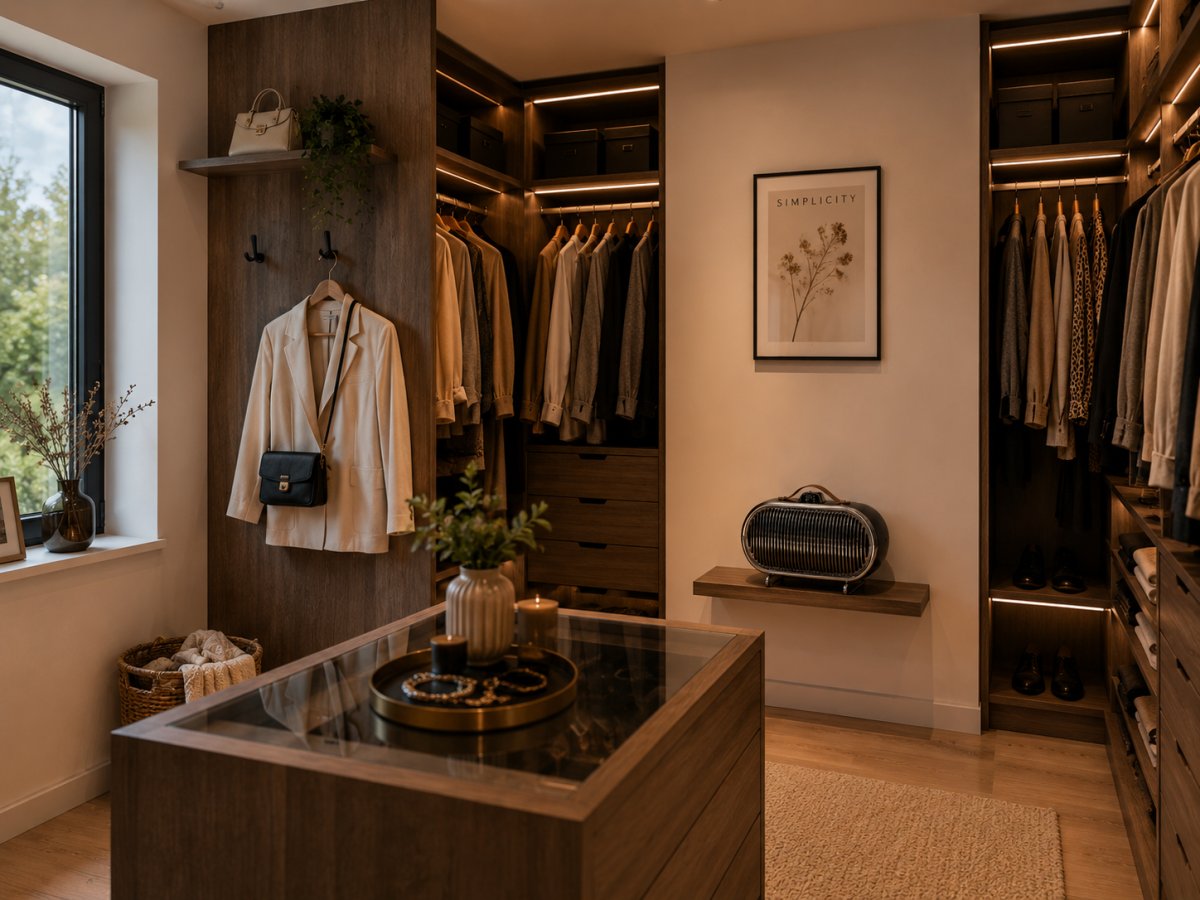
Looking to buy an electric heater? Don't start with just price or wattage. The best unit depends on the room, insulation, desired heating speed, noise level, and the actual heating time. A compact fan heater, quiet wall convector, oil-filled radiator, and infrared heater all provide heat, but they are not intended for the same use.
This buying guide helps Belgian and Dutch households purchase an electric heater that demonstrably suits their situation. You compare six technologies, calculate the required power and actual operating costs, and check safety, thermostat, placement, warranty, and operation. This way, you avoid a bad purchase and exaggerated claims about energy efficiency.
Key points
- Choose the type based on usage: quick local heat requires something different than daily room heating.
- Calculate power using room volume and insulation; square meters alone provide a rough indication.
- A higher wattage is not automatically more expensive per month: actual duty cycle and heat loss are decisive.
- Wi-Fi does not save energy on its own; good schedules, an accurate thermostat, and discipline can limit waste.
- Check product-specific safety data, mounting distances, and IP rating before ordering.
Why buy an electric heater as supplementary heating?
At its core, a heater is a compact unit that uses electric heating to bring a specific space to a targeted temperature. While we once often thought of it as a temporary emergency solution, the modern heater has evolved into a high-quality convector that seamlessly combines technology and aesthetics. It serves as the perfect addition to an existing system, focusing on comfort wherever you are at that moment.
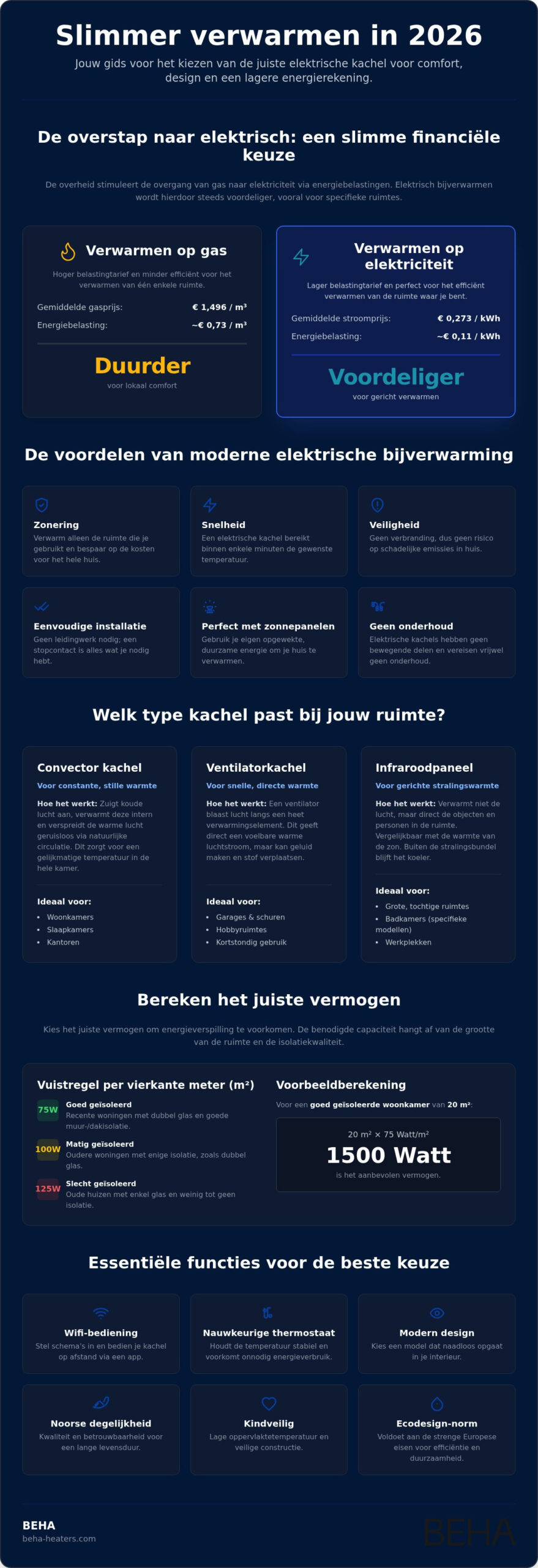
Targeted electric supplementary heating can be practical when you use one small, reasonably insulated room for a short time and the main heating can be turned down elsewhere. This does not automatically mean that resistance heating is cheaper than gas or a heat pump. Energy prices, taxes, and contracts change; therefore, compare your current Belgian or Dutch rates and measure actual consumption.
Why use a small heater for extra heating?
The biggest advantage of supplementary heating is the possibility of zoning. It is simply a waste to heat an entire floor if you are only in your home office or hobby room. By using a small heater, you create a local heat zone. This is ideal for rooms without a fixed radiator or places where the main heating reacts too slowly. The speed of electric heat sources is a decisive factor here; you reach a comfortable temperature within a few minutes, which provides enormous flexibility in your daily routine.
Advantages of electric heating compared to gas
Electric heating is safer and cleaner for your immediate living environment. Because no combustion takes place, you are not bothered by harmful emissions in your home. Moreover, installation is child's play. No complicated pipework is required; a power outlet is often sufficient to get started immediately. Solar panels can supply a portion of consumption when production and heat demand coincide. On winter evenings, this is often limited; therefore, do not automatically behasolar power as free energy for a small electric heater. Where cheap DIY store models often fall short in efficiency, the Norwegian convectors from BEHA offer the durability and innovation needed for a responsible, modern lifestyle. The result is a reliable heat source that meets the strictest Ecodesign requirements.
Which type of electric heater to buy?
When searching for a heater, you will encounter various technologies. The main distinction lies in the way the heat is distributed: via the air (convection) or directly onto objects and people (radiation). Your choice depends entirely on the specific room and how intensively you use it. While one technology excels in speed, another is designed for stable and long-lasting comfort.
Convector heaters for constant heat
These devices work by drawing in cold air at the bottom, heating it internally, and expelling it at the top. This process creates a natural, silent air circulation that heats the entire room evenly. For a living room or bedroom, an electric convector with Wi-Fi often the best choice. Unlike fan heaters, a convector produces no disturbing blowing, making them perfect for spaces where peace and quiet are desired. Furthermore, the modern BEHA are equipped with advanced thermostats that meet the strictest Ecodesign requirements, making them much more efficient than traditional models.
Fan heaters for fast heating
Sometimes you need instant heat, for example in a cold garage or a small hobby room. A fan heater blows air forcefully past a heating element, making the effect immediately noticeable. However, these heaters are less suitable as a permanent solution for larger living spaces. They produce more noise and can move dust particles around the room. Use them primarily for short-term tasks where speed is more important than constant, quiet heat distribution.
Infrared panels for targeted radiation
Infrared works fundamentally differently. It does not heat the air, but the people and objects located directly within the radiation beam. This feels similar to the warmth of the sun on your skin. In large, drafty rooms, this can be effective because the heat does not simply blow away with the airflow. The disadvantage is that it quickly feels cold again outside the direct beam of the panel. Although these panels can be aesthetically pleasing, they often lack the deep, enveloping warmth that a high-quality convector provides.
For a sustainable and comfortable solution that blends seamlessly into your interior, we recommend taking a look at our smart convectors with a steel or glass front. These combine Norwegian quality with the latest technology for optimal results.
Buying an electric heater: six types fairly compared
Anyone looking to buy an electric heater will find hundreds of models at major online retailers. The technology primarily determines how quickly and where the heat is felt. Virtually all standard resistance heaters convert the electricity consumed by the unit into heat; a ceramic element or oil filling does not magically make a device more efficient per kilowatt-hour.
| Type | Heat | Speed | Sound | Best use | NB |
|---|---|---|---|---|---|
| Wall convector without fan | Even room air | Fast | Very quiet | Daily zone heating | Requires a fixed location and free airflow |
| Portable convector | Room air | Fast | Quiet | Flexible between rooms | Check anti-tip protection and stable base |
| Fan heater | Warm airflow | Very fast | Audible | Short-term use in a workshop or cold corner | Dust displacement and noise |
| Ceramic fan heater | Warm airflow | Very fast | Audible | Compact, short warm-up | Not automatically cheaper to use |
| Oil-filled radiator | Gradual convection and radiation | Slow | Quiet | Heat gently and for longer | Heavy and slower to adjust |
| Infrared heater or panel | Persons and surfaces in the radiation zone | Immediately palpable | Quiet | Fixed seating or workstation | Less effect outside the radiation zone |
Which electric heater suits which room?
- Home office: choose infrared for a single fixed seat or a silent convector if the entire room needs to be comfortable.
- Living room: a wall convector can provide targeted support, but compare it to the main heating system or a heat pump for many hours of use.
- Bedroom: avoid an audible fan and choose precise temperature control; always follow the instructions for nighttime use.
- Bathroom: use only a model with a suitable IP rating and installation according to the electrical zone classification.
- Garage or hobby room: quick fan heat can be useful while you are present, provided dust and flammable materials do not pose a risk.
If you want to buy an electric heater for several hours a day, also compare it to an air-to-air heat pump. It moves heat and can deliver more heat per kilowatt-hour of electricity than a standard resistance heater. For very localized supplementary heating, an infrared panel or heating pad might be more logical.
Buying an electric heater: how many watts do you need?
For an initial indication, calculate the volume: length × width × height. Use approximately 25 to 30 watts per cubic meter for good insulation and 35 to 40 watts per cubic meter for average insulation. For an old, drafty room, single glazing, multiple exterior walls, or an unheated attic above, a heat loss calculation is more reliable.
An appliance that is too small may not reach the desired temperature. A larger appliance heats up faster, but does not make a kilowatt-hour of electricity more efficient. As soon as the target temperature is reached, an electronic thermostat temporarily switches off the element.
Power table at a ceiling height of 2.5 meters
| Surface area | Volume | Good insulation 25-30 W/m³ |
Average insulation 35-40 W/m³ |
|---|---|---|---|
| 8 m² | 20 m³ | 500-600 W | 700-800 W |
| 10 m² | 25 m³ | 625-750 W | 875-1,000 W |
| 12 m² | 30 m³ | 750-900 W | 1,050-1,200 W |
| 15 m² | 37.5 m³ | 940-1.125 W | 1,310-1,500 W |
| 20 m² | 50 m³ | 1,250-1,500 W | 1,750-2,000 W |
Example: a study of 12 m² and 2.5 meters high has a volume of 30 m³. With average insulation, you will approximately need 1,050 to 1,200 watts. Before buying an electric heater, also check the windows, exterior walls, draught sealing, and the temperature you wish to achieve.
How much does an electric heater cost to use?
The nominal power is the maximum, not automatically the continuous consumption. A 1,000-watt appliance consumes 1 kWh when the element is active for a total of one hour. Use this formula: power in kW × actual duty cycle × your price per kWh.
Example: a 1 kW heater that actively heats for a total of three hours over the course of an evening uses 3 kWh. At a self-chosen calculation price of €0.30 per kWh, that is €0.90. For an accurate monthly estimate, use your current energy contract and measure over a few cold days. A fixed national price figure becomes outdated quickly.
When can supplementary heating save money?
Buying a small electric heater can make financial sense if you are heating one small room briefly and the central heating in the rest of the home can demonstrably be turned down. For prolonged main heating, a standard electric heater consumes a lot of electricity. For this reason, Milieu Centraal does not consider resistance heaters to be an economical replacement for gas heating; read the current explanation on smart alternatives to gas.
Six ways to reduce consumption
- Heat only the used space and only during the necessary hours.
- Choose a realistic target temperature and avoid unnecessary overheating.
- Improve gaps and insulation before buying extra capacity.
- Use an accurate thermostat and a suitable weekly program.
- Keep the air intake and outlet clear of curtains and furniture.
- Measure actual kWh consumption instead of relying on general savings percentages.
Buying an electric heater in Belgium or the Netherlands
Most household models operate on 220-240 volts in both countries. However, energy contracts, network costs, housing stock, and terminology differ. Base your purchase on your own room and contract rather than on a single average price.
- Belgium: with a digital meter, take into account 15-minute peaks when multiple heavy appliances are active simultaneously. Check if the heater is compatible with the selected circuit.
- Netherlands: compare the costs with your central heating boiler or heat pump based on current electricity and gas rates. The savings mainly result from heating less elsewhere.
- Solar panels: production is often low on winter evenings. Calculate based on self-consumption, injection or feed-in, and any storage.
- Dynamic rates: a program may avoid certain hours, but comfort and safety remain more important than solely the lowest hourly rate.
Anyone looking to buy an electric heater for daily and long-term use should therefore not only compare the purchase price. Also calculate kWh per month, warranty, expected lifespan, controls, and alternatives such as insulation or a heat pump.
Important features for safety and comfort
A modern heater is more than just a source of warmth; it is an advanced device that combines safety with maximum control. While older models were often notorious for their high power consumption and fire hazard, current generations meet strict European standards that protect both your home and your wallet. The difference between a cheap emergency solution and a high-quality convector often lies in the details you don't immediately see, but which make all the difference in your daily living comfort.
Smart control via Wi-Fi and apps
With the current average electricity price of €0.273 per kWh, efficiency is not a luxury, but a necessity. Smart technology plays a key role in this. Via the BEHA app, you can easily set up detailed heating schedules that seamlessly align with your own daily rhythm. You heat the home office only during office hours and ensure the living room is at exactly the right temperature the moment you arrive home. Did you forget to turn off the heater when leaving? No problem; you can switch off the device from anywhere in the world via your smartphone. This can prevent unnecessary heating. Check per model whether the app actually displays consumption data; Wi-Fi itself does not reduce energy consumption.
Safety features: from tilt protection to Ecodesign
European Ecodesign requirements apply to local space heaters, but available features vary by product. Check the documentation for electronic thermostat, weekly program, open window detection, overheating protection, and applicable certifications. Do not confuse marketing terms with product-specific certification.
- Low surface temperature: The surface temperature varies by model and setting. Check the technical documentation and keep children and pets at a safe distance.
- Overheating protection: A thermal protection device may switch off in the event of overheating. Never cover the device and maintain the prescribed clearance.
- Dust-free heating: Because the elements do not glow, no dust is burned. This improves air quality and prevents that typical “burning smell” you often smell with cheap fan heaters.
Investing in a high-quality heater means choosing peace of mind and a responsible lifestyle. You rely on more than 100 years of Norwegian experience in electric heating. Discover our full range and choose the reliability of smart convectors from BEHA for a safe and sustainably warm home.
Why a heater from BEHA is the smartest choice
When choosing a heater, you want to be certain that you are investing in a solution that will last for years and seamlessly aligns with your living preferences. The market is flooded with cheap DIY store models that often fall short in terms of durability, safety, and aesthetics. BEHA distinguishes itself through a no-nonsense, quality-oriented approach where Norwegian reliability is the standard. It is the choice for those who not only seek warmth but also value technological superiority and a responsible lifestyle.
The Norwegian quality and tradition of BEHA
BEHA has been developing electric heating products in Norway for over 100 years. The current series combine natural convection with electronic control and are available with various power levels and front materials.
Compare the technical documentation for each model: thermostat, Ecodesign features, IP rating, dimensions, warranty, and operation. This ensures that the choice for BEHA is based on verifiable product specifications rather than solely on origin or general quality claims.
A small stove that fits into your interior
A common complaint about supplementary heating is that the device detracts from the interior. At BEHA we believe that technology should be invisible when desired. Our smart convectors feature a sleek, minimalist design that exudes tranquility. You have the choice between a classic steel front or a luxurious glass finish, both designed for compact wall mounting that keeps the room tidy.
For those seeking truly seamless integration, we offer a unique solution. You can choose a paintable radiator. This allows you to give the front the exact same color as your wall, making the heater blend completely into the background. This way, you enjoy state-of-the-art Wi-Fi-controlled heating without compromising your carefully curated interior. The result is a harmonious blend of comfort and style that you won't find with any other provider. By choosing BEHA , you are not just bringing a heat source into your home, but a well-thought-out component of a smart and stylish home.
Buying checklist: buying an electric heater without making a bad purchase
- Usage: does this involve minutes, a few hours, or daily main heating?
- Room: are the power, volume, insulation, and desired temperature correct?
- Type of heat: do you want to heat the entire room or one person and a workspace?
- Control: are the thermostat, timer, and weekly program accurate and simple?
- Noise: does the device have a fan and is a noise level specified?
- Safety: check certification marks, thermal protection, tip-over protection on mobile models, and mounting distances.
- Bathroom: assess the product-specific IP rating and electrical zones; have installed if in doubt.
- Connection: preferably use a suitable grounded wall socket and avoid overloading the circuit.
- Operation: remains manual operation possible if Wi-Fi or the app fails?
- Service: compare warranty, manual, parts, and support in the Benelux.
The Dutch Fire Service advises avoiding damaged cords, fully unrolling cable reels, and not overloading power strips. View the broader checklist for fire-safe living. Additionally, always follow the manual of the chosen heating appliance.
Choose sustainable living comfort today
An efficient heater is no longer a temporary solution, but a fundamental part of a modern, gas-free household. By calculating the correct power output and opting for advanced convection technology, you create a healthy heating zone without unnecessary energy waste. You now have the knowledge to make an informed choice that goes beyond just the purchase price; it is about the balance between Norwegian quality, safety, and a design that enhances your interior rather than detracts from it.
Since 1917, BEHA tradition with innovation to meet the strictest Ecodesign standards. Whether you opt for a luxurious glass front or a unique paintable variant that blends seamlessly into your wall, you are choosing a system that is ready for the future. View the full range of smart heaters from BEHA and discover how easy it is to gain complete control over your own living comfort. Turn your home into a behaplace where technology and design go hand in hand.
Frequently asked questions about electric heaters
How much does an electric heater you want to buy consume?
A 1,000-watt appliance consumes 1 kWh for one hour of continuous heating. Multiply this by your current kWh price. After reaching the target temperature, an electronic thermostat switches the element on and off in cycles; therefore, measure the actual operating time.
What is the safest heater for the bedroom or children's room?
There is no universally safest type. Choose a model that, according to the manufacturer, is suitable for the room, with thermal protection and clear mounting distances. For a portable unit, tip-over protection is important. Never cover the heater and do not leave children or pets near a hot appliance without proper supervision.
Can I buy a small electric heater as my main heating source?
Technically, this is possible if capacity and insulation are sufficient, but conventional resistance heating can be expensive with heavy use. Anyone looking to buy an electric heater as their primary daily heating source should first compare the expected monthly consumption with a heat pump, central heating system, or other efficient solution.
What should you look out for when buying a heater for the bathroom?
Check the product-specific IP rating, the electrical zone classification, and the minimum distances to the bath and shower. Not every BEHAseries has the same IP rating. If in doubt, have fixed installation or connection carried out by a certified electrician.
How many watts if you want to buy an electric heater for 20 m²?
For a 20-square-meter room, you typically need a power output between 1,500 and 2,000 watts. In a well-insulated home, 70 to 80 watts per square meter is often sufficient, which works out to a 1,500-watt appliance. For an older home with more heat loss, a 2,000-watt heater is a more sensible choice to ensure comfort. Round the calculated requirement to the size of an available model, but keep in mind that extra wattage does not convert a kilowatt-hour of electricity into heat more efficiently.
Is buying an electric heater with Wi-Fi automatically more economical?
Not automatically. Wi-Fi can limit waste when you consistently use schedules and the remote control. However, it does not make the heating element itself more efficient. Focus primarily on comparing thermostat accuracy, programmability, and the ability to operate it without the internet.
What is the difference between a convector and a fan heater?
The difference lies in the method of heat distribution and the associated noise level. A convector heats the air silently via a natural process of air circulation, which is ideal for prolonged use in living spaces. A fan heater blows warm air into the room with force, resulting in very rapid but often noisy heating. For a home office or living room, a quiet convector is preferred, whereas a fan heater is particularly useful for very short-term use in a garage or shed.
Can I connect a small electric heater to an extension cord?
Preferably connect a powerful heater directly to a suitable grounded wall socket and follow the manual. Do not use a coiled cable reel or lightweight power strip. If an extension cord is permitted by the manufacturer, it must be undamaged, fully unrolled, and appropriately sized.