
Want to buy the best electric heater? The complete guide for 2026
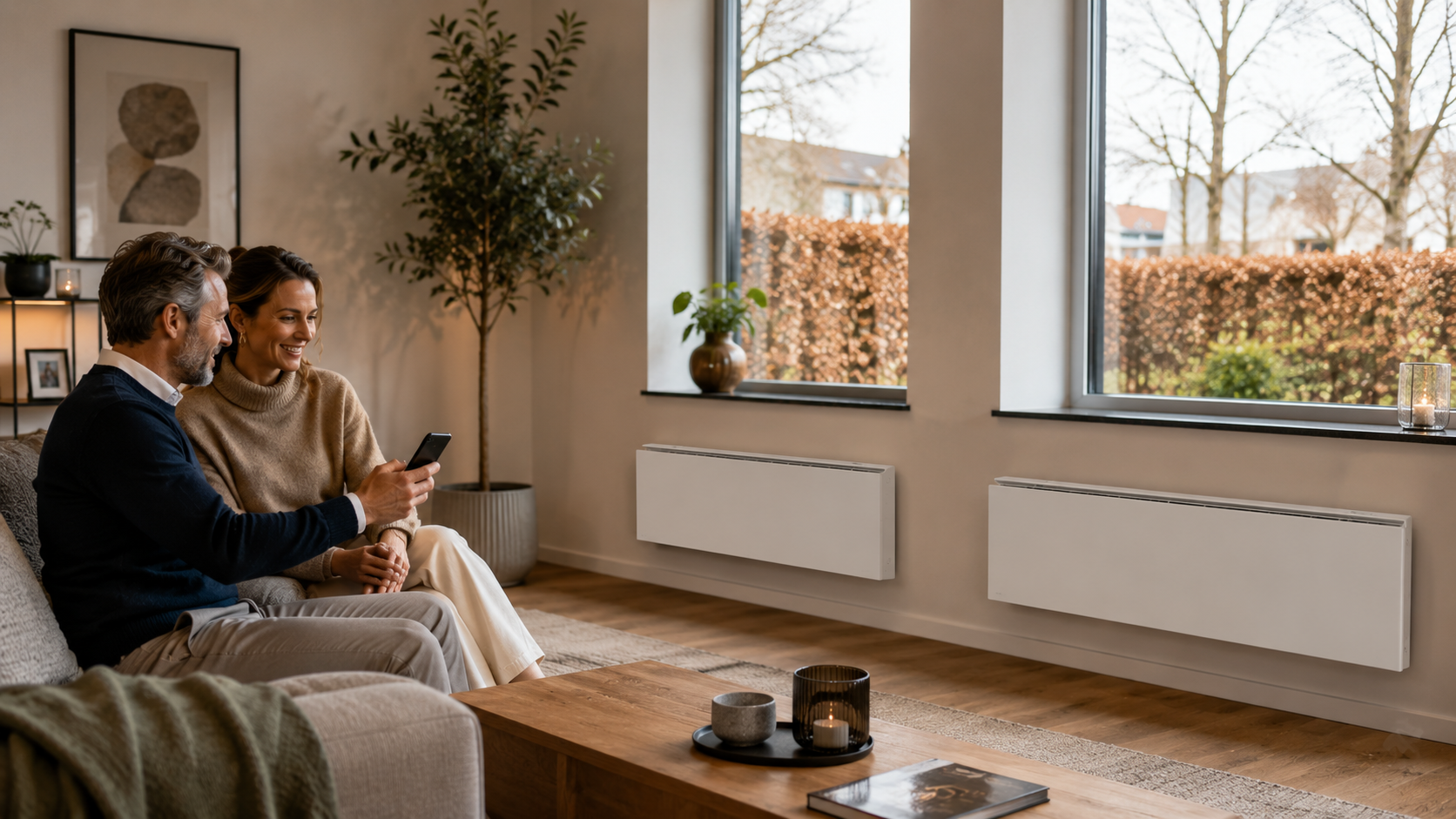
Looking to buy the best electric heater? Don't start with a random top 10, but with the room you want to heat. After all, the best choice for a quiet bedroom is not automatically the best heater for a bathroom, home office, or large living room. In this buying guide, we compare convection heaters, fan and ceramic heaters, oil-filled radiators, and infrared heating based on warmth sensation, noise, controls, placement, safety, and actual operating costs.
For consumers in Belgium and the Netherlands, the intended use is the primary determining factor. Do you want to heat a single room specifically for a few hours, a frost-free workspace, or use electric primary heating? How well is the home insulated? And can the electrical installation safely supply the required power? With the tables, calculation formula, and purchase checklist below, you can choose a suitable heater without marketing claims about “free” or “magically energy-efficient” heat.
Key points
- Electric resistance heaters convert virtually all the power drawn into heat at the point of use. The difference lies primarily in heat distribution, control, noise, and application.
- A thermostat, timer, weekly program, or app can limit consumption by heating for a shorter time or at a lower temperature; however, the element itself does not generate more heat from the same kWh as a result.
- For a single room, targeted electric heating can be practical. For long-term main heating of an entire home, a heat pump is generally more energy-efficient.
- Calculate the hourly costs using power in kW × duty cycle × your current electricity price. Always compare rates for Belgium and the Netherlands based on your own contract.
- Check capacity, socket, clearance, thermostat, overheating protection, and suitability for the room before purchasing.
Buying the best electric heater: understand how it works first
In electric resistance heating, current flows through a heating element that emits heat. The basic technical principle is called electric heating or Joule heating. A convector primarily heats air flowing past it, a fan heater accelerates the airflow, and infrared directs radiant heat at people and surfaces. They use different methods to distribute the same electrically generated heat.
That distinction is important: a 2000W heater operating continuously at full power for an hour consumes approximately 2kWh of electricity. This applies regardless of whether the device operates using convection, a fan, oil as a heat buffer, or infrared. A better-chosen model may, however, be more comfortable, heat the desired spot faster, or remain switched on for a shorter period due to precise control.
Supplementary heating or primary heating?
Electric supplementary heating is powerful when you only heat the room in use: for example, the home office during the day or the seating area on a cool evening. This prevents the need to turn on the entire central system. For a complete, moderately insulated home, prolonged direct electric primary heating can consume a lot of power. A heat pump transfers existing ambient heat and therefore typically delivers more heat per kWh of electricity.
Milieu Centraal explains that an electric resistance heater generates approximately one kWh of heat from one kWh of electricity, while a heat pump extracts additional heat from the air or soil using the same current. Therefore, in addition to a local heater, also check out the explanation on sustainable electric heating if you want to make the entire house permanently gas-free.
What does Ecodesign mean?
Local space heaters sold in the European Union are subject to Ecodesign requirements. These rules consider not only the element but also product information, controls, and features that can limit unnecessary use. The European Commission outlines the current requirements for local space heaters. Check the product specifications when purchasing; the word “Ecodesign” alone does not prove that a device is suitable for your space or consumption pattern.
Buying the best electric heater: compare the different types
Anyone to buy the best electric heater compares the sensation of warmth first, and only then extra features. Competitors behamany individual models; this table helps you choose a type before comparing brands, wattages, and prices.
| Type | Heat and speed | Sound | Best application | Point of attention |
|---|---|---|---|---|
| Convector | Heats the room air evenly; noticeable after heating | Very quiet without a fan | Bedroom, living room, study | Requires free air circulation and appropriate capacity |
| Fan heater | Instantly noticeable warm air and rapid distribution | Fan audible | Short-term supplementary heating, garage, workplace | Less suitable if silence is important |
| Ceramic fan heater | Fast and compact; often multiple settings | Fan audible | Temporary, targeted heat | Check tip-over and overheating protection |
| Oil-filled radiator | Slower heating; continues to emit heat after switching off | Usually quiet | Longer, even supplementary heating | Heavy and not more economical due to the oil; it only buffers heat |
| Infrared panel | Direct radiant heat in one zone | Quiet | Fixed seating, desk, or short-term use zone | Positioning and line of sight determine comfort |
Convector: quiet, even room heating
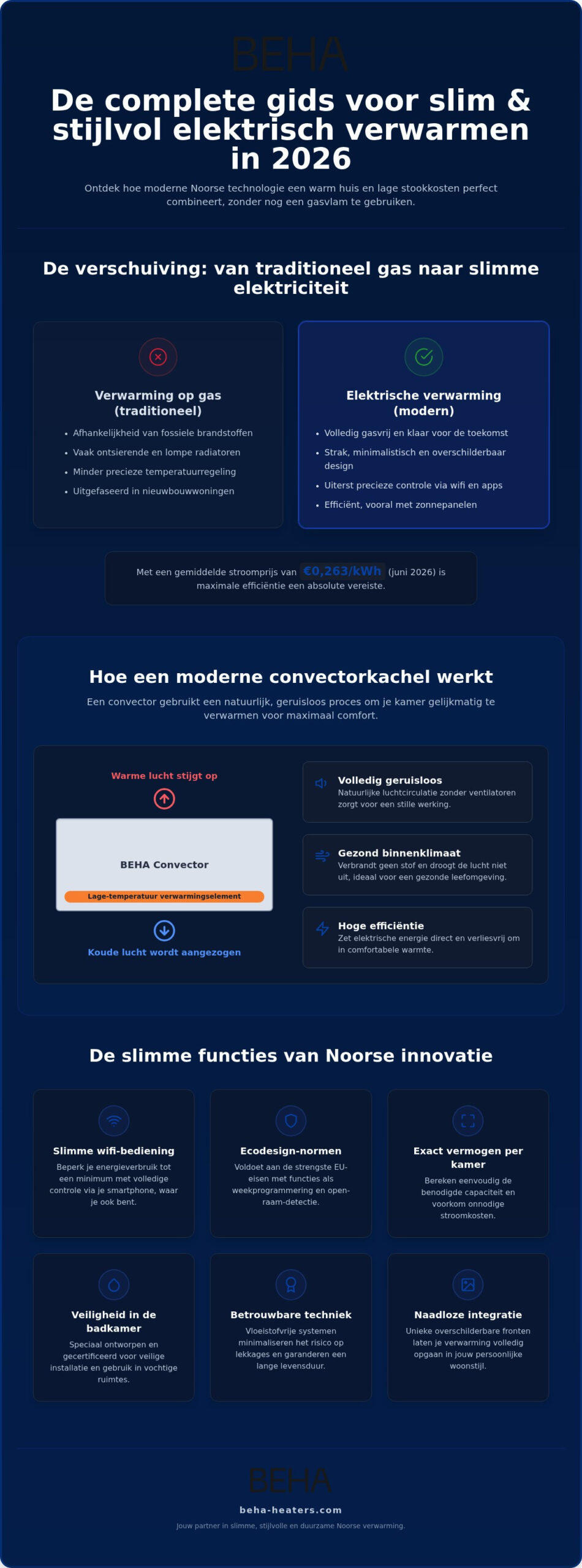
A convector draws in cold air at the bottom, heats it, and releases the rising air at the top. A model without a fan does not have a continuously running motor and is therefore suitable for a bedroom or workspace. It is not entirely impossible for the material to make a soft ticking sound when heating or cooling, but there is no fan noise. For features and placement, also check the guide on an electric convector with Wi-Fi.
Fan or ceramic: fast result
A fan heater actively blows heated air into the room. As a result, you feel the effect quickly, which is convenient when you only use a garage, guest room, or bathroom for a short time. The noise level and directed airflow can be less pleasant during prolonged use. “Ceramic” refers to the heating element; such a device also uses the wattage stated on the rating plate at full power.
Infrared: heat where you sit
Infrared primarily heats people and surfaces within the radiation zone. This can be a smart choice for a single fixed workspace, as it does not require all the air in a large room to be heated first. However, as the primary heating source for multiple rooms, direct infrared resistance heating is not automatically more economical than a standard electric heater. Savings are only realized when heating smaller areas, for shorter periods, or more locally.
Steel, glass, or paintable front?
The front primarily determines the appearance, maintenance, and construction of the product. A glass front looks sleek and is easy to clean; steel is robust and timeless. If you want the heater to visually disappear, look exclusively at models that the manufacturer explicitly designates for finishing. The guide on paintable radiators explains what to look out for in this regard. Never paint grilles, sensor openings, or a non-approved unit.
Buying the best electric heater: power and consumption
the best electric heater starts with a heat loss calculation. The number of square meters alone is insufficient: ceiling height, insulation, glass surface area, ventilation, adjacent unheated rooms, and the desired indoor temperature have a major influence. A modern bedroom in an apartment requires less power than a detached, drafty workshop with the same floor area.
How many watts do you need?
First calculate the volume: length × width × height. A rough guideline often lies between approximately 25 and 50W per m³, ranging from very well insulated to moderately insulated, but this is no substitute for a heat loss calculation. Large windows, exterior walls, drafts, and a high desired temperature increase the heat demand. If in doubt, choose with the help of a supplier or installer; insufficient power will not reach the target temperature, while unnecessarily high power results in a higher connection load.
| Sample room | Contents | Orientation at 25–50 W/m³ | What else to check? |
|---|---|---|---|
| 10m² × 2.5m high | 25m³ | 625–1250W | Insulation, exterior wall, window and desired temperature |
| 15m² × 2.5m high | 37.5 m³ | 940–1875W | Usage time, doors and heat from adjacent rooms |
| 20m² × 2.5m high | 50m³ | 1250–2500W | Group load and optionally two heat sources |
These ranges are deliberately wide. They demonstrate why the general statement “2000W always heats 20m²” is too simplistic. For fixed main heating or a renovation, have the heat loss calculated per room.
Calculate actual electricity costs
Use this formula: power in kW × number of hours the element is actually on × your price per kWh. A 1500W heater uses 1.5 kWh if the element heats continuously for one hour. With a thermostat, the element switches off regularly after reaching the target temperature; the actual operating time depends on heat loss and the setting.
| power output | Consumption at 1 hour at full power | Hourly rate formula | Current at 230V |
|---|---|---|---|
| 500W | 0.5 kWh | 0.5 × your kWh price | approximately 2.2A |
| 1000W | 1.0 kWh | 1.0 × your kWh price | approximately 4.3A |
| 1500W | 1.5 kWh | 1.5 times your kWh price | approximately 6.5A |
| 2000W | 2.0 kWh | 2.0 × your kWh price | approximately 8.7A |
Do not use the national average price as a personal cost estimate. Contracts, fixed costs, levies, feed-in tariffs, and dynamic rates differ in Belgium and the Netherlands. Therefore, check your current invoice or energy supplier app. A simple energy meter can provide insight into actual consumption over several days.
Thermostat, timer, and Wi-Fi: where are the savings?
An electronic thermostat prevents a heater from continuing to heat unnecessarily after the desired temperature has been reached. With a timer or weekly program, you only heat when the room is being used. Wi-Fi adds remote control, but only saves energy if you use it to lower the temperature or operating time. Therefore, pay attention to control quality, minimum setting, frost protection, child lock, open-window detection, and what happens after an internet or power outage.
Buy the best electric heater for every room
The search query " buying the best electric heater" therefore has no universal product answer. Choose per room based on usage time, noise, humidity, available wall space, and required heating speed.
Living room: even heat and precise control
For longer stays, a well-sized convector with an electronic thermostat is often comfortable. Placement near a cold exterior wall or under a window can help counteract cold drafts, provided the product manual permits that location and curtains or furniture do not obstruct the airflow. For example, view the buying guide for an electric heater with a steel front.
Bedroom: silence and a reliable program
Choose a convector without a fan when silence is a priority. Do not set the temperature higher than necessary and use a program to heat only for bedtime or before getting up. Check if displays can be dimmed and if, according to the manufacturer, the unit is suitable for prolonged or nighttime use. Keep bedding, curtains, and clothing outside the prescribed clearance.
Home office: zone heating
A small convector heats the entire office evenly. If you sit in one spot in a large, otherwise unused room, directional infrared might be more interesting. Research into local electric heating illustrates that zone heating can limit total energy demand under specific circumstances. Do not compare only the maximum wattage, but especially how much of the building you are actually heating.
Bathroom: both product and installation must be suitable
In a bathroom, a general claim such as “IP24, so safe everywhere” is insufficient. The required degree of protection and permitted installation depend on the bathroom zone, distance to the bath or shower, electrical installation, and national regulations. Use only a device that the manufacturer expressly permits for the chosen bathroom location, and have fixed installation or any doubts assessed by a certified electrician.
Garage, attic or holiday home
For short-term use, a fan heater can provide quick heat; for longer use, a convector is quieter. A frost mode is only helpful if the appliance and power supply remain reliable. “Frost mode” does not mean that the device consumes almost no power: as soon as heating is required, the element can switch on with considerable power. Insulate pipes and the room if structural frost protection is important.
Buying the best electric heater: 9 safety checks
- Read the entire product manual and use the heater exclusively in the specified rooms and position.
- Place a freestanding appliance stably; choose anti-tip protection when the usage scenario requires it.
- Keep the prescribed distance from the bed, sofa, curtains, paper, clothing, and other flammable materials.
- Never cover an electric heater and do not block the air intake, exhaust, or temperature sensor.
- Connect a powerful device as prescribed by the manufacturer, preferably directly to a suitable grounded wall socket.
- Do not use an unsuitable power strip or coiled extension cord, and include other heavy appliances on the same circuit in your count.
- Stop if a plug, cable, or socket is hot, discolored, or damaged, and have the installation checked.
- Keep children and pets away from hot surfaces and use a child lock if available.
- Ensure that smoke detectors are working and do not leave the heater running unattended or while sleeping unless the manufacturer explicitly permits this use.
Buying the best electric heater from BEHA: when is it suitable?
A BEHAconvector is particularly interesting if you are looking for quiet, even space heating and value a quiet wall-mounted model. For short-term, immediately noticeable heat, a fan heater might be a better fit; for long-term heating of an entire home, a heat pump might be more logical. A credible buying guide also states when its own product is not the first choice.
Norwegian experience, regulation and design
When comparing wall-mounted convectors, you should consider the quality of the thermostat and controls, available power output, dimensions, cord or connection, warranty conditions, and permitted installation. Smart control is particularly valuable if you want a separate schedule for each room. View the current range of smart convectors and check the product specifications for each model, rather than assuming the features of the entire category.
Choosing a design without obstructing the airflow
A steel, glass, or suitable paintable front makes it possible to match the stove to the interior. Always mount with the supplied or prescribed bracket and observe minimum distances. Only replace an appliance if the manufacturer permits this for that exact model. You can compare models for homes in the Netherlands and Belgium via BEHA Benelux
Buying the best electric heater: 11-step checklist
- Determine the goal: local supplementary heating, whole room, frost protection, or main heating.
- Measure the room: note length, width, height, exterior walls, and glass surface area.
- Assess insulation: check windows, drafts, roof, floor, and adjacent cold spaces.
- Choose the sensation of heat: even convection, fast fan air, or targeted radiation.
- Calculate capacity: use an indication and have structural main heating calculated accurately.
- Check the electrical system: socket, grounding, circuit breaker, other appliances, and cable length.
- Compare control system: electronic thermostat, timer, weekly program, app, and child lock.
- Check safety: overheating, tipping over, clearances, surface, and bathroom suitability.
- Pay attention to noise: ask about fan noise, relay clicks, display, and user experiences.
- Calculate total costs: purchase plus expected kWh based on your rate and usage.
- Read terms and conditions: warranty, returns, parts, app support, and installation guide.
With this approach, you can buy the best electric heater for your situation, not the heater that happens to be at the top of a general ranking. Do you want to compare a quiet, smart convector? Then view the full range of electric heaters from BEHA and match wattage, dimensions, and features to your space.
Conclusion: choose based on usage, not wattage alone
Buying the best electric heater summarized: first choose the right type, then calculate the power, and subsequently check the controls, safety, and connection load. All direct electric resistance heaters consume the indicated number of watts at full power. Comfort and savings come primarily from proper sizing, zone heating, insulation, and a thermostat that prevents unnecessary operating hours.
For quiet room heating, a convector is often powerful; for a few minutes of quick warmth, a fan heater is suitable; for a single fixed spot, infrared can be the logical choice. Be cautious about direct electric primary heating for a poorly insulated entire home and compare it with a heat pump instead. This way, you are not buying the heater with the biggest marketing promise, but the solution that truly suits your home in Belgium or the Netherlands.
Frequently asked questions about buying the best electric heater
Which electric heater is the most energy-efficient?
With direct resistance heating, the same electrical consumption delivers approximately the same amount of heat at the point of use. In practice, a device becomes “more economical” through better matching with the zone, an accurate thermostat, and a shorter operating time. For long-term primary heating, a suitable heat pump typically uses less electricity for the same amount of heat.
How much does an electric heater cost per hour?
Multiply the power in kW by the time at full power and your own kWh price. A 2000W heater uses a maximum of approximately 2 kWh per hour when the element is on continuously. The average may be lower due to thermostat cycles, but this depends on the setting, insulation, outside temperature, and room.
Is 2000W enough for 20m²?
Sometimes yes, but surface area alone is insufficient. At a height of 2.5 meters, 20 m² equals 50 m³. Insulation, windows, exterior walls, ventilation, and the desired temperature determine whether 2000W is ample, appropriate, or insufficient. Use a heat loss calculation for primary heating.
Can an electric heater stay on at night?
Do this only if the manufacturer declares the specific device suitable for that use. Follow distances and mounting instructions, never cover the device, do not use an unsuitable extension cable, and ensure that the smoke detectors are working. Overheating protection reduces risk but does not replace correct use.
Is a convector completely silent?
A convector without a fan does not produce constant fan noise and is generally very quiet. However, soft noises may occur due to material expansion, switching of components, or the electronics. Check product information and reviews if you are very sensitive to noise.
Is Wi-Fi really more energy-efficient?
Wi-Fi does not change the electrical conversion. It only helps when you heat for shorter periods using schedules, lower temperatures, or remote control. An accurate local thermostat and a suitable weekly schedule are often more important than the app itself.
Can I install a wall convector myself?
You may install a plug-and-play model according to the included mounting instructions if you have suitable tools and a matching socket. Have fixed wiring, a new circuit, or bathroom installation carried out by a qualified professional. Check for pipes before drilling and observe all minimum distances.
Does an electric heater dry out the air?
A heater normally does not remove water from the air. When the temperature rises without adding extra moisture, the relative humidity does drop. This can feel drier. Ventilate healthily and, if necessary, measure with a hygrometer before using a humidifier.
Can I paint over any electric radiator?
No. Only paint the designated front of a model for which the manufacturer explicitly permits this, and follow their paint specifications. Keep the grilles, sensor, controls, and rear clear. An unauthorized modification may affect heat output, safety, and warranty.