
Choosing steel electric panel heating for wall mounting
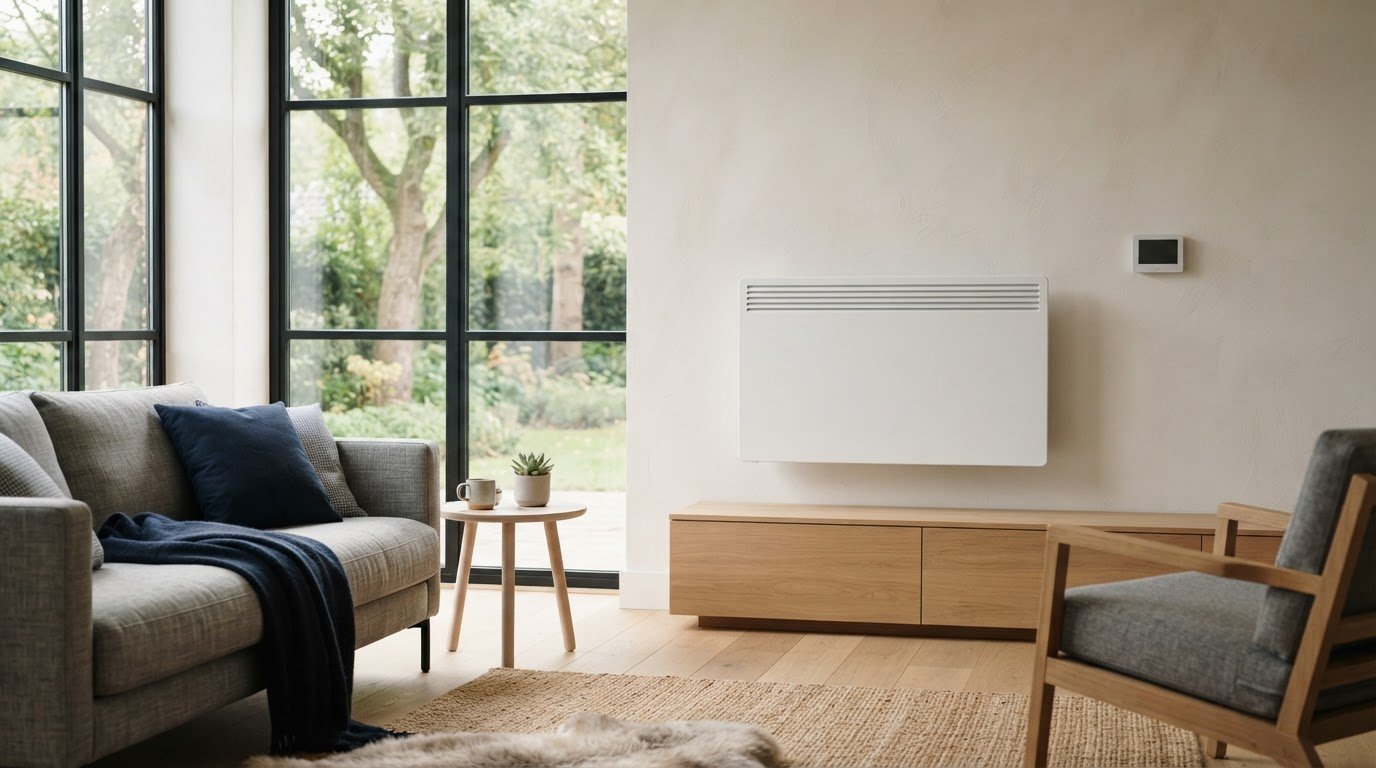
For steel electric panel heating for wall mounting, the required power depends primarily on the insulation and usage: in a modern, well-insulated house with a ceiling height of 2.5 meters, count on an average of 60 to 70 watts per square meter. In an older, less well-insulated home, the requirement can rise to 100 watts or more per square meter. The connection also plays a role: a standard circuit can handle a maximum of 3600 watts.
Choosing an appropriate capacity is therefore important, but safe installation starts with the bigger picture. You want to know how the panel heats the room, where it looks best on the wall, and what points to consider regarding connection and electrical safety. In this article, you will read how to match the capacity for primary or supplementary heating, what the differences are between small and large rooms, and what to look out for during installation. This allows you to calmly compare the options and make a choice that suits your home and heating needs.
Key points
- Match the output to the insulation and ceiling height, and ask whether the panel will be used for primary or supplementary heating.
- Take the layout of the room into account when placing the furniture: it can limit heat dissipation.
- When making the electrical connection, pay attention to the load on the circuit and to appropriate protection.
- When making your choice, compare not only the purchase price, but also which controls and model suit your heating needs.
Required power for main and auxiliary heating
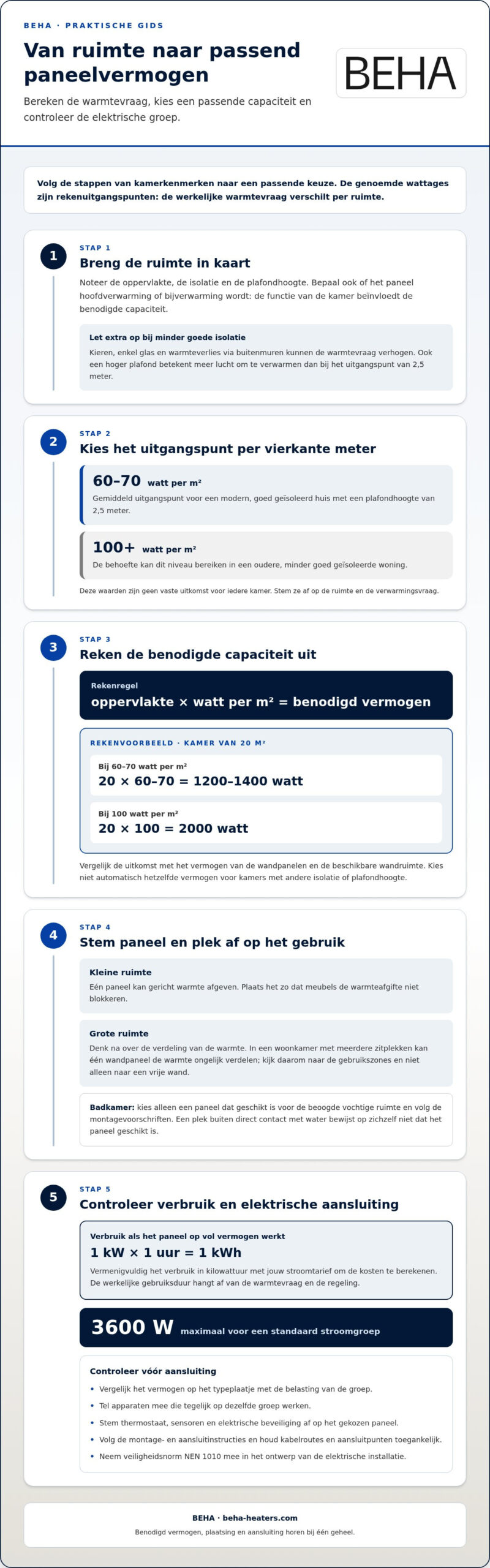
Start with the surface area, insulation, and ceiling height of the room. For a modern, well-insulated house with a ceiling of 2.5 meters, the average is 60 to 70 watts per square meter. That is a practical starting point for primary heating, but not a fixed result for every room. A wall-mounted steel electric panel heater must provide enough power to meet the room's heat demand.
In an older, less well-insulated home, the requirement can rise to 100 watts or more per square meter. Gaps, single glazing, and heat loss through exterior walls increase the demand. Therefore, do not automatically choose the same capacity as for a well-insulated room. For a bathroom, factors such as how often you heat the room and how warm you want it to be also play a role. The function of the room partly determines whether the panel serves as primary or supplementary heating.
First calculate the surface area and multiply it by the corresponding wattage per square meter. As an example, a 20-square-meter room requires 1,200 to 1,400 watts at 60 to 70 watts per square meter. At 100 watts per square meter, the same surface area comes out to 2,000 watts. This way, you compare the required capacity with the power of the wall panels. Ceiling height matters: a higher ceiling means more air to heat than the stated baseline of 2.5 meters.
How much does electric panel heating consume and what are the electricity costs? A 1-kilowatt panel operating at full power for one hour consumes 1 kilowatt-hour. Multiply the consumption in kilowatt-hours by your electricity rate to calculate the costs; the actual operating time depends on the heat demand and control system.
The wattage determines the heating capacity and helps in choosing the size and location. Compare the required wattage with the dimensions of the panel and the available wall space. The color does not change the heat requirement. Choose a finish that matches your interior, but let the required capacity be the guiding factor. Do not place the panel behind furniture, as this can hinder heat output.
With infrared heating, heat is released after 5 to 10 minutes, depending on the type and material. This may be suitable for targeted heating, whereas primary heating requires sufficient power for the entire room. More power does not automatically mean you save on electricity: consumption also depends on the set temperature and how long the panel heats.
Heating of small and large spaces
In a small space, a single panel can direct heat; a large room requires a well-thought-out distribution. Consider a home office: position the panel so that furniture does not block the heat output. In a living room with multiple seating areas, a single wall panel can distribute heat unevenly. The required capacity and insulation are determining factors, but the layout of the room also plays a role.
An infrared panel primarily heats people and the surfaces the radiation falls on. A steel electric panel typically heats the air via convection. According to available market information, infrared panels for wall or ceiling mounting are 2 to 3 cm thin. This slim size can be useful when wall space is limited. In large rooms, choose the position based on usage zones, not just the free wall space.
For a bathroom, moisture resistance is an important selection criterion. Use only a panel suitable for the intended damp area and follow the installation instructions. A location out of direct contact with water does not in itself prove that a panel is suitable. Base your choice on the room, the electrical connection, and the product instructions.
Which thermostat, timer, or smart control fits depends on the panel. The thermostat, sensors, and electrical safety features must be compatible with the design. Wi-Fi control varies by model and does not, in itself, guarantee savings.
Unlike a central heating radiator, electric panel heating operates without a connection to a central heating water circuit. This allows for localized heating, for example in an office that is not used continuously. A central heating radiator, on the other hand, is suited to a home with central heating. The choice depends on the heat source, the usage schedule, and the desired temperature.
Compare wall availability, heat distribution, and controls for each room. Smart convectors with a steel front are an option when you are looking for an electric wall solution with a steel finish.
Electrical connection and safety
A wall panel provides heat, but also requires a suitable electrical connection. In the Netherlands, electrical installations must comply with safety standard NEN 1010. Incorporate this standard into the design, along with the panel's capacity and the existing circuit. This prevents comfort in the living room from being compromised by a safe installation.
A standard circuit can handle a maximum of 3600 watts. Therefore, add the load on the panel to that of other appliances operating on the circuit simultaneously. A high-power panel, when combined with a kettle for example, can approach the available capacity. Distribute the load across circuits where necessary and have the connection assessed based on the total electrical load.
Match the thermostat, sensors, and electrical safety devices to the chosen panel. These components help determine how the temperature is regulated and how the system responds. The thermostat must be compatible with the panel's operation. If you use multiple infrared panels, plan the controls so that each heating zone aligns with its usage.
- Check the power rating on the rating plate and compare it with the group load.
- Include the thermostat and sensors in the design of the installation.
- Follow the panel's mounting and connection instructions.
- Keep cable routes and connection points organized and accessible.
The placement affects safety and heat distribution. Keep the panel free of obstacles that impede air circulation or radiant heat. This allows the panel to release heat more evenly and ensures the control system responds as intended. Also, leave sufficient space for cables and connections, in accordance with the product instructions.
For a fixed installation, expert assessment is advisable if you have doubts about the circuit or wiring. An electrician can assess the existing installation, circuit load, and protection together. This ensures the connection is matched to the panel, while optimal heating and daily comfort remain the central focus. During installation, also note where cables run so that drilling later does not lead to damage.
How much does steel electric panel heating for wall mounting cost in the Netherlands?
The total costs include more than just the purchase of the panel. Also take into account operation, any necessary modifications to the electrical connection, and power consumption. The situation can differ between an existing wall socket and a fixed connection. The work required depends on the home and the chosen setup.
The purchase price depends on factors such as power output, finish, and operation. A panel for a small study requires a different capacity than heating for a spacious living room. It also makes a difference whether you are heating a single room or need multiple panels. Therefore, compare appliances with an appropriate power output and the same application.
Operating costs depend on how much heat you need and how long the panel is on. A well-insulated room generally loses less heat than a drafty space. The set temperature, the usage schedule, and your electricity tariff also affect the energy bill. A timer or thermostat can adjust the heating hours to the room's usage, but does not guarantee savings.
For a fair comparison, make a list of all cost items:
- The panel, suitable for the space and the required power.
- Controls such as a thermostat or timer, if necessary.
- Any adjustments to the circuit, wiring, or connection point.
- Electricity consumption, calculated based on your usage and rate.
Also compare electric heating with your current heating source. A panel that only heats your home office when you work there has a different usage pattern than primary heating for daily use. Therefore, look not only at the purchase price, but also at the expected usage over a representative period. Note which rooms you heat, when they are occupied, and what temperature you find comfortable.
This prevents a low purchase price from becoming the sole deciding factor. Higher capacity can be relevant in a room with more heat loss, while operation and operating time influence recurring costs. Compare options based on capacity, operation, and application. Then calculate the expected operating costs using your own electricity tariff so that the comparison suits your household.
BEHA: Smart convectors steel front
BEHA offers smart convectors with a steel front for those seeking electric wall heating with an understated look. The convectors can be fully controlled via Wi-Fi, allowing you to tailor the heating to your daily usage.
Prefer a different finish? BEHA also offers smart convectors with a glass or paintable front. Classic convectors are an alternative if you are looking for a simple design. Which option suits you best depends on the space, the desired operation, and the look of your interior.
Compare the design with your heating requirements and the location where the unit will be installed. This will allow you to make a more informed choice between a steel front and the other BEHAconvector variants. Contact BEHA to discuss the options for your space.
Choose a solution that suits your home
Don't choose based solely on the panel, but also on how you use the space. A home office that you heat occasionally requires something different than a living room that needs to be comfortable every day. Consider in advance what controls you want, where the panel will be mounted on the wall, and what look suits your interior.
Would you like to explore steel electric panel heating for wall mounting further? BEHA offers smart convectors with steel, glass, or paintable fronts. Compare the finishes and match your choice to your heating needs and room decor.
Take your wishes and the characteristics of the room as a starting point. Contact BEHA to view the convector options. By choosing one that suits your home, you take a targeted step towards pleasant heating comfort.
Frequently Asked Questions
Assembly and safety: what to look out for?
Before installation, check the wall, cable routes, and clearance around the panel. Furniture can restrict heat output, so do not place the unit behind a cabinet or sofa. For built-in wall heating, secure the cable routes and mounting points for later use. Also, match the thermostat, sensors, and safety features to the unit and the electrical installation.
What power ratings and dimensions are available for steel electric wall panels?
The available power depends on the product line. The PV/LV smart convectors with a steel front are available from 400 to 2000 watts. For comparison, the PGV/LGV models with a glass front range from 600 to 1250 watts. Dimensions vary by model. Therefore, compare the dimensions of the chosen unit with the available wall space, connection location, and desired heating capacity.
How many watts of electric panel heating are needed per m²?
For a modern, well-insulated house, the starting point is an average of 60 to 70 watts per square meter with a ceiling height of 2.5 meters. In an older, less well-insulated home, this can be 100 watts or more per square meter. For a well-insulated room of 12 square meters, the starting point comes down to 720 to 840 watts.
How do you install and mount an electric steel heating panel to the wall?
Follow the installation manual for the selected panel and use the accompanying mounting materials. First determine the location, check the wall, and ensure that fixings do not touch cables. Take into account furniture that could block the heat. Connect the unit according to the product instructions. Have a qualified electrician perform the permanent connection or assess the wiring if you have any doubts.
Which electrical connection and circuit are required for wall-mounted panel heating?
That depends on the capacity of the panel and the other devices on the same circuit. A standard circuit can handle a maximum of 3600 watts. Include the simultaneous load, for example, a panel and other devices that are often switched on together. The thermostat, sensors, and electrical protection must be compatible with the design. Have the circuit assessed if the total load is unclear.
Are there safety regulations or quality marks for electric wall heating in the Netherlands?
Electrical installations in the Netherlands must comply with the safety standard NEN 1010. This concerns the installation, not automatically a certification mark for every panel. Additionally, check product information regarding the application area and any classifications. For example, the PGV/LGV series has IP24, which indicates splash water protection, but does not have complete watertightness. EcoDesign conformity is a product requirement, not a substitute for safe installation and connection.