
Choosing a child-friendly electric heater: what to look for?
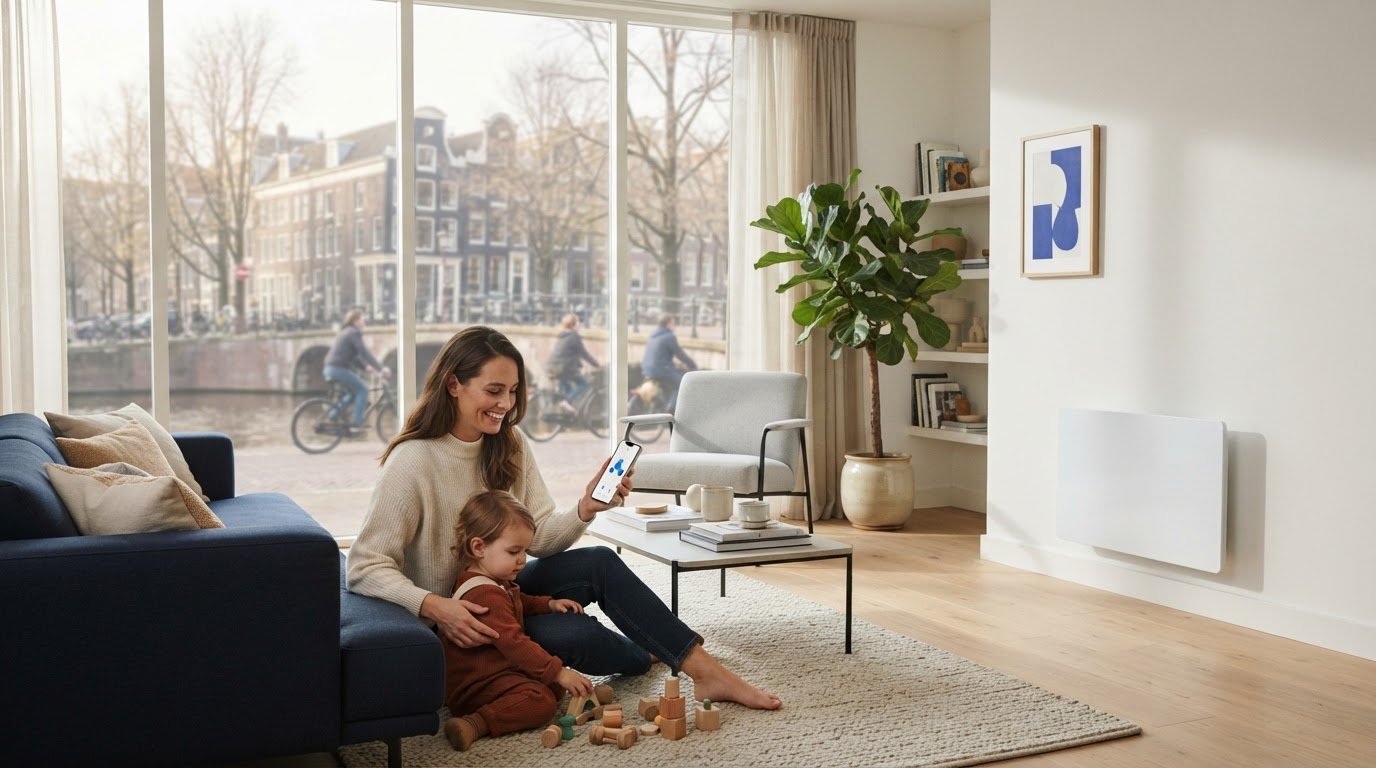
Making an electric heater child-friendly doesn't start with a promise on the packaging, but with where it is placed and how you use it. A warmer room is pleasant, but with children in the house, you also want to know how hot the appliance can get, how much distance is required, and which features are specified for the model.
Those questions are logical. A term like 'child-safe' does not, in itself, indicate what protection a heater offers. Therefore, consult the manual and the model specifications. Align the placement with the room and your family's daily movements. Ease of use can help regulate the heating more consciously, but it does not replace a safe setup or supervision.
In this article, you will read what to look for when choosing an electric heater, which risks require attention, and how to use the appliance practically. You will discover how electric convectors fit into a well-considered heating plan and how to establish a fixed routine for placement, spacing, and usage. This way, you can assess claims objectively and choose home heating comfort with greater confidence.
Key Points
- Child-friendly heating means limiting risks, not eliminating every risk. Take touching, knocking over, cords, and supervision into account when making your choice.
- Check the manual and product information for model features. Evaluate operation and thermostat control as comfort functions, not automatically as child safety.
- Compare convectors and other electric heaters based on heat distribution and placement. Base your choice on the layout of the room and your family's habits.
- Using an electric heater in a child-friendly way starts with a suitable location, the clearance prescribed by the manufacturer, and a fixed routine for use and supervision.
- BEHAconvectors are available with various front finishes. Wi-Fi and app control can assist in regulating heat and comfort.
What does a child-friendly electric heater mean in the home?
Child-friendly heating does not mean that every risk disappears, but rather that you recognize risks and limit them as much as possible. Choosing a child-friendly electric heater therefore means looking beyond appearance and operation. The location in the room, the children's behavior, and agreements at home also play a role.
Child-friendly heating means choosing and using an electric heater in a way that limits risks for children, without assuming that touching, knocking over, or accidents can be completely ruled out. What is appropriate depends on the type of appliance, the setup, daily use, and the age and habits of your child. For example, a toddler who likes to explore requires different attention than an older child who understands the rules but can reach the controls.
Make the assessment practical. Can a child reach the appliance or pull on it? Is there a cord lying in a walkway? Is the heater located in a place where toys or clothing could easily come into contact with it? Also consider moments when your attention is elsewhere, such as while cooking or when you briefly leave the room. The combination of product information and daily conditions provides a more realistic picture than a general claim on packaging.
Which risks require attention in children?
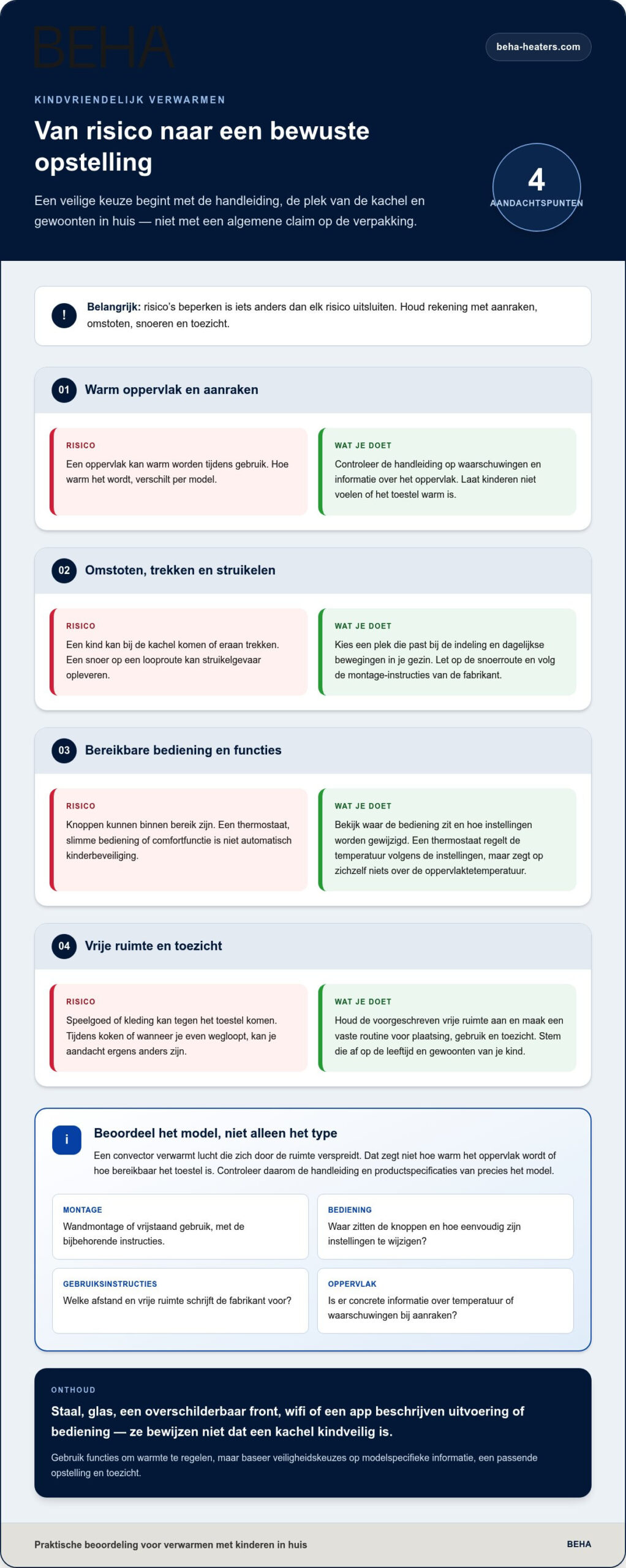
A surface may become warm during use. How hot it gets and what warnings or usage restrictions apply vary by model. Therefore, consult the manual before placing the heater and take into account the described clearance. Do not let children feel if an appliance is warm.
Also be aware of tripping hazards caused by cords and by buttons or other controls within reach. General advice helps identify potential hazards, but only the manual provides model-specific information about the device. Do not assume a safety feature unless it is explicitly described for the model in question.
What makes an electric convector different?
A convector heats air: air near the device heats up and spreads throughout the room. That describes the operation, not the safety of the surface or accessibility for children. Therefore, the term 'convector' is not proof of child safety either. A general overview of types of electric heaters helps to recognize the different operating principles.
BEHA manufactures electric convectors with steel, glass, and paintable fronts. The smart models can be controlled via Wi-Fi and an app. Such features can assist with heat regulation, but do not automatically make a device safer for children. If you want to know more about the operation and functionality of this type of heating, please view the guide on electric convectors with Wi-Fi.
When making your choice, look at concrete information about the specific appliance and the room in which you intend to use it. A wall-mounted model, for example, takes up a different space than a freestanding unit, but installation and distance from children still require attention. Align the setup with the manufacturer's instructions and how your family uses the room. This way, you make an informed choice without confusing comfort features with safety measures.
Which features of an electric heater are relevant for children?
Product information helps you evaluate a stove based on facts rather than a reassuring name or attractive image. Pay attention not only to the power output, but also to the installation, operation, and usage restrictions described by the manufacturer. Compare these characteristics to your home situation: is the stove within reach, can children access the controls, and will the area around the appliance remain clear?
A thermostat regulates the temperature according to the device's settings. This can help to tailor the heat to the room, but it says nothing in itself about how hot the surface gets or who can use the controls. For those questions, look for separate, explicit information about the specific model.
What information do you check in the product data?
Start with the manual and product specifications for the exact model you are considering. Note the mounting method, operating options, and safety instructions. Also check whether the manufacturer provides information regarding surfaces and the conditions under which the device may be used. If a detail is not included in the brief product description, do not draw any conclusions from it. Consult the model manual.
- Installation: is the device intended for wall mounting or freestanding use, and what instructions apply?
- Operation: where are the buttons located and how easy is it to change settings?
- Instructions for use: what distance and clearance does the manufacturer prescribe?
- Surface: Is there concrete information about the temperature or warnings about touching it?
Material and design are useful for comparing appearance and finish. However, a steel or glass front, or a paintable front, does not prove that the surface heats up less. Similarly, words like 'smart' or 'comfort' do not automatically tell you which safety features are present. Base your judgment on the described properties, not on assumptions.
What can Wi-Fi control mean, and what can it not mean?
With a smart convector, Wi-Fi and app control can make regulating the temperature easier. Depending on the model, you can adjust settings via the app. This is a comfort feature: remote control does not automatically mean there is a child lock, access restriction, or other safety function. Check the manual to see which features the model has and how to set them up.
Smart controls do not replace supervision and careful use. Keep controls out of reach where practical and discuss with older children which settings they are and are not allowed to change. Even when controls are operated via your phone, the product data remains the primary source of information.
BEHA manufactures smart convectors with steel, glass, and paintable fronts, controlled via Wi-Fi and an app. If you wish to compare materials and finishes, the buying guide for an electric heater with a steel front provides additional context regarding that product feature. Additionally, view the range of smart convectors to compare different front finishes side by side. Always base your choice on what the manual says regarding installation, operation, and use in a home with children.
Compare electric heaters: choose based on your family situation
The best choice does not depend solely on how quickly a room needs to be heated. Also consider the permanent location of the appliance, the traffic routes, and how often children will have access to it. A heater for a playroom, for example, requires a different assessment than temporary supplementary heating in a room where children rarely go. Compare the operation and usage situation, and then check the information for the specific model.
| Type | Heat and service | Placement and point of attention |
|---|---|---|
| Convector | Heats air that spreads throughout the room; controls vary by model. | Can be permanently mounted to the wall or installed according to the model specifications. Take accessibility and walking routes into account. |
| Fan heater | Blows heated air into the room; often intended to provide local or temporary heat. | Pay extra attention to the position of the device and the cord. Follow the instructions for use and supervision. |
| Oil-filled radiator | Emits heat via the radiator surface; the controls and warm-up time vary by model. | A freestanding appliance takes up space. Consider knocking it over, moving it, and access to the controls. |
| Radiant heater | Emits heat primarily in the direction in which the device is pointed. | The setup determines who can get close. Check the instructions and model-specific information regarding the surface. |
This comparison describes general characteristics, not a safety assessment. Models within the same category may differ in surface finish, controls, installation, and operating instructions. Use the table to determine what information you need, not to automatically label a device type as child-safe.
When is an electric convector right for your household?
A fixed-wall convector can be practical if you want to keep floor space clear or prefer not to move a portable heater around the room. Consider a room where toys regularly end up on the floor: a fixed position can make the layout more organized, but it does not automatically prevent children from touching the unit. Check the installation instructions and determine whether the location is off-limits.
What considerations do you make regarding temporary heating?
A portable appliance may seem convenient for a short-term heating need, but it requires attention at every new location. Check that the cord does not run across a walkway, that the heater is stable, and that children can reach it during use. Easy portability does not mean you can leave the appliance running unsupervised. The manual remains the primary guide for operation and operating conditions.
Make your choice based on daily life at home. Consider where children play, their ages, and whether the heater will be there permanently or temporarily. Choosing a child-friendly electric heater involves balancing heat comfort, available space, and what you can manage during use. If the situation changes, for example, because you rearrange the room, reassess the placement accordingly.
This is how you set up the room for safe use of an electric heater
A fixed routine makes safe use clearer. Start with the spot, then check the appliance and the cord, and keep an eye on the situation during use. This way, you will notice more quickly when toys, a blanket, or a changed room layout affect the free space around the heater.
Where do you place the stove in a household with children?
Choose a location away from busy walkways and play areas. Do not place a heater next to curtains, furniture, bedding, or other materials that the manual states must be kept at a distance. Ensure that children cannot pull on the cord or play near the controls. The prescribed clearance varies by model. Therefore, follow the manufacturer's instructions instead of assuming a general distance.
Use this routine every time you set up the stove or rearrange the room:
- Choose the location. Place the equipment where children do not run or play and where it is not in the way. Take doors, walkways, and the layout of furniture into account.
- Read the instructions. Check the installation method and the clearance required for this model. Move furniture or textiles if they are too close to the stove.
- Assess the cord. Lay it down so that no one can trip over it and children cannot pull on it. Use the device as prescribed by the manufacturer for the electrical connection.
- Check before switching on. Check that the device is standing or hanging stably and undamaged, and that the area around it is free of toys and loose materials.
- Supervise. Pay attention to where children are and whether they can touch or operate the device. Do not assume unsupervised use unless the manual permits it for the specific situation.
Which daily checks help?
Check the visible condition of the appliance and the cord before each use. Do not use a damaged appliance and follow the instructions in the manual regarding operation and operating conditions. Also check if the location has changed since the last time, for example, because a chair, laundry basket, or toys have been added.
Make clear age-appropriate agreements with children: do not touch the heater, do not pull the cord, and do not place objects in front of it. An agreement does not replace supervision, especially with young children. Turn off the appliance when you leave the room if the operating instructions require it or when you cannot manage the situation.
Consult an expert for permanent electrical modifications, such as changes to the electrical connection. Do not carry out such modifications yourself. A well-considered placement and regular checks help make an electric heater more child-friendly to use, but do not eliminate all risk. View the electric convectors from BEHA and tailor your choice to the room and the model's instructions.
BEHA electric convectors: comfortable heating with conscious choices
You don't choose a suitable electric heater based solely on appearance. The room, desired operation, and location of the unit matter, as do the product specifications that determine how you use the model. BEHA manufactures electric convectors with various front designs. This allows you to match the heater to your interior and evaluate the information regarding operation and use for each model.
BEHA was founded in 1917 and therefore has extensive experience with electric heating. The products comply with ECODESIGN requirements. This is relevant information regarding product requirements, but not proof of child safety and not a substitute for the user instructions. When determining whether an electric heater is child-friendly, the characteristics of the specific model and the way in which it is used remain the deciding factors.
Which BEHAconvector suits your interior?
BEHA 's smart convectors are available with a steel, glass, or paintable front. These versions offer a choice in appearance and finish. Consider how the unit fits into the room and whether control via Wi-Fi and an app meets your needs. View material and design as product choices, not as an indication of surface temperature or a safety feature.
The smart models can be controlled via Wi-Fi and an app. This can be practical when you want to regulate the temperature without using the controls on the device. It is a comfort feature, not an automatic child lock. Check the product specifications and manual for the model to see which control functions are available and which safety instructions apply. Do not assume features that are not explicitly listed there.
How do you take a well-considered next step?
Compare your situation with the product information before choosing a model. Consider the room you want to heat, the desired controls, and the location where the appliance will be installed. Next, consult the manual for the prescribed installation, clearance, and operating conditions. This way, you compare not only the appearance but also the practical requirements that suit your household.
- Room: determine where the convector will be placed and how the room is used daily.
- Operation: choose whether operation on the device or via Wi-Fi and an app suits your preferences.
- Execution: compare the steel, glass, or paintable front based on interior and finish.
- Usage: read the product specifications and follow the model manual for installation and operation.
Take the time to review the information carefully. A conscious choice combines thermal comfort with a suitable location and realistic expectations regarding the features. Discover electric heating from BEHA and see which convector model matches your space and preferences.
Turn your choice into a suitable home routine
A conscious heating choice works best when it aligns with how your family uses the space. Therefore, consider not only the appliance in your decision, but also the daily routine: where do the children play, who operates the heating, and what changes when the room is rearranged? This ensures that child-friendly use of an electric heater remains a point of attention that you can continually adapt to the situation at home. If, in addition to safe heating, you are also looking at other ways to promote well-being and peace in the home, you can find practical information about home grounding products at aarding.org/nl
Before making your choice, make a brief note of the room, the desired operation, and the location where the convector can be placed. Compare this with the product specifications and manuals of the models you are considering. This makes comparisons clearer and helps you weigh comfort against practical use, without automatically viewing a specific feature as a guarantee of safety.
Would you like to calmly compare the options side by side? Discover the electric convectors from BEHA and explore which model suits your home and preferences. With clear information and a well-thought-out layout, you can work with confidence to create pleasant warmth for the whole family.
Frequently Asked Questions
Is an electric heater safe with small children in the house?
That is possible, but no electric heater is automatically without risk for small children. Consider a child reaching for a button while playing or putting something against the device. Choose a location where you can supervise the device and follow the instructions for the specific model. If the heater or the cord is damaged, do not use the device until the problem has been resolved.
Which electric heater is the most child-friendly?
There is no single type that is most child-friendly for every family. Consider the space, your child's age and habits, and the model-specific information regarding installation, surface area, and operation. A permanently mounted unit might be suitable if you do not want a freestanding heater on the floor, but it does not, in itself, indicate anything about the surface temperature. Therefore, compare manuals and product specifications.
Can I leave an electric heater on when my child is alone?
Do not leave a child alone with a working heater if you cannot oversee the situation. A thermostat or app control does not replace that supervision. If you have to leave for a moment, consult the manual for instructions on the model and determine whether switching it off is the sensible choice. Also tell children that they are not allowed to change settings themselves or place items near the heater.
How far should an electric heater be from furniture and curtains?
The required clearance varies by appliance, so follow the manufacturer's spacing and placement instructions. Do not use a fixed measurement based on another model. Also check the space in front of and above the heater: curtains may move, and a chair or laundry basket may be moved closer later. Keep the designated zone clear so that it is not unintentionally used as a play or storage area.
Is an electric convector more suitable for a child's room than a fan heater?
Not automatically. A convector heats air in the room; a fan heater blows heated air around. Which option is a better fit depends on how you use the room, where the unit is placed, and what the manual prescribes. In a child's room, noise and the location of the cord can also be factors. Evaluate both types based on the specifications of the specific model, not just the category.
Does Wi-Fi control make an electric heater safer for children?
No, Wi-Fi control does not automatically make an electric heater safer for children. Depending on the model, you can adjust settings remotely via an app. This can be convenient if you want to control the heating without walking to the unit, but it does not prevent a child from touching the heater or entering the room. Check which functions the manual describes and behaapp control as a convenience, not as a replacement for supervision.