
Choosing a fast-heating fan heater: what to look for?
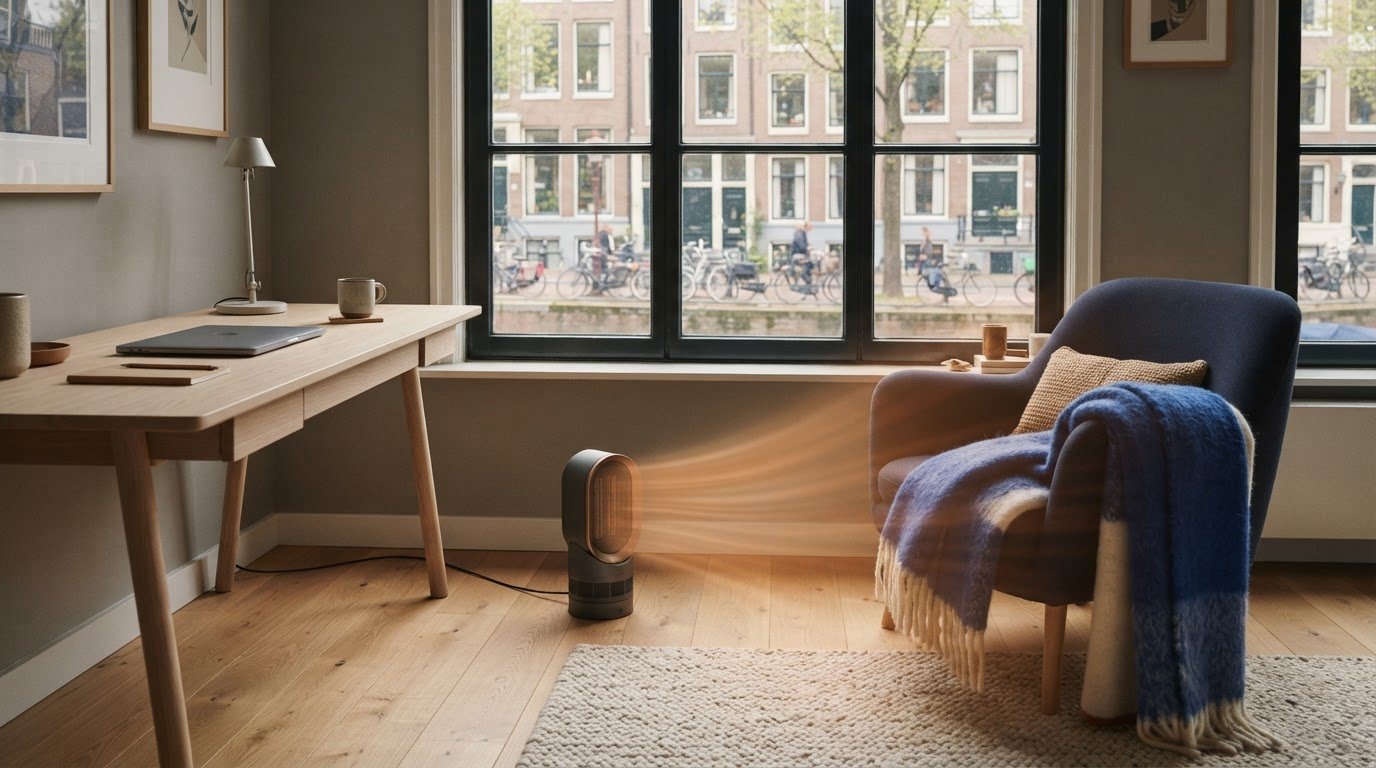
A fast-heating fan heater does not automatically bring the entire room to a comfortable temperature quickly. The heat comes directly from the unit, but how far it reaches and how evenly the room heats up also depends on the power, the location, and the size of the room.
Are you looking for a quick extra warmth in your home office, or do you want to heat a larger space? Then pay attention not only to the output, but also to placement, operating time, and heat distribution. Safety features and noise are equally important, especially if you use the device while working or relaxing.
In this article, you will read how fan heating works and which features to compare. We discuss when fast, localized heat is useful, how to estimate power consumption, and when a convector better suits your expectations.
Key Points
- A fast-heating fan heater can make the heat felt quickly, but that does not automatically mean that the entire room reaches the desired temperature quickly.
- Base your choice on the room, the time you need heat, and the desired heat distribution.
- Compare fan heaters and convectors based on air displacement, heat output, and the time of use that suits you.
- Before purchasing, check the manual, installation instructions, and safety features of the specific model.
- Estimate the power consumption based on the wattage and operating time. Additionally, carefully compare the product specifications.
What exactly does a fast-heating fan heater do?
A fan heater is an electric heater that directs air past a heating element and blows the heated air into the room with a fan. You can feel the heat as soon as the airflow reaches you. This does not mean that the entire room is immediately at temperature: walls, furniture, and air further away from the device do not all heat up at the same rate.
With a fast-heating fan heater, it is useful to distinguish between direct heat in one spot and a pleasantly heated room. The former is related to the air flowing towards you. For the latter, the heat must spread further throughout the room. how a fan heater works in the technical explanation on Wikipedia.
How does a fan heater provide heat quickly?
The heating element releases heat into the air. The fan then moves that air into the room. As a result, you can feel a warm airflow sooner than when heat spreads without forced air movement. The distance to the unit, the direction of the airflow, and the placement influence how immediately you feel the heat. If you are sitting outside the airflow, the effect may be less noticeable.
The room also plays a role. An open door, a cold exterior wall, or a large room can affect how quickly the heat spreads and how long it remains comfortable. Therefore, do not just look at the promise of quick warmth, but also at where you are sitting and which part of the room you want to heat.
For which moments is fan heating suitable?
Fan heating can be practical if you want temporary extra warmth in a place you use. Think of a home office you heat while working from home, or a room that needs some extra comfort during a cold spell. The targeted airflow can provide heat exactly where you need it, without automatically heating the entire home.
Your usage pattern helps determine if this type of heating is suitable. If you use it briefly and locally, the direct airflow may meet your needs. If you want to maintain a room temperature for an extended period as the primary heating source, also consider heat distribution, comfort, and energy consumption. A supplementary heating unit is not automatically the best choice for continuous use. Therefore, compare your requirements with the specifications and instructions for the specific model.
Which features determine whether a fan heater suits your space?
Don't start with the highest power output or the largest number of features. First, determine where you want to use the heater, when you need heat, and whether you want to make one spot or a larger part of the room comfortable. An appliance for a workspace where you sit occasionally does not need to have the same features as an appliance you use for longer periods in a larger room.
Make the comparison concrete by noting down the data relevant to your situation for each model. Power indicates electrical consumption and heat output, but is not in itself a guarantee that a device will heat your space adequately. Compare the stated power with the product information and any manufacturer guidelines. Also pay attention to the features you notice every day:
- Room: where is the stove located and how much of the room do you want to heat?
- Usage time: do you use the device for short periods or for longer periods?
- Operation: does the method of operation suit how you want to use the stove?
- Noise: check if the noise level is listed, especially if you work or value quiet in the room.
- Safety: check which features the specific model has and follow the installation and usage instructions.
How do you assess capacity and the size of the space?
The required power depends, among other things, on the size of the room and the insulation. Your goal also matters: temporarily heating a seating area requires something different than maintaining an entire room at temperature for an extended period. Do not use a general power rule if it is not substantiated for your circumstances and the chosen appliance. Check the product specifications and the manufacturer's recommendations, and compare models for which this information is available.
with a fast-heating fan heater, the power output of the unit is not the only important factor. Also check whether the intended heat output suits the location and usage.
Which controls and user experience are important?
Check per model which settings, temperature control, and operating options are actually listed. A thermostat or multiple settings can be useful if they suit your usage, but they are not automatically present. Sound is also subjective: look for information in the product specifications or manual instead of making assumptions.
Safety is also part of the comparison. The U.S. Consumer Safety Commission shares general safety guidelines for heaters. Always follow the manual and local instructions for your specific appliance. If you want to compare models, view the available fan heaters from BEHA and check the features per model.
Fan heater or convector: which gives you the right heat?
Both types of heating operate electrically, but emit heat in different ways. A fan heater blows heated air directly into the room. A convector heats air, which then circulates naturally throughout the room. Therefore, the choice is not about one type that is always better, but about how and when you want to experience warmth.
| Point of comparison | Fan heater | Convector |
|---|---|---|
| Heat output | Heated air is blown out by a fan. | The device heats the air, which then circulates automatically. |
| Heat distribution | Targeted airflow, with quickly noticeable heat near the device. | More gradual distribution of heat throughout the room. |
| Moment of use | Handy if you want temporary extra heat at your place of stay. | To consider if you want to heat a room more gradually. |
| Point of attention | The airflow and potential fan noise are not suitable for every situation. | The heat may be less directly felt. Check controls and features by model. |
When is a fan heater better suited to your usage?
Choose fan heating if you want to feel warmth quickly during a cold moment where you are sitting, for example at a desk or in a temporarily used room. You feel the heat mainly where the air is blown. If peace and quiet are important to you, check the stated noise level and the operating instructions. A fan can be audible, but the exact sound varies by device.
When is a convector worth considering?
A convector might be suitable if you want to heat the room more gradually and prefer not to have a directed airflow. How suitable it is depends, among other things, on the room, the duration of use, and the control you are looking for. Compare the specifications of the chosen device and view the smart convectors with Wi-Fi from BEHA. There is no universally best choice: match the type to your usage and desired comfort.
Decision rule: If you want to feel warmth in one spot for a short time, compare fan heaters. If you want the heat to spread more gradually throughout a room, consider a convector. For both types, check the manual and instructions for safe use. The Fire Department provides additional information on the safe use of electrical appliances.
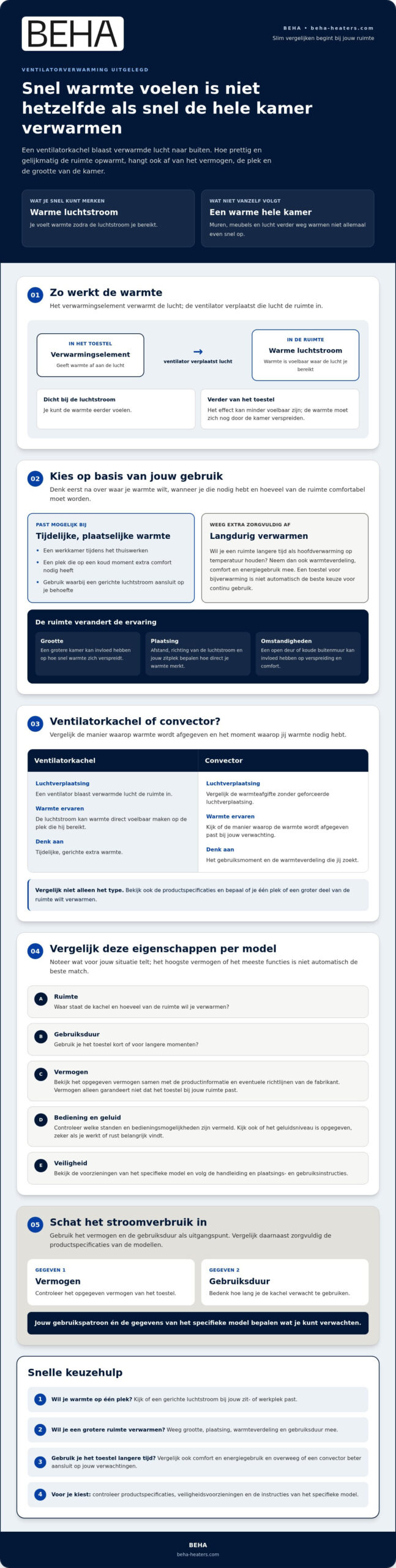
This is how you check safety and operating costs before purchase
An appliance that emits heat quickly must suit the location and the way you intend to use it. Therefore, do not just check the power output, but also read the manual and product information for the specific model before purchasing. This will prevent you from assuming features that may not be present.
What safety information do you check on the product?
Use these points as a checklist. Safety features vary by device. Therefore, view overheat protection and tip-over protection as things to check, not as standard features.
- Check the product information and manual to see which safety features the manufacturer lists for this model.
- Check the instructions for placement, the surface, and the clearance around the device.
- Read what the manufacturer says about supervision during use and suitable operating conditions.
- Check how and when you can clean and maintain the device.
Always follow the manufacturer's instructions. If information regarding safe use or maintenance is not clearly stated, consult the complete manual before using the appliance. A fast-heating fan heater is no reason to skip installation instructions.
How do you estimate the power consumption?
The capacity indicates how much electrical power an appliance draws at a given moment and is often expressed in watts or kilowatts. Energy consumption is measured in kilowatt-hours (kWh). This depends on the capacity as well as on how long the heater is actually on. The simple calculation is:
power in kilowatts × operating time in hours = energy consumption in kilowatt-hours
Calculation example: an appliance with a power of 1.5 kW that operates at that power for two hours consumes 3 kWh during that period. This is a calculation example, not a statement about a specific model. Actual consumption depends on the duration of use and the operation of the appliance, for example, whether it runs at the same power for the entire time. Use the calculation to compare different usage scenarios, without assuming that a heater operates continuously at full power.
Before you decide, evaluate the required specifications, safety information, and expected lifespan together. View the fan heaters BEHA and check the details and instructions for each relevant model.
This is how you choose a fan heater and discover the BEHArange
A suitable choice starts with your usage, not with a single feature or a general promise about quick heating. Take the space and the time when you need heat as your starting point. This allows you to assess more specifically which product details are important to you. Use these steps as a final check before choosing a model.
- Determine the space: note where you want to use the heater and whether you are looking for heat for a single spot or for the room as a whole.
- Map out your usage: how often and for how long do you expect to turn on the device? Temporary supplementary heating requires a different assessment than long-term use.
- Compare the specifications: check the power and the available information regarding operation and sound. Do not assume features that are not confirmed for the specific model.
- Check safety: read the manual, installation instructions, and information regarding safety features and maintenance before you decide.
Also ask yourself whether you primarily want quick, localized heat, or a different distribution of heat throughout the room. A fast-heating fan heater might be suitable for a temporary heating moment. If you want to explore an alternative without a targeted airflow, compare convector heating and the features that match your space and usage.
What questions do you ask before making a choice?
Make your wishes concrete. Do you use the heating occasionally or daily, and is it for short periods or longer durations? Is direct heat at your seating area sufficient, or do you want the room to warm up more gradually? Additionally, determine how much noise you find acceptable and what controls you require. Then check whether the product information confirms those wishes.
What else can you view at BEHA ?
Fan heating is a category within BEHA's electric heating range. BEHA also offers convectors, including smart models with Wi-Fi, and convectors with a paintable front. The available features vary by product. Therefore, always check the current product specifications and manual.
View the range of electric heating products from BEHA and compare the available information for each product. This way, you can base your choice on the room, your usage duration, and the features that are important to you.
Choose heating that suits your usage
A fast-heating fan heater might be suitable if you want temporary warmth in your current location. Do not automatically expect the entire room to heat up at the same speed: heat distribution also depends on the room and its placement. If you want to heat for a longer period or distribute heat differently throughout the room, consider comparing a convector heater as well.
Let your choice be guided by three points: where you need heat, how long you will use the appliance, and which specifications and safety features the manufacturer lists for that model. This way, you compare features that matter, without assuming functions or performance.
BEHA has over 100 years of experience with electric heating. Fan heating is part of the range, alongside smart convectors with Wi-Fi and convectors with a paintable front, among others. Check the current product information for the features of a specific model. 's electric heating products BEHA and compare which solution suits your space and expectations.
Frequently Asked Questions
Does a fan heater heat a room up quickly?
A fan heater can provide noticeable warmth quickly, but that does not mean the entire room is immediately warm. The device blows out heated air, meaning you mainly feel the warmth when you are sitting in the airflow. The distribution throughout the room depends on factors such as placement, size, and insulation. A fast-heating fan heater is therefore particularly interesting if you are looking for warmth quickly in a specific spot.
Is a fan heater suitable as primary heating?
A fan heater is often chosen for temporary or localized supplementary heating, but is not necessarily suitable as the primary heating source for a home. Whether long-term use is appropriate depends on the room, the unit's capacity, the insulation, and your desired comfort. Compare the model specifications with the manufacturer's recommendations and also check the expected power consumption. For structural heating, a different solution might be a better fit for your situation.
What is the difference between a fan heater and a convector?
A fan heater distributes heated air using a fan and can therefore quickly make warmth felt in a specific spot. A convector heats air, which then circulates through the room automatically. As a result, the heat output is different and can feel more gradual. A fan heater moves air and can be audible. With a convector, that specific fan noise does not occur in the same way. Always check the specifications of the chosen model.
How much power does a fast-heating fan heater need?
There is no fixed power output suitable for every room. The required capacity depends on factors such as the dimensions of the room, the insulation, and whether you want to heat a seating area or the entire room. Check the power output in the product specifications and follow any manufacturer guidelines. Compare this information with your usage situation rather than simply choosing the highest wattage.
Does a fan heater make a lot of noise?
That varies by model and user. Because a fan heater moves air, the sound of the fan can be noticeable, for example in a quiet office or bedroom. Check if the manufacturer specifies a noise level and read the user information. If you are sensitive to noise, take this point into account alongside power, operation, and the location where you intend to use the device.
Is a fan heater safe to leave on for extended periods?
Do not leave a fan heater running for an extended period without first checking the manual for the specific model. Follow the instructions regarding supervision, placement, clearance, and operating time. Also check which safety features the manufacturer lists, such as protection against overheating or tipping over. Do not assume that every device has these features. In case of doubt regarding safe use, the manual is the guiding principle.
How do you calculate the power consumption of a fan heater?
Multiply the power in kilowatts by the number of operating hours to calculate the energy consumption in kilowatt-hours. According to this calculation, a 2-kilowatt appliance operating at that power for one and a half hours consumes 3 kilowatt-hours. This is a calculation, not a prediction of actual consumption: that depends on how long and at what power the appliance actually operates.