
Choosing a smart electric heater for your space

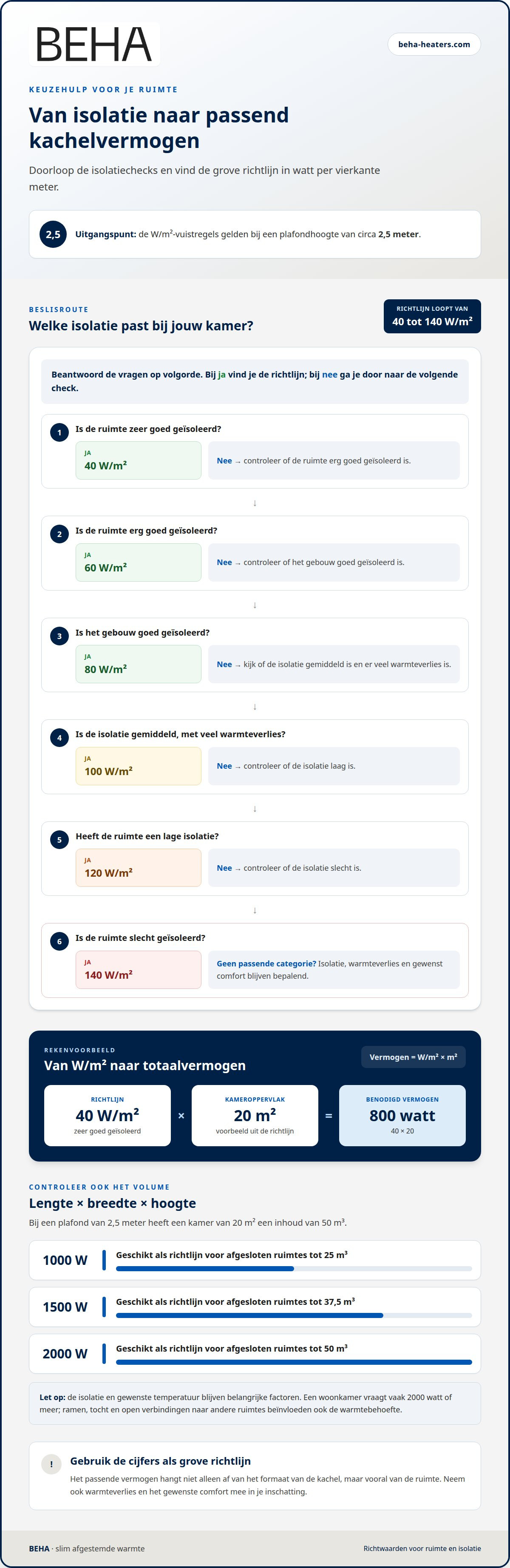
The correct power output depends not only on the size of the heater, but primarily on the room you want to heat. As a rough guideline, 40 W/m² applies to a very well-insulated room and 140 W/m² to a poorly insulated room; these rules of thumb are based on a ceiling height of approximately 2.5 meters. Additionally, a smart electric heater gives you control via an app and heating schedules.
You want to get a room comfortably warm without leaving the heating on longer than necessary. In this article, you will read which smart electric heater suits your space, how to estimate the required power, and the difference between convectors and infrared panels. You will also discover how app control and heating schedules tailor the heat to your usage.
Key points
- Match the output to the insulation, room volume, and heat loss so that the heater suits the room.
- Use the app and heating schedules to adjust the temperature to when you use the room.
- See how convection heat and infrared heat spread and which placement suits your situation.
- Determine whether you are looking for extra heat in one spot or want to heat a room, and then choose a suitable convector.
What are the differences between electric heaters?
The right choice depends on the room, the insulation, and the desired comfort. Compare the wattage, the way the device distributes heat, and the location where you want to use it.
Take space and insulation into account
Start with the insulation and surface area of the room. As a rough guideline, 40 W/m² applies to very well-insulated rooms, 60 W/m² to very well-insulated rooms, and 80 W/m² to well-insulated buildings. For averagely insulated rooms with significant heat loss, 100 W/m² applies. Calculate with 120 W/m² for low insulation and 140 W/m² for poor insulation.
These rules of thumb are based on a ceiling height of approximately 2.5 meters. For a very well-insulated room of 20 m², 40 W/m² equates to 800 watts, for example. A smart electric heater with insufficient power can remain switched on longer. Also take into account windows, drafts, and open connections to other rooms.
Whether an electric heater is cheaper than gas heating or a heat pump depends on consumption, heat loss, and desired comfort. Calculate power consumption by multiplying the power in kilowatts by the number of hours the appliance is actually switched on. Compare a heat pump separately, as it operates on a different principle.
What safety risks and rules apply to electric heaters in the home? Watch out for heat, tipping over, and moisture, and follow the manual for placement and use. In a damp room, the appliance, placement, and installation must be suitable together.
Match power to room volume
Also measure the volume of the room: length × width × height. With a ceiling of 2.5 meters, a 20 m² room gives a volume of 50 m³. As a guideline, a 1000 W model is suitable for enclosed spaces up to 25 m³, 1500 W up to 37.5 m³, and 2000 W up to 50 m³. Insulation and the desired temperature remain important factors.
A 1000-watt heater can heat a small room; for a living room, 2000 watts or more is often required. Convectors primarily heat the air. The distribution depends partly on the unit and the layout. Infrared panels emit both radiant and convective heat. Their placement and an unobstructed view of the seating area influence comfort.
Control smart heaters with an app and heating schedules
With an app, you control the heat without walking to the heater. A smart electric heater with Wi-Fi can be controlled via your phone, allowing you to adjust settings at home or on the go.
Connect the heater to your Wi-Fi network and open the accompanying app. Follow the on-screen steps to add the device. Then set the desired temperature or adjust the controls. The options depend on the model.
With a heating schedule, you determine in advance when a room needs heat. For example, set separate schedules for workdays and weekends. This way, the heating aligns with your usage pattern. Room-by-room temperature control can limit unnecessary heating hours if the settings match the occupancy.
- Choose a temperature for each room that suits its use, such as a home office during the day.
- Create a schedule for times when you typically use the room.
- Adjust the schedule when your daily rhythm changes.
Control via Wi-Fi and an app is convenient if you come home earlier or later. You can adjust the settings without standing at the panel. This works when the device is connected to Wi-Fi and the app has access. Check which heater you are controlling, especially if you have linked multiple devices.
Voice control via Siri or another assistant depends on support from both the heater and the smart system. Therefore, app control does not automatically mean that voice commands work. Models can differ in their control options and the way you set schedules.
Use the app to tailor the heat to your routine. A fan heater and a convector can react differently and offer different settings. Choose the control you need, such as adjusting the temperature, managing schedules, or controlling remotely. This keeps smart control practical.
Automatic switching on and off and heating when needed
Automatic temperature control adjusts the electric heating to usage and occupancy. Set a temperature for each room and link it to the times you are there. As a result, a home office does not need to heat according to the same rhythm as a living room. Schedules help limit unnecessary heating hours when they align with your daily routine.
Start with your fixed weekly schedule. For example, set a lower temperature for a room that is empty during the day and a more comfortable temperature when you use it. Adjust the schedule if your work-from-home days change. A schedule switches the heating on or off at set times, but power output and heat loss also determine how quickly the room reaches the desired temperature.
The usage patterns at home and at work differ mainly. A workspace might only need heat when you are there, while your living room needs to be warm in the evening as well. Note when you use each room and adjust the temperature control accordingly. This way, you heat each room individually, rather than all rooms according to one general schedule.
With multiple heaters, controlling by room makes things clearer. Give each appliance or room a recognizable name, such as 'study' or 'living room'. Then check which thermostat is measuring the temperature and which heater is responding. A control system for multiple appliances works as intended when the controls and appliances work together. Do not set identical schedules for rooms that are used at different times.
- Create separate schedules for rooms with different usage times.
- Lower the set temperature when a room is empty.
- Adjust the settings for a changed work or weekly rhythm.
An air purifier with a heating function combines two purposes in one device. Compare the heating capacity, operation, and suitability for the room with those of a separate heater. A fan heater might be suitable if you want quick warmth in one spot. Choose the function that suits your usage and set the temperature and schedule accordingly.
Purpose and scope of application of an electric heater
An electric heater is suitable for targeted heat in a chosen room. Think of a home office that you only use during working hours, or a bedroom that you want to heat locally. Such a device does not automatically replace the heating of an entire home. Therefore, first determine whether you are looking for extra heat in one spot or want to keep an entire room comfortable.
For an infrared panel, placement and an unobstructed view of the usage area are important. Aim the panel at the place where you sit or work. Furniture or other obstacles between the panel and that spot can affect comfort. Convectors primarily heat the air; how the heat is distributed depends partly on the unit and the interior design. Choose based on how you want to experience the heat in the room.
An electric heater can be suitable for a bedroom if you need warmth there without heating other rooms. At a workspace, however, warmth at a single desk might be desired. Note which room you heat, where you spend time, and when you need comfort. This will help you determine whether localized heat is sufficient or if you want to heat the entire room.
Take the warm-up time into account. An electric heater does not automatically reach the desired temperature immediately. The result depends on the model, the starting temperature, and the room, among other factors. A cold room therefore requires different planning than a room that is already partially warm. Adjust usage to when you need the room.
Consumption depends on the power output and the actual operating hours. A 2000-watt appliance consumes 2 kWh of electricity per hour that it is fully switched on. Calculate this by multiplying the power output in kilowatts by the number of hours the appliance is actually switched on. This allows you to determine more accurately whether additional electric heating suits your usage.
BEHA: Smart convectors steel front
BEHA offers smart convectors with a steel front that you control via Wi-Fi and an app. Adjust the heating to your usage and create heating schedules. The steel front suits those seeking a calm, functional look.
For a different finish, there are also smart convectors with a glass front or a paintable front. Classic convectors are an alternative if smart control is less important. When making your choice, consider the room, the desired controls, and the look of your interior. This ensures the convector matches your heating needs and decor.
A convector is an option if you want to heat a room with a device that heats the air. Compare the models in terms of operation and finish and determine what suits your situation. BEHA sells smart convectors with steel, glass, and paintable fronts, as well as Classic convectors.
Make your next choice consciously
When making your choice, look beyond just the appliance. Consider which room needs heat, when you use it, and how much control you want over the operation. This will clarify which features make a difference for you. A smart electric heater is particularly useful if the smart controls align with your daily routine.
Take that consideration into account when choosing a version. Also think about the look within your interior and how you want to control the heating. With a clear picture of your wishes, you can determine more effectively which solution suits your space and usage.
convectors BEHA or discuss which model suits your situation? Contact BEHA. Take the step at your own pace and choose heat that fits how you use your space.
Frequently Asked Questions
Which heater is suitable for my situation?
Choose a device that suits the room, usage, and desired operation. For an infrequently used home office, a smart electric heater with app control can be practical. In the bathroom, only a model designated for this purpose is suitable. The PGV/LGV convectors from BEHA are splash-proof and suitable for installation in the bathroom. Also take the layout into account.
How do you connect a smart electric heater to Google Home, Alexa, or Apple HomeKit?
First, check if the device and the platform are compatible. Check if the device works with the desired platform. Connect the heater to Wi-Fi and follow the steps in the app to add the device. Then, link the app to the desired platform and select the heater. The steps may vary depending on the app.
What should you look out for when buying a smart electric heater?
Compare the power, operation, finish, and the location where you want to use the device. Also check if the app fits your smart home. Choose, for example, between a steel, glass, or paintable front. For use in the bathroom, the specified IP rating is relevant. This way, you choose a version that suits your space and preferences.
How do you set a smart electric heater to be energy-efficient?
Adjust the settings to your presence. For example, create a schedule for the hours you work from home and adjust it when you are at the office. Set separate schedules for rooms with different usage times. Take into account the time the room needs to become comfortable. This way, the heating fits your daily routine.
Which models are available at Dutch stores and what are the warranty conditions?
BEHA offers smart convectors with steel, glass, and paintable fronts, in addition to Classic convectors. A twenty-year element warranty applies to the PV/LV series with a steel front. This warranty applies to the elements of that series, not automatically to other versions. Before purchasing, review the terms and conditions of the model you choose.