
Choosing an electric convector for your space
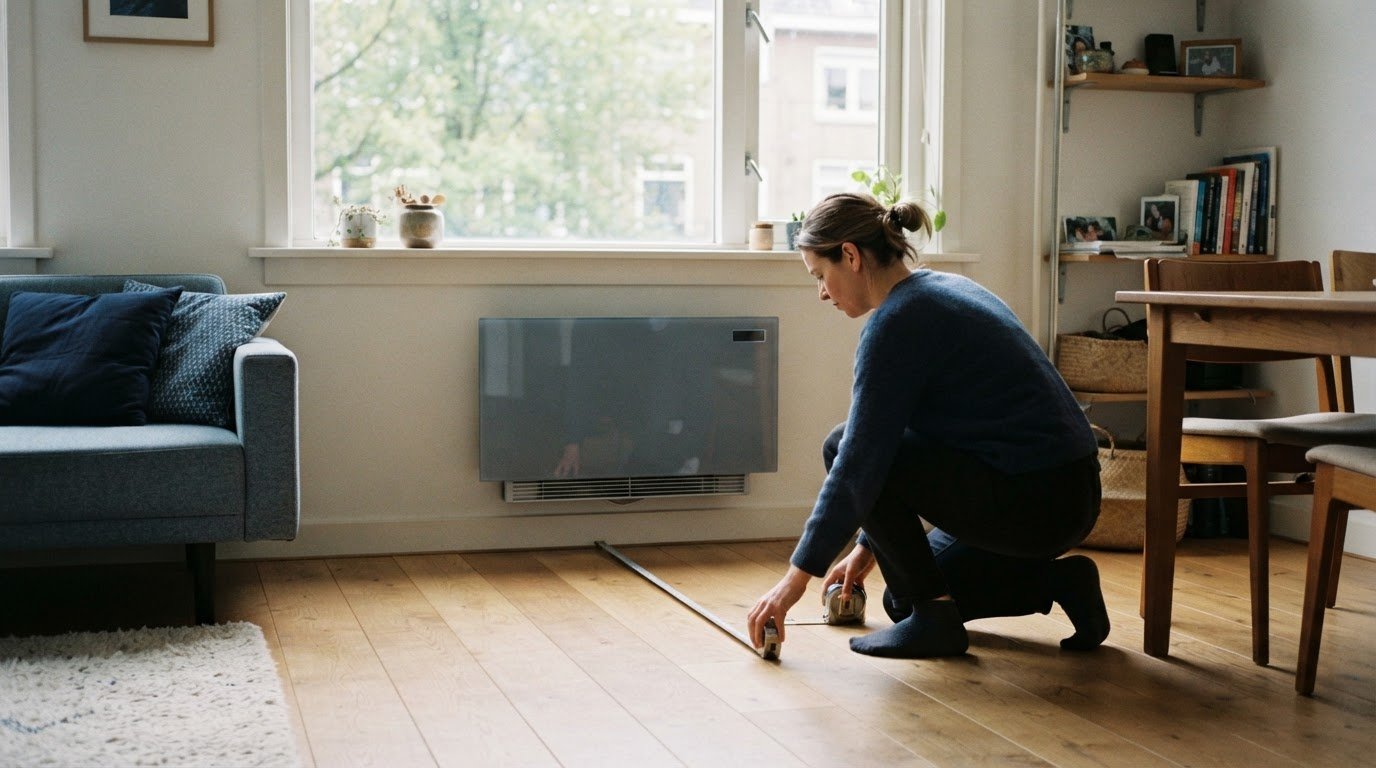
Buying an electric convector starts with the power output that suits your space: in a reasonably insulated room, about 100 watts per square meter is a practical guideline. With this, a 1,000-watt convector heats approximately 10 m² and a 2,000-watt model approximately 20 m². How long the heater is on and the power output you choose also determine how much electricity it consumes.
A larger heater might seem like the safest choice, but the required power depends on the room and how you heat. You want sufficient heat without consuming unnecessary electricity. Read here how to estimate the power, when Wi-Fi control is practical, and how to calculate power consumption based on the power, usage time, and your electricity tariff.
This way, you weigh the options against comfort and usage and determine more specifically which electric convector suits your room and daily routine.
Key points
- Match the output to the room and take the insulation into account, so that the convector suits your heating needs.
- Determine whether Wi-Fi control fits your routine and how you use the heating at home.
- Calculate power consumption using the wattage, usage time, and your electricity tariff to better estimate the costs.
- Pay attention to heat and safety during installation, especially if you want to use a convector in the bathroom.
How big can the room be for my electric heater?
In a reasonably insulated room, calculate with approximately 100 watts per square meter. This allows you to estimate the power output suitable for the floor area. Therefore, buying an electric convector starts with determining the length and width of the room.
Whether you can receive a subsidy in the Netherlands depends on the scheme and the measures to which it applies. The power guideline below helps you choose a heating system for your space.
Power matched to room surface area
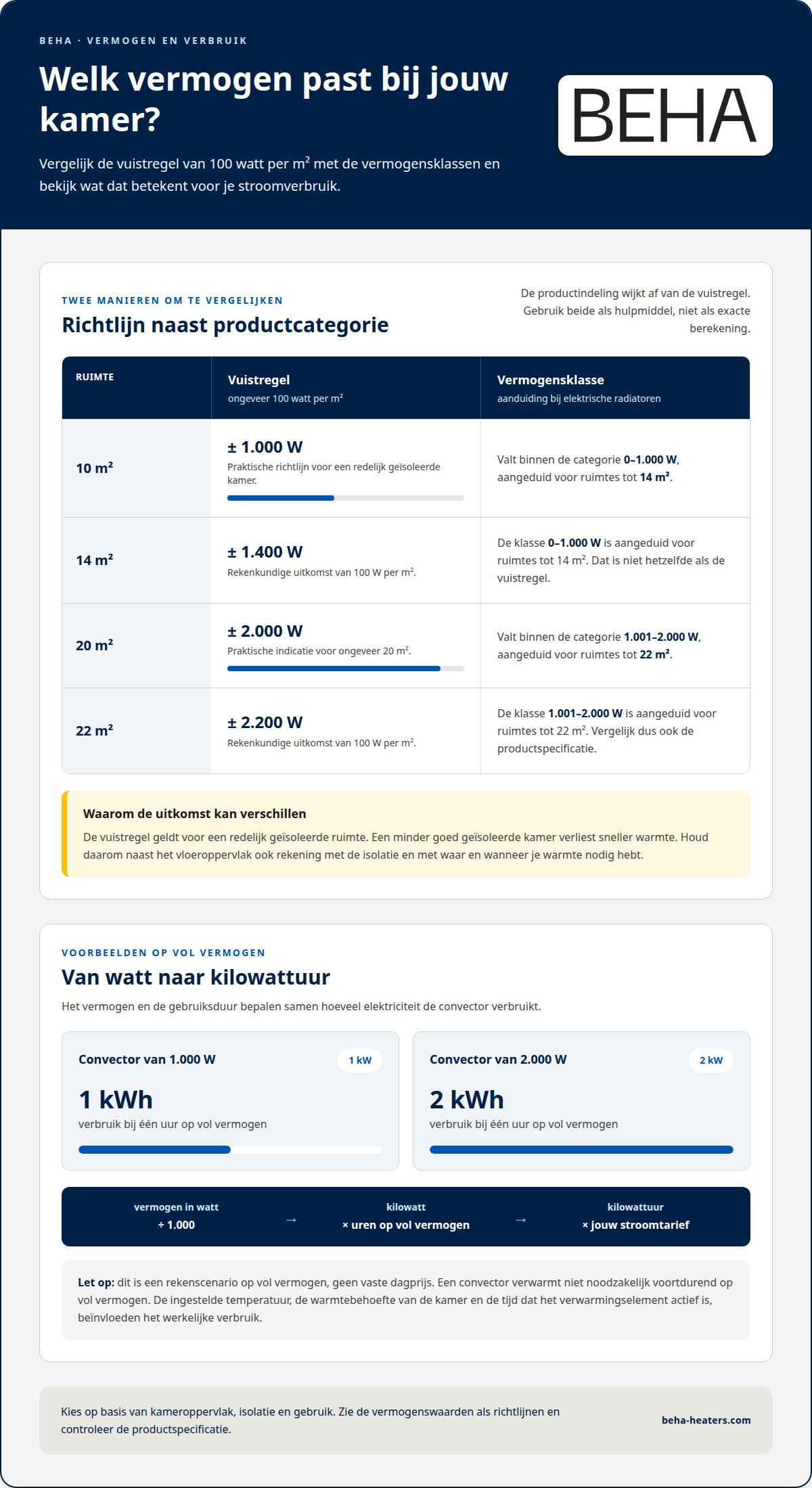
First, measure the length and width of the room and multiply them together. For 10 m², the guideline of 100 watts per m² gives approximately 1,000 watts. For 20 m², the calculation comes out to approximately 2,000 watts. This is how you compare the room surface area to the power of a heater.
Use the result as a guideline, not as an exact calculation. Insulation affects how much heat a room requires: a less well-insulated room loses heat faster than a well-insulated room of the same surface area. Therefore, take insulation into account in addition to square meters when choosing a model.
Suitable capacity per room type
According to the guideline, a 1,000-watt heater is suitable for a small room of approximately 10 m². For a living room, 2,000 watts or more is often required. As a practical indication, a 2,000-watt model is suitable for approximately 20 m². Therefore, compare the power output with the size and use of the room.
Power classes are also used for electric radiators. The 0 to 1,000 watt category is designated for rooms up to 14 m². The 1,001 to 2,000 watt category applies to rooms up to 22 m². These designations deviate from the rule of thumb of 100 watts per m². Therefore, assess both the product specification and your room.
For a small office or bedroom, 1,000 watts may suffice for a limited surface area. For a larger living room, 2,000 watts provides more power, but the required heat also depends on insulation and usage. Buying an electric convector for a small room therefore requires more than just considering the room type. If you are only heating part of a larger room, also take into account where and when you need heat. Additionally, if you are setting up a workshop or workspace where, in addition to heating, you require reliable equipment and a power supply, Champion Baltics a wide range of power equipment.
Can I control an electric heater with Wi-Fi?
Yes, you can control a smart electric heater with Wi-Fi via an app. That is convenient if you want to adjust settings without walking to the device.
Control via an app
BEHA smart convectors can be controlled via Wi-Fi and the BEHA Smart app. You can set the temperature per room and schedule heating times. The app also offers a vacation mode, frost protection, and push notifications. This allows you to customize the controls to your needs.
Consider your daily usage in advance. For example, if you only heat a home office during working hours, app control can help tailor the heating to your routine. If you mainly use the device in one fixed location and rarely change anything, controls on the device may suffice.
Wi-Fi and weekly schedules
Wi-Fi control and a weekly schedule are different functions. Wi-Fi enables control via an app; a weekly schedule allows you to pre-set heating times when the device has that function. So decide whether you prefer to adjust primarily manually or use a fixed rhythm.
A thermostat or heating schedule can help ensure the heating only runs when you are using the room. For example, set heating times around your usual arrival time. This way, you align the heating with your routine and prevent the appliance from staying on unnecessarily long.
BEHA smart convectors are available with a steel front (PV/LV), a glass front (PGV/LGV), or a paintable front (RAW). They can be controlled via Wi-Fi and the BEHA Smart app, with features such as room-by-room temperature control, a schedule, and a vacation mode. Choose the version and controls that suit your space and daily routine.
Electricity consumption and heating costs
The power output determines how much electricity a convector uses when heating at full capacity. A 2,000-watt heater has a power output of 2 kilowatts. If it runs at full power for an hour, it consumes 2 kilowatt-hours. You calculate the cost by multiplying this consumption by your electricity rate per kilowatt-hour.
That is the amount for one hour at full power. The duration of use and your electricity rate together determine the cost.
A different electricity tariff results in a different amount. For a calculation that suits your situation, use your current price per kilowatt-hour and multiply it by the hourly consumption.
Lower power also makes a difference. A 1-kilowatt heater consumes 1 kilowatt-hour per hour at full power. Only compare such examples at the same electricity price and usage duration.
A convector does not necessarily operate at full power continuously during use. The actual consumption depends on how long the heating element is active. The set temperature and the room's heat demand play a role in this. A calculation based on full power is therefore a calculation scenario, not a fixed daily price.
Here is how to make a usable estimate yourself:
- Divide the power in watts by 1.000 for kilowatts.
- Multiply the number of kilowatts by the hours at full power.
- Multiply the result in kilowatt-hours by your rate.
Adjust the number of hours to your usage. This way, you compare different heating scenarios in the same way.
What safety risks and certifications apply to electric convectors?
The housing of an electric convector can reach 70 to 80 degrees. Take this into account during installation, especially if children or pets enter the room. Leave sufficient space around the unit and do not cover the convector. This prevents heat from being trapped or materials from becoming unintentionally hot.
Read the appliance's instructions before use. These explain how to install and use the convector. Keep the air vents clear and do not place or lay any objects on or against the device. For example, a towel over the heater can obstruct heat dissipation. Follow the manufacturer's instructions for cleaning and maintenance.
In a bathroom, the distance to the bath or shower is important. In bathroom zone 3, starting from 60 centimeters next to the bath or shower enclosure, a minimum IP21 rating is required for an electric convector. Use this value to assess suitability for that location. Do not simply place a device in another bathroom zone; distance alone is not a sufficient indicator.
When making a choice, pay attention to the product information regarding the intended use and protection class. A quality mark or technical marking is only meaningful within the application for which the device is intended. Therefore, check which model is suitable for the room and the mounting method. A convector for a standard room is not automatically suitable for a humid environment.
Also take the electrical connection into account. Do not continue using the device if the cord is damaged, the plug is loose, or the socket becomes hot. Position cords so that no one trips over them and they do not rest against hot parts. Use the convector according to the manual and do not open the housing yourself.
Perform this practical check before installation:
- Compare the place of use with the indicated protection class.
- Keep air vents clear and do not cover the device.
- Check the cord, plug, and assembly according to the manual.
BEHA
BEHA sells electric convectors that you tailor to your space and daily use. The range includes smart models with a steel, glass, or paintable front, and Classic convectors. This allows you to consider both operation and appearance when making your choice.
Use the points in this guide as a starting point: the required power depends on the surface area and insulation, while Wi-Fi control can be handy if you want to adjust settings via an app. A thermostat or weekly schedule can help align the heating duration with your routine. Placement and suitability for the room also deserve attention, especially in a bathroom.
Compare the features of the different convectors with what your room needs. Would you like to know more about the possibilities of BEHA? Then contact us and discuss your question.
Choose a convector that suits your daily life
If you want to buy an electric convector, check which version suits your preferences. BEHA offers smart convectors with a steel front (PV/LV), a glass front (PGV/LGV), or a paintable front (RAW). Compare the finish and operation and choose what is important for your space.
Do you have a clear idea of your requirements, but would like to discuss the options further? Contact BEHA and take the next step towards heating that suits your home.
Frequently Asked Questions
How does a convection heater work?
A convector heats the air in the room. Cold air enters the unit at the bottom, heats up along the heating element, and then rises. This creates air circulation that distributes the heat throughout the room. Do not place the convector behind furniture or curtains, as these can obstruct the airflow. A convector makes little noise and cools down quickly after being switched off.
How do you choose the power of an electric heater?
Choose the power output based on the floor area and insulation. As a practical guideline, approximately 100 watts per square meter applies to a reasonably insulated room. For a 12 m² room, this works out to about 1,200 watts. A poorly insulated room requires relatively more heat. Therefore, do not look only at the surface area, but also at how much heat the room loses.
Is an electric heater suitable as primary heating?
That is possible, provided the capacity and placement supply sufficient heat for the room and usage. In a well-insulated room that you heat regularly, suitable electric heating can serve as the primary source. For multiple rooms, assess the heat requirement per room. Also, take into account the number of hours you intend to heat: this affects power consumption and costs.
Can I set the temperature on a convection heater?
Yes, with a convector equipped with a thermostat, you can set a desired temperature. The thermostat then regulates when the heating element emits heat. With a heating schedule, you can plan times in advance, for example, for workdays and days off. Smart convectors from BEHA can be controlled via Wi-Fi and the BEHA Smart app. This allows you to set the temperature per room and schedule heating times.
Can I install an electric convector in the bathroom?
This is only possible with a convector suitable for the chosen bathroom location. In zone 3, starting 60 centimeters from the bath or shower cabin, a minimum IP21 rating applies. Choose a convector for the bathroom that is suitable for the chosen location and follow the installation instructions. Do not install a unit based solely on distance; also take into account the protection class and installation instructions.
Can I hang an electric heater on the wall?
Yes, certain electric convectors are suitable for wall mounting; other models are freestanding or offer both options. Follow the installation instructions for the specific unit and use the appropriate mounting hardware. According to the product information, a horizontal convector cannot be mounted vertically. Therefore, the shape and mounting method determine where and how you can safely place the heater.