
Choosing electric heating: 12 smart tips
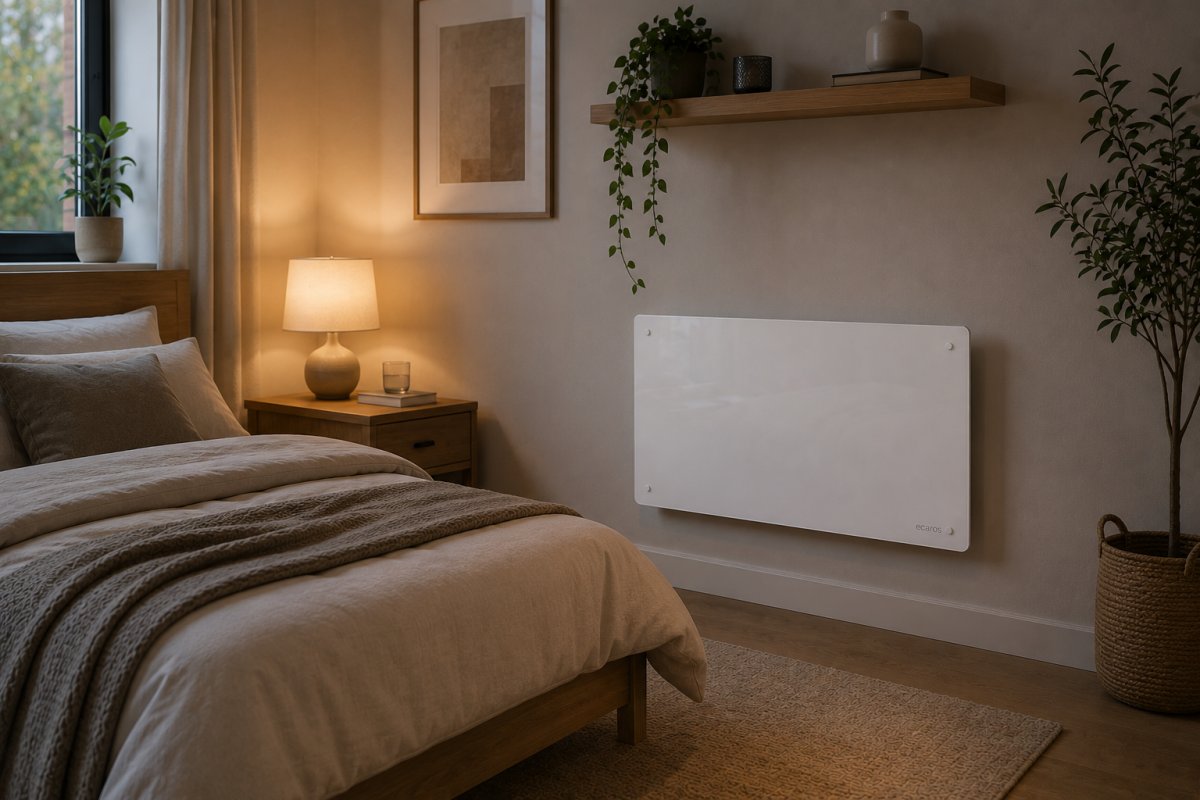
Choosing electric heating doesn't start with a brand or wattage, but with the question of what you want to heat: a single workspace, a room used for a few hours, or an entire home. A convector, infrared panel, electric radiator, underfloor heating, and heat pump all run on electricity, but differ significantly in terms of comfort, installation, and operating costs. With this comprehensive selection guide, you will find a solution that suits your home in Belgium or the Netherlands.
Choosing electric heating in brief
- For a single room or temporary heating, a convector, radiator, or infrared panel is often practical.
- For many hours of heating or an entire home, a heat pump is generally more efficient.
- Direct electric resistance heaters deliver approximately the same amount of heat at the same power input; control and application make the difference.
- Select the capacity based on heat loss, insulation, room volume, and desired temperature.
- Calculate costs using your own electricity rate and the actual operating time of the appliance.
Choosing electric heating: when is it sensible?
Choosing electric heating makes sense when you want to heat a specific room quickly and precisely, cannot install central heating pipes, or want to control each room independently. Think of a home office, bedroom, bathroom, guest house, or well-insulated holiday home. Purchase and installation are often simpler than with a central water-based system.
For long-term main heating of an entire home, the trade-off is different. A direct electric heater converts electricity into heat via resistance. A heat pump transfers heat from outside air, the ground, or water and therefore typically delivers more room heat per kWh of electricity. Milieu Centraal explains why a heat pump heats electrically more efficiently.
Main heating or supplementary heating?
Supplementary heating supports an existing system or temporarily heats a single zone. Primary heating must be able to cover the entire heat loss, even during cold days. Convectors, oil-filled radiators, ceramic heaters, and infrared panels are common for supplementary heating. For primary heating, you first look at insulation and a professional heat loss calculation; often, an air-to-air or air-to-water heat pump then comes into play.
Direct electric is not the same as a heat pump
With resistance heating, 1 kWh of electricity is converted into approximately 1 kWh of heat at the point of use. A heat pump uses electricity to transfer ambient heat. Therefore, a comparison must always state whether “electric heating” means a resistance unit or a heat pump. This distinction is often missing in simple product comparisons.
Choosing electric heating: eight systems compared
This table helps you get a quick overview. The final choice depends on usage hours, space, insulation, desired warmth level, and available electrical capacity.
| System | Heat | Best application | Important point of attention |
|---|---|---|---|
| Electric convector | Primarily natural air circulation | Silent, fast zone heating | Cools down relatively quickly |
| Oil-filled radiator | Convection and radiation with thermal mass | Heat evenly for longer | Slower and heavier |
| Ceramic fan heater | Forced warm air | Very rapid, short-lived heat | Fan noise and dust displacement |
| Infrared panel | Direct radiation | Fixed work or seating area | Comfort especially within the radiation range |
| Electric underfloor heating | Radiation over a large surface area | Bathroom or small renovation area | Slow response and underfloor installation |
| Accumulator | Stores heat in stones | Situations with appropriate rate and planning | Large, heavy and less flexible |
| Electric central heating boiler | Heats water for existing distribution system | Specific technical situations | Direct electrical consumption for the entire home |
| Heat pump | Displaces ambient heat | Many hours and central heating | Higher investment and good design needed |
Convector or electric radiator?
A convector heats the room air quickly and is lightweight. An oil-filled electric radiator has more mass, reacts more slowly, and emits heat for longer after being switched off. Both are resistance devices: for the same power consumption, the amount of heat produced is comparable. Therefore, choose based on response speed, quiet operation, weight, controls, and duration of use.
Infrared or convection?
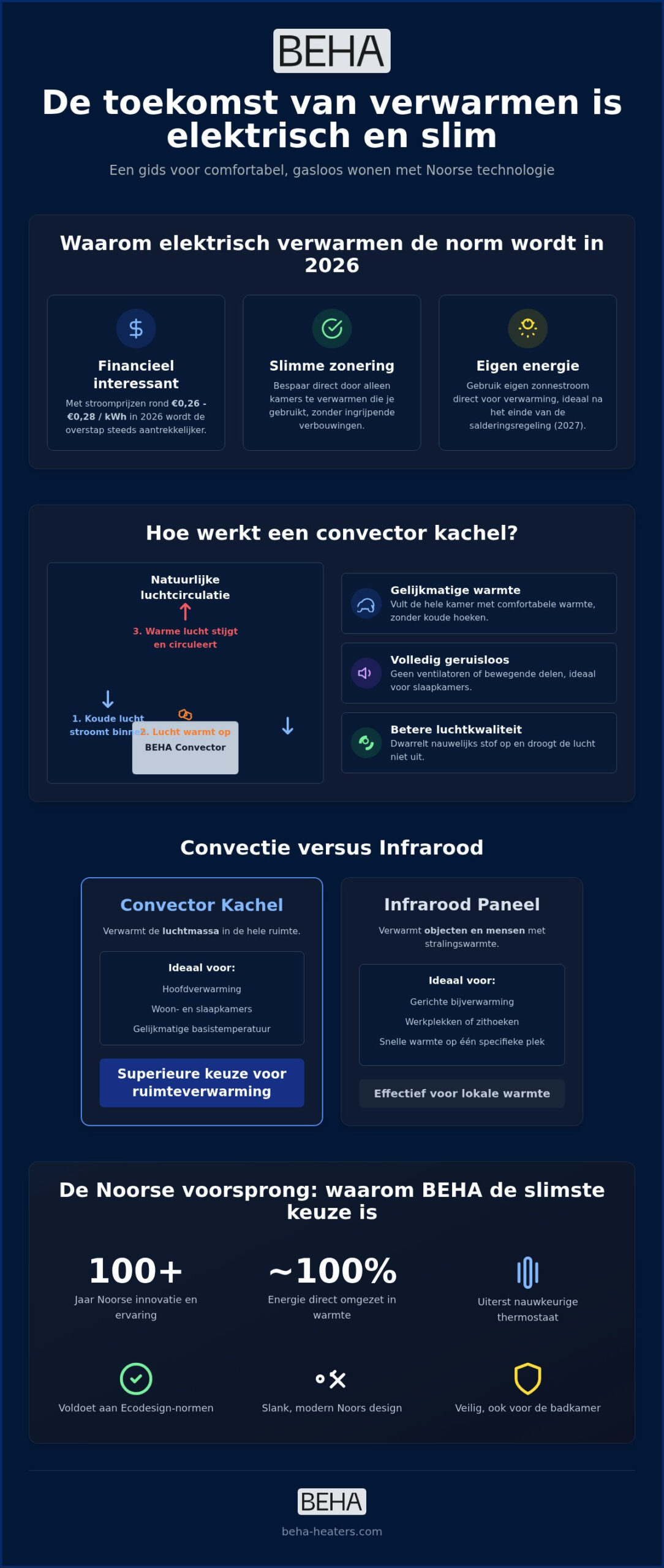
Infrared is directional: you feel the radiation quickly when you are within range. Convection heats the air in the room. Infrared can be used efficiently for a single desk or seating area; for an entire room where people walk around, a convector or radiator is often more practical. Neither is universally “the best”.
Heat pump for the entire home
A heat pump requires a higher initial investment, but generally has lower operating costs than direct resistance heating with high operating hours. Performance depends on outdoor temperature, supply temperature, insulation, sizing, and installation. Therefore, have a heat loss calculation and system design performed.
How exactly does an electric convector work?
An electric convector draws in cooler air from below. This air flows past a heating element, becomes warmer, and rises back into the room through the top. The cooled air sinks and returns to the unit. This natural process is called convection. You can find more technical background at electric heating.
A fanless model uses no fan and is therefore virtually silent. The thermostat switches off the element as soon as the set temperature is reached. A good program can use a different temperature for each day and time period. This only reduces consumption if it results in fewer hours of heating or heating at a lower temperature.
What does nearly 100% conversion mean?
Virtually all electrical energy consumed ends up in the room as heat. This does not mean that direct electric heating is the cheapest or most sustainable option. The price per kWh of heat delivered and the origin of the electricity remain important. Furthermore, a device with a marketing claim of “100% efficient” does not produce more heat from the same amount of electricity than another resistance heater.
Does an electric heater dry out the air?
A heating appliance does not remove water from the room air. Due to the higher temperature, the relative humidity drops, and the air may feel drier. Ventilating well, not heating too high, and measuring the humidity are more sensible than choosing a type of appliance based solely on this feeling.
Choosing electric heating based on cost and consumption
Anyone to choose electric heating benefits more from a formula than from a rapidly outdated average energy price. Calculate the maximum costs as follows: power in kW × actual duty cycle × your total price per kWh.
A 1,500-watt heater that heats continuously for a full hour uses 1.5 kWh. If the element is on for a total of 30 minutes within that hour thanks to thermostat control, the consumption is approximately 0.75 kWh. Multiply that by the current rate of your own contract.
| Assets | Maximum consumption per full heating hour | Current at 230 V, approximately |
|---|---|---|
| 500 W | 0.5 kWh | 2.2 A |
| 1,000 W | 1.0 kWh | 4.3 A |
| 1,500 W | 1.5 kWh | 6.5 A |
| 2,000 W | 2.0 kWh | 8.7 A |
Compare total costs, not just purchase
A cheap unit that runs for many hours daily can be more expensive over its lifespan than a more efficient central system. Take into account purchase, installation, expected consumption, maintenance, lifespan, and any modifications to the electrical installation. For a rarely used guest room, a simple convector may actually be more economical than a large system investment.
Are solar panels enough for electric heating?
Solar panels can cover part of electricity consumption, but most heating demand occurs during the dark winter months and outside the hours with the highest solar production. Therefore, calculate based on actual simultaneous self-consumption and the applicable feed-in or feed-in tariff, not on the full annual yield as if it were always available.
How do you save without losing comfort?
- Heat only occupied rooms and close doors between temperature zones.
- Use a realistic weekly schedule instead of permanently maintaining the same temperature.
- Lower the set temperature when the room is empty.
- Seal gaps and improve the most cost-effective insulation first.
- Do not block air vents and thermostat sensors with furniture or curtains.
- Check the actual consumption with a suitable energy meter or app.
Choosing electric heating for every room
The best solution varies depending on the usage profile. Below is a practical selection for common spaces.
Living room
For a living room that needs to be warm for many hours daily, first compare a heat pump or an efficient water-based system. A well-insulated living room that is only used for certain hours can be heated with multiple smartly distributed convectors. A single unit in a corner sometimes results in an uneven temperature in a long, open space.
Bedroom
A fanless convector or electric radiator is quiet and can be controlled by time intervals. Heat specifically around bedtime and waking up, instead of keeping it on high all night. Choose a model without a distracting display and with a child lock when relevant.
Home office
For fixed office hours, a fast-responding convector works well. For one person in one fixed spot, an infrared panel can be more targeted. A schedule prevents the room from remaining unnecessarily warm in the evenings and on weekends.
Bathroom
In the bathroom, electrical zones, IP protection, and mounting location are determining factors. A towel radiator, suitable convector, infrared panel, or electric underfloor heating may fit, but not every model is permitted. Follow the installation manual and have any doubts assessed by a certified electrician.
Holiday home, garage or attic
A programmable device with frost protection can protect a rarely used room without permanently maintaining a comfort temperature. Check Wi-Fi coverage, local control in the event of an internet outage, and whether the device is suitable for the environment.
Choosing electric heating based on power and safety
A first indication of power is approximately 25 to 50 watts per cubic meter. The low value applies only with good insulation. Multiply the floor area by the ceiling height and then by an appropriate factor. This is a guideline, not a substitute for a heat loss calculation.
| Space at 2.5 m high | Contents | Indication 25–50 W/m³ |
|---|---|---|
| 10 m² | 25 m³ | 625–1,250 W |
| 15 m² | 37.5 m³ | 940–1.875 W |
| 20 m² | 50 m³ | 1,250–2,500 W |
| 30 m² | 75 m³ | 1,875–3,750 W |
Extensive glazing, exterior walls, ventilation losses, high ceilings, and a high desired temperature increase the heat demand. An undersized unit can continue heating without reaching the target temperature. Overcapacity does not reduce the heat demand and requires sufficient electrical capacity.
Check socket and circuit
A 2,000-watt appliance draws approximately 8.7 amperes at 230 volts. Two such appliances together consume about 17.4 amperes and are overloaded by a standard 16A circuit when running at full power simultaneously. Take other appliances on the same circuit into account and avoid faulty extension cords or power strips.
Safe installation
- Never cover an electric heater.
- Respect the minimum distances to the floor, curtains, and furniture.
- Use the supplied wall bracket or approved feet.
- Keep air intake, exhaust, and thermostat sensor clear.
- Check whether the device is designed for continuous use and the selected room.
- Have a fixed connection or any doubts regarding group load assessed by a professional.
Ecodesign and smart features
European regulations for local space heaters set requirements for product information and control options. Check current documentation on local space heaters via the European Commission. Useful features include an electronic thermostat, weekly program, open window detection, frost protection, and low standby consumption.
Wi-Fi: convenience is not the same as return
Wi-Fi does not make a resistance element more efficient. However, it can save energy if you remotely switch off a forgotten appliance, program zones separately, or set fewer heating hours. Also check local control without internet, privacy, software support, and operation by multiple family members.
When is a Norwegian electric heater from BEHAsuitable?
When choosing electric heating, a fair product match is essential. BEHAconvectors are designed for quiet, fast-responding, and individually adjustable room heating. They are particularly suitable when you do not want to install central heating pipes, require a schedule per room, or want to provide targeted supplementary heating to an existing space. View the current models on BEHA Heaters.
For many hours of heating throughout a home, a heat pump may be more logical; for a fixed workspace, infrared may be suitable. A fanless electric convector excels at quiet zone heating. Our guide on an electric convector with Wi-Fi helps compare controls and programs.
Design and interior integration
In addition to steel and glass fronts, there are versions that, according to the manufacturer, are paintable. Use only the prescribed materials and keep grilles, sensors, and controls clear. Read the practical points to consider in our guide on a paintable radiator.
12-step checklist before purchase
- Determine main heating, supplementary heating, or one heated zone.
- Note how many hours per day and days per week you need heat.
- Compare convection, radiation, thermal mass, and a heat pump.
- Calculate the room volume and have the heat loss determined for main heating.
- Choose sufficient power for the coldest relevant conditions.
- Check the socket, circuit, and concurrent electrical load.
- Calculate usage costs using your own rate and expected duty cycle.
- Compare thermostat, weekly program, and open window detection.
- Check sound, dimensions, and mounting distances.
- Check IP rating and suitability for bathroom or damp room.
- Rate warranty, service, and app support in Belgium and the Netherlands.
- Read the installation and safety instructions before commissioning.
Ready for the future with BEHA
A future-proof solution is correctly sized, reliably regulated, and suited to the intended use. Do not choose based solely on high wattage or a low purchase price. On beha, you can compare dimensions, power, and features for each current model.
Make a choice based on usage, not marketing
After choosing electric heating, the most important step follows: use the appliance only where its strengths are most effective. The search query “choosing electric heating” therefore revolves around usage hours and the heating experience. Direct electric is convenient and fast for a limited zone. A heat pump is usually more efficient for many heating hours. With good insulation, appropriate capacity, and smart control, you prevent comfort from consuming unnecessarily high amounts of electricity.
Frequently asked questions about choosing electric heating
What is the most energy-efficient electric heater?
For long-term main heating, a well-designed heat pump is generally the most energy-efficient. For short-term localized heating, a convector or infrared panel can be practical, depending on whether you want to heat the entire room air or a single spot.
Is electric heating more expensive than gas?
That depends on current rates, system efficiency, the home, and usage. Direct resistance heating can be more expensive per unit of heat delivered than gas or a heat pump. Zone heating can still save money if it keeps the rest of the home cooler.
Can I heat my entire house with electric convectors?
Technically, this is possible if the capacity and electrical installation are sufficient, but costs can become high with high operating hours. Have heat loss and circuit load calculated and compare heat pumps before choosing direct electric primary heating.
How many watts do I need for 20 m²?
With a ceiling height of 2.5 meters, the volume is 50 m³. A rough range of 25 to 50 W/m³ corresponds to 1,250 to 2,500 watts. The exact value depends on insulation, glazing, ventilation, and the desired temperature.
Is an electric heater safe during the night?
Only when the appliance is designed for continuous use, is correctly installed, and is used according to the manual. Use the thermostat and night program, never cover the appliance, and keep the air vents clear.
What is better: a convector or an infrared panel?
A convector is suitable for heating the room air. Infrared is suitable for direct heat for a person or a specific zone. The dimensions, lifespan, and how people use the space determine the best choice.
Do I need to modify my meter box or fuse box?
That depends on the total capacity, existing circuits, and simultaneous use. Multiple appliances of 1,500 or 2,000 watts can overload a circuit. For a larger system, have the installation assessed by an electrician beforehand.
How does Wi-Fi control work on an electric heater?
The heater connects to an app or control system that allows you to manage temperature and schedules per zone. Check whether operation without internet remains possible and how long software support is provided.
Which electric heater is suitable for the bathroom?
That depends on the electrical zone, mounting position, and IP rating. Choose only a model that is suitable for that position according to the manufacturer and local regulations. If in doubt, consult a certified installer.
Is a more expensive resistance device more energy-efficient?
Not automatically. At the same power consumption, resistance heaters produce approximately the same amount of heat. However, a more expensive model may regulate better, be quieter, be safer to install, or last longer, thereby improving comfort and actual use.
Which function saves the most energy?
A suitable schedule and lower temperature during absence often have the greatest practical effect. Open window detection and zone control help prevent waste, but no smart feature compensates for poor insulation or an unsuitable heating method.