
Compact fan heater for the home office: how to choose wisely
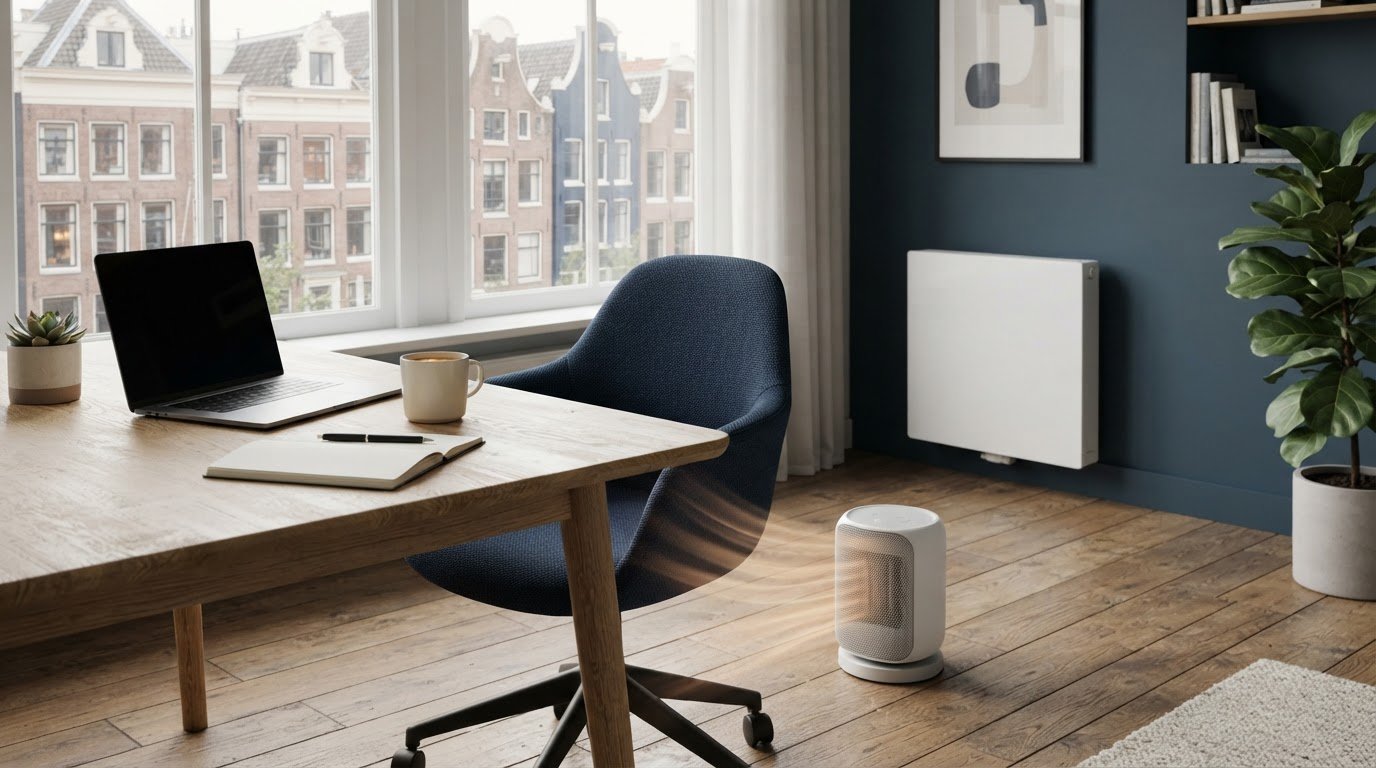
The smallest heater is not automatically the most pleasant choice for your home office. A compact fan heater for the office can be handy if you want warmth quickly, but the noise and airflow can affect your concentration. If you are looking for quiet, even heat, a convector might be a better fit. The right choice therefore depends not only on the size, but also on how and when you use the room.
In this article, you will read what distinguishes a fan heater from a convector and what to consider regarding noise, placement, and the size of your home office. This will allow you to assess whether fan heating is suitable for short work sessions or if a convector is a better fit for longer workdays. You will also discover how BEHA's freestanding fan heaters, including the Vesuvius, Hekla, and VT620 series, fit into that consideration.
Key Points
- Choose a compact fan heater for the home office based on your work rhythm and comfort preferences, not just the size.
- Compare fan heating with a convector on heat distribution and noise to determine what works comfortably while working from home.
- Map out the size of your room, the insulation, the lifespan, and your existing heating before comparing models.
- Determine whether you want to use the heater as temporary supplementary heating or for your entire workday, and base your choice on that.
- BEHA offers freestanding fan heaters in the Vesuvius, Hekla, and VT620 series.
When is a compact fan heater suitable for your home office?
Do you use the home office occasionally for short periods, or do you work there for extended periods daily? That difference helps determine which heater suits you best. A fan heater blows air past a heating element and distributes the heated air throughout the room using a fan. As a result, you experience the heat differently than with a convector, where warm air rises and spreads without a forced airflow. A compact fan heater for the home office can be practical if you want to provide temporary supplementary heating at your workspace, for example, when you use the room briefly or it feels chilly.
The compact size in itself says something about the dimensions, not about the heating capacity or how comfortable the heat is for you. The room, the existing heating, and your seating position also play a role. You can read more about the operation of this type of heater in the fan heater.
What does a fan heater do in a home office?
A fan blows air past a heating element and directs the heated air into the room. You therefore notice an airflow, often primarily in the direction the heater is positioned. This feels more direct than with a convector, where warm air rises and spreads gradually throughout the room. The airflow can be pleasant if you want to feel warmth quickly at your workspace, but it can also be distracting when it constantly blows past you.
Therefore, pay attention not only to the heat, but also to noise and placement. During concentrated work, the sound of a running fan can be more disruptive than during a short break. Do not direct the airflow directly at yourself if you find that uncomfortable. Also consider whether you can position the heater so that the air moves freely into the room. Fan heating can stir up dust, something to take into account if you are sensitive to it.
When is supplementary heating sufficient?
A home office that you only use briefly sometimes requires a different approach than a room where you sit for an entire workday. If, for example, you only do administrative work there for an hour, local supplementary heating may suit that usage. If you work in the room for extended periods daily, consider how to keep the space comfortable as a whole. A portable heater is not automatically a replacement for the existing heating system.
Check how cold the room usually is when you start, whether the existing heating already brings the room up to temperature, and where you sit while working. This prevents you from relying solely on the dimensions of a device. A compact model may take up little space, but that does not automatically mean it heats adequately or that the airflow is comfortable.
A fan heater can be practical if you use a home office briefly and want temporary, targeted heat at your workspace.
Fan heater or convector: which is more comfortable while working from home?
The choice depends on what you find important while working. If you want to feel warmth quickly at a chilly start to the day, fan heating might be suitable. If silence is important during conversations or concentrated work, a convector heater makes the more logical choice. Neither works best for everyone: your work rhythm, the location of the heater, and your sensitivity to noise all play a role.
This comparison describes the general operation of both heating types. The experience may vary depending on the model and room.
| Heating type | Heat distribution | Sound | Suitable work rhythm |
|---|---|---|---|
| Fan heater | A fan blows warm air into the room, often directed at a specific spot. | The fan makes noise and may be audible during quiet operation. | Shorter sessions or moments when you want to feel localized heat. |
| Convector | Warm air rises and spreads gradually without a fan. | No fan noise; quiet operation can be pleasant for concentration. | Longer working days or situations where silence weighs heavily. |
Use the table as a tool, not as a fixed ranking. A compact fan heater for the home office might make sense if you only use the room at certain times. However, if you work there for hours at a time and make regular phone calls, the absence of fan noise might actually outweigh the direct airflow.
When does fan heating fit better with your work rhythm?
During a short work session, you might primarily want warmth for as long as you are in the room. In that case, a fan heater can be a practical form of targeted supplementary heating. Consider the placement of the unit: the airflow can be noticeable, and the fan noise can be distracting during a phone call, online meeting, or focused reading. How strongly you notice this depends on the room, the distance, and your preference.
Also consider what you usually do while working. For tasks where you speak a lot or need silence, an audible fan might be less pleasant. For short tasks where you mainly want to feel the warmth at your workspace, that direct airflow can actually be a good fit.
When is a convector a suitable alternative?
A convector heats without a fan and can therefore be an alternative if you want to minimize background noise during long workdays. That does not automatically make the choice better: the heat is distributed differently, and preference remains personal. If you want to delve into the operation and features, read the guide on the electric convector with Wi-Fi.
So don't just compare size. Compare your daily work rhythm, desired heat distribution, and need for peace and quiet. Also take a look at the BEHAconvectors if you want to consider a fanless alternative.
Which compact heater suits the size and decor of your home office?
Do not choose a suitable model based solely on how small the device is. First, assess the space and your usage: how large is the room, how long do you typically work there, and what heating is already installed? Also take the insulation and window surface area into account. A room with a lot of glass or limited insulation can feel different from a comparable room that retains heat well.
Choose the power output based on the room and usage, not just on the size of the heater. Power output and recommended surface area vary by model. Therefore, compare models based on their published product specifications and behaa general rule of thumb or estimate as a BEHAspecification. A compact appliance is not automatically suitable for every room or work rhythm.
Which data helps you choose an appropriate asset base?
Note the surface area of your home office and how long you usually use it at a time. Add the insulation, the amount of window surface area, and the existing heating to this. This way, you compare models with your specific situation in mind, rather than selecting solely based on dimensions or appearance. Check the stated specifications and any room recommendations for each model. Because models vary, a single general power standard is not suitable for every home office.
- Space: note the surface area and check if the room connects openly to another room.
- Usage: distinguish between short work sessions and daily long-term use.
- Heat loss: take insulation and the window surface into account.
- Existing heating: determine whether the heater supplements a heated room or needs to play a larger role.
This inventory provides you with a better basis for compact fan heaters for the home office . It does not replace the product specifications, but helps you apply them to your situation.
How do you keep the workplace practical and comfortable?
Next, consider the layout. Measure the available floor space and determine where a freestanding model can stand stably without obstructing your walking path or workspace. Also, take the position of the power outlet into account so you know in advance where the device can be placed. Always follow the manufacturer's instructions for use and placement.
Because a fan heater blows air into the room, the direction of the airflow is important. Choose a spot where the flow does not constantly hit your hands, face, or papers, and where the air can spread throughout the room. Try out the spot during a normal workday: are you comfortable, is your desk easily accessible, and does the device not distract you?
If you would prefer to consider a convector, the buying guide for an electric heater with a steel front helps you include that type of heating in your comparison. This way, you weigh space, usage, and interior design together before making a choice.
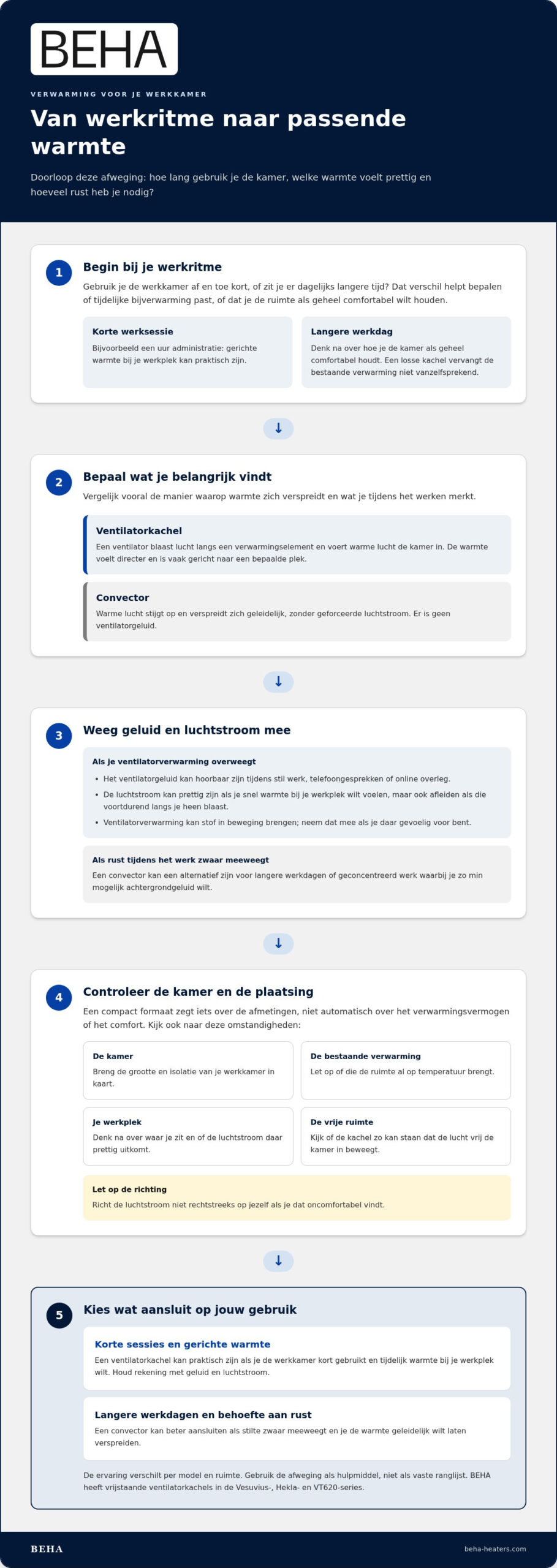
This is how you comfortably use a fan heater during your workday
First, determine what you want to use the heater for: as temporary supplementary heating during chilly moments or as heating that remains on throughout your entire workday. This distinction helps you align usage with your work rhythm. Always follow the manual for the chosen model for instructions on use and placement.
Use this checklist before and during your workday:
- Determine the time of use. Consider when you use the home office and whether you need extra heat at the start, during a short work session, or for a longer period.
- Check the location. Place a freestanding model stably and ensure that the air supply is not blocked.
- Keep the airway clear. Remove items that could obstruct the airflow and choose a spot where the expelled air does not disturb your workspace.
- Follow the manual. The instructions for the specific model are leading. Use them also to determine which restrictions apply to installation and use.
- Tailor its usage to your work. Take into account the times when you make calls, hold meetings, or want to work with concentration.
What do you check before you turn on the heater?
Before switching it on, take a moment to check the setup. Is the appliance stable? Is the airflow unobstructed and can the warm air circulate into the room? Also, pay attention to loose items around the heater that could obstruct the airflow. The exact usage restrictions may vary by model. Therefore, follow the manual and do not treat general assumptions as behaand fast rules.
If you change the layout or move the unit, re-check whether the location is suitable. A setup that was initially free-standing can become awkward due to a chair, bag, or stack of papers. This way, the heater remains part of your workspace without you having to constantly take it into account while working.
How do you prevent heat from interrupting your work?
Plan usage around your work blocks. If you use the room primarily for a short task, temporary supplementary heating may suffice. If you have a meeting or want to read undisturbed, pay extra attention to the sound of the fan and the direction of the airflow. If you find this disturbing, another location or a different type of heating might better suit your preferences.
Fan heating provides targeted heat, while sound comfort determines whether that heat remains pleasant during your work.
If you want to compare a freestanding solution with BEHAfan heating, take a look at the BEHAfan heaters for your home office and tailor your choice to how you use the space.
BEHAfan heaters for your home office: which solution suits you?
Once you have determined that freestanding fan heating fits your work routine, you can compare the BEHAfan heater series. BEHA offers freestanding fan heaters in the Vesuvius, Hekla, and VT620 series. These series are suitable to include in your comparison if you are looking for a standalone unit rather than a fixed wall-mounted convector. Choose a model based on the published product information and what suits your space and usage.
Start practically. Consider where the unit can be placed, how often you use the office, and whether you need the heat primarily temporarily. Also take into account your preferences regarding airflow and noise during working hours. Therefore, do not choose a compact fan heater for the office solely because it seems to take up little space. Compare the product specifications of the model and follow the user manual for placement.
When do the BEHAfan heater series suit your choice?
Vesuvius, Hekla, and VT620 are BEHAseries of freestanding fan heaters. They fit your search if you are specifically looking for a freestanding unit with fan heating. The series name alone does not tell you which model best suits your room or workday. Therefore, compare the models based on their published product information and your priorities, such as the location in the room and the times when you want to use the heater.
This way, you don't base your choice solely on a name or a compact appearance. Note down in advance what is decisive for you: a freestanding setup, temporary use, or the way you want to experience warmth. Then compare the BEHAmodels with those preferences. This keeps your choice focused on your home office, without automatically attributing features of one model to an entire series.
When do you prefer a BEHAconvector?
Fan heating is not the most comfortable form for every workplace. If you would prefer to consider a different type of heating, BEHAconvectors are an alternative. This is particularly relevant if you prefer to avoid airflow or audible fan noise while working from home. The choice depends on your personal comfort, the layout, and how you use the space.
If you want more insight into that category, the guide on the electric convector with Wi-Fi provides an explanation of convector heating. Use that information alongside your own requirements and the product specifications. Features of one series do not automatically apply to another.
Have you determined your preference? View BEHAmodels and the purchasing process via the dealer locator. Find a BEHAdealer to view fan heaters and convectors.
Choose heating that suits your workday
Make your choice based on how you use your home office. Do you want localized extra heat at specific times, or are you looking for a solution for prolonged work? The location of the device and how much peace and quiet you need during conversations also play a role. This ensures that a compact fan heater for the home office is not chosen based solely on size, but becomes a well-considered component of a pleasant workspace.
BEHA was founded in 1917 and builds on more than a hundred years of experience in heating. That background provides context to the range, but your space and preferences remain the guiding principles. Compare models and heating types with your own usage in mind. A suitable choice begins with clearly knowing what you need.
Would you like to explore the possibilities further? View the BEHAheating solutions and find a dealer.
Frequently Asked Questions
Is a compact fan heater suitable for a home office?
Yes, a compact fan heater can be suitable if your workspace temporarily needs extra warmth and you are looking for a freestanding unit. However, a compact fan heater for the home office is not automatically suitable for every room. Check the product specifications and how you use the room. In a shared space, placement is especially important so that the airflow does not bother your colleague or housemate.
Does a fan heater make a lot of noise while operating?
A fan heater makes noise because a fan is running, but how audible that is varies by model and usage situation. During a video call in a quiet room, the sound may be more noticeable than when working independently with background noise. Check any noise information in the product specifications. Also consider whether you want to use the heater during calls or preferably at other times.
Can I leave a fan heater on for the entire workday?
That depends on the instructions for the chosen model. Follow the manual for permitted operating time, placement, and any limitations. Do not automatically assume that every appliance is suitable for continuous use. If you intend to use the heater during a long workday, read the operating instructions first and operate the appliance according to those directions.
How do I choose the right capacity for my home office?
Compare the stated power output and any surface area recommendation for each model with your room specifications. Note the floor area, how long you use the room, and what heating is already installed. A power recommendation for one unit does not automatically apply to another model or room. Therefore, use the product specifications of the unit itself, not a general rule of thumb as a substitute.
Is a compact fan heater more energy-efficient than a convector?
Not only because the device is compact or uses a fan. Electricity consumption depends, among other things, on the power output, how long you heat, and how much heat the room loses. Therefore, compare not only the heating types, but also the product specifications and your usage duration. A short supplementary heating session is different from heating for a full workday. As a result, it is difficult to identify an overall winner.
Which fan heaters does BEHA offer?
BEHA offers freestanding fan heaters in the Vesuvius, Hekla, and VT620 series. Which model suits you depends on your needs and the model specifications. Check features such as power or noise level per model, rather than deducing them from the series name. BEHAproducts are available through a dealer network. Use the dealer locator to view models and purchasing options.
Can I use a fan heater as my primary heating source?
That depends on the model and the heating requirements of the room. According to the product specifications, an appliance you intend to use as primary heating must be suitable for that application and match the room. Therefore, check the recommended application and capacity of the specific model. If these specifications do not align with your usage, behanot automatically treat the heater as a replacement for your existing primary heating.