
Comparing BEHAheating with Adax Neo Wifi: which one suits you?
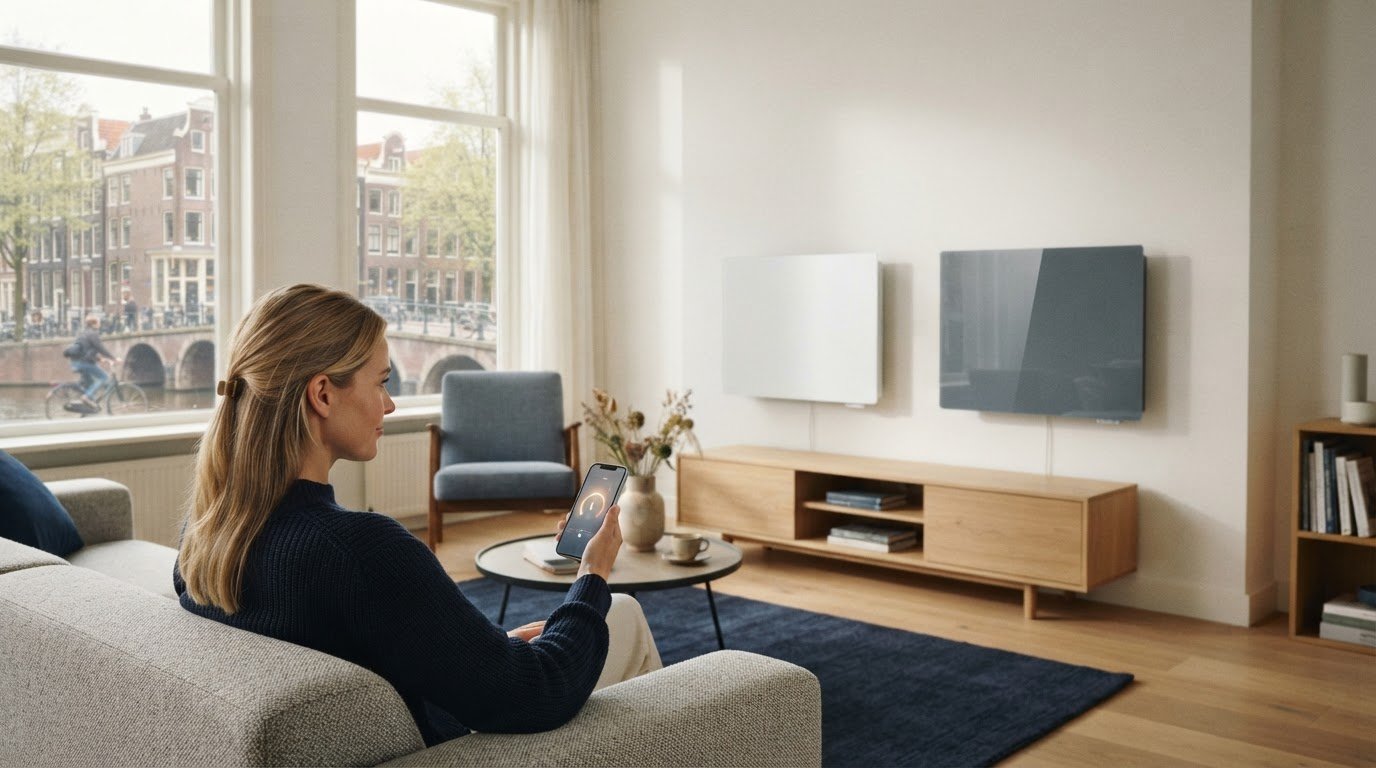
The smartest choice is not automatically the heater with the most smart features. If you want to compare BEHA heating with adax neo wifi, focus primarily on what makes a difference in your room: power output, ease of use, and appearance. An app is handy if you want to adjust the temperature remotely. If you are primarily looking for simple operation, other features may be more important.
Comparing product information from different brands side by side is not always easy. Therefore, compare BEHAconvectors and the Adax Neo Wifi using the same criteria, rather than general marketing claims. Look at the power output and dimensions of the models you are considering, the app control, and the finish of the front panel.
In this article, you will read which specifications to compare and how to weigh them against your preferences. You will also discover how BEHA’s steel, glass, and paintable fronts fit into various interiors. This allows you to evaluate the options in a targeted manner and make a choice that aligns with your daily use.
Key Points
- Start with the room and your usage requirements to fairly compare BEHAconvectors and the Adax Neo Wifi.
- Use the same criteria for both brands and compare the data of the selected models.
- When comparing beha heating with Adax Neo Wi-Fi, weigh the controls against the front panel design and other features that matter to your situation.
- See how a steel, glass, or paintable front fits your interior, without judging solely by appearance.
- Follow four steps: determine the space, choose your operating preference, consider the front, and then compare the model details.
Comparing BEHAheating with Adax Neo Wifi: where do you start?
Two brands can offer a solution for the same heating need, but their product information may be structured differently. Therefore, start with your situation, not with the question of which brand sounds better. Consider a home office you use regularly or a room where extra heat is needed. The function of the convector determines which specifications you compare first.
A fair comparison starts with the same space, usage requirements, and type of model specifications for both brands. This way, you do not compare a general brand claim with a specific feature of a single device.
Which question must you answer before the brand comparison?
Start with the room: where will the convector be placed, and will it be the primary heating source or a supplement? Also determine how you want to operate the device. Do you want to adjust settings on the unit itself, or does Wi-Fi control via an app suit your routine better? This preference makes the comparison more concrete but does not, in itself, determine which model is suitable.
Assess the power output in relation to the room and usage. A model that fits one room is not automatically suitable for another. Therefore, note the stated power output and dimensions for each candidate. Do not compare models with different power outputs as if the only difference were the brand.
What does Adax Neo Wifi mean in this comparison?
Adax Neo Wifi is the specific Adax model in this comparison, not a collective name for all Adax heaters. The model features Wi-Fi control via a smartphone app. The mentioned capabilities include adjusting the temperature and setting programs. BEHA offers smart convectors with Wi-Fi control and an app. Compare the features associated with the specific models.
Both are convector heaters. With this type, air is heated and circulates through the room. You can find a general explanation of how they work under convector heating. For the comparison, it is particularly important to look at the same technical points, rather than ranking the brands based on a single general promise.
Keep three types of information separate:
- Trademark claims: general statements about the brand or product range.
- Product specifications: concrete details, such as power, dimensions, and operation.
- Model differences: features that apply only to a specific version.
This way, you avoid comparing general features of the BEHArange with properties that apply only to the Adax Neo Wifi. If you want to know more about smart control, the guide on electric convectors with Wi-Fi provides additional background.
Compare BEHA and Adax Neo Wifi on the same technical criteria
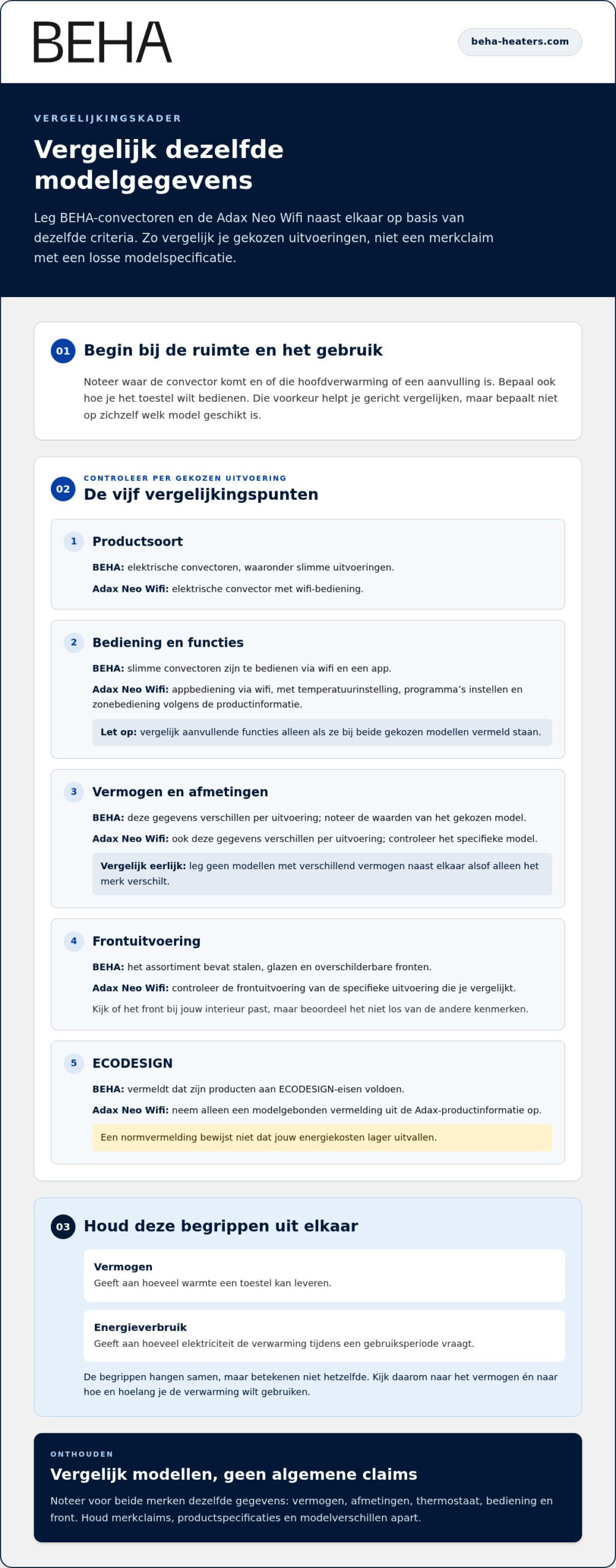
A product comparison is only useful if the data pertains to comparable versions. Therefore, do not pit the entire BEHArange against a single Adax model and draw a general conclusion. The table shows which features apply at the brand level and which you evaluate for the chosen version.
| Criterion | BEHA | Adax Neo Wifi |
|---|---|---|
| Product type | Electric convectors, including smart models | Electric convector with Wi-Fi control |
| Operation | Smart convectors can be controlled via Wi-Fi and an app | Operation via Wi-Fi and smartphone app; Adax lists temperature setting, programming, and zone control |
| Power and dimensions | Differences by version; compare the specifications of the selected model | Differences by version; compare the specifications of the selected model |
| Front version | Steel, glass, and paintable fronts in the range | Check the front panel design of the specific Adax Neo Wi-Fi version |
| ECODESIGN | BEHA states that its products meet ECODESIGN requirements | Include only a model-specific entry from Adax product information |
Which technical specifications are truly comparable?
Compare the stated power output of the selected models, not just the brand name or product family. Also look at the dimensions, thermostat information, and any program functions. A feature specific to one model does not automatically apply to all models of the same brand. ECODESIGN at BEHA is a standard designation, not proof that your energy costs will be lower.
Capacity indicates how much heat a device can deliver, while energy consumption indicates how much electricity it consumes during a period of use. The concepts are related but do not mean the same thing. Therefore, look at the capacity as well as how and for how long you intend to use the heating.
How do you compare Wi-Fi and operation without assumptions?
Wi-Fi describes a control option, not heating performance. Adax lists Wi-Fi app control for the Neo, including adjusting the temperature and setting programs. BEHA offers smart convectors with Wi-Fi and an app. Compare additional features only when they are listed in the product information for both selected models. This way, you avoid confusing a feature of a product family with a characteristic of a single device.
When comparing beha heating with adax neo wifi, it helps to note the information for each model in the same way: power, dimensions, thermostat, controls, and front panel. This way, you can see where the real differences lie. For additional context regarding a steel version, you can use the complete buying guide for BEHAconvectors with a steel front.
Also view the range of smart BEHAconvectors the features of BEHAcompare
Front, size, and placement: which convector model suits your interior?
A heater is often visible. The front panel and size therefore matter, in addition to the technical specifications. BEHA offers smart convectors with steel, glass, and paintable fronts. For the Adax Neo Wifi, look at the version of the specific model. Therefore, do not compare a general impression of one brand with a single concrete version of another.
How do you choose a front that matches your interior?
Start with the look you want for the room. A steel front can suit an understated, functional decor. Glass can complement an interior with smooth, reflective surfaces. A paintable front is an option if you want the heater to visually match the wall. These are considerations regarding appearance, not indications of capacity or other performance.
The choice of front panel does not automatically determine which dimensions, power outputs, or features are available. These can vary by model. Therefore, compare the finish and specifications: what front panel does the device have, how wide and tall is it, and does that size fit the location where you want to use it? This way, you prevent a desired finish from distracting your attention from a practical mismatch.
If you want to know what a paintable surface can mean for the appearance of a room, read the guide on the paintable radiator. Then evaluate the properties of the specific convector model.
Which placement questions do you include in the comparison?
First, look at the available wall space and the place where the heater logically fits. Measure the space and compare it with the dimensions of the selected BEHAmodel and the Adax Neo Wifi version. Do not focus solely on the width. Height and depth also determine whether a unit fits in your designated spot.
Include wall mounting or other installation options only if the product information describes them for the specific model. Do not assume a possibility simply because a comparable device from the same brand range offers it. In this way, base the comparison on the characteristics of the chosen version.
- Interior: determine which front finish matches the materials and colors in the room.
- Size: compare the dimensions of the selected models with the available space.
- Version: pay attention to the front and placement characteristics for each appliance.
When beha heating with adax neo wifi, this order helps to assess appearance and practical suitability separately. View the BEHAconvectors with different fronts if you want to include the versions in your interior choice.
Which heating suits your usage and what are common misconceptions?
Wi-Fi can be convenient, but it does not determine which model suits you on its own. First, consider how you use the heater daily. Do you want to adjust the temperature while on the go, or do you usually set it just once? If remote control is important, compare the features of the apps. If not, the design, dimensions, or other specifications may be more important factors.
When is smart control a decisive criterion?
App control is practical if you want to change settings without being at the unit, for example when you come home unexpectedly early. Adax mentions Wi-Fi control via a smartphone app for the Neo, including temperature adjustment and programming. BEHA offers smart convectors with Wi-Fi control via an app. Features may vary by model, so compare what the product information describes for the selected versions.
Distinguish between ease of use and heating performance. Wi-Fi describes how you operate the device, not how much heat it provides or how much electricity it consumes during your use. A program can help tailor the heating to your routine, but it does not in itself prove that your energy bill will be lower.
How do you avoid making a choice based on a single marketing claim?
Check which model and version a claim relates to before taking it into account. Words like 'economical', 'quiet', or 'sustainable' are only useful with clear, comparable substantiation. Compare, for example, the stated power output, dimensions, controls, and front panel design. Power consumption depends partly on the heat demand in the room, your settings, and how long you use the heating.
A practical assessment might look like this:
- Prioritize app usage: compare the described app features and determine whether you use them in your daily routine.
- Interior as priority: take the available front versions into account, without deriving a technical advantage from them.
- Prioritize the right appliance: compare the power and dimensions of the specific models for the room you want to heat.
When comparing beha heating with Adax Neo Wi-Fi, there is no universal winner. BEHA offers smart convectors with steel, glass, and paintable fronts. Adax Neo Wi-Fi offers app control with features such as temperature setting and programming. Which features weigh most heavily for you depends on your needs and the specifications of the chosen model. For more background on features and points to consider, you can consult the guide on smart convectors with Wi-Fi.
Check out the smart BEHAconvectors if you want to include front options and smart control in your comparison.
Choose a BEHAconvector that matches your comparison criteria
A good choice doesn't start with a brand preference, but with the combination of space, operation, and design that suits your daily use. Comparing it to the Adax Neo Wifi helps you determine which features are important. Then, use those criteria to find a smart convector within the BEHArange that suits you. Evaluate each model based on its own specifications.
A short checklist for your final choice
Follow these four steps before choosing a model. This way, you keep your needs as the starting point and prevent one prominent feature from determining the entire decision.
- Map out the space. Note which room you want to heat and what role the convector will play there. This way, you will know which model specifications, including power and dimensions, you need for the comparison.
- Choose your control preference. Decide whether you want to manage settings on the device or use Wi-Fi and an app. Then compare the control options of the specific models.
- Choose a front finish. Consider the look that suits the room. A steel, glass, or paintable front may influence your interior choice, but says nothing in itself about the technical performance.
- Compare the model data. Compare the information of the selected BEHAconvector with that of the Adax Neo Wifi. Compare the same data, such as power, dimensions, and control functions.
With this sequence, you turn comparing beha heating with adax neo wifi into a practical selection aid. For example, first determine which dimensions fit in your room, then decide whether app control is relevant to you, and finally take the front panel design into account. This way, you clearly separate necessary features from personal preferences.
What BEHA adds to the comparison
BEHA has over 100 years of experience with electric heating. The range includes smart convectors with a steel front, a glass front, or a paintable front. These versions offer you various options for your interior choice. The manufacturer's experience is relevant background, but it does not replace assessing the specifications of the model you are considering.
Make your comparison concrete: note the room, desired operation, and your preferred front panel. Then compare the model details. This way, you compare BEHA with Adax Neo Wifi without treating a general brand claim as conclusive evidence behaView 's electric heating BEHA and use the same criteria for the convectors that suit your needs.
Turn comparing into a choice that suits your daily use
Take your comparison to the room where the heater will be installed. Consider in advance which feature is decisive and which preference carries less weight. This prevents a striking function or general brand promise from determining the choice. When beha heating with adax neo wifi, it is all about a model that suits your usage, preferences, and room.
Choose one or two BEHAmodels that suit your needs and compare them to the Adax Neo Wifi. Compare the specifications of each model based on your most important criteria. Not all features need to carry equal weight: decide for yourself which combination of operation, appearance, and technical features makes sense to you.
BEHA’s experience with electric heating and the mention of ECODESIGN requirements provide context for the range, but your choice of model remains personal. Take the time to view the versions and apply the same comparison criteria to each device. ’s electric heating BEHA and see which convector suits your needs.
Frequently Asked Questions
Is BEHAheating comparable to Adax Neo Wifi?
Yes, compare specific models with each other. For example, note down the model name, power output, and operating options of each version. This way, you can see what your choice is based on and avoid incorporating features from another model.
What is the difference between BEHA and Adax Neo Wifi?
That depends on the BEHAconvector you choose. BEHA offers smart convectors with various front finishes; Adax Neo Wifi is one specific model from Adax. Compare the exact versions and the features and specifications that are relevant to your room. This way, you are not pitting an entire range against a single model.
Can I control BEHAheater with an app?
Yes, BEHA offers smart convectors that can be controlled via Wi-Fi and an app. The available app features may vary by model. Consider when remote control is useful to you, for example, if you sometimes come home earlier and want to adjust the temperature. If you use the heating according to a fixed routine, other features may be more important.
Is the Adax Neo Wifi more energy-efficient than a BEHAconvector?
You cannot determine this solely from the brand or the Wi-Fi function. Electricity consumption depends partly on the heat demand, the temperature setting, and how long you heat. Compare appliances for the same room and a comparable usage period. An app can support operation, but it does not in itself prove that an appliance consumes less energy or results in lower costs.
Which front finishes does BEHA offer for electric convectors?
BEHA offers smart convectors with a steel, glass, or paintable front. Consider the visible finish in the room: do you want the unit to form a distinctive accent or to blend in with the wall? The appearance does not tell you how much heat a unit delivers.
What should I look out for when comparing two Wi-Fi convectors?
Start with the exact model names and then note down the details that determine your choice. Consider power output, dimensions, thermostat information, app control, and front panel design. Use the same comparison fields for both models. If you want to adjust settings remotely, look specifically at the described app functions. This prevents you from assuming an advantage when comparing beha heating with adax neo wifi without it being based on the model data.