
Comparing Norwegian convectors: BEHA, Adax, or Mill for your home in 2026?
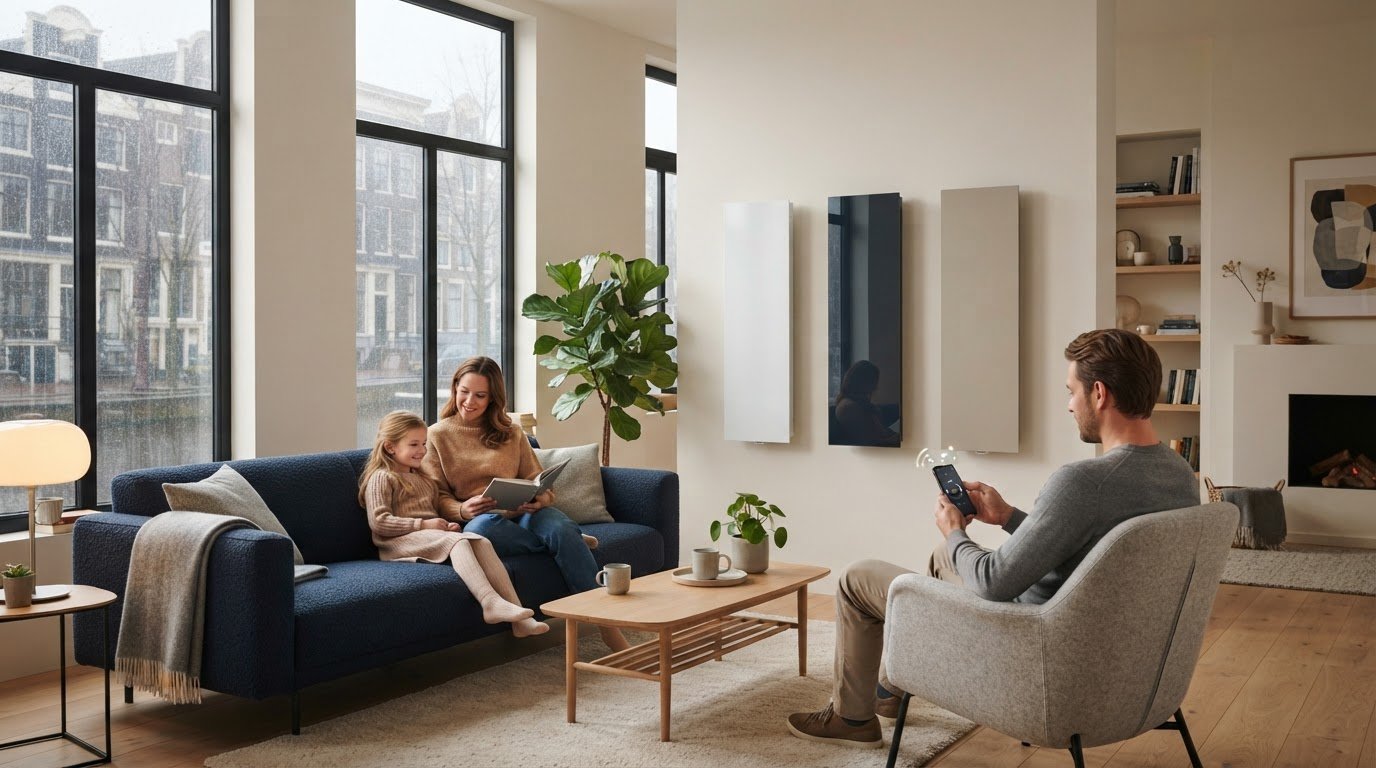
The sleekest minimalist design does not automatically guarantee a behaindoor climate. If you want to compare Norwegian convectors (BEHA, Adax, Mill), you will soon discover that true Scandinavian comfort is primarily about solid engineering and reliability. You surely recognize the dilemma: you are looking for an electric heater that heats your rooms evenly, but you fear ticking noises, the smell of burning dust, or an unreliable app that loses the Wi-Fi connection as soon as it freezes outside. Additionally, you naturally want the panel to harmonize perfectly with your interior in terms of appearance.
In this guide, you will discover the decisive differences between BEHA, Adax, and Mill in terms of technology, energy consumption, and sustainability. We clearly compare reliability, smart thermostat functions, and the specific benefits of steel, glass, and paintable fronts, so you can confidently make the right choice for years of quiet and energy-efficient comfort.
Key Points
- If you want to compare Norwegian convectors: BEHA, Adax, and Mill differ fundamentally in element construction, which is decisive for whisper-quiet operation without unpleasant dust combustion.
- A highly accurate electronic thermostat keeps the room temperature constantly stable and prevents unnecessary power consumption.
- Discover the practical and aesthetic properties of steel, glass, and unique paintable front panels for every type of interior.
- Gain immediate insight into the stability of Wi-Fi modules and app control, so your heating always reliably adapts to your daily rhythm.
Why Norwegian convectors are the standard for electric heating
In Norway, reliable electric heating is not a luxury, but an absolute necessity. Where outdoor temperatures regularly drop well below zero, heating systems must perform uninterruptedly for months on end without interruption. This demanding climate forced Norwegian engineers to reconsider conventional radiators early on. Traditional electric heaters often consume unnecessary amounts of power due to crude thermostats and cause unpleasant odors caused by overheated heating elements. Scandinavian manufacturers therefore developed advanced convectors that combine extremely precise electronic control with a controlled airflow.
The strict Norwegian safety and building standards form the basis of these constructions. Local regulations impose high demands on fire safety, low surface temperatures, and a healthy indoor climate. The result is a heating technology that eliminates dust combustion and responds immediately to minimal temperature fluctuations. If you compare Norwegian convectors (BEHA, Adax, Mill), you will see that this shared Norwegian standard forms the foundation, although manufacturers implement the technical details each in their own way.
The secret of Scandinavian convection heat
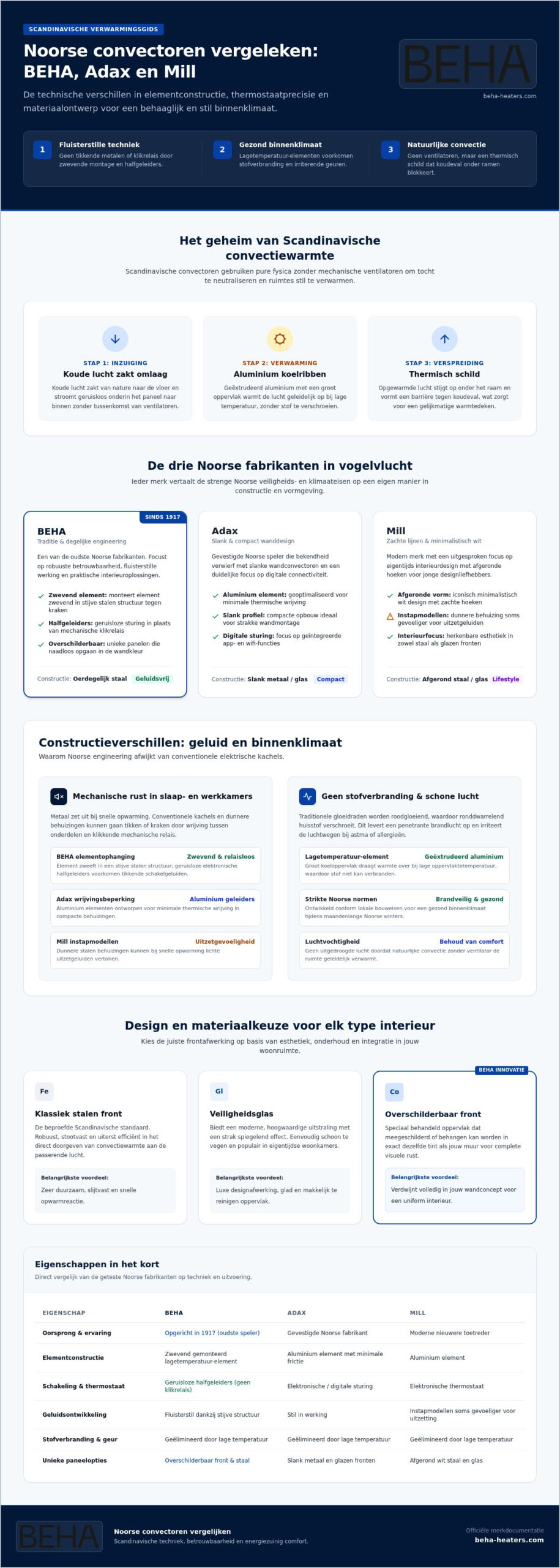
Scandinavian convection heating relies on pure physics without mechanical fans. Cold air sinks to the floor, flows into the bottom of the heating panel, and glides past a specially shaped heating element. This element, usually made of large-surface extruded aluminum, gradually heats the air at relatively low temperatures. The heated air rises silently and spreads evenly throughout the room.
If you place an elongated wall convector under a window, the rising warm air forms a thermal shield. This neutralizes the so-called cold draft, the chilly draft created when air cools down along cold glass. The result is an even blanket of heat throughout the entire room, without disruptive air movement or dry, burnt air.
The three major players at a glance
Anyone delving into Norwegian heating technology invariably encounters three leading names:
- BEHA: Founded in 1917, making it one of the oldest Norwegian manufacturers. BEHA is known for rock-solid engineering, whisper-quiet operation, and robust materials, complemented by handy innovations such as paintable panels.
- Adax: An established player that gained recognition with sleek, compact designs and a strong focus on slim wall-mounted models with digital connectivity.
- Mill: A modern brand that entered the market with a distinct focus on soft, rounded shapes and a stylish white design aimed at young interior enthusiasts.
If you compare Norwegian convectors from BEHA, Adax, and Mill, you will discover clear choices regarding technology, sustainability, and ease of use behind these different design traditions.
Comparison based on heating technology and energy efficiency
Many specification lists show only wattage and dimensions. However, anyone who truly wants to compare Norwegian convectors (BEHA, Adax, Mill) must look deeper: at the heat transfer within the unit and the sophistication of the controls. The European Energy Efficiency First principle imposes strict requirements on space heating. A convector that peaks unnecessarily or distributes heat poorly immediately drives up power consumption. True efficiency therefore begins with the construction of the heating element and flawless thermostat measurement.
Construction of the heating element and noise generation
Differences in quality become particularly apparent when a panel heats up and cools down. Cheap electric heaters often use simple filaments that glow red, scorching swirling dust. This causes a pungent burning smell and irritates the airways of people with asthma or allergies. Top Scandinavian models therefore utilize low-temperature elements with extruded aluminum cooling fins.
In addition, mechanical quietness plays a major role in bedrooms and offices. When metal expands upon heating, a poorly designed housing can creak or tick noisily. BEHA mounts the heating element floating within a rigid steel structure and uses silent semiconductors instead of mechanical click relays. Adax employs similar aluminum elements with minimal friction, while Mill, in some entry-level models with thinner steel housings, sometimes proves more susceptible to slight expansion noises during rapid heating.
Thermostat precision and real energy savings
A stable indoor temperature is the key to a low energy bill. Simple thermostats often let the temperature overshoot by one to two degrees before switching off. Every degree of overheating immediately means approximately 6% extra power consumption. The Norwegian standard is significantly higher:
- BEHA: Operates with a highly sensitive electronic triac thermostat with a deviation of only 0.2 degrees. As soon as the target temperature is reached, the power modulates down silently.
- Adax: Offers digital thermostats with weekly programming and adaptive start, ensuring the room reaches the desired temperature exactly on time.
- Mill: Uses Predictive Heating via the app, where algorithms learn how quickly the room cools down and heats up.
All three brands meet the strict ECODESIGN Lot 20 guidelines thanks to features such as open window detection. Those who want maximum control over consumption and comfort preferably choose an electric convector with Wi-Fi. Curious which technical configuration best suits your home? Then check out the well-thought-out solutions at behabeha-heaters.com a sustainably heated living space.
Design and material selection: steel front, glass or paintable
Looks matter, but in practice, the front panel determines more than just the appearance of your room. It also influences ease of maintenance and robustness in daily use. Those looking for targeted heating for specific rooms often consciously choose direct convection. Especially now that organizations are critically pointing out the high electricity costs and disadvantages of an electric central heating boiler as the main installation, compact wall convectors are ideal for heating only the rooms where you actually spend time. But which material suits your situation best?
Durability of steel versus fragility of glass
Tempered safety glass instantly gives a radiator a sleek, contemporary finish. Brands such as Mill and Adax are focusing heavily on glass fronts to enrich modern interiors. However, there is a practical side to glass. In busy households with playing children or pets, every speck of dust and every greasy fingerprint is visible on the reflective surface. Moreover, glass requires caution when installing it in narrow hallways.
Powder-coated steel therefore remains the most durable choice. The material conducts heated air quickly and withstands impacts from toys or vacuum cleaners without scratching or cracking. Would you like to delve deeper into the sturdiness and technical benefits of this rock-solid finish? Then consult our guide on the electric heater with a steel front.
The unique aesthetics of paintable panels
If you compare Norwegian convectors (BEHA, Adax, Mill), you will encounter a fixed interior boundary with most brands. Adax primarily supplies sleek rectangles in white or anthracite, while Mill emphasizes soft curves in neutral white. Such panels always remain visibly present as a clearly recognizable radiator.
BEHA solves this design challenge in a fundamentally different way with innovative paintable panels. These steel front plates are factory-equipped with a special bonding layer, allowing you to effortlessly paint them using exactly the same wall paint as your back wall. Whether you choose warm earth tones, deep blue, or a concrete look: the panel blends seamlessly into the overall design. Read all practical installation steps and finishing tips in our comprehensive manual on the paintable radiator. This way, you combine Norwegian heating technology with complete design freedom, without being tied to factory colors.
Smart control: app experience, Wi-Fi stability and smart home
Setting up a well-designed heating schedule via your smartphone sounds ideal, but in practice, it stands or falls with reliable software. Nothing is more frustrating than a heater that suddenly goes offline due to an update or a malfunctioning home network. When comparing Norwegian convectors (BEHA, Adax, Mill), we see that all manufacturers are focusing on digital connectivity. However, the underlying architecture, susceptibility to malfunctions, and degree of cloud dependency vary considerably.
A closer look at the app features of BEHA, Adax, and Mill
The user experience varies significantly by ecosystem. Mill opts for a visually appealing app with beautiful graphs and predictive schedules. However, users of this platform frequently report synchronization problems after router updates. Adax offers a clear layout that allows you to quickly configure weekly schedules and connections with external platforms such as Homey or Google Home. Switching is smooth, although the menu structure sometimes requires some getting used to.
BEHA approaches app control with Norwegian reliability and simplicity. The application focuses on pure stability, clear zone divisions, and immediate response times:
- Zone management: Group radiators by room (such as study, bathroom, or living space) and adjust the target temperature with a single slider.
- Consumption monitoring: Instantly track how long the convectors actually consume power to eliminate peak moments.
- Intuitive schedules: Set separate comfort, eco, and anti-frost modes for each part of the day without confusing submenus.
Connectivity, privacy and manual backup
Most modern routers combine 2.4 GHz and 5 GHz into a single dynamic mesh network. As a result, cheaper Wi-Fi chips often lose their connection. The latest generations from these Norwegian brands therefore use Bluetooth to ensure a seamless initial setup. Nevertheless, the risk of internet outages always remains. What happens if your provider is down for a day, or if you have guests over who want to adjust the heating?
In some minimalist designs, physical buttons are almost entirely absent, leaving you dependent on cumbersome resets in the event of a network failure. BEHA deliberately opts for robust dual control: full smart control via the app, combined with discreet, manual controls on the panel itself. Even if the internet is lost, the internal memory continues to execute the schedule locally. Would you like to experience for yourself how worry-free a stable heating system operates? View the complete range of smart convectors at behabeha-heaters.com regulate your indoor climate with proven reliability.
Which Norwegian brand suits your situation best?
The decisive choice between these Scandinavian manufacturers depends primarily on your interior design preferences, the type of living space, and how much importance you place on acoustic comfort. When comparing Norwegian convectors (BEHA, Adax, Mill), it becomes clear that each brand caters to a very distinct user profile. While one panel shines primarily as a visual statement in a trendy seating area, another excels through quiet, invisible warmth in the background.
Selection guide based on your home and interior style
To quickly determine which manufacturer suits your living room, office, or bedroom, this direct overview will help:
- Choose Mill if your interior is dominated by soft shapes and modern designer furniture. Mill is perfectly suited for those seeking a striking, elegant stove with rounded corners that can be considered a modern design object.
- Choose Adax when dealing with limited wall space. The extremely slim, rectangular profiles fit well in narrow niches or under low window sills, provided you choose the standard factory colors white or anthracite.
- Choose BEHA if absolute silence, a shock-resistant construction, and aesthetic harmony are paramount. Are you looking for a radiator that literally disappears against the wall because you paint the front along with it, or do you want a robust steel panel for the nursery that never ticks or burns dust? Then BEHA the most complete solution.
Ready for carefree Norwegian comfort in your home
A well-considered selection begins with a thorough inventory for each room. Determine the surface area, check the insulation value, and match the required power to the function of the space. After all, a bedroom places very different demands on noise reduction and thermostat precision than a flow-through space such as the hallway.
As a Norwegian family business, BEHA heating solutions since 1917 that effortlessly withstand harsh polar winters. This manufacturing experience of over a hundred years translates directly into reliable ECODESIGN controls, whisper-quiet heating elements, and well-considered material choices. Do you want to equip your home with proven technology that provides heat trouble-free for years? Explore the versatile possibilities and choose your ideal BEHA convector for an energy-efficient and behahome.
Choose sustainable heat and Norwegian reliability for your home
True living comfort requires more than just a beautiful exterior. If you want to compare Norwegian convectors (BEHA, Adax, Mill), be sure to look at what is happening under the hood: an extremely stable thermostat, trouble-free operation, and heating elements that do not make annoying noise or scorch dust. This ensures a behaindoor climate and a low energy bill.
With over 100 years of Norwegian heating tradition since 1917, BEHA this robust technology with unparalleled design freedom. While other brands restrict you to standard factory colors, BEHA your radiator to blend seamlessly into your interior. Add to that the whisper-quiet, allergy-friendly elements and strict adherence to the latest ECODESIGN standards, and you bring home a reliable solution that will last for dozens of winters. Discover the complete range of Norwegian convectors from BEHA and enjoy carefree warmth every day.
Frequently asked questions about Norwegian convectors
What is the main difference between Norwegian convectors from BEHA, Adax, and Mill?
The main difference lies in the construction philosophy and the aesthetic finish. Mill focuses primarily on contemporary, round shapes in neutral white. Adax supplies sleek, compact panels with digital smart home functions. BEHA distinguishes itself with a rich Norwegian history dating back to 1917, whisper-quiet low-temperature elements, and unique paintable steel fronts that blend seamlessly into your wall. If you want to compare Norwegian convectors (BEHA, Adax, Mill), BEHA offers the most interior freedom combined with robust quality.
Are Norwegian convectors more energy-efficient than regular electric heaters?
Yes, Norwegian convectors consume noticeably less power thanks to highly precise electronic thermostats. While simple heaters with mechanical thermostats cause the room temperature to fluctuate by several degrees, Norwegian sensors react to minimal deviations of just 0.2 degrees. Because the power continuously modulates with fine-meshed precision and features such as open window detection and smart weekly scheduling immediately counteract heat loss, you prevent overheating and save significantly on unnecessary power consumption.
Why do people choose paintable convectors instead of standard white?
People choose paintable convectors because they allow the radiator to match the exact shade of their interior. Standard white or dark radiators often stand out harshly against a carefully colored wall. With a speciallybeha-treated steel front panel, you can effortlessly paint the heater along with regular wall paint. This allows the panel to visually blend with your room, without compromising on fast heat conduction or reliable Norwegian technology.
Can I continue operating a Norwegian convector if the Wi-Fi connection drops?
Yes, high-quality Norwegian convectors always continue to function locally without an active internet connection. Although the smartphone app offers great convenience for weekly schedules, reliable models feature physical controls on the panel itself. Should your network fail, the internal memory simply continues to execute the programmed schedule locally. Furthermore, you can easily adjust the target temperature manually, ensuring you are never left in a cold house.
Are Norwegian convectors suitable as primary heating for an entire home?
In well-insulated homes, Norwegian convectors can serve excellently as comfortable primary heating. By installing a panel with the correct output in every room and programming them smartly via zones, you achieve highly targeted heating. In less well-insulated houses, on the other hand, they function particularly well as direct supplementary heating in specific living spaces, such as the home office or bedroom, where you desire warmth quickly and silently.
Do Norwegian convectors make ticking noises while heating up and cooling down?
High-quality Norwegian convectors are specifically designed to operate whisper-quietly without annoying ticking. The disturbing crackling in cheap heaters is caused by expanding frame parts and ticking mechanical relays. Manufacturers such as BEHA prevent this by mounting extruded aluminum heating elements suspended within a rigid housing and using electronic triac switches. As a result, you hear no clicking noises, which is essential for a peaceful night's sleep in the bedroom.
Are BEHA electric convectors safe for use in a family with small children?
Yes, BEHA convectors are exceptionally safely designed for families with growing children. The heaters operate with advanced low-temperature elements, ensuring the surface temperature of the steel front panel remains pleasantly low and eliminating the risk of burns. Additionally, no swirling dust burns, protecting the respiratory system. The solid steel housing effortlessly withstands impacts from toys, while a child lock prevents settings from being accidentally changed.