
Connecting a wall convector for caravans and motorhomes at the campsite
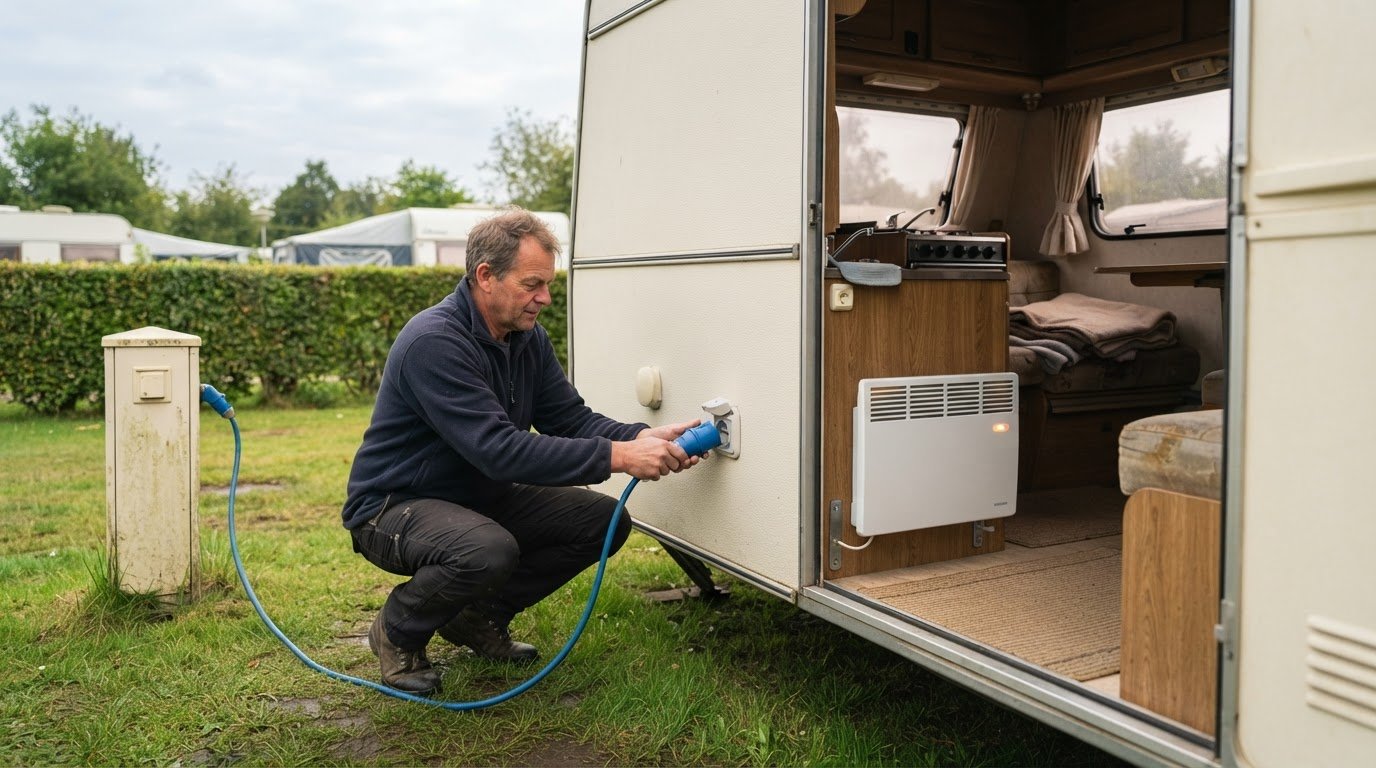
A wall-mounted convector for caravans and motorhomes is connected to the 230-volt power supply at the campsite. Keep in mind that electric heating easily requires at least 10 A of campsite power. The available power therefore determines whether you can use the heater without overloading the power supply.
At the campsite, you want to be pleasantly warm and be certain that the connection and installation of your heater are safe. In this article, you will read how to estimate power consumption and what to look out for before using a wall convector for caravans and motorhomes.
You will read practical tips on connecting, installing, and safely heating a caravan or camper. It also covers why ventilation is important and when electric heating is less suitable, for example, if you are camping without mains power and rely on a battery and inverter.
Key points
- Discover how electric air heating distributes heat throughout the caravan or camper and when another heating method is a better fit.
- Learn to estimate the power consumption of a heater and take it into account when choosing one for use at the campsite.
- See what to look for regarding wall mounting, free airflow, and the suitability of a heating panel for the room.
- Read how to heat safely and which features of convection heaters suit your camping style.
Why choose electric heating in your camper?
Electric heating can provide extra warmth in motorhomes and caravans. The right choice depends on, among other things, the existing heating system, the camping season, and the available power.
Electric air heating for motorhomes and caravans
Two types of heating systems are found in motorhomes: circulating air systems and circulating fluid systems. With air heating, warm air is often distributed throughout the motorhome via ducts, so that the heat extends beyond the location of the unit. Consider where you need heat and whether air heating suits the layout of your vehicle.
A caravan owner who usually camps from May to October might not expect to need electric heating often. Those who also travel in cold conditions are more likely to look at the heating capacity and warm-up time. A caravan is considered winter-proof when it heats up from -15°C to +20°C within four hours. That is a different need than occasional supplementary heating.
Electric heaters for caravans, campers, and tents
An electric heater can be suitable as temporary supplementary heating, whereas a permanent system is part of the setup. When using electric heating, it is important to check what power supply is available. Therefore, first determine whether you will use the heater primarily at the campsite or also want to heat while on the road.
Different considerations apply to a tent compared to a caravan with fixed wall space. Check where heat is needed and what power supply is available. A portable heater can be moved, whereas a wall-mounted model requires a suitable installation location. These practical differences help determine which type of heating suits your camping setup.
Electric and infrared heating
An electric convector heats the air in the room. Infrared heating works differently: the radiation directly heats the people and objects it falls on, without first heating the air. That is why where you sit or stand also plays a role. Consider, for example, a seating area that you want to make more comfortable temporarily.
Portable infrared panels can be used in a location where temporary heat is needed. Flat, lightweight panels can be mounted on the wall or ceiling. Compare not only the heating method, but also the use: do you want to heat the air in the room or targeted heat in a specific spot?
How do you connect an electric heater at the campsite?
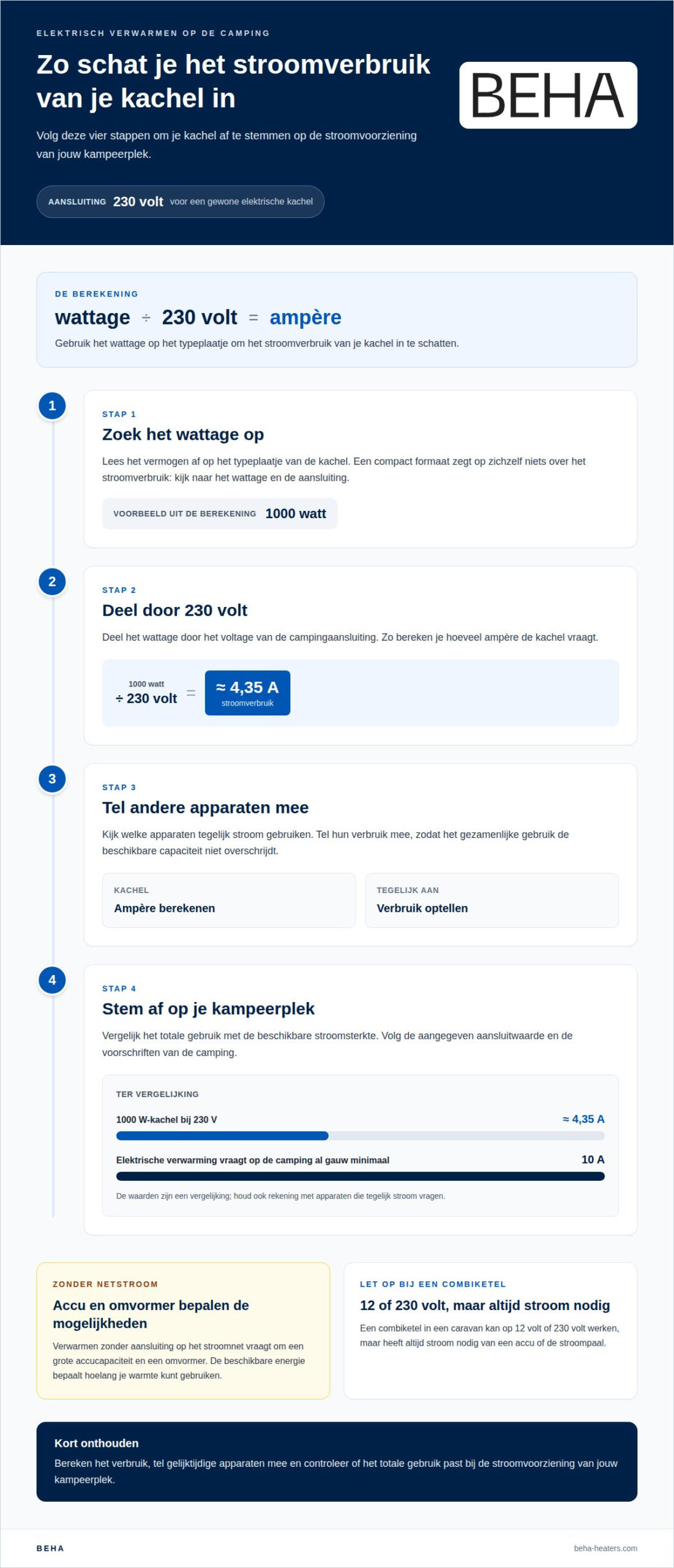
An electric heater for a caravan or motorhome operates on 230 volts and requires connection to the campsite's power grid. For Dutch campsites, follow the indicated connection value and the campsite regulations. There is no specific national rule mentioned here regarding heater usage; the available current practically determines how much power you can use.
Calculate the power consumption by dividing the wattage by the voltage. A 1000-watt heater uses approximately 4.35 amperes at 230 volts. For comparison, electric heating at a campsite easily draws at least 10 A. Also include other devices that draw power simultaneously. This prevents you from exceeding the available capacity.
Use these steps to estimate the power:
- Look up the wattage on the heater's rating plate.
- Divide that number by 230 volts to calculate the current consumption in amperes.
- Take into account devices that are switched on at the same time.
- Adjust your total usage to the power supply at your campsite.
A combi boiler in a caravan can operate on 12 volts or 230 volts, but always requires power from a battery or a mains connection. The fan draws air into the combustion chamber. A standard electric heater also requires a mains connection. Heating without a connection to the power grid therefore requires a large battery capacity and an inverter; the available energy determines how long you can use the heat.
A compact heater can be handy in a place with limited space, but a small size says nothing about power consumption. Look at the wattage and the connection, not just the dimensions. A wall-mounted convector for caravans and motorhomes must also match the capacity of the campsite's power supply. Base your choice on the camping pitch, appliances that use power simultaneously, and the desired heat.
Adhere to the indicated connection capacity and the campsite regulations. The available current limits the power you can practically use. Therefore, also include other appliances consuming power simultaneously.
IP rating and placement of heating panels
Start with the location: a convector panel for a caravan hangs low on the wall or stands on the floor. Check how much free space the installation site offers and take furniture and foot traffic into account. For example, 50 cm of height and 70 cm of width may be available for a replacement heater. Measure the available space before choosing a model.
The IP rating helps you assess whether a panel is suitable for the environment in which you intend to use it. Choose a model with an appropriate rating, especially for a wet room in the caravan. Do not base your choice solely on appearance: check the IP rating and installation instructions. A heating panel on a dry wall requires different attention than heating close to moisture.
Infrared panels are flat and lightweight, and can be mounted on a wall or ceiling. This makes them suitable as local supplementary heating, for example, directed at a seating area. Heating mats also exist for warm feet. A camper reported that an 80-watt floor heating mat in a small caravan could maintain the temperature at around 18 degrees when left on all day. That example shows how application and duration of use are related.
The systems differ in heat distribution and placement. A convector heats the air; infrared heats people and objects directly within the range of the radiation. A free-standing model requires floor space, while a wall panel leaves that space free. For wall mounting, a caravan owner used spacers to keep a distance of 1 cm from a cupboard. That is a practical example, not a general mounting distance. Follow the installation instructions for your specific appliance. Electric heating does not involve fuel combustion inside the caravan itself. If you want a quiet solution, check whether the chosen system uses a fan and how it distributes heat.
Safety and overheating protection
When heating a caravan or camper, appliance safety, placement, and ventilation are all important. Review these points before switching on the heating while traveling.
Protection against overheating
For infrared heating, choose a model with overheating protection and an IP rating suitable for the operating environment. The protection helps limit the risk if the device becomes too hot. A location in the bathroom requires different attention than a dry wall next to the seating area.
Keep the air vents clear and do not place any items against the unit. A jacket or cushion over a heater can obstruct heat dissipation. Follow the installation and operating instructions, even if you are only using the heater temporarily.
Safe use and ventilation
Always ensure adequate ventilation when using a heater in a caravan or camper. This also applies when the heat feels pleasant and you want to keep the space comfortable. Keep ventilation openings clear and do not completely seal off the caravan while heating.
Electric heating does not use a gas burner in the appliance itself. A gas heater works by combustion and therefore requires attention to the gas installation and air supply. Have the installation professionally checked in accordance with the stated maintenance advice of once every two years. If you use different heating systems while traveling, follow the specific manual for each appliance.
Before use, check the location, the connection cable, and the free space around the heater. Place a freestanding unit securely and keep textiles and luggage away. A wall panel must be firmly attached so that movement of the camper does not dislodge it. Do not use the unit if the cable is damaged or the mounting is unstable.
A fan can distribute heat throughout the room, but ensure the air outlet remains clear. Turn off the heating before moving items or cleaning the area. This prevents luggage from blocking the airflow when you turn the heater back on.
BEHA
BEHA offers electric convectors for those seeking an alternative heating solution. The range includes smart convectors with a steel, glass, or paintable front, and Classic convectors. The smart versions can be controlled via Wi-Fi and an app.
For use in a caravan or camper, the mounting location and power supply are important selection criteria. Compare these with the specifications of the convector. This way, you determine whether a wall-mounted model suits the interior and use at the campsite, without losing sight of the connection capacity.
Would you like to choose an electric convector that suits your heating needs? Contact BEHA to discuss the possibilities.
Choose heating that suits your camping plans
Choose heating based on how you use your caravan or camper. Consider the available space, the power supply, and where you need heat. A wall convector for caravans and campers therefore requires more consideration than just looking at the appearance. Choose a solution that fits the interior and your camping style.
BEHA offers smart convectors with a steel, glass, or paintable front. The finish can therefore also be a factor in your choice of an electric convector. View the options and determine which model suits your needs for home or camping.
Would you like to discuss your choice further? Contact BEHA. With a suitable choice, you take a calm, comfortable step towards warmth during your next camping trip.
Frequently Asked Questions
What should you look out for?
Pay attention to the power output, the mounting, and the space the heater occupies. Also consider where the cables run so that they do not block a walkway or door. In a camper that is often on the road, secure mounting is especially important. Additionally, determine whether you want to heat the entire space or primarily a single seating area. This will help you choose the most practical type of heating.
What is the best heater for your caravan?
The best choice depends on how the caravan is used. For occasional warmth at a campsite, an electric heater might be suitable; when traveling during cold periods, the need for structural heating is more important. Also check whether the caravan already has a heating system and how much space is available. A solution that fits the layout is more practical than choosing based solely on the appliance type.
How many watts of power does a wall convector need for a caravan or camper?
There is no fixed wattage that is suitable for every caravan or camper. The required heat depends on factors such as space, insulation, outside temperature, and duration of use. A small caravan that only needs extra heat requires something different than a camper used in colder conditions. Also, match the power output to the available power capacity.
How much does a wall convector for a caravan or camper cost in the Netherlands?
The price depends on the unit and the model. Compare not only the purchase price, but also the heating method, installation, and operation. For a convector at the campsite, it is particularly important whether the specifications match your space and power supply. Check the product information for the model you are considering.
What is the power consumption of an electric wall convector at the campsite?
Consumption depends on the power output and how long the convector is switched on. Calculate the energy consumption by multiplying the power in kilowatts by the number of operating hours. A 1000-watt unit that heats for two hours consumes a maximum of 2 kilowatt-hours if it operates continuously at full power. A thermostat can affect the actual operating time at full power.
Can a wall-mounted convector be used at a campsite with 6 or 10 amps of power?
That depends on the power output of the convector and what you are using simultaneously. A 1000-watt heater draws approximately 4.35 amperes at 230 volts. With a 6-amp connection, that leaves little room for other appliances; more capacity is available at 10 amperes. Take into account items such as a kettle or refrigerator, and the campsite's connection requirements.