
Convector heating: Everything about efficient electric heating
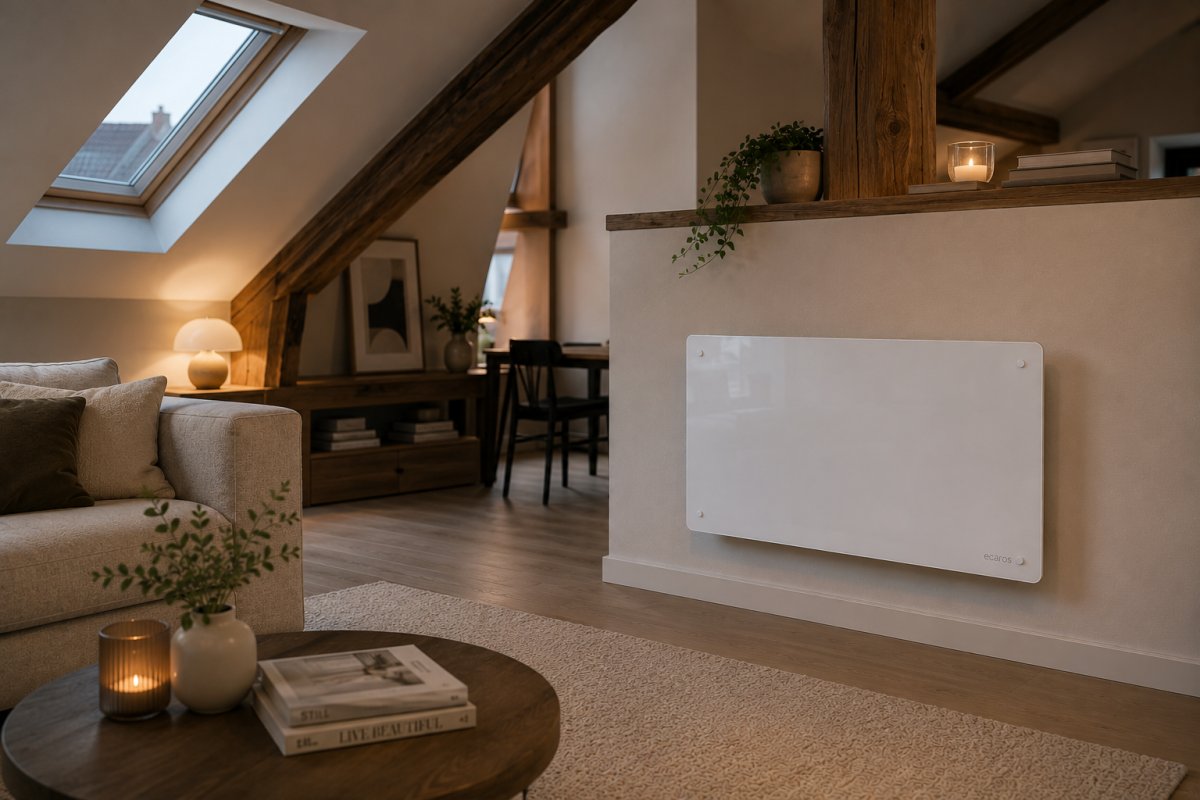
Convector heating is a fast and quiet way to electrically heat a single room or multiple zones. But what power output do you need, how much does a convector cost per hour, and when is a radiator, infrared panel, or heat pump a more sensible choice? In this practical guide, you will get honest answers, concrete calculation examples, and a buying checklist for homes in Belgium and the Netherlands.
Convector heating in brief
- An electric convector heats the room air primarily through natural convection.
- Fanless models are quiet and responsive, making them strong as zone or supplementary heating.
- Power consumption is determined by wattage, actual duty cycle, insulation, and thermostat setting.
- An electronic thermostat and weekly program save by limiting unnecessary heating hours.
- For long-term main heating of an entire home, a heat pump is generally more efficient.
What is a convector and how does this heater work?
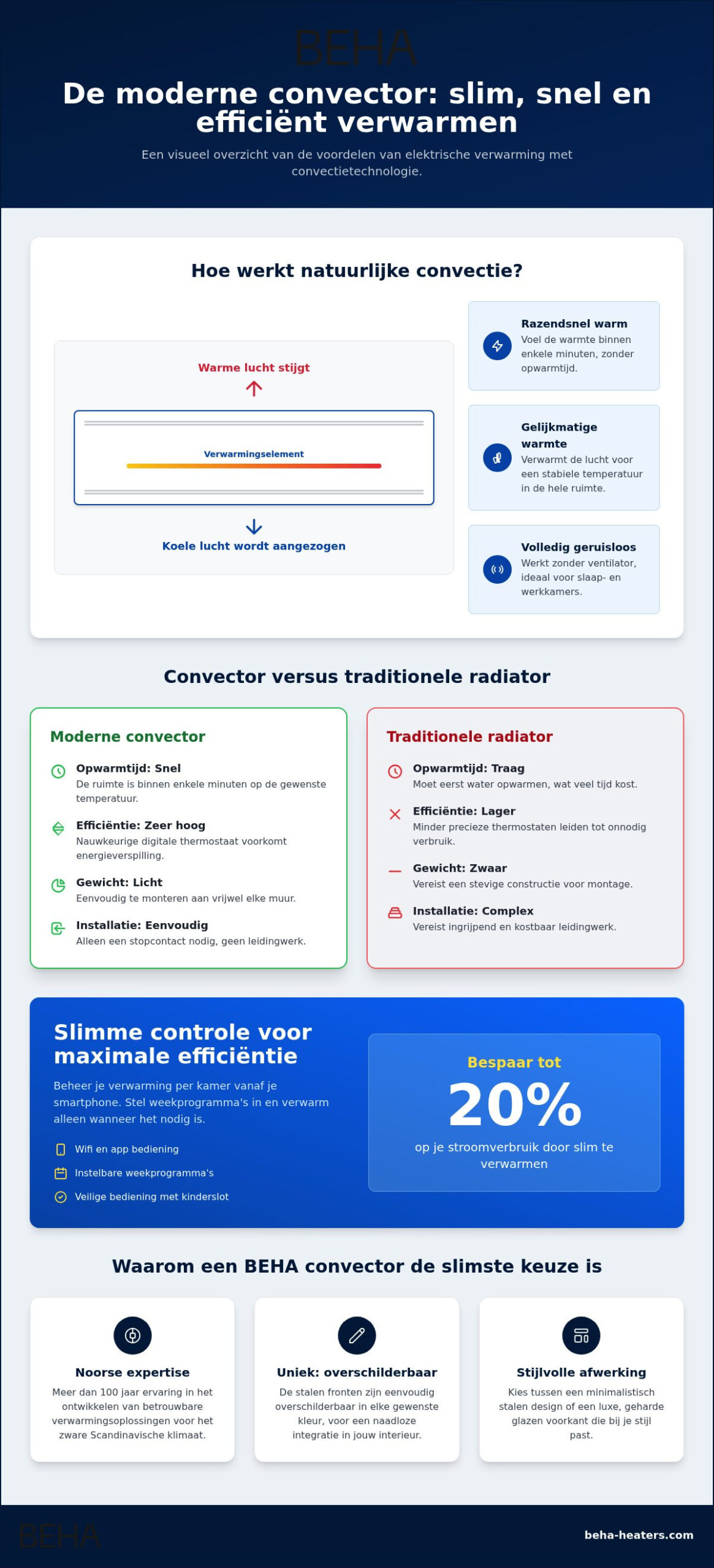
An electric convector draws in cooler air from below. This air flows past an electric heating element, heats up, and rises back into the room through the top. As soon as the air cools, it sinks and the cycle begins again. This is called natural convection. You can find more background on the physical principle at convection heaters.
Not every convector uses electricity. A water-based convector contains a heat exchanger with hot water from a central heating boiler or heat pump. A floor convector is installed in a channel near a window. This page focuses primarily on electric convector heating: a standalone device with a plug or fixed electrical connection and its own thermostat.
Convection heat as opposed to radiant heat
Convection primarily heats the air. Radiant heat heats people and surfaces directly. The distinction is not absolute: a radiator also uses airflow, and the warm casing of a convector also radiates heat. A fanless convector usually responds quickly but retains little heat after being switched off. A heavy oil-filled radiator responds more slowly and cools down more slowly.
Does a convector dry out the air?
A convector does not remove moisture from the air. However, heating does lower the relative humidity because warmer air can hold more water vapor. As a result, the air may feel drier. Ventilating, avoiding unnecessary heating, and possibly measuring the humidity are the best measures.
Advantages and disadvantages of electric convector heating
Convector heating is particularly attractive when a room needs heat quickly and you do not want to install pipes. A fanless model has no fan and is therefore suitable for spaces where peace and quiet are important.
The main benefits
- Quick response: the element and airflow get going shortly after switching on.
- Silent operation: a model without a fan has virtually no moving parts.
- Room-by-room control: you only heat the zone that is being used at that moment.
- Easy installation: no central heating pipes, pump, or boiler are required.
- Low maintenance: keep air vents clear and clean the unit according to the manual.
- Flexible design: fixed wall-mounted models and movable versions on feet are available.
The limitations you need to know in advance
- With many daily operating hours, direct electric heating can have relatively high operating costs.
- After switching off, there is little stored heat.
- With high ceilings, warm air can collect at the top.
- Blocked air vents reduce performance and can be unsafe.
- Air circulation can move dust; regularly removing dust helps.
Is an electric convector really energy-efficient?
An electric resistance element converts virtually all the electricity consumed into heat at the point of use. Therefore, a 1,500-watt convector is not automatically more economical than another 1,500-watt electric resistance heater. The advantage lies in precise control, fast response, and zone heating. A good thermostat prevents overshoot, and a program limits the hours when no one needs heat.
For long-term main heating, a heat pump transfers heat and typically delivers more heat per kWh of electricity. Milieu Centraal explains why a heat pump heats electrically more efficiently. A convector remains a good option for temporary heating, individual rooms, or when installing a central system is not suitable.
Convector versus radiator: which one do you choose for your home?
The term radiator can refer to a water-based panel radiator or an electric, oil-filled model. Therefore, compare not only names, but also energy source, heat output, controls, and service life.
| System | Strong point | Best application | Point of attention |
|---|---|---|---|
| Electric convector | Fast, quiet, and adjustable per room | Zone and supplementary heating | Electricity costs over a long period of use |
| Water-based radiator | Works with central heating or heat pump | Central heating multiple rooms | Pipes and heat source needed |
| Oil-filled radiator | Even heat and slow cooling | Prolonged use in one room | Heavier and slower warming |
| Infrared panel | Direct radiation to person or surface | Fixed work or seating area | Less effect outside the radiation zone |
| Heat pump | High seasonal efficiency | Many heating hours or entire home | Higher investment and design needed |
When is a convector the best choice?
Choose convector heating for a study used only during the day, a bedroom that needs to be warm shortly before bedtime, an insulated hobby room, or a holiday home with separate zones. An accurate schedule makes all the difference here. For a poorly insulated home that needs to stay warm all day, it is better to first investigate insulation and a more efficient main system.
Comfort and warmth experience
A convector can heat the room air evenly when the unit is properly sized and the air circulates freely. However, with a high ceiling, the temperature can differ between the floor and the ceiling. Infrared feels warm directly on the skin more quickly; a convector is better when you want to heat the entire air volume of a room.
Calculate the power and consumption of convector heating
The correct capacity starts with the heat loss of the room. Surface area alone is insufficient: ceiling height, glazing, exterior walls, ventilation, draft sealing, insulation, and desired temperature all play a role. For primary heating, a professional heat loss calculation is the most reliable choice.
Quick indication in watts
For an initial orientation, you can calculate with approximately 25 to 50 watts per cubic meter. Use the low side only for a well-insulated room. Multiply the floor area by the ceiling height and then by the chosen wattage factor.
| Space at 2.5 m high | Contents | Indication 25–50 W/m³ |
|---|---|---|
| 10 m² | 25 m³ | 625–1,250 W |
| 15 m² | 37.5 m³ | 940–1.875 W |
| 20 m² | 50 m³ | 1,250–2,500 W |
| 30 m² | 75 m³ | 1,875–3,750 W |
An appliance with insufficient capacity cannot reach the set temperature. A more generously sized appliance does not continuously consume its maximum power when the thermostat switches correctly, but the electrical circuit must be able to handle the peak load.
How much does a convector cost per hour?
Calculate the maximum costs using: power in kW × number of hours the element is actually on × your total price per kWh. A 2,000-watt appliance that heats for a full hour uses a maximum of 2 kWh. If the element is on for a total of 30 minutes during that hour due to thermostat control, the consumption is approximately 1 kWh.
| Assets | Maximum consumption per full heating hour | Current at 230 V, approximately |
|---|---|---|
| 500 W | 0.5 kWh | 2.2 A |
| 1,000 W | 1.0 kWh | 4.3 A |
| 1,500 W | 1.5 kWh | 6.5 A |
| 2,000 W | 2.0 kWh | 8.7 A |
Always use your own current energy contract. Rates, network costs, and levies differ between Belgium and the Netherlands. Solar panels do not automatically make winter heating free, because production and heat demand often do not coincide.
Installation and safety of convector heating
For good natural airflow, air must be able to flow in at the bottom and out freely at the top. Under a window, a convector can help limit cold drafts, but always follow the prescribed mounting distances for the specific model.
- Never cover the appliance and do not dry clothes on it.
- Keep curtains, furniture, and other flammable materials at the prescribed distance.
- Use the original wall bracket or suitable feet and ensure stable placement.
- Do not use a faulty extension cable or an overloaded power strip.
- Check the circuit load when multiple electrical appliances are operating simultaneously.
- In the bathroom, use a suitable model only in a permitted zone.
- If in doubt about the connection or IP protection, call in a certified electrician.
European Ecodesign functions
European regulations for local space heaters set requirements for product information and control options. Check the functions and documentation of the selected device using the current information from the European Commission on local space heaters. Useful features include an electronic thermostat, weekly program, open window detection, frost protection, and low standby consumption.
What should you look for when buying a convector?
Good convector heating suits both the room and the usage pattern. Therefore, first assess how many hours per day you need heat and whether the unit will serve as primary or supplementary heating.
Living room
A living room usually requires more power and an even distribution. In a long or open room, two smaller, distributed units can be more comfortable than one large convector in a corner. For long-term daily use, you should also compare a heat pump or a water-based system.
Bedroom
Choose a quiet, fanless model with a weekly program and a precise low temperature setting. Preferably heat specifically around bedtime and waking up. A child lock can be useful in a child's room.
Study or home office
The quick response of a convector is well-suited for office hours. With a schedule, the room does not need to remain at a comfortable temperature unnecessarily in the evenings and on weekends.
Bathroom
A bathroom imposes stricter requirements on electrical safety and installation. Choose only a device that is suitable for the zone in question according to the manufacturer and local regulations. A standard portable convector is not automatically suitable.
Wall-mounted or freestanding?
A wall-mounted model takes up no floor space and has a fixed, predictable position. A freestanding model is flexible, but can be moved to an unfavorable location or tip over if the feet are not mounted correctly. Check whether the selected product is approved for both mounting methods.
Steel, glass or paintable front
The front primarily influences appearance, cleaning, and placement. Some steel fronts can be matched to the interior color. When doing so, follow the manufacturer's instructions exclusively to maintain air vents, heat output, and warranty. Read more in our guide on paintable radiators or view the buying guide for steel fronts.
Smart control with Wi-Fi and app
Wi-Fi does not change the conversion of electricity to heat. However, it can save money if it means you heat for shorter periods or at a lower temperature. Pay attention to weekly programs, zone control, open window detection, local control without internet, and the expected support for the app. Our guide on an electric convector with Wi-Fi goes into this in more detail.
When is BEHA convector heating a suitable choice?
BEHA develops fanless electric convectors for quiet, individually controllable room heating. They are particularly suitable when you want quick comfort without central heating pipes and each room needs its own schedule or temperature. View the current models and product specifications on BEHA Heaters.
Honest advice looks beyond a single product. For many heating hours in an entire home, a heat pump might be the more logical choice. For a single fixed seating area, infrared might be suitable. An electric convector excels in quiet, fast-responding zone heating and easy installation.
11 points for your purchase
- Determine whether you are looking for main heating, supplementary heating, or zone heating.
- Calculate the room volume and have the heat loss determined for main heating.
- Select sufficient power without overloading the electrical circuit.
- Compare the expected operating hours with alternatives such as a heat pump.
- Choose an electronic thermostat with suitable programming functions.
- Check if the model is fanless and quiet.
- Measure the available wall or floor space and mounting distances.
- Check security, IP rating, and suitability for the room.
- Calculate consumption using your own electricity tariff.
- View warranty, service, and app support in Belgium and the Netherlands.
- Follow the manufacturer's installation and usage instructions.
Paintable fronts for a seamless interior
A paintable front allows the heater to visually blend in with the wall. Never paint grilles, sensors, or other parts where this is not permitted. Check the product manual and warranty conditions before you begin.
Norwegian quality and sustainability
Sustainability is not just about the energy source, but also about appropriate sizing, long service life, and repairability. Therefore, compare product warranty, available parts, and support. behaYou can find up-to-date information per BEHAmodel
Switch with a realistic heating plan
Convector heating is not a universal replacement for every heating system. It is powerful when you want to heat a single room quickly and quietly, control the temperature per zone, or cannot install water pipes. Combine the right power output with insulation, a realistic schedule, and safe installation for the best results.
Frequently asked questions about convector heating
Is a convector heater economical to use?
For short-term zone heating, a convector can be used economically. For long-term main heating, direct electric resistance heating generally consumes more electricity than a heat pump. The thermostat, insulation, and duration of use determine the costs.
Can I leave a convector on all night?
Only if the appliance is designed for continuous use, is installed correctly, and is used according to the manual. Use the thermostat and a night program, never cover the appliance, and keep the air vents clear.
What is the difference between a convector and an infrared panel?
A convector primarily heats the room air. An infrared panel radiates heat directly to people and surfaces within its range. For an entire room, convection is often a better fit; for a fixed workspace, infrared can be more targeted.
How many watts do I need for a 20 m² room?
With a ceiling height of 2.5 meters, the volume is 50 m³. A rough indication of 25 to 50 W/m³ works out to 1,250 to 2,500 watts. Insulation, glazing, and outside temperature determine where within that range you fall.
Does an electric convector make noise?
A fanless model is virtually silent. Due to the expansion and contraction of materials, a soft click may sometimes be audible. A fan coil unit, however, does produce fan and air noise.
Can I paint the front of a BEHAconvector myself?
Only if the specific front is paintable according to the product instructions. Use the prescribed materials and procedure and keep grilles, controls, and sensors clear.
Is electric convector heating safe for children and pets?
A correctly assembled device with appropriate safety features can be used safely, but the housing and outgoing air may become hot. If necessary, use a child lock, respect distances, and prevent covering or knocking over.
Can I connect multiple convectors to one circuit?
That depends on the total power, other loads, and the capacity of the circuit. Two 2,000-watt appliances draw approximately 17.4 amperes together at 230 volts and are too much for a standard 16A circuit when using full power simultaneously. Have any doubts assessed by an electrician.
Where should I place a convector?
Place it where air can flow in freely at the bottom and out at the top. Cold drafts under a window can be limited, provided the curtains and windowsill respect the prescribed distances.
Does a heavier convector always have higher energy consumption?
The maximum consumption per heating hour is higher, but a thermostat switches off a suitable unit as soon as the temperature is reached. The heat demand of the room remains the decisive factor. An undersized unit can actually continue heating almost continuously.