
Convector vs. underfloor heating: what is the best choice for your home in 2026?
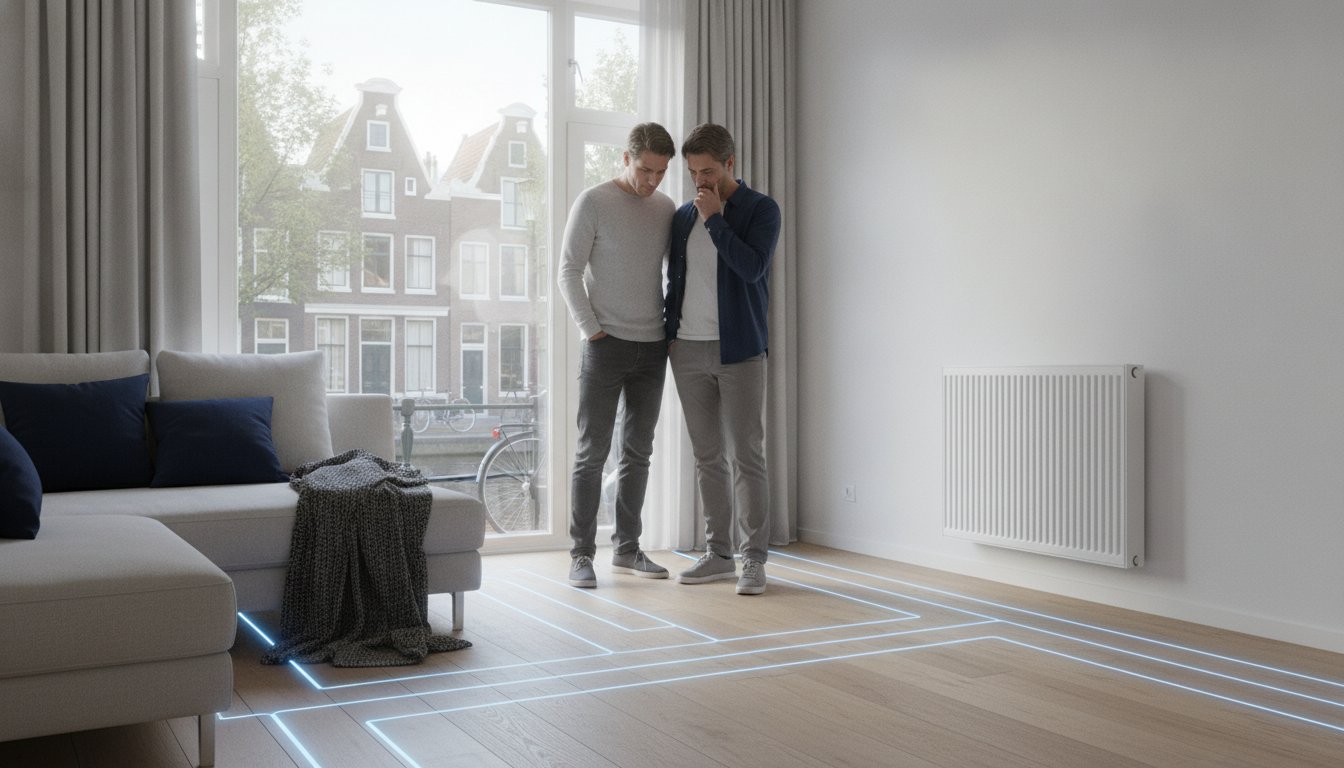
Imagine this: it is a crisp morning in 2026 and you step into your living room, but it takes hours for the floor to finally reach the desired temperature. Although underfloor heating is often praised for its even warmth, the high installation costs and slow warm-up time leave many homeowners hesitant. Is that major renovation really worth the investment if you also want immediate comfort? Nowadays, a smart convector is a serious alternative to underfloor heating, especially when you are looking for flexibility and speed without breaking up your entire floor.
We understand that you want to make a choice that both increases your living comfort and keeps your monthly costs manageable. In this article, you will discover the crucial differences between convectors and underfloor heating, so you know exactly which solution best suits your home and budget. We dive deep into the world of modern heating technology, from the benefits of Wi-Fi control via the BEHA app to the savings you can realize by heating smarter. In doing so, we pave the way for an informed decision that ensures a warm, smart, and sustainable home.
Key Points
- Understand the fundamental difference between circulating air and direct radiant heat for ideal heat distribution in your home.
- Discover why a smart convector is the ideal alternative to underfloor heating when you want to be able to switch quickly to fluctuating temperatures.
- Learn how to avoid high renovation costs by choosing a system that requires no hacking or breaking of your existing floor.
- Gain insight into the total costs over fifteen years and discover why the purchase price of convectors is often a fraction of floor systems.
- Experience how the BEHA app gives you complete digital control over your energy consumption and the temperature in every individual room.
What is the difference between a convector and underfloor heating?
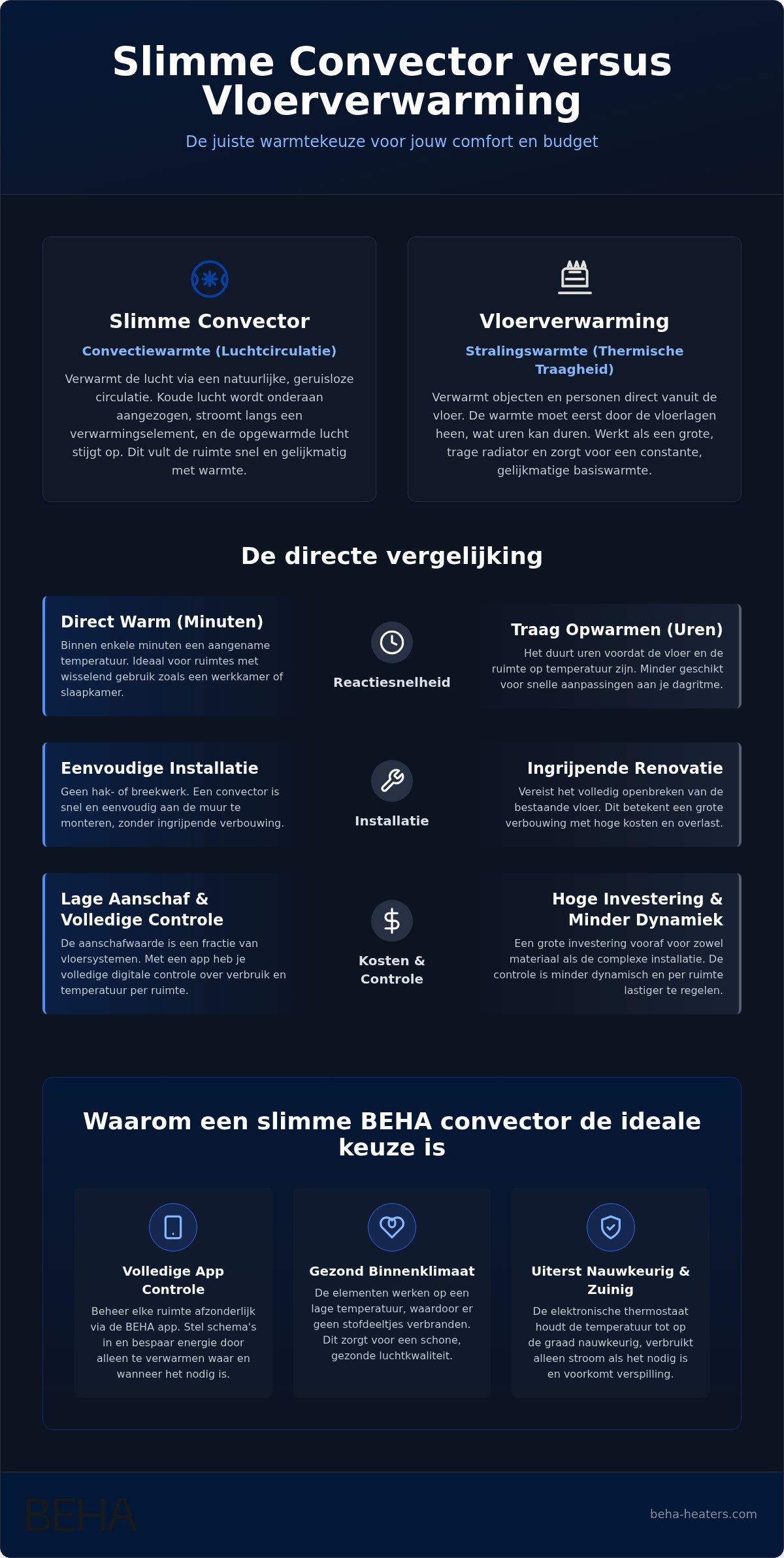
To make the right choice for your home, it is essential to understand how heat travels. With underfloor heating, everything revolves around radiant heat. The floor acts as a large radiator that directly heats objects and bodies in the room. A convector works differently; it uses air circulation to bring the room up to temperature. For many people looking for a flexible alternative to underfloor heating, this technology offers benefits that are immediately noticeable in daily life. The level of insulation in your home plays a major role in this. In a modern Dutch home with good insulation, both systems perform excellently. However, the way you experience the heat differs significantly. The choice determines whether you opt for constant, slow base heat or for a system that responds immediately to your needs.
How does an electric convector work?
An electric convector operates on the principle of natural airflow. Cold air is drawn in at the bottom of the unit. This air flows past an internal heating element, heats up, and then rises again through the top. This process creates a circulation that quickly fills the entire room with warmth. If you are curious about the exact physics behind " What is a convector?", it is good to know that this process is completely silent. In BEHA , these elements have been developed to operate at a lower surface temperature. As a result, they do not glow. They do not burn dust particles, which is essential for healthy air quality in the home. The built-in electronic thermostat monitors the temperature to the nearest degree. The heater only consumes energy when it is truly necessary.
How underfloor heating works in a nutshell
Underfloor heating is characterized primarily by thermal inertia. The heat must first travel through the screed and the final floor covering before reaching the room. This process can take hours. Therefore, you cannot simply switch the heating on or off. In new Dutch construction, this is often the standard solution for the base load. However, for renovation projects, the impact can be significant due to the necessary adjustments to the floor. There is a fundamental difference between water-based systems and electric variants. While water-based systems work well with heat pumps, electric underfloor heating can take a substantial bite out of your budget due to its high power consumption. That is precisely why a smart electric heater is an attractive alternative to underfloor heating in rooms where you desire immediate control and a fast response time.
Comfort and responsiveness: how quickly do you want to get warm?
In a country like the Netherlands, where the weather can fluctuate significantly throughout the day, the responsiveness of your heating system is a determining factor in your living comfort. While underfloor heating takes hours to bring a room to the right temperature, a convector responds almost immediately. This makes a modern convector a smart alternative to underfloor heating, especially in homes where not every room is used intensively throughout the day. The ability to determine when and how intensely each room is heated creates a dynamic indoor climate that adapts to your daily rhythm.
The benefits of rapid heating
Imagine stepping into your home office in the morning. With a traditional floor heating system, you have to plan hours in advance to get it beha. A convector heats the air instantly, allowing you to experience a pleasant temperature within minutes. This flexibility is indispensable for people with irregular schedules or those who work from home frequently. An electric convector with Wi-Fi helps you time your comfort precisely via a user-friendly app, ensuring the heater only operates at full power when you are there.
This principle is also ideally suited for the bedroom. Here, you often want a cooler climate for sleeping, but a brief period of warmth when getting up or getting dressed is certainly pleasant. Underfloor heating is often too cumbersome in such rooms; the system is either on all the time, or it is always too cold at the moments you actually use the room. By opting for targeted, rapid heating, you save energy and increase daily comfort in every individual room of your home.
Why underfloor heating is sometimes too slow
The large mass of a floor acts as a thermal battery. That sounds efficient, but it brings with it a major disadvantage: thermal inertia. On a sunny winter day, this can lead to overheating. The sun heats the room through the glass, while the floor continues to radiate heat for hours because the system cannot stop immediately. The result is an unpleasantly warm room and wasted energy because the thermostat cannot compensate for the inertia of the floor mass.
With a cold start, it can sometimes take up to half a day to reach the desired temperature. Consequently, in many cases, households still require an additional heat source to handle these peaks in heat demand. A smart heater from BEHA offers the solution here, whether as primary heating or as powerful backup. Curious about the possibilities for your interior? Check out our smart convectors with a steel front for a reliable and fast heating solution.
Installation and renovation: the impact on your home
When making an existing home more sustainable or refreshing it, the impact of the installation is often the deciding factor when choosing a heating system. Underfloor heating is often seen as the gold standard, but the reality of the renovation deters many people. A smart convector serves as the ideal alternative to underfloor heating in this regard, as the installation has no drastic impact on the structure of your home. While floor systems require weeks of work and a significant amount of construction dust, a modern convector can be mounted on the wall within an hour. It is an efficient way to add immediate comfort without turning your whole life upside down.
Renovate without breaking
The greatest strength of electric convectors during renovation is their simple wall mounting. You don't need to mill grooves or break open floors. This not only saves time but also prevents a huge amount of mess in your living space. For those who value a sleek interior, there are solutions that seamlessly combine aesthetics and functionality. A paintable radiator from BEHA for example, blends completely into the wall because you can paint it in exactly the same color as your wall. Do you need a different layout for your room later? Then you can easily move the heaters to a new spot without needing an installer.
The complexity of installing underfloor heating
Installing underfloor heating in an existing home is a complex process that rarely proceeds without unforeseen costs. In addition to the system itself, you have to deal with leveling, milling, and often the need for completely new floor covering. These hidden costs often make the project considerably more expensive than originally budgeted. Moreover, you are limited in your choice of flooring; certain types of solid wood or thick carpets insulate too much, causing the heating efficiency to plummet. Another technical bottleneck is the build-up height. In many homes, extra centimeters on the floor cause problems with existing doors and thresholds, leading to even more modifications.
In addition to the installation, long-term maintenance is a point to consider. Water-based underfloor heating systems require periodic maintenance, such as flushing pipes to prevent sludge formation. BEHA 's smart convectors, on the other hand, are virtually maintenance-free. Thanks to Norwegian build quality and the absence of moving parts or fluids, these systems last for decades. It is a reliable solution that provides peace of mind, both during the installation phase and in the years that follow. Whether you choose a sleek steel front or a luxurious glass finish, you are choosing a system that adapts to your living preferences.
Cost comparison: purchase, consumption, and maintenance
When choosing a heating system, many people look solely at the monthly energy bill. However, for a fair picture, it is crucial to calculate the total costs over a period of fifteen years. When you add up the costs of purchase, installation, and maintenance, a smart convector often proves to be a surprisingly affordable alternative to underfloor heating. While a complete floor system in an average home can easily cost thousands of euros in materials and specialized labor, you invest only a fraction of that amount in a convector. This immediately leaves you with budget for other sustainable improvements in your home.
Investment versus return
The direct savings on your construction budget are substantial. Because you do not need a professional installer for routing pipes or leveling floors, you save thousands of euros in labor costs. You can invest this capital in additional solar panels, for example. With current electricity prices in the Netherlands, which hover around €0.27 to €0.29 per kWh, solar panels ensure that the operating costs of electric heaters drop drastically. Moreover, Wi-Fi-controlled heaters prevent unnecessary consumption. You can easily set up zone control via the BEHA app, so you only pay for the heat in rooms where you are actually present. At a time when gas prices are fluctuating above €1.50 per m³, this targeted electric control is an effective way to keep a grip on your monthly expenses.
Maintenance and lifespan
A frequently overlooked cost with water-based systems is periodic maintenance. Pumps can seize up, and pipes can accumulate sludge or even start leaking over time. Choosing maintenance-free electric heating means completely eliminating these worries and costs. There are no moving parts to wear out, and no liquid flows through your walls or floors. BEHA heaters are known for their Norwegian reliability and are designed to function trouble-free for decades.
Moreover, the installation is so simple that you can carry it out entirely yourself. With a simple wall bracket and a plug, your system is operational. No complicated manifolds, no annual inspections, and no unexpected repairs to hidden pipes. This makes the switch to a modern system not only financially attractive but also technically worry-free. Are you ready to save smartly on your heating costs? 's efficient heating solutions BEHA and calculate your savings.
Why a smart electric convector from BEHA is the ideal choice
BEHA is more than just a manufacturer; it is a Norwegian family business with a history of over 100 years. This rich tradition forms the basis for the technological superiority of their current generation of heaters. In a market demanding sustainability and digital connectivity, BEHA offers a solution that harmoniously combines tradition and innovation. For those seeking a reliable alternative to underfloor heating, BEHA supplies products that not only meet the strict ECODESIGN requirements but often exceed them. The result is a heating system that exudes tranquility through its solidity and progressiveness.
Smart features for a modern home
With the BEHA app, you have complete control over your indoor climate, whether you are sitting on the couch or on the other side of the world. The app is available for both iOS and Android and allows you to manage each room individually. The technology behind these heaters is designed to make your life easier and more economical:
- Open window detection: As soon as the heater detects a sudden temperature drop due to a draft, it immediately stops heating to prevent energy waste.
- Accurate thermostats: The electronic sensors regulate the temperature with an accuracy of up to 0.2 degrees, ensuring a constant heating experience without fluctuations.
- Wi-Fi control: Adjust your heating schedules on the go, so you always come home to a warm house without the heater running unnecessarily all day.
Design that fits into every interior
A heating solution should enrich your home, not detract from it. That is why BEHA various aesthetic options that align with modern living preferences. You can choose from a sleek steel front, a luxurious glass finish, or a paintable front that you can paint in the color of your wall. Such refined designs fit perfectly into an interior where high-quality materials such as MARMSAVAS take center stage. These compact heaters take up minimal space on the wall, making them a discreet alternative to underfloor heating in every room of your house. BEHA seamlessly combines timeless Norwegian design with the high standards we set in the Netherlands for our interior design and functional styling.
At BEHA safety is not an afterthought but a core value woven into every detail. The heaters are equipped with advanced overheating protection and have a low surface temperature, making them extremely child- and pet-friendly. By choosing BEHA , you are investing in a sustainable future. The brand positions itself as a guide to a smart and responsible lifestyle, where comfort and environmental awareness reinforce each other. You are not just choosing a product, but a partner that contributes to a warm, safe, and technologically advanced home.
The choice between a convector and underfloor heating ultimately comes down to the balance between direct control and constant base heat. For those seeking flexibility and quick installation, the smart convector is the most efficient alternative to underfloor heating in 2026. This allows you to avoid the high costs and disruption of a major renovation, while benefiting from a system that responds precisely to your daily rhythm and energy needs.
At BEHA , we translate our expertise into solutions that take your living comfort to the next level. We offer Norwegian quality since 1917, simple installation without drilling, and full control via the intuitive BEHA app on your smartphone. This way, you choose worry-free heating that is ready for the demands of tomorrow. 's smart convectors BEHA and immediately experience the warmth that suits your lifestyle. Turn your house into a smart, warm place where you feel at home every day.
Frequently Asked Questions
Is a convector more energy-efficient than underfloor heating?
A convector is particularly more economical when considering targeted energy consumption per room. Underfloor heating is often left on all day due to its slow response time, whereas you only switch on a convector when you are actually using the room. Thanks to the accurate electronic thermostats and the BEHA app, you prevent unnecessary consumption in unused rooms. This makes the convector a smart alternative to underfloor heating in homes where not every room needs to be heated constantly.
Can I combine a convector with underfloor heating?
The number of heaters required depends on the surface area and the insulation level of your living room. On average, we calculate with 60 to 100 Watts per square meter. For a 30 m² room, you therefore need approximately 2,400 to 3,000 Watts of power. You can distribute this across two or three strategically placed heaters under the windows for optimal air circulation and even heat distribution throughout the room.
Are electric convectors safe for children and pets?
Absolutely, BEHA heaters are designed with safety as a priority. The surface temperature of the fronts remains relatively low, minimizing the risk of burns from brief contact. Additionally, all models are equipped with advanced overheating protection that immediately shuts off the power if airflow is blocked. This provides peace of mind in households with playing children or curious pets that get close to the heat source.
What is the effect of a convector on humidity?
A modern electric convector has no direct influence on the humidity in the home. Unlike older systems, the elements in a BEHA heater do not burn dust particles because they operate at a lower temperature. This ensures a healthier indoor climate and prevents that typical dry air smell. Relative humidity decreases simply because warm air can hold more moisture, which is a natural physical process in any form of heating.
Can I install a convector myself or do I need a professional?
You can very easily install a convector yourself without the help of a professional. Every heater comes with a handy wall bracket that you attach to the wall with a few screws. Once the heater is hanging in the bracket, you simply need to plug it into the socket. No drilling is required, and you do not need to lay any pipes. This makes the wall convector an excellent alternative to underfloor heating when you want quick results.
How does the Wi-Fi control work on a BEHA heater?
Wi-Fi control works via the intuitive BEHA app on your smartphone or tablet. After connecting the heater to your home network, you can adjust the temperature or set weekly schedules from anywhere in the world. You can group different heaters, for example by floor or by room. The app gives you immediate insight into the status of your heating, ensuring you always maintain full control over your comfort and energy consumption.
Are convectors suitable for a home with a high ceiling?
Convectors are certainly suitable for homes with high ceilings, provided the output is properly matched to the total volume of the room. Because warm air rises, it takes slightly longer for the heat to reach the living area in rooms with high ceilings. By mounting the heaters in strategic locations and using the precise thermostat, you ensure a constant airflow that heats the room effectively and comfortably without creating cold spots.