
Convectors and radiators for commercial projects
A radiator is not automatically the most practical choice for a commercial space. Convectors generally heat up and cool down faster, while often being smaller than radiators with a comparable heat output. The choice of convector radiators for commercial furnishing therefore depends not only on the desired comfort but also on the available space and the existing heating system.
In a project, more factors come into play than just the way a device emits heat. Consider large windows, rooms without central heating, and the desired appearance of the interior. The use of a space also helps determine which solution is suitable.
In this article, you will read how convectors and radiators differ from each other and what to look out for in commercial spaces. You will also discover which electric convectors are suitable when central heating is absent, and how to weigh options based on comfort, placement, and design.
Key points
- Adjust the heating to the heat requirement of the room and the temperature of the heating system; these help determine the appropriate power output.
- Consider electric convectors for rooms without central heating and factor placement and temperature control into your choice.
- Do not assess energy consumption based solely on the type of heating: usage times and desired heating level also play a role.
- For a business space, choose a solution that matches the layout and appearance, such as a steel, glass, or paintable front.
What is the difference between radiators and convectors?
Radiators emit heat through their surface; convectors primarily heat air currents. For a commercial space, the desired temperature, the required power, and the connection to a heat pump also play a role.
Heat output and heat distribution
A panel radiator emits radiant heat and also heats the surrounding air. With a convector, cold air flows past a heat exchanger with fins. The heated air rises and spreads through the room via natural convection. As a result, convectors generally heat up faster and cool down faster. When making your choice, consider both the heat requirement and sufficient space for air circulation.
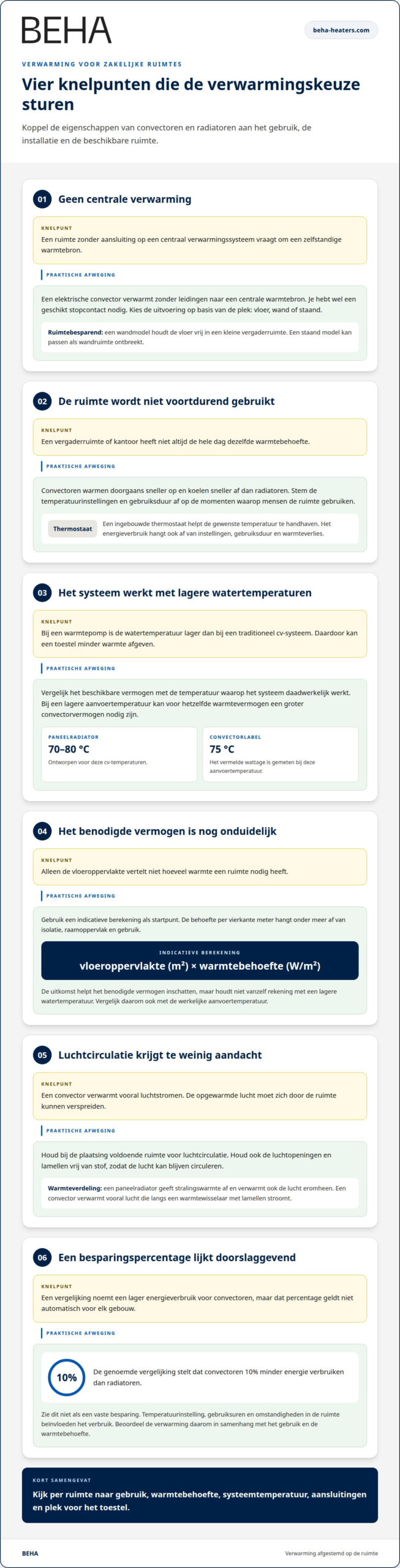
For an indicative calculation, multiply the floor area in m² by the required heat per m² in W/m². This requirement depends on factors such as insulation, window surface area, and usage. The result helps estimate the required power but does not automatically take a lower water temperature into account.
Suitability for low-temperature heating
A panel radiator is designed for central heating temperatures of 70-80 °C. Convectors may not get as hot, but the available power depends on the supply temperature. At lower supply temperatures, a higher convector capacity may be required for the same heat output. Therefore, compare the power rating with the temperature at which the system actually operates.
A heat pump operates with lower water temperatures than a traditional central heating system. Convectors combine with this when their heat output at that temperature is sufficient for the room. Also check the label: the wattage of a convector is measured at a supply temperature of 75 °C. At that lower system temperature, the same convector can deliver less heat.
Convector radiators and panel radiators differ primarily in the way they emit heat and respond to temperature. Underfloor heating distributes heat via the floor surface, while radiators and convectors emit heat from a unit. The best choice depends on the desired heat distribution and the available space.
The total costs in the Netherlands consist of the appliance and any installation. They depend on the chosen capacity, the type of appliance, and the work involved. A concrete amount therefore requires a calculation based on these components.
For maintenance, keep the air vents and fins free of dust so that air can continue to circulate. The stated lifespan is approximately 20 to 30 years for convectors and 25 to 40 years for radiators.
Electric convectors for rooms without central heating
An electric convector heats a room without being connected to a central heating system. The right choice depends on the usage, the available space, and the desired temperature.
Space, placement and connections
Electric convectors are available in floor, wall, and freestanding versions. A wall-mounted model, for example, keeps the floor clear in a small meeting room; a freestanding model can fit when wall space is lacking. Unlike a water-based radiator, an electric convector does not require pipes to a central heat source. However, a suitable power outlet is required.
For non-residential buildings, there is no single heating appliance that fits every room. The function, desired temperature, heat demand, and available connections together determine the choice. An office space, for example, requires a different assessment than a storage space with varying usage times.
Points to consider during renovation or replacement
When renovating, first determine which room needs to be heated and how it is used. Then consider the insulation, window surface area, available connections, and the location for the unit. This prevents replacement heating from failing to match the heat demand or the interior design.
Also consider the existing installation. If you replace a radiator on the central system with electric heating, the connection and the way the room is heated will change. Therefore, take the electrical supply and the desired power output into account when selecting the project. This is especially relevant when heating multiple rooms separately.
A compact unit can help furnish a limited space practically. Convectors heat air currents, while radiators also emit radiant heat. A built-in thermostat helps maintain the desired temperature. Choose for each room based on heat requirements and usage times, not just on design.
In rooms without central heating, electric convectors offer heating without pipes or complex infrastructure. Compare the installation options and match the unit to the room. This allows you to make an informed choice for heating and rapid warm-up, without extending a water-based system.
Energy efficiency and rapid heating
Rapid heating is useful when a room is not in continuous use. A convector generally heats up faster and cools down faster than a radiator. This allows you to tailor the desired temperature to the usage times of, for example, a meeting room. The controls and heat demand remain the determining factors for comfortable heating.
For energy-efficient use, adjust the settings to the times when people use the room. A built-in thermostat helps maintain the desired temperature. If an office is empty outside working hours, it makes sense not to run the heating unnecessarily high. Actual energy consumption depends on the settings, the duration of use, and the heat loss of the room.
One comparison mentions 10% lower energy consumption for convectors than for radiators. That percentage does not represent a fixed saving for every building: the temperature setting, hours of use, and room conditions influence consumption. Therefore, when considering a project, compare not only the units but also how long they heat daily and what temperature is required.
Air circulation also plays a role. A convector without a fan has no moving parts and operates completely silently. This can be suitable for a consulting room or workspace where noise is disruptive. A version with a fan actively moves air and can distribute heat more quickly; however, take the noise of the fan into account.
Assess energy efficiency in conjunction: determine when the room is occupied, adjust the thermostat accordingly, and consider the required heat output. Rapid heating is particularly valuable when heating is not needed all day. In a room where continuous comfort is required, a stable temperature and appropriate control also play a role.
For an electric convector, the connection is also important. Match the power output to the heat requirement and do not confuse rapid heating with lower energy consumption. A device that runs for a shorter time is not automatically more energy-efficient if it has to deliver a higher temperature during that time. The settings, operating time, and desired temperature together provide a more useful picture.
Convectors for business projects
For commercial projects, the heating must match both the space and the interior design. Consider an office with high windows, a reception area with limited wall space, or a meeting room that is not used continuously. The layout, usage, and required capacity help determine which type of convector is suitable. This prevents the choice from being determined solely by appearance.
In a room with floor-to-ceiling windows, a floor convector can emit heat along the glass. Some convectors are built into the floor or a cabinet, so that only a grille remains visible. This can free up wall space and suits a design where visible heating is kept to a minimum. When making your choice, take into account the location of the unit and the required air circulation.
Appropriate heat distribution begins with the right capacity for the space. A large conference room requires a different assessment than a small office space. Therefore, map out the usage, desired temperature, and available space for each room. This way, you choose heating that aligns with the function of each zone, rather than a single model for the entire building.
Models vary in design and placement. Therefore, when selecting convector radiators for commercial projects, you weigh the design, available space, and heat requirements together. A steel, glass, or paintable front can each complement the interior in a different way. With built-in installation, the grille is also part of the visible result. This allows you to match the heating to the materials and lines of the room.
The choice of fan-assisted convectors also requires attention: such models often have a lifespan of 15 to 20 years. This makes maintenance and accessibility relevant in project planning. Consider, for example, accessibility when a unit is placed in a cabinet. Involve specialists in the technical assessment of capacity, placement, and the function of the room, with specialized distributors such as VECO Hurtownia HVAC supplying suitable climate and ventilation solutions for non-residential projects.
Would you like to view the options for your commercial space? Discover convector solutions for projects and compare the versions with your interior design requirements.
BEHA
BEHA helps you tailor your heating choice to the function, layout, and appearance of commercial spaces. The range includes smart convectors with steel, glass, or paintable fronts, as well as Classic convectors. This allows you to take both the desired heating and the visibility of the unit into account during the project design.
The smart convectors can be controlled via Wi-Fi and an app. This allows you to tailor the heating to the use of different rooms. Which version suits you depends on the layout and the requirements of the project. Therefore, compare the available fronts and convector types with your choices regarding power output and placement.
Would you like to discuss the heating options for your business project? Contact BEHA.
Make your project choice concrete
A commercial heating choice works best when you consider technology and interior design together. Determine which spaces need to be heated, how they are used, and what aesthetic suits the design. This way, the choice of convector radiators for project furnishing becomes part of the overall plan, rather than just a decision about a specific unit.
BEHA offers smart convectors with steel, glass, and paintable fronts. This allows you to visually match the unit to the room. In your next step, consider the desired finish and heating requirements. This will help you determine more specifically which version suits your project.
Would you like to discuss the possibilities for your business space? Discuss your project with BEHA. With a clear picture of the space and its usage, you take a targeted step towards a suitable solution.
Frequently Asked Questions
Do convectors make noise?
A convector without a fan operates completely silently because it has no moving parts. A version with a fan actively moves air and is therefore not silent. For this reason, a convector without a fan can be a suitable choice in a quiet consultation room or concentration area. When considering a project, also look at the function of the room and how important silence is there.
How do I choose the right convector?
Choose based on the use of the space, the required heat, and the available space. For example, distinguish between a meeting room used only during gatherings and a workspace that is occupied daily. Next, determine whether wall-mounted, floor-standing, or freestanding installation is suitable. Finally, match the power and controls to the desired temperature and the heating system.
How much power does a convector produce?
The output depends on the chosen model. At BEHA , smart convectors with a steel front range from 400 W to 2000 W; models with a glass front deliver 600 W to 1250 W. These values represent the nominal output of those product ranges. Additionally, the heat required in a room depends on factors such as insulation, window surface area, and the desired temperature.
Can I connect a convector to a standard central heating boiler?
No. BEHA electric convectors run on electricity and do not require a central heating boiler or pipes. You plug them into a standard socket. This makes them suitable for rooms without a connection to the central heating system. However, when making your choice, do take into account the required power and the electrical connection of the room.
What are convector radiators and how do they work?
A convector radiator emits heat as air flows past a heat exchanger. In a water-based version, hot water flows through a copper tube with aluminum fins. The air heats up and rises, after which cooler air is drawn in. Electric convectors heat without hot water pipes. Therefore, first determine which type of heat source is available in the room.
Which types of convector radiators are suitable for project furnishing?
The suitable version depends on the desired placement and the appearance of the project. In addition to Classic convectors, BEHA offers smart convectors with steel, glass, or paintable fronts. A paintable front can match the wall color, while steel or glass can become a visible part of the interior. When making your choice, also consider the function of the room, heat requirements, and installation location.