
Ecodesign for heating: what does it mean for your choice in 2026?
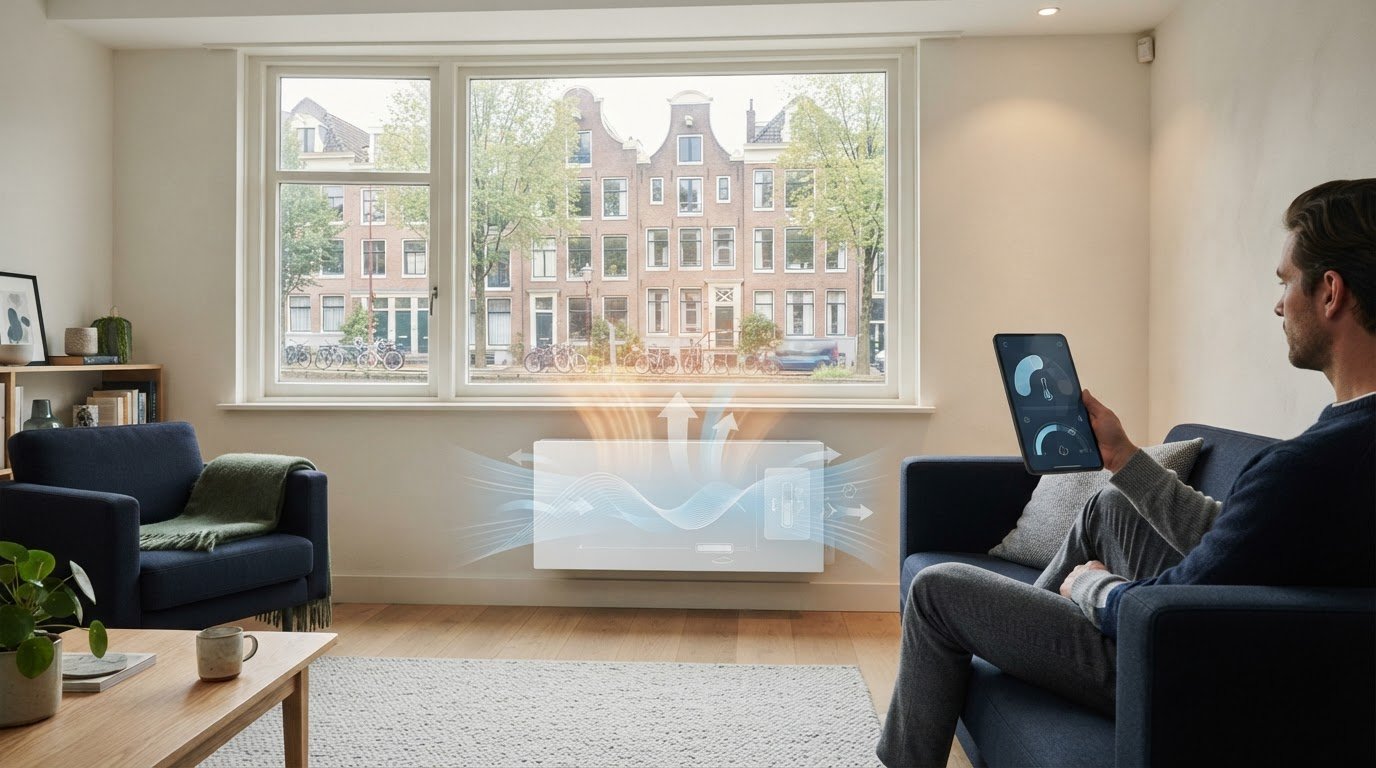
A heating system that complies with Ecodesign standards is not automatically energy-efficient in every home or for every usage. This makes Ecodesign heating sometimes difficult to assess: the term sounds technical, whereas you primarily want to know what it says about the appliance you are considering.
Since 1 July 2025, most requirements of European Regulation (EU) 2024/1103 apply to local space heating. Ecodesign sets minimum requirements that products must meet in order to be sold on the European market. It therefore specifies product requirements, but does not predict how much energy your heating system consumes in practice. That also depends on the room, the settings, and how you use the appliance.
In this article, you will read what Ecodesign means for heating products and how to carefully evaluate product claims. We compare Ecodesign with the CE marking and energy labels and discuss what information is helpful when comparing electric convectors. This allows you to better contextualize features such as operation and adjustability, without making technical documents or sustainability claims sound better than they are.
Key Points
- Ecodesign heating helps you understand which European product requirements a heater must meet, but does not predict how much energy the appliance will consume in your situation.
- Distinguish between Ecodesign, the CE marking, and an energy label, so that you know what each indication does and does not tell you.
- When comparing, first check the product type and model details. Then compare these with the corresponding technical documentation.
- Adjustability and operation can contribute to daily comfort, but do not in themselves guarantee energy savings.
- Discover how to use Ecodesign information when comparing BEHAconvectors. BEHA has over 100 years of experience with heating products.
What does Ecodesign mean for heating?
Ecodesign is the European approach whereby product design rules must contribute to better environmental performance. For heating, there is no single general standard for every appliance. The product category and intended use determine which regulations and requirements are relevant. Ecodesign sets, among other things, minimum requirements for products offered on the European market.
Regulation (EU) 2015/1188 applied to local space heating. This was repealed on 1 July 2025 and replaced by Regulation (EU) 2024/1103. Most provisions of the new regulation have applied since that date. Therefore, look at the current regulations and the precise product type, not just at a general reference to “Ecodesign”. The European Ecodesign Directive provides background on the broader approach and objectives.
Meeting the applicable requirements is not a personal savings guarantee and does not automatically rank appliances from most efficient to least efficient. The rules set product requirements; your energy consumption also depends on the room, the settings, and how often and for how long you heat. Ecodesign heating helps you understand product information, but does not, in itself, tell you what an appliance will consume in your home.
Which heating products fall under the regulations?
Local space heating is intended to heat a defined area, such as a separate room. An electric convector can fall into that category. This is different from a central heating system that distributes heat throughout multiple rooms. Heat pumps and central heating products are subject to different European regulations; those seeking broader climate and heating solutions for the home can seek advice from a specialist such as D-technix. Therefore, do not assume a single Ecodesign rule applies to all forms of heating: applicability depends on the category, the design, and the intended use.
Even products that appear similar can legally belong to different categories. Therefore, check the product description and the associated regulations. This will prevent you from applying requirements for a local heating appliance to, for example, a central system.
Why does Ecodesign exist?
The rules are intended to improve the environmental performance of products, including during the usage phase. They provide manufacturers with frameworks for design and production and set conditions for placing products on the market. Depending on the category, control and operation may also be taken into account. A thermostat, for example, can help regulate the temperature, but does not prove that a device consumes the same amount of energy in every room or for every use.
View Ecodesign as a lower limit for product requirements, not as a prediction of your consumption. A heater in a well-insulated room that you only use at certain times has a different usage situation than an appliance that heats a larger, less well-insulated space for an extended period. The statutory product requirements are linked to the appliance and its category, not to a single universal consumption scenario.
Which Ecodesign requirements apply to electric heating?
The requirements for electric heating depend on the product category and the rules applicable to it. These rules describe product requirements and how certain performances are assessed. Therefore, you can only properly interpret technical data if you know which type of appliance it concerns and which measurement method applies to that category.
Since 1 July 2025, Regulation (EU) 2024/1103 applies to local space heating, which replaced Regulation (EU) 2015/1188. The new regulation entered into force on 9 May 2024; most provisions apply since 1 July 2025. The precise scope varies by product type. Consult the current regulations and documentation of the specific appliance before applying a requirement or limit value to it.
The European Commission also works with a broader framework, the Ecodesign Regulation for Sustainable Products. That framework broadens the European approach to product design; concrete requirements are developed for product groups. It is therefore not, in itself, a complete list of requirements for every electric heater.
What role do the thermostat and control system play?
A thermostat measures or helps regulate the temperature in a room, allowing you to set a desired comfort level. Features such as time programs or app control may also be relevant, if they are included with the specific device. Check the product documentation to see which features are available and how they are described.
A feature is not a guaranteed result. A program can, for example, help you set the heating at fixed times, but the actual usage also depends on your choices. Smart convectors from BEHA can be controlled via Wi-Fi and an app. This offers configuration options and ease of use, but does not in itself guarantee lower energy consumption.
What does conformity say about the device?
Conformity means that a product meets the requirements applicable to the relevant product category. It is a statement regarding the appliance and the applicable rules, not regarding your future energy consumption. Therefore, a compliant product does not guarantee a fixed energy bill or specific savings. Household consumption depends partly on the room, the temperature setting, and how long you heat.
Statutory product requirements describe what a heater must meet; your actual consumption is partly determined by the room and how you use the appliance.
Compare the product name and model details with the accompanying documentation. Verify that information regarding operation and performance truly applies to that model, and read claims in conjunction with the measurement method and product category. This way, you evaluate ecodesign heating based on relevant data, without confusing general promises with your specific usage situation. For example, view the electric convectors from BEHA to compare product features and operating options.
Ecodesign, CE marking and energy label: what is the difference?
On a product page, Ecodesign, CE, and an energy label can appear side by side. They do not mean the same thing and each provides a different type of information. For Ecodesign heating, it helps to assess them separately: Ecodesign refers to product regulations, CE to the manufacturer's declaration, and a label can provide information on energy performance if applicable to the product category.
| Concept | Meaning and function | What can you deduce from this? |
|---|---|---|
| Ecodesign | European product regulations with requirements for product groups. | Which requirements are relevant for the product type and how the manufacturer reports on them. |
| CE marking | A marking by which the manufacturer declares that the product complies with the applicable European regulations. | That the manufacturer takes responsibility for that conformity, not an independent quality award. |
| Energy label | Standardized energy information for product categories subject to a labelling scheme. | A comparison according to the data and scale of that regulation, if applicable to the product. |
Ecodesign versus CE marking
Ecodesign describes requirements laid down in European regulations for specific product groups. The CE marking is not an additional Ecodesign label. With the marking, a manufacturer indicates that the product complies with all applicable European regulations, including Ecodesign if the relevant rules require it. Therefore, CE does not automatically mean that a device has been independently tested or performs better than comparable products.
Read the marking together with the product documentation. Look for the product category, model details, and references to applicable regulations. This will prevent you from drawing conclusions about energy efficiency or quality based solely on the CE mark.
Ecodesign versus energy consumption and energy label
Ecodesign requirements establish product conditions. Where a labeling scheme is mandatory or available, an energy label provides standardized information about a specific product category. Do not assume that every electric heater has an energy label. Labeling rules vary by category. Therefore, check whether an applicable labeling scheme applies to the appliance and whether the displayed label corresponds to exactly that model.
An energy label does not directly predict your home's consumption either. A label and technical product data are intended to evaluate products based on established information. Your consumption is influenced in part by the size and insulation of the room, the set temperature, and the duration of use. Therefore, a marking or label does not tell you how much your household ultimately consumes.
Use the three concepts as separate checkpoints: look at which product regulations apply, read what the manufacturer states regarding conformity, and assess an energy label only if it applies to that product category. This way, you carefully compare product information without confusing regulations, marking, and actual consumption.
This is how you assess Ecodesign information for a heater
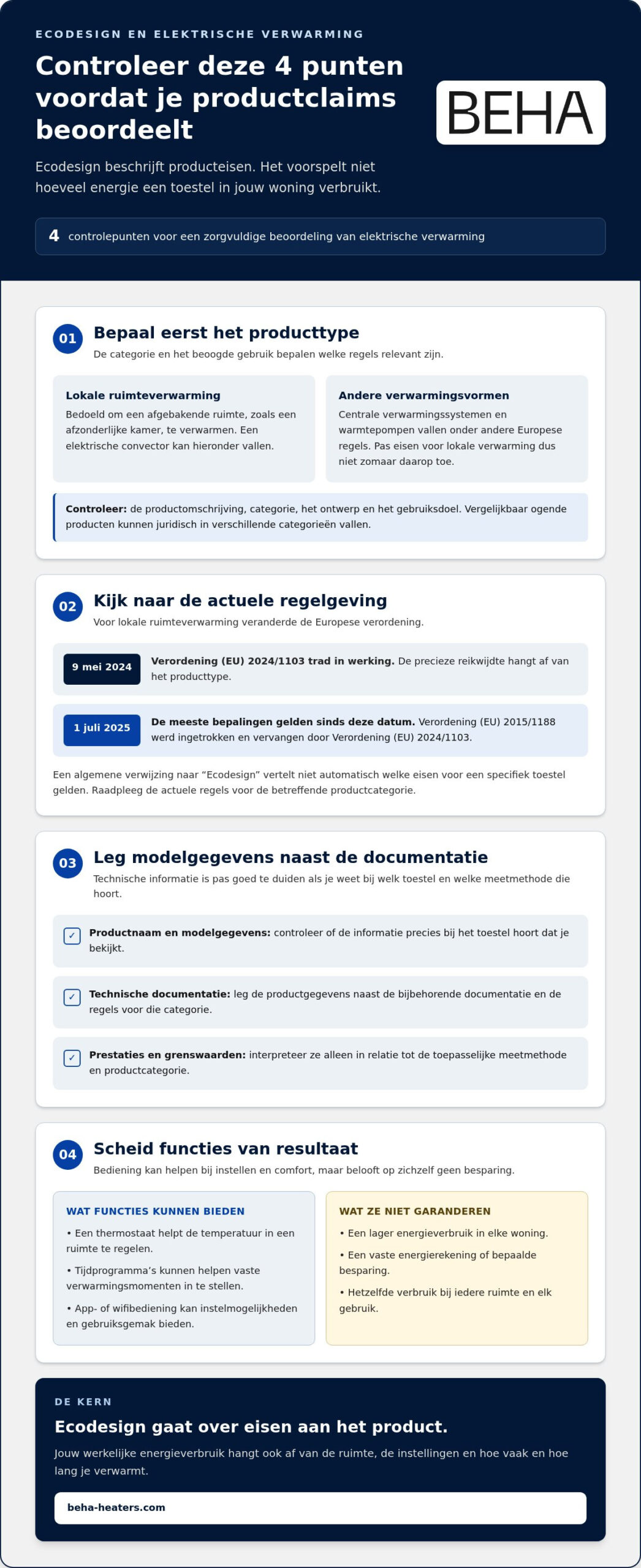
A claim such as “meets Ecodesign standards” is a starting point, not a complete comparison. Match the statement to the correct product and accompanying documentation to understand what it means for a heater. Follow these steps before comparing appliances:
- Determine the product type. Is it an electric convector for a separate room or another type of heating? The category determines which rules may apply.
- Note down the model details. Copy the product name and model designation exactly. This way, you won't mix up information from similar devices.
- Look up the supporting documentation. Consult the technical documentation and check which applicable regulations are mentioned therein. Verify whether that information applies to your model.
- Read the claim carefully. Does it concern compliance with product requirements, an existing regulatory provision, or a statement regarding energy consumption? Those are different assertions.
- Compare identical data. Only compare devices based on properties that are described in the same way and are relevant to your application.
Which product information are you viewing?
Start with the product description: what is the appliance intended for and what type of heating is it? Then compare the model identification with the technical documentation. Look for the statement regarding applicable regulations and check whether it applies specifically to the appliance, not just to a general product family.
Note control options and nominal data as stated by the manufacturer. Do not infer a feature not listed in the documentation from an image, general description, or claim for another model. This way, you base your comparison on verifiable product information.
How do you translate the information into your space?
A device may meet product requirements, but its suitability for your room also depends on the space and usage. Consider the size and insulation of the room, when you are there, and what temperature you find comfortable. Therefore, compare not only a single claim, but also the operation and other documented features that align with your situation.
A thermostat or app control can make setting the heating easier. The result in use remains dependent on the chosen settings and how you operate the device. The guide on electric convectors with Wi-Fi helps you compare such product features further.
An Ecodesign claim indicates applicable product requirements, but does not prove how much energy a device consumes in your room. Keep this distinction in mind when reading specifications. If you want to view the features of electric convectors, discover the convectors from BEHA and compare the information relevant to your choice.
Ecodesign and BEHAheating: translating rules into everyday comfort
European product requirements only become meaningful for the appliance you are considering. BEHA manufactures electric convectors with steel, glass, and paintable fronts, including smart models with Wi-Fi and app control. The products comply with Ecodesign requirements. For a proper comparison, consult the documentation for the specific model and compare the product data with the statements regarding applicable requirements.
BEHA has over 100 years of experience with heating products. That brand history is not proof of conformity: that assessment belongs to the product and the accompanying documentation. Therefore, do not just look at a general description of a product group, but check whether the information matches the model designation of the convector you are comparing.
What does compliance mean for a BEHAconvector?
Compliance means that the specific device meets the requirements applicable to the product category. When evaluating a BEHAconvector, read the product description together with the accompanying technical information. Ensure that the product name and model details match. Also, distinguish between a regulatory statement and information regarding functions or operation.
If you are looking for a version with a steel front, you can use the guide on electric convectors with steel fronts to better understand product features. Use these features as a supplement to the documentation, not as a replacement for it. A material or operating characteristic does not, in itself, indicate whether a product meets a specific requirement.
From product requirements to a suitable choice
Ecodesign helps you meet legal product requirements, but it does not predict how much energy a heater will consume in your home. Therefore, start with the room: how is it used, what temperature do you want to set, and which method of operation suits your daily routine? Then compare the features relevant to your situation, such as the type of front panel, the control options, and the information in the technical documentation.
With smart convectors, you can control settings via Wi-Fi and an app. This makes it easier to adjust the temperature or a setting, for example, without standing directly at the unit. Ease of use depends on how you utilize the functions. Smart control does not guarantee a lower energy bill; the room, settings, and usage time also play a role.
In this way, ecodesign heating becomes a practical tool for your choice. It helps you read product information accurately, while your comfort needs and the characteristics of your space determine the rest of the comparison. If you would like to view the electric heating products and associated product information, discover the BEHA.
Make your next choice consciously
Use product information as a starting point for a choice that fits your daily routine. First, consider when you heat the room, what controls you find convenient, and which type of convector suits your decor. This way, you compare not only individual claims but also features you notice during use.
Next, consult the documentation for the model you are considering. Check whether the product details align with your requirements and use Ecodesign heating as a framework to understand statutory product information, not as a prediction of your consumption. At BEHA you will find smart electric convectors with various front finishes. The products comply with Ecodesign requirements; view the specifications associated with the model.
Making the right choice starts with clarity about what you need. Compare the models and operating options and determine which features contribute to daily comfort. 's electric heating solutions BEHA and discover which convector suits your space and preferences.
Frequently asked questions about Ecodesign for heating
What does Ecodesign mean for heating?
Ecodesign in heating refers to European requirements for the design and environmental performance of specific heating appliances. Which requirements apply depends on the product category and the intended use. Therefore, a convector for a room is not automatically assessed according to the same rules as an appliance for a central heating system. Look in the product information for the category and regulations mentioned for that model.
Does Ecodesign also apply to electric heating?
Yes, certain electric heating devices are covered by Ecodesign rules. For local space heating, Regulation (EU) 2024/1103 applies, most provisions of which have been in force since 1 July 2025. This does not mean that every electric device is subject to exactly the same requirements. Check, for example, whether it concerns a convector for a separate room or another type of product and consult the accompanying documentation.
Is Ecodesign the same as an energy label?
No. Ecodesign refers to statutory product requirements; an energy label provides standardized energy information if a labeling scheme applies to that product category. Therefore, do not assume there is a label for every electric heater. Check whether the label belongs to the specific product type and read the scale according to the accompanying information. A label does not replace the technical documentation and does not tell you how to use the device.
Does Ecodesign heating guarantee a lower energy bill?
No, compliance with Ecodesign requirements does not guarantee a lower bill. The requirements say something about the product, whereas energy costs depend partly on how often and how long you heat, the desired temperature, and the characteristics of the room. If you want to better understand your own consumption, compare your meter readings over similar periods and note which settings you use. This way, you assess your own situation rather than a general product claim.
How do you know if an electric convector meets Ecodesign requirements?
Note down the full product name and model designation and locate the corresponding technical documentation. Verify that the information explicitly refers to that model and which regulations or declaration of conformity are mentioned. Do not compare this information with a general description of another version. BEHA products comply with Ecodesign requirements; the product-specific documentation helps you apply this information to the model you are viewing.
What is the difference between Ecodesign and CE marking?
Ecodesign encompasses product requirements for specific product groups. With the CE marking, the manufacturer declares that the product complies with the applicable European regulations. It is therefore not a separate Ecodesign designation, nor is it an independent quality award. For a convector, read the CE information together with the product documentation to determine which regulations and data are relevant to the specific device.
Can an Ecodesign heater be used in every room?
No, an Ecodesign heater is not automatically suitable for every room. Suitability depends, among other things, on the purpose and use of the room and on the product characteristics. For example, if you are considering a device for a home office, you should evaluate the features relevant to that application, not just the Ecodesign claim. Follow the product information and take the room and desired comfort into account.