
Efficient electric auxiliary heating for extra comfort
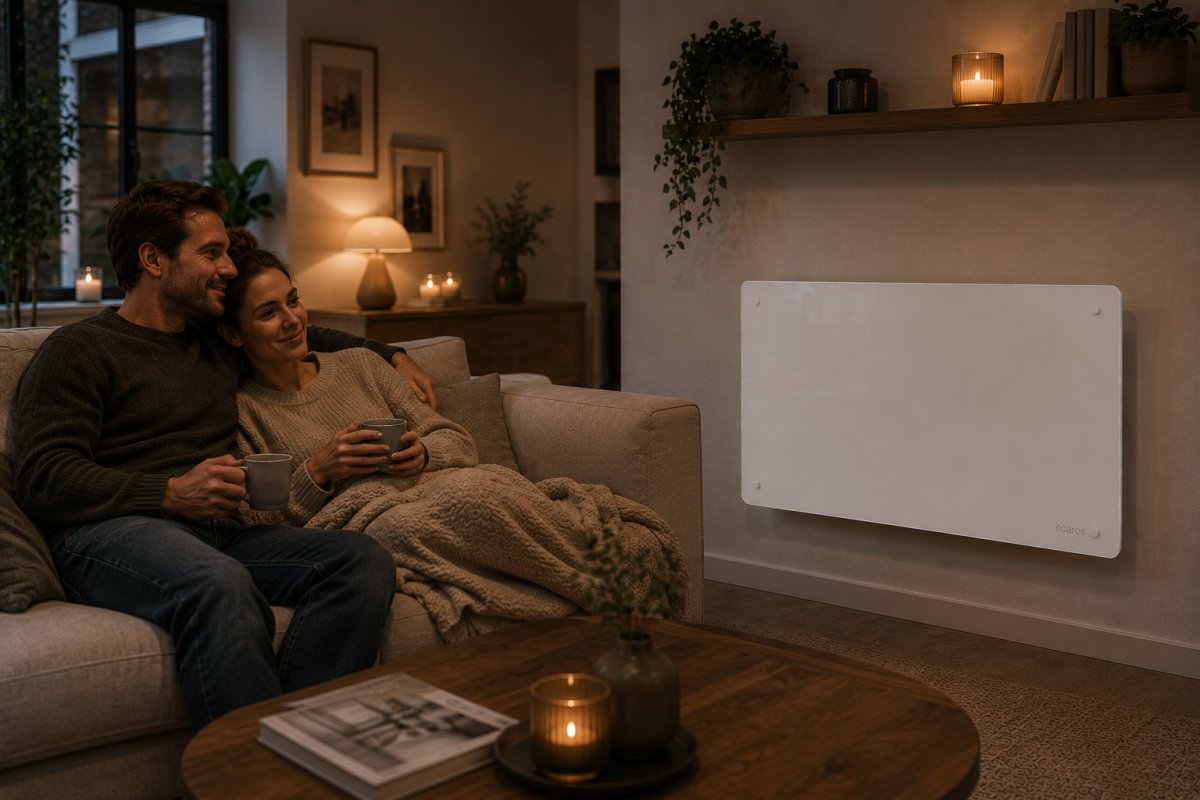
Efficient electric supplementary heating does not mean that one specific type of heater magically generates more heat from the same amount of electricity. The savings arise from heating only the room or comfort zone in use, during the hours when it is needed. If you simultaneously turn down the central heating and limit heat loss, electric supplementary heating can be practical for a home office, sitting area, bedroom, bathroom, or hobby room.
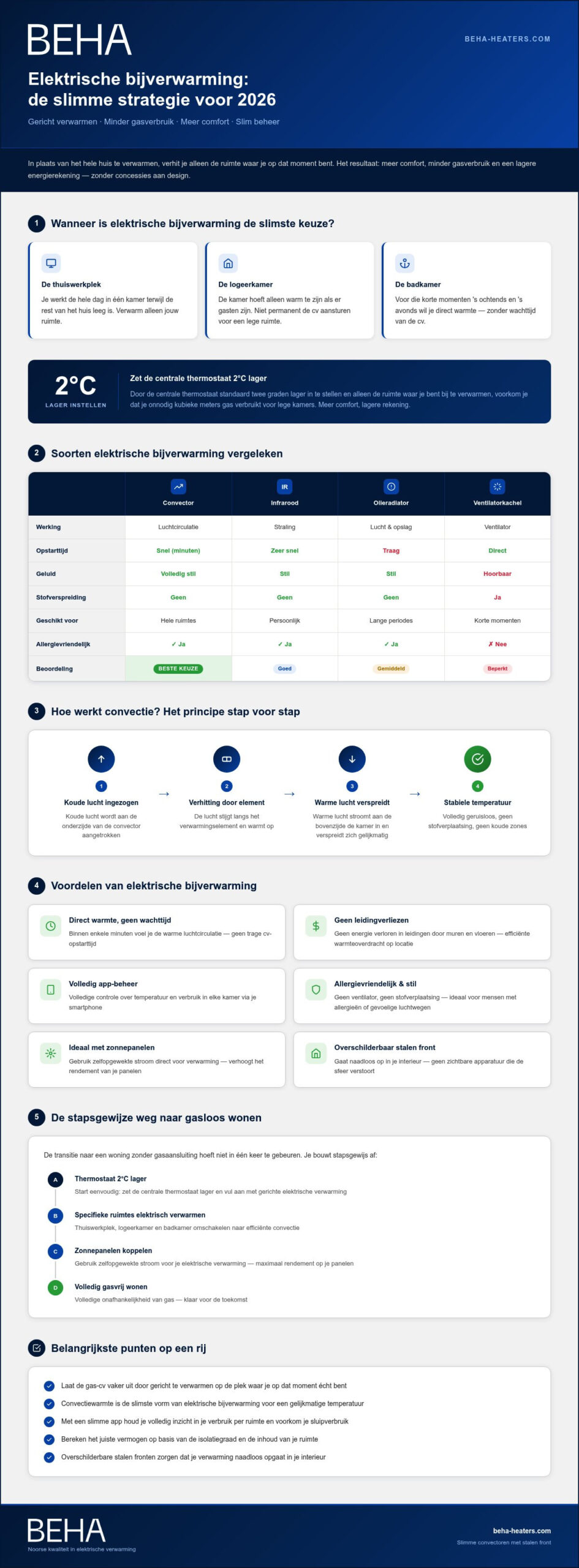
In this guide for Belgium and the Netherlands, we compare convectors, infrared panels, ceramic fan heaters, and oil-filled radiators. You receive a power matrix, a formula for hourly costs, safety advice, and a selection plan per room. We also honestly explain when direct electric heating actually consumes a lot of electricity and when a heat pump or improving insulation is a more sensible choice.
Key points
- Electric supplementary heating only saves money when it heats a smaller area for a shorter time or at a lower central temperature.
- Direct resistance heaters generate approximately one kWh of heat from one kWh of electricity at the point of use; the type and controls primarily determine comfort and operating time.
- A convector is suitable for quiet room heating, infrared for a fixed zone, and a fan heater for very short use.
- Calculate costs using power in kW × actual duty cycle × your current electricity price per kWh.
- For long-term heating of large or poorly insulated spaces, a suitable heat pump typically uses less electricity.
Efficient electric supplementary heating: what does it mean?
Supplemental heating temporarily or locally complements the existing main heating system. Examples include a convector in the home office, an infrared panel above the workspace, or a bathroom unit that only runs around shower time. The goal is not to run two systems at maximum heat simultaneously, but to shift comfort to where you actually are.
Direct electric heating uses a resistance element. When a 1000W unit heats continuously for one hour, it consumes approximately 1 kWh of power. A thermostat can switch off the element as soon as the target temperature is reached. A timer, app, or open-window detection does not produce more heat from the same kWh, but can prevent unnecessary operating hours.
When can local supplementary heating save energy?
- You use one room while the rest of the house is allowed to stay cooler.
- You lower the main thermostat enough to compensate for the local power consumption.
- The zone to be heated is small, reasonably insulated, and in use for only a limited number of hours.
- The chosen heat source suits your behavior: radiation for one fixed seating spot or convection for the entire room.
- The system prevents heating during absence or when a window is open.
When are you unlikely to save?
If you leave the central heating system at the same temperature and place an electric heater next to it, you are primarily adding to energy consumption. The same applies when a small appliance continuously tries to heat a large, drafty room. First, insulate visible gaps and cold building components without cutting off necessary ventilation. Then, measure consumption instead of judging solely by feel.
For long-term main heating, direct electric resistance heating is rarely the most economical electrical solution. Milieu Centraal explains that a resistance heater generates approximately one kWh of heat from one kWh of electricity, whereas a heat pump transfers heat from the air or ground. Therefore, compare the operation and consumption of a heat pump when you want to heat many rooms or for long periods.
Efficient electric auxiliary heating: types compared
The right technique depends on how much space you want to make comfortable, how quickly you need heat, and how much noise is acceptable.
| Type | feeling of warmth | Sound | Best use | Point of attention |
|---|---|---|---|---|
| Convector | Even heating of room air | Very quiet without a fan | Study, bedroom, living room | Do not block with furniture or curtains |
| Infrared panel | Direct radiation on people and surfaces | Quiet | Fixed seating or desk | Good sightline and positioning needed |
| Ceramic fan heater | Quickly noticeable warm air | Fan audible | Short-term use in a small space | Check free airflow and anti-tip protection |
| Oil-filled radiator | Slow, even release with residual heat | Usually quiet | Longer temporary heating | Heavy; oil buffers heat but does not automatically save electricity |
| Electric blanket or foot warmer | Instantly heats the body | Quiet | Personal comfort on the sofa or desk | Use only according to the manual and check the condition |
| Air-to-air heat pump | Active air heating | Indoor and outdoor unit audible | Many hours of use and larger zone | Higher investment and professional installation |
Convector: when the whole room needs to be comfortable
A convector draws in cooler air from the bottom, heats it, and allows the warm air to rise. A model without a fan is typically very quiet and suitable for longer stays in a small or medium-sized room. For control options, also check the guide on an electric convector with Wi-Fi.
Infrared: when one comfort zone is sufficient
Infrared primarily heats people and surfaces within the radiation area. This can be more targeted than heating all the air when you are sitting in one fixed spot. A panel that is misaligned or hung behind furniture provides less benefit. For a room where multiple people are walking around, convection often feels more even.
Fan heater: fast, but audible
A fan heater provides noticeable heat quickly and is therefore suitable for use for a few minutes in a hobby room or suitable bathroom setup. The fan makes noise and moves air and dust. Check if the device is suitable for the room and never place it where textiles or water pose a risk.
Oil-filled radiator: residual heat is not free energy
The oil temporarily stores heat and releases it further after being switched off. The element absorbed energy to do so during the warm-up phase. The residual heat therefore primarily changes the heat output profile, not the total amount of heat from a kWh. The device is suitable when slow, even heat and mobility are more important than a quick response.
Consumption and costs of efficient electric supplementary heating
Use this formula: power in kW × actual time the element is on × your price per kWh. Take your current Belgian or Dutch energy contract; national averages can differ significantly from fixed, variable, and dynamic rates.
| power output | Consumption at 1 hour continuous | Current at 230V | Hourly rates |
|---|---|---|---|
| 500W | 0.5 kWh | approximately 2.2A | 0.5 × your kWh price |
| 750W | 0.75 kWh | approximately 3.3A | 0.75 × your kWh price |
| 1000W | 1.0 kWh | approximately 4.3A | 1.0 × your kWh price |
| 1500W | 1.5 kWh | approximately 6.5A | 1.5 times your kWh price |
| 2000W | 2.0 kWh | approximately 8.7A | 2.0 × your kWh price |
Example: home office for one workday
A 1000W convector available for eight hours does not automatically consume 8 kWh. If the element is switched on for an average of 40 percent of the time after warming up, the example comes to approximately 3.2 kWh. The actual percentage depends on the outside temperature, insulation, thermostat setting, ventilation, and heat from people and equipment. Therefore, measure over several comparable days with a suitable energy meter.
How does it compare to central heating?
First, record energy consumption without supplementary heating. Then, test the same type of day with a lower main thermostat and a local heater. Compare total costs, not just the plug-in heater. For gas, you must convert consumption in m³ using your contract price and carefully keep fixed costs separate. Saving on gas is not automatically a financial saving if a lot of expensive electricity is added.
The role of thermostat, timer, and app
An accurate thermostat prevents overheating above the target temperature. A timer or weekly schedule prevents empty room hours. Wi-Fi only helps if you actually use the settings. Check local control, operation during internet outages, app support, and privacy. The European Commission describes the current Ecodesign requirements for local space heaters, in which control and product information play a role.
9 practical money-saving tips
- Heat only the zone in use and close interior doors.
- Lower the central thermostat when the local heater takes over comfort.
- Use a weekly schedule instead of manually forgetting to turn off.
- Seal drafts, but keep permanent ventilation openings clear.
- Do not block convector grilles with a sofa, desk, or curtains.
- Direct the infrared at the place where someone is actually sitting.
- Lower the target temperature one step and reassess the comfort.
- Measure kWh over multiple cold days and compare similar conditions.
- Investigate insulation or a heat pump if the unit runs almost continuously.
Efficient electric supplementary heating per room
Floor area alone is not a reliable capacity calculation. Also measure the height and assess insulation, glazing, exterior walls, ventilation, and desired temperature. As a starting point, approximately 25–50W per m³ is often used, ranging from very well to moderately insulated. Have the main heating system calculated accurately if in doubt.
| Space at 2.5m height | Contents | Indication 25W/m³ | Indication 35W/m³ | Indication 50W/m³ |
|---|---|---|---|---|
| 10m² | 25m³ | 625W | 875W | 1250W |
| 15m² | 37.5 m³ | 940W | 1310W | 1875W |
| 20m² | 50m³ | 1250W | 1750W | 2500W |
Living room and seating area
If you want to keep the entire room comfortable for a few hours, a correctly sized convector makes sense. For just the sofa corner, infrared heating with an unobstructed line of sight might be more effective. If you heat the entire living room for extended periods daily, compare heat pumps and improve insulation before adding multiple resistance heaters.
Home office
A small convector is suitable when the entire office needs to be warm. An infrared panel or personal foot warmer may require less total power if you always sit in the same spot. Keep cables clear of the desk chair and walkway, and do not use an unsuitable power strip.
Bedroom
Preferably choose a quiet device without a fan and program it only for the period before going to sleep or waking up. Use an electric heater at night only if the manufacturer permits it for the specific model. Keep bedding, curtains, and clothing outside the prescribed clearance.
Bathroom
A bathroom imposes additional requirements regarding the degree of protection and placement in electrical zones. Use only a device that the manufacturer explicitly permits for the chosen position. Have fixed installation or any doubts regarding Belgian or Dutch regulations assessed by a qualified electrician; a general IP code does not automatically make a device safe everywhere in the bathroom.
Garage, hobby room and holiday home
For very short use, a fan heater provides quick results. For longer stays, a convector is quieter. A frost setting does not mean that the appliance is always used sparingly: when heat is needed, the element can switch on at full power. Insulate pipes and the room if frost damage would have major consequences.
Safely use efficient electric auxiliary heating
- Read the manual and use the device only in permitted areas and positions.
- Connect powerful appliances as prescribed, preferably directly to a suitable grounded wall socket.
- Do not use a damaged cord, an unsuitable power strip, or a coiled extension cord.
- Include other heavy appliances on the same circuit and have any doubts about capacity checked.
- Never cover the device and keep the air vents and sensor clear.
- Respect the distance from curtains, furniture, paper, clothing, and bedding.
- For a portable appliance, choose tip-over and overheating protection where necessary.
- Stop at a hot, damaged, or discolored plug or socket.
- Ensure that the smoke detectors are working and do not leave the device operating unattended if the manual advises against it.
Efficient electric supplementary heating: 3 practical examples
Scenario 1: one remote worker in a small room
The central thermostat is located in the living room, but during the day only a 10m² study is used. Efficient electric supplementary heating here could consist of a small convector with a time program, while the rest of the home remains a few degrees cooler. An indication based on 25m³ and average insulation comes out at around 875W. Measure whether the lower central heat demand exceeds the extra power consumption; without that comparison, you will not know if the approach yields a financial benefit.
Scenario 2: only extra heat at the couch
The living room is large, but in the evenings, two residents consistently sit in the same spot. A well-aimed infrared panel can provide local comfort without further heating the entire volume of the room. The main heating may then not need to be turned up. Pay attention to the unobstructed line of sight, recommended distance, and installation. If people move around the room or use multiple seating areas, a convector can offer more even comfort.
Scenario 3: cold bathroom in the morning
The bathroom only needs to be warmer around shower time. An approved electric radiator or fan heater with a timer can start shortly before use and then switch off. Efficient electric supplementary heating here primarily means a short operating time and appropriate power output. The bathroom zone and electrical installation determine which appliance may be placed where; always have any doubts assessed by a qualified electrician.
These examples show why a product ranking never provides the whole answer. The same 1000W can be used efficiently in a small room with a lower central temperature, but be a waste when the appliance runs for hours alongside an unchanged main heating system. Therefore, always use a measurement period and compare the total energy consumption.
When does efficient electric heating suit BEHA?
A BEHAconvector is particularly suitable when you are looking for quiet, even heating and room-by-room control. For a few minutes of direct heat, a fan heater might be more practical; for a single fixed seating area, infrared might be more logical. The best choice is therefore determined by the room, not just by the brand.
Compare the technical data sheet
Check the wattage, dimensions, mounting method, thermostat, app functions, cord or connection, surface temperature, and warranty conditions for each model. View 's current range of electric heating solutions BEHA and compare the product specifications with your calculated needs.
Design and paintable finish
A wall-mounted convector saves floor space and blends seamlessly into the interior. Some fronts are specifically designed to be finished. Always follow the model instructions and keep grilles and sensors clear. Read more in the guide on a paintable radiator.
Supplementary heating for professional spaces
Zone control can also be useful in an office, practice, or small-scale workspace. In a business context, usage hours, concurrent load, installation responsibility, and energy costs play a greater role. For this, consult the guide on electric heating for professionals.
Choosing efficient electric supplementary heating in 10 steps
- Determine which room or personal zone actually needs heat.
- Note how many hours per day and days per week you are present there.
- Measure floor area, ceiling height, windows, and exterior walls.
- Assess insulation and seal unnecessary drafts without blocking ventilation.
- Choose convection, radiation, or fast fan heat based on behavior.
- Calculate an appropriate capacity and check the electrical circuit.
- Compare thermostat, timer, app, sound, and safety features.
- Calculate hourly and seasonal costs with your own kWh price.
- Plan how far the central thermostat can be turned down during local use.
- Measure total energy consumption after purchase and adjust schedule or temperature.
Conclusion: local comfort with controllable consumption
Efficient electric supplementary heating works best as a targeted strategy: a small zone, limited hours, appropriate power, and a lower main thermostat. A convector is powerful for quiet room heating, infrared for a single fixed spot, and a fan heater for very short use. No single resistance type generates more heat from the same kWh; the practical gain comes from control and selective use.
Do you want to compare a quiet convector with room-by-room control? View the BEHArange, read the technical data sheet, and calculate your expected kWh in advance. For long-term heating of large spaces, also compare insulation and a heat pump.
Frequently asked questions about efficient electric supplementary heating
What is the most energy-efficient electric supplementary heating?
For direct resistance heating, no type is universally more economical. The best result is achieved by heating the smallest relevant area for the shortest possible time using a thermostat. For a single person, an electric blanket or directional infrared may require less total power; for an entire room, a convector is often more comfortable.
How much does efficient electric supplementary heating cost per hour?
Multiply the power in kW by the actual duty cycle and your own kWh price. A 1500W heater uses 1.5 kWh per hour when the element is on continuously. Thermostat cycles can lower the average.
How many watts do I need for 20m²?
At a height of 2.5 meters, that is 50 m³. A rough range of 25–50 W per m³ gives approximately 1,250–2,500 W, depending on insulation, glazing, exterior walls, and the desired temperature. For a precise choice, a heat loss calculation is better.
Can I save money by turning down the central heating?
This is possible if the gas or heat demand of the rest of the home decreases sufficiently and the local heater runs on a limited basis. Measure the total gas and electricity consumption over comparable days. Without lowering the main heating, you usually only add electricity consumption.
Is a convector suitable for the whole night?
Only when the manufacturer declares the specific model suitable for this purpose. Follow mounting, clearance, and electrical instructions, never cover the device, and ensure that the smoke detectors are working. Safety devices do not replace correct use.
Do I need a separate circuit?
That depends on the total power, existing circuit, wiring, and other concurrent appliances. A 2000W appliance draws approximately 8.7A at 230V. Have multiple heavy appliances or any doubts assessed by a qualified electrician.
Does electric heating dry out the air?
A heater does not normally remove water from the air. However, due to the higher temperature, the relative humidity does decrease, which can make the air feel drier. Ventilate healthily and, if necessary, measure with a hygrometer.
Can I paint over any electric radiator?
No. Only paint a front that the manufacturer designates suitable for the exact model and follow the painting instructions. Keep air vents, sensor, controls, and rear clear.