
Electric bathroom heating: Efficient and smart choices
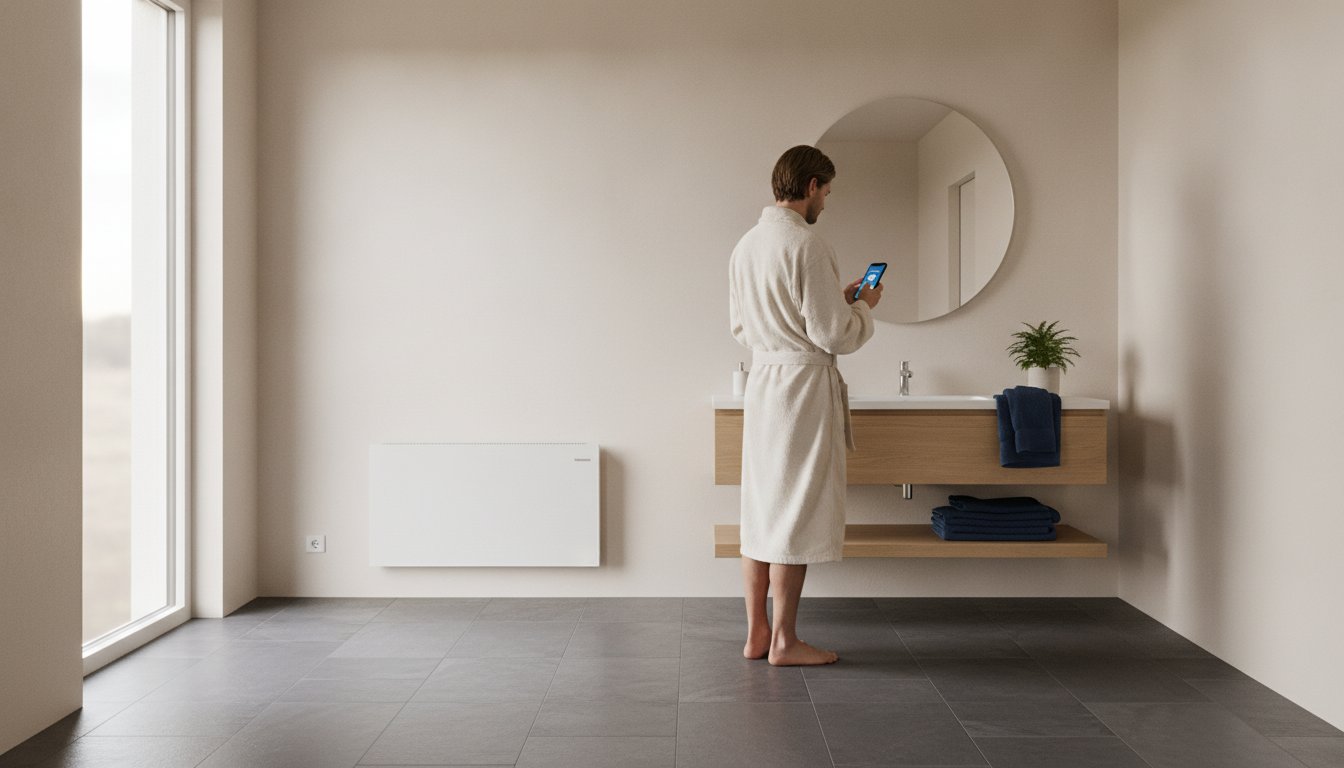
You get out of bed and walk barefoot into the bathroom, where the chilly morning draft immediately gives you the shivers. It is a familiar problem: you want a warm start to the day, but the central heating is slow and the energy bill often rises faster than the temperature. Moreover, many people are rightly concerned about the safety of electricity in a damp room or fear an unsightly device on the wall.
Fortunately, electrically heating your bathroom in 2026 will be smarter and safer than ever before. In this article, you will discover how, with the right technology, you can enjoy comfortable warmth within minutes without unnecessary waste. We discuss the benefits of smart convectors with Wi-Fi, look at essential safety standards such as NEN 1010, and show how modern design and functionality seamlessly come together in your interior. This way, you transform your bathroom into a sustainable oasis of tranquility where you enjoy spending time at any time of day, while maintaining full control over your consumption costs.
Key Points
- Learn why electrically heating your bathroom is the ideal solution for instant comfort without having to heat your entire home.
- Discover how to ensure safe heating in damp rooms in accordance with applicable standards with an IP24-certified convector.
- Understand the difference between convection and infrared and why a convector is often the most comfortable choice for a humid bathroom.
- Calculate the correct power for your space and save on consumption costs with smart control via a Wi-Fi app.
- Experience how Norwegian quality and the timeless design of BEHA ensure a stylish finish for your bathroom interior.
Why heating your bathroom electrically is a smart choice in 2026
In a time when we are more conscious of energy and comfort, the way we heat our homes has fundamentally changed. Electrically heating your bathroom is no longer a stopgap solution for poorly insulated houses, but a strategic choice for targeted comfort. Whereas a central system often has to heat the entire house to make one specific room beha, an electric convector operates independently and efficiently. It is the most direct way to create heat where you need it most.
Many modern homes are currently equipped with a heat pump and underfloor heating. Although this system is very energy-efficient, it responds slowly to a sudden demand for heat. An electric heater offers the perfect solution as supplementary heating. You have instant heat when you need it, without the main pump having to switch on hours in advance. Additionally, you save significantly on installation costs. No complicated pipework is required; a simple power outlet is sufficient to mount the convector and use it immediately. Moreover, technology has advanced to the point that the consumption of these devices is many times lower than that of the old, inefficient radiant heaters of the past.
The benefits of targeted heat
The bathroom is a space that you typically use intensively only for short periods. Heating your bathroom electrically allows you to reach a comfortable temperature in less than 10 minutes. This is due to the rapid air circulation of modern convectors, which draw in cold air, heat it up, and immediately redistribute it. Instead of leaving the radiator on all morning, you switch on the heating only when you are actually there. This independence from the central system results in a noticeable reduction in unnecessary heating costs for the rest of your home.
Sustainability and gas-free living
The transition to gas-free living makes electric solutions indispensable in a modern household. For households with solar panels, the calculations in 2026 are particularly favorable. Because the net metering scheme is still fully in effect this year, you can immediately use your self-generated electricity for your own comfort. This significantly reduces net operating costs. Moreover, the latest generations of convectors comply with the strict Ecodesign guidelines. This means they are equipped with smart thermostats and sensors that minimize environmental impact. Therefore, you are choosing not only your own well-being but also a responsible, future-proof solution that fits a sustainable lifestyle.
Safety and IP ratings: everything you need to know about electricity in damp areas
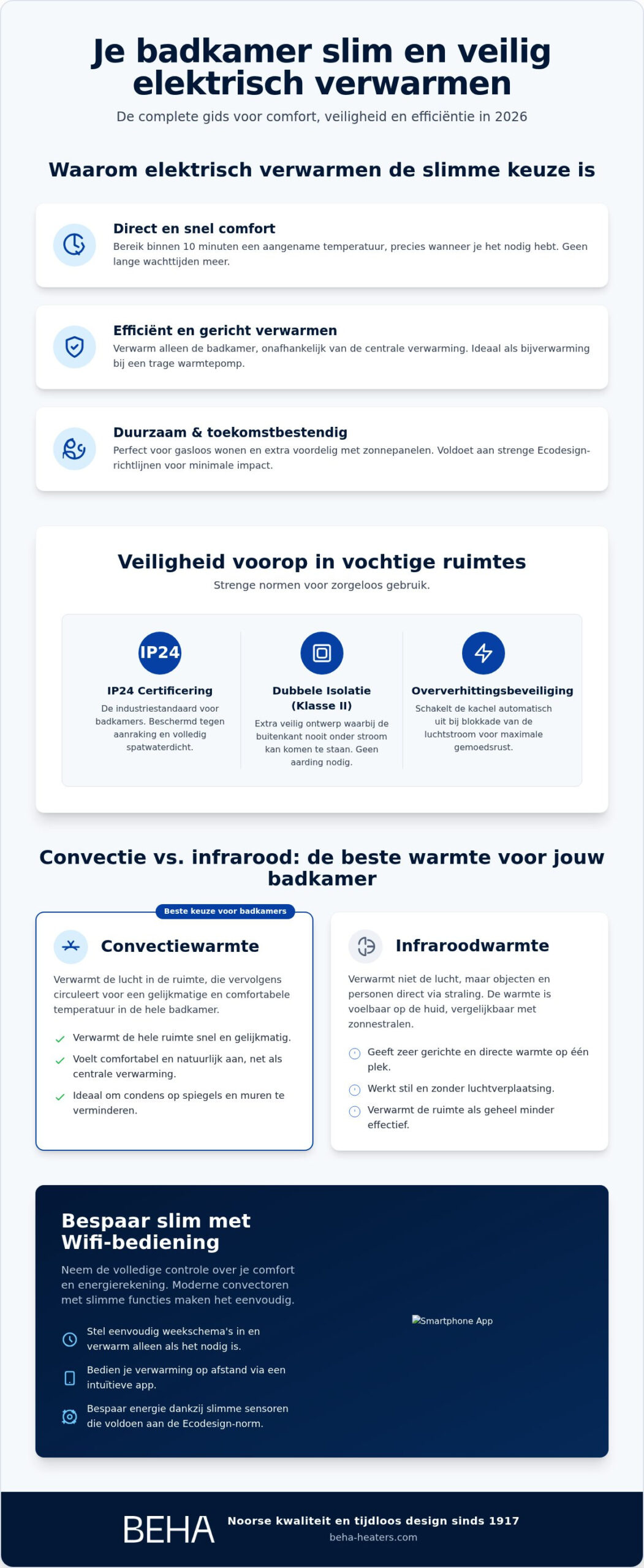
Safety is the absolute priority when you decide to heat your bathroom electrically. Moisture and electricity form a combination that requires strict precautions and high-quality equipment. In the Netherlands, we use the NEN 1010 standard for this, which precisely prescribes the requirements that electrical installations in wet areas must meet. This concerns not only the device itself, but primarily its resistance to penetrating moisture and accidental contact.
In addition to proper placement, the technical construction of the heater is essential. Modern convectors are often equipped with double insulation, also known as Class II. This means that the device is extra safe and does not require grounding via the plug, as internal defects can never energize the exterior. Combined with reliable overheating protection, which immediately switches off the power if the airflow becomes blocked, you create a safe environment for the whole family.
What exactly does IP24 mean?
The IP rating (ingress protection) indicates the degree to which an electrical product is protected against liquids and solids. For a bathroom convector, the IP24 classification is the industry standard. The first digit, the 2, stands for protection against contact with fingers and the ingress of objects larger than 12.5 millimeters. The second digit, the 4, is crucial for the bathroom; this means that the device is splash-proof from all directions. The Norwegian quality devices from BEHA are designed according to these strict standards as standard, guaranteeing years of safe use in damp environments.
Installation zones in practice
To ensure safety, the bathroom is divided into different zones. Zone 0 is the inside of the shower or bath, where, naturally, no heaters may be placed. Zone 1 is the area directly above the shower or bath up to a height of 2.25 meters. A convector with an IP24 rating is specifically intended for zone 2. This is the space up to 60 centimeters around the shower or bath. By mounting the heater on the wall in this zone, the unit hangs in a fixed, safe place, and the floor remains free of cords and any puddles of water.
Wall mounting is always preferred over a freestanding model on legs. It prevents the device from tipping over or being accidentally placed too close to a water source. When installing our smart convectors, it is also wise to pay attention to concealing the connection cable. A fixed connection to a splash-proof wall socket ensures the safest and most aesthetically pleasing finish for your electric bathroom heating project.
Convection versus infrared: which electric heater suits your bathroom?
When choosing electric heating for your bathroom, you often face a dilemma: do you opt for a convector or an infrared panel? The fundamental difference lies in the way the heat is distributed. Infrared works with radiation that directly heats objects and people, similar to the sun's rays. Convection, on the other hand, heats the air in the entire room by creating a natural airflow.
In a humid room like the bathroom, convection often has the edge in terms of overall comfort. While infrared only keeps you warm as long as you are standing directly in front of the panel, a convector ensures that the entire room feels pleasant. This is especially nice when you step out of the shower and want to dry off; the warm air completely surrounds your body, preventing you from cooling down immediately due to the surrounding cold air.
The power of modern convection heating
An electric convector with Wi-Fi offers precise control over the indoor climate. Thanks to air circulation, the heat is distributed evenly, ensuring that no cold corners remain in the bathroom. A major advantage of BEHA is the use of low-temperature elements. As a result, no dust combustion takes place, which improves air quality and prevents the familiar dry air odor. Moreover, these devices operate completely silently. Unlike fan heaters, there is no disturbing blowing, which contributes to the soothing atmosphere in your bathroom.
When do you choose infrared?
Infrared panels can be an excellent addition in specific situations, for example as targeted supplementary heating above a washbasin or as mirror heating to prevent condensation. However, as the primary source for electric heating in your bathroom, infrared has its limitations. As soon as you step out of the direct radiation, the rest of the room often still feels chilly. Also, objects standing in the “shadow” of the radiation are not heated.
Considering the costs, infrared panels are often more expensive to purchase than a high-quality convector. While they are efficient for short-term spot use, a smart convector with an accurate thermostat offers a better balance between investment and daily consumption. For those seeking constant and enveloping warmth throughout the bathroom, the convector remains the most logical and comfortable all-round choice.
Calculate ideal power and save with smart Wi-Fi features
To behamaximum efficiency, it is essential that the heater's capacity accurately matches the room. Insufficient power means the room never becomes truly beha, while excess power leads to an unnecessarily high investment. Therefore, electrically heating your bathroom always starts with a thorough calculation. Many simple calculation tools only consider the floor area, but this gives a distorted picture. After all, a high ceiling or large windows require more energy to bring and maintain the air at the desired temperature.
In addition to the dimensions, the insulation value of your home plays a crucial role. In a modern, well-insulated house, heat lingers longer, allowing you to get by with a lower wattage. However, if you have an older home with single glazing or many exterior walls, the convector has to work harder to compensate for heat loss. By making the correct calculation beforehand, you prevent the device from having to run at full power constantly, which benefits both your energy bill and the lifespan of the heater.
Step-by-step plan: calculate your wattage
Follow these three steps to determine the required capacity for your situation:
- Step 1: Measure the length, width, and height of the bathroom to determine the volume in cubic meters (m³).
- Step 2: Set the desired temperature. For a comfortable bathroom, this is usually 22 to 24 degrees Celsius.
- Step 3: Multiply the volume (m³) by the appropriate insulation factor. In a well-insulated room, calculate with approximately 60 Watts per m³. With moderate insulation or a large glass surface area, 80 Watts per m³ is a more realistic choice.
A bathroom of, for example, 15 m³ in a modern house therefore requires a convector of at least 900 Watts to heat the space efficiently.
Save with the BEHAapp
As soon as the right device is installed, the real savings begin. Heating your bathroom electrically only becomes truly cost-effective when you utilize the smart Wi-Fi features. Via the BEHAapp, you can easily program a weekly schedule so that the heating is only active when you are actually in the bathroom. It is no longer necessary to leave the heater on all day to enter a warm room in the evening.
'Open window detection' is another innovative feature that prevents energy waste. As soon as the sensor signals a sudden drop in temperature, for example while airing the room after showering, the heater temporarily switches itself off. Additionally, you can switch on the convector from your bed via your smartphone, so the room is already comfortable before you get up. With direct insight into your consumption via the app, you keep monthly costs precisely under control. Want to get started immediately with an energy-efficient solution? View all smart convectors and find the model that suits your bathroom.
Stylish and functional: the Norwegian quality of BEHA in your bathroom
Electrically heating your bathroom is a long-term decision, and the quality of the hardware plays a decisive role in this. BEHA has been setting the standard in the world of electric heating for over 100 years. This Norwegian tradition is rooted in an environment where reliability is not a luxury, but an absolute necessity. When you choose a convector of this caliber, you bring home technological superiority specifically designed to last for decades, even in the challenging, humid conditions of a bathroom.
The aesthetics of the heaters have been deliberately kept minimalist. You have the choice between a sleek, robust steel front or a luxurious tempered glass finish. Both options are designed to provide a focal point in your interior. Furthermore, the units are very compact, making them easy to place even in smaller bathrooms without taking up valuable floor space. The focus here is on a functional design that does not scream for attention, but stands out through its refinement and high-quality choice of materials.
Design that deserves to be seen (or perhaps not)
For those who prefer a radiator to blend seamlessly into the design, the paintable radiator a unique solution. While many suppliers only display standard white models, BEHA allows you to give the heater the exact same color as your bathroom wall. This ensures seamless integration that exudes tranquility in the room. In the comprehensive guide on everything about the paintable radiator, you can read exactly how to go about this for a professional result. The durability of the steel ensures that the paint adheres well and heat conduction remains optimal, regardless of the color you choose.
Easy installation and maintenance
A major advantage of this Norwegian technology is its ease of use and installation. You can mount the convector yourself within minutes using the included wall brackets. No installer is required; as soon as the bracket is in place and the plug is in the socket, the installation is complete. Because there are no moving parts or liquids inside the device, the heaters are virtually maintenance-free. Occasionally dusting with a soft cloth is sufficient to maintain efficiency. In this way, you combine the highest level of user-friendliness for your bathroom with the proven reliability of a brand that has been at the forefront of innovation for a century.
Choose lasting comfort and smart heating
Electrically heating your bathroom is the most direct way to transform your daily routine from a chilly start into a moment of pure relaxation. Through the combination of advanced technology and over 100 years of Norwegian experience, BEHA offers a solution that is both powerful and highly sophisticated. The safe IP24-certified products guarantee worry-free operation in damp environments, while simple Wi-Fi control via the app ensures you never consume a kilowatt-hour more than necessary. You can easily program your comfort based on your own rhythm, so the room is at exactly the right temperature when you need it.
By choosing high-quality materials and a timeless Norwegian design, you invest in a system that lasts for years without compromising on efficiency. Whether you opt for a minimalist front or a unique paintable variant, the technology remains reliable under all circumstances. Discover the perfect electric heating for your bathroom at BEHA every day behathat perfectly suits your lifestyle.
Frequently asked questions about electric bathroom heating
Is an electric heater in the bathroom safe?
Yes, an electric heater is absolutely safe provided it meets the correct protection rating for damp rooms. In the bathroom, an IP24 certification is the industry standard, which means the device is splash-proof from all directions. All BEHA bathroom convectors are designed according to these strict safety standards. By mounting the heater in a fixed position on the wall and respecting the official installation zones, you can enjoy a wonderfully warm room every morning without any worries.
How much electricity does an electric bathroom heater consume?
Consumption depends entirely on the wattage of the device and the duration of use. A 1000-watt convector consumes exactly 1 kWh per hour when running at full power. At an average price of 29 cents per kWh, an hour of intensive heating therefore costs you approximately €0.29. However, thanks to smart Wi-Fi control and precise thermostats, the device only switches on when strictly necessary, which significantly reduces actual consumption in practice.
Can I place a regular electric heater in the bathroom?
No, it is unsafe to place a standard heater without the correct IP24 rating in a damp room. Ordinary heaters are not protected against moisture ingress or splashing water, which can lead to short circuits or dangerous situations. You may only heat your bathroom electrically with equipment specifically approved for this environment. Always check that the appliance is double-insulated and has the correct certifications before installing it near water sources.
What is the best place to hang the heater in the bathroom?
The ideal location is on a free wall in zone 2, at a minimum distance of 60 centimeters from the shower or bath. Wall mounting is always preferred because the unit hangs at a fixed height and there are no loose cords running across a wet floor. Preferably, place the convector low on the wall; after all, warm air rises, ensuring the entire room is heated more efficiently and evenly for optimal comfort during your morning routine.
How many watts do I need to heat my bathroom?
You calculate the required power by multiplying the volume of the room in cubic meters by a specific insulation factor. For a bathroom in a well-insulated home, you should calculate with approximately 60 Watts per m³ to reach a temperature of 24 degrees. In older homes with more heat loss, 80 Watts per m³ is a more realistic choice. Therefore, in most cases, a 15 m³ bathroom requires a convector with a power output of at least 900 Watts.
Can I control the bathroom heater with my phone?
Yes, BEHA 's modern convectors can be fully controlled via an intuitive smartphone app. With this Wi-Fi functionality, you can adjust the temperature remotely or set up a detailed weekly schedule. This ensures the bathroom is already behawarm before you get out of bed, without the heater running unnecessarily when you are away from home. This not only offers a high level of comfort but also directly helps to reduce your monthly energy costs.
Are BEHA convectors suitable for damp rooms?
Absolutely, BEHA bathroom convectors are specifically developed for long-term, safe use in humid environments. They feature the necessary IP24 rating, which means they are splash-proof and can be safely installed in the appropriate zones of the bathroom. Furthermore, Norwegian quality guarantees that the materials used, such as high-quality steel, are resistant to high humidity. This makes them a sustainable choice for anyone who wants to combine safety with a stylish design.
What is the difference between a bathroom radiator and a convector?
A traditional bathroom radiator is often a towel dryer that slowly emits radiant heat and is primarily intended for drying textiles. An electric convector, on the other hand, heats the air in the room directly by creating a natural airflow. As a result, a convector is much faster at bringing a cold bathroom to a comfortable temperature in just a few minutes. Whereas a radiator often has to stay on for hours, a convector provides targeted heat at the moments you are actually using the room.