
Electric bathroom heating: 7 smart choices
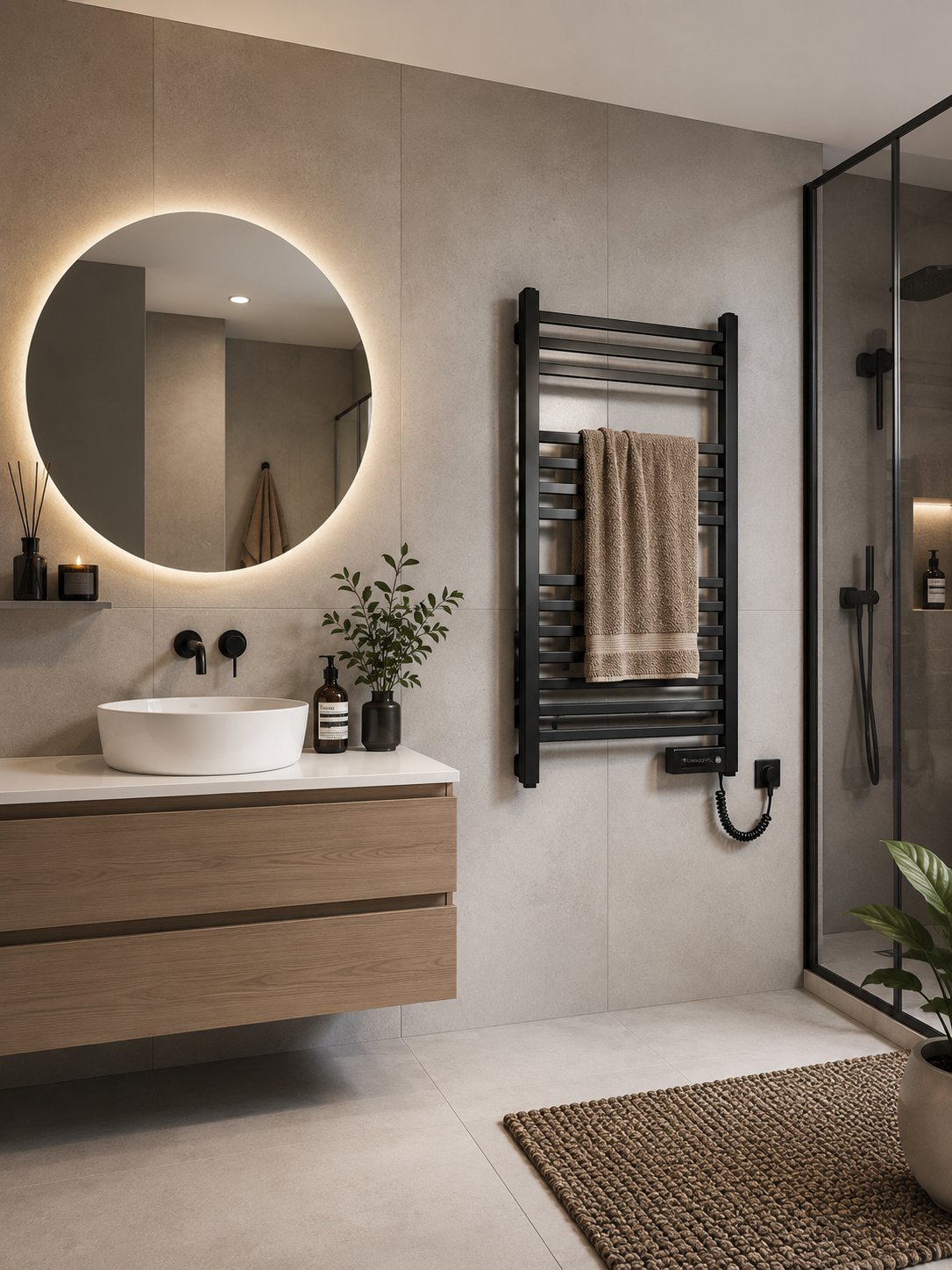
electric bathroom heating requires more attention than a standard heater for the living room. Water, condensation, and electric zones place demands on the appliance, connection, and installation location. Moreover, a small towel dryer is not automatically powerful enough to heat the entire bathroom, while a convector must never be covered with towels.
This buying guide for Belgium and the Netherlands compares convectors, electric towel radiators, infrared, fan heaters, and underfloor heating. You will learn how to estimate the required power, calculate consumption, and check IP rating, bathroom zone, and controls. This way, you choose electric bathroom heating based on safety, heat demand, and daily use, rather than just design or wattage.
Key points
- Electric bathroom heating must comply with the electrical zone, IP rating, and national installation regulations.
- A low-power towel dryer dries textiles but does not automatically heat the entire bathroom.
- Calculate the power based on heat loss; fixed watt-per-m³ rules are only a first indication.
- Operating costs = power in kW × active heating hours × your own all-in electricity price.
- Heating accelerates drying, but ventilation is necessary to effectively remove moisture.
- Never cover a convector; use only a radiator or holder designed for that purpose for towels.
Which electric bathroom heater suits your space?
With the principles of electric heating, electricity is converted into heat in or near the room. In the bathroom, this allows for quick, zone-by-zone heating without central heating pipes. This is practical during renovations, for a separate morning routine, or for a bathroom that is only used briefly each day. However, for long-term primary heating, you must also assess insulation, total electricity demand, and alternatives such as a heat pump.
The best electric bathroom heater depends on two different needs: do you want to heat the air and surfaces of the room, dry towels, or both? A narrow 60-watt towel dryer can comfortably heat textiles, but provides insufficient power for many complete bathrooms. A powerful convector can heat the room, but should not be covered with wet towels.
Five systems fairly compared
| System | Best application | Strong point | Point of attention |
|---|---|---|---|
| Bathroom convector | Quickly heat the room air | Quiet and precisely adjustable | Never cover; check zone and IP class |
| Electric towel radiator | Drying towels and additional heat | Functional and decorative | Low power is not always space heating |
| Infrared panel | Targeted radiant heat | Immediately within reach | Positioning, zone, and clear radiation line are determining factors |
| Bathroom fan heater | Very short heat demand | Fast heating | Noise, airflow and strict installation requirements |
| Electric underfloor heating | Warm floor and even base heat | Invisible and comfortable | Floor insulation, structure, control and installation costs |
Those electric bathroom heating can combine systems. Underfloor heating, for example, provides gentle base warmth, while a towel radiator dries textiles. A convector, on the other hand, can warm up quickly just before the morning routine. Only combine systems if the power output, controls, and electrical installation are designed to handle it.
Heating does not replace ventilation
Warm air can hold more moisture, and a higher surface temperature reduces temporary condensation. However, water vapor from showering remains in the room until ventilation removes it. Therefore, use mechanical or natural ventilation in accordance with the home design. Keep ventilation grilles open and allow the extraction system to continue running for a sufficient length of time after showering.
Good electric bathroom heating supports comfort and drying, but does not independently prevent mold. Thermal bridges, leaks, and insufficient ventilation require a structural or ventilation solution.
Supplementary heating or primary heating?
For a bathroom that is used briefly in the morning and evening, programmable zone heating is often a good fit. As the primary heating system, the unit must be able to cover the design heat loss at low outdoor temperatures. In a poorly insulated bathroom with a large exterior surface area, the heat demand can be high. If in doubt, have the capacity per room calculated.
Safe electric bathroom heating: IP and zones
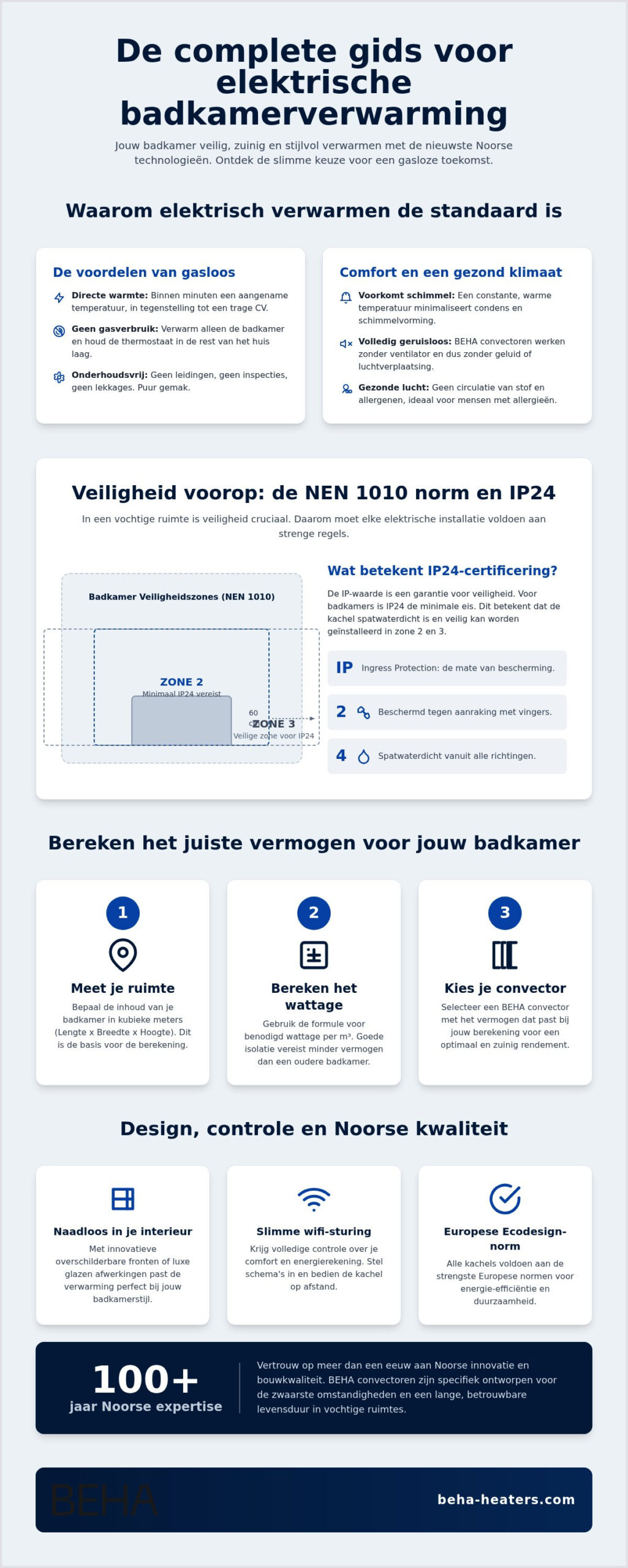
Water and electricity require correct product selection and installation. The IP code describes protection against contact, ingress of objects, and water. Higher water protection may be necessary as a device is placed closer to the bath or shower, but a single IP code never independently authorizes every installation location.
What does IP24 mean?
With IP24, the first digit indicates protection against finger access; the second digit represents protection against splashing water from various directions. Whether an IP24 device may be mounted in a specific location depends on the bathroom zone, construction, product instructions, and the regulations applicable in Belgium or the Netherlands. Also check whether the device is intended for fixed mounting or use with a plug.
General safety information for electric space heaters emphasizes clearance and correct use, but does not replace Belgian or Belgian and Dutch installation standards. Have a new circuit, permanent connection, or installation in a damp zone carried out by a qualified electrician.
Zone, earth leakage protection and connection
- Check the exact boundaries of the zones around the bath and shower.
- Use only a device that the manufacturer permits for that application.
- Have protection, grounding or double insulation, and differential or earth leakage protection assessed.
- Place the cord, plug, and controls outside prohibited or unsafe zones.
- Do not use a loose extension cord in the bathroom.
- Never cover a convector and keep air vents clear.
Anyone electric bathroom heating for a household with children should also pay attention to the child lock, operating height, surface temperature, and sturdy wall mounting. Overheating protection is important, but it does not make incorrect placement or covering safe.
Product documentation over sales terms
Words such as “bathroom-proof”, “splash-proof”, or “plug-and-play” are insufficient for an installation decision. Check the manual, IP code, electrical class, permitted mounting area, and minimum distances. You can find product information on BEHA Heaters , but always have the final placement verified against the on-site installation.
Power and consumption of electric bathroom heating
A bathroom is often desired to be warmer than a bedroom and frequently features exterior walls, tiles, and ventilation. However, there is no universal exact wattage per m² or m³. The required power is derived from heat loss: the amount of heat that escapes through the structure and ventilation when it is cold outside.
Which factors determine net worth?
- length, width and ceiling height;
- roof, wall and floor insulation;
- type and surface area of windows;
- ventilation rate and any drafts;
- adjacent heated or unheated rooms;
- desired temperature and heating time;
- towel drying versus full space heating.
For an initial product selection, a salesperson can use a range per cubic meter. Do you want electric bathroom heating as your primary heating source, or do you have large glass areas, high ceilings, or moderate insulation? Then have a heat loss calculation performed. This will prevent you from choosing an undersized unit that remains active for too long, or an unnecessarily heavy electrical load.
Calculate usage costs yourself
Formula: power in kW × active heating hours × all-in electricity price = operating costs. A 1,200-watt appliance that actually heats for two hours uses 2.4 kWh. Multiply that by your own rate; sample prices on the internet are no prediction of your bill.
The thermostat switches in cycles after heating up. Therefore, calculate using measured kWh or actual active hours, not just the time the appliance is switched on. A suitably installed energy meter can provide insight into when it is permitted for the power consumption and the bathroom environment.
Seven choices before purchase
- Determine whether you need space heating, towel drying, or both.
- Calculate or substantiate the heat loss of the bathroom.
- Check IP rating and permitted bathroom zone.
- Have the circuit, earth leakage or differential protection, and connection assessed.
- Select the desired control: thermostat, timer, weekly program, or Wi-Fi.
- Check mounting distances, warranty, and cleaning instructions.
- Calculate usage with your own rate and expected active hours.
Practical choice per bathroom type
In a small, well-insulated bathroom with a short morning routine, fast, programmable heating is often more important than long-term heat storage. In a family bathroom with consecutive showers, sufficient continuous power, ventilation, and drying capacity carry more weight. A large bathroom with exterior walls or a walk-in shower requires extra attention to cold surfaces and heat loss.
In renovations without central heating pipes, a fixed electric solution can limit chiseling. In new construction, you can combine underfloor heating, towel drying, ventilation, and power outlets from the design stage. Tenants only choose a portable model if the manufacturer permits bathroom use at the intended location; a freestanding unit is not automatically safer than wall mounting. Always discuss drilling, fixed connections, and modifications with the owner or installer.
With this approach, electric bathroom heating a safe and predictable choice. You prevent a decorative towel dryer from being mistaken for full heating or a powerful appliance from being placed in an unsuitable location.
When does Wi-Fi help?
Wi-Fi can be useful for varying routines, multiple zones, or remote control. The savings result from shorter heating times and an appropriate temperature, not from Wi-Fi itself. A local weekly schedule can achieve the same results when your routine is fixed. For example, heat briefly before use and then let the bathroom ventilate and drop to a lower temperature.
Design and installation of electric bathroom heating
In a compact bathroom, wall mounting is often practical, but safety and free air circulation take precedence over appearance. Only choose a position after checking the electrical zones, minimum distances, and cable routing. A socket “nearby” does not automatically mean the location is suitable.
Convector or towel radiator?
A convector is designed to allow air to flow through the unit and must not be covered. If you want warm and drier towels, choose an electric towel radiator with dedicated rods. Additionally, check whether the nominal power is sufficient for the room's heating demand.
Paintable front
A paintable front can visually blend into the wall. Use only the paint system and procedure prescribed by the manufacturer. Do not paint air vents, the sensor, controls, or the back. Ordinary “heat-resistant paint” is not automatically suitable for every material or for a damp room.
Glass, steel and maintenance
Glass has a sleek appearance and a smooth surface; steel is robust and timeless. Check the permitted cleaning agents for both materials. Switch off the appliance, allow it to cool down, and do not use excessive water or abrasive products around the controls and openings.
Check which versions are available via BEHA Heaters , but always compare the product sheet, dimensions, power, IP code, and installation manual. This ensures that design remains supportive of a safe installation.
Discover the Norwegian quality of BEHA convectors
When choosing a heating solution, the origin of the technology is often a good indicator of reliability. BEHA is a Norwegian family business with over 100 years of experience in developing electric heating. In a country where winters are extreme, high-quality heating is not a luxury but a necessity. This expertise is immediately reflected in the robust construction and sophisticated technology of every unit. For those looking for the best electric bathroom heatingoffers BEHA the assurance of a product tested under the toughest conditions.
The modern convector is much more than a metal casing with a heating element. It is an intelligent system that meets the strictest European Ecodesign requirements. This means that the units are designed to behamaximum results with minimal energy consumption. Thanks to the combination of a highly accurate electronic thermostat and an intuitive app, you maintain full control over your energy consumption. You never heat more than necessary, which is essential in a time when we are mindful of our resources and energy bills.
Why choose a specialist?
The difference between a general provider and a specialist like BEHA lies in the details and the long-term vision. Our focus is entirely on sustainability and climate-friendly solutions that meet modern living needs. An investment in a quality convector is an investment in years of comfort without worries about safety or defects. Moreover, you benefit from local expertise and support within the Benelux market. We understand the specific needs of Belgian and Dutch consumers and offer the right technological answers, from paintable fronts to advanced smart-home integrations.
Ready for the next step?
Creating a warm, stylish, and safe bathroom starts with the right equipment. Whether you are renovating an existing space or furnishing a new bathroom, our smart convectors offer the flexibility you need. Want to dive deeper into the technical possibilities? Then read more about the electric convector with Wi-Fi to discover how to optimally set up your heating schedules for an energy-efficient home.
View our full range and find the model that perfectly matches your interior and heating needs. Do you still have specific questions about installation or the required power after reading this guide? Then feel free to contact our experts for professional, tailored advice. We are happy to help you create the ideal bathroom experience.
Enjoy a warm start every morning from now on
Heating the bathroom requires a smart approach where safety and efficiency go hand in hand. You now have a clear picture of how to choose the right IP rating, calculate the required power, and select a design that seamlessly complements your interior. With electric bathroom heating, you choose a gas-free future without compromising on comfort or style. It is the most direct path to a healthy and mold-free space that is always ready for use.
BEHA has offered you the assurance of Norwegian quality since 1917. Our convectors meet all strict Ecodesign standards and, thanks to simple Wi-Fi control via the app, can be fully adjusted to your personal daily rhythm. This keeps energy costs low while you enjoy a bathroom that has the desired temperature at exactly the right moment.
Are you ready to transform your bathroom into a modern wellness space? Discover our smart bathroom heating and order now to experience the difference of Norwegian craftsmanship for yourself. Make your bathroom the most comfortable place in the house.
Frequently asked questions about electric bathroom heating
Which heater is best for a bathroom?
That depends on space heating, towel drying, warm-up time, and available installation location. A convector heats the air, a towel radiator dries textiles and provides additional heat, infrared provides targeted radiation, and underfloor heating ensures floor comfort.
Is IP24 always sufficient?
No. IP24 describes protection against contact and splashing water, but the permitted installation also depends on the bathroom zone, product instructions, and national installation regulations. If in doubt, have the installation site assessed by an electrician.
How many watts do I need?
The required power is derived from the heat loss. Surface area, ceiling height, insulation, windows, ventilation, and desired temperature all play a role. Use a watt-per-m³ rule only for an initial selection and request a calculation for primary heating.
Can a towel radiator heat the entire bathroom?
Only when the heating capacity is sufficient for the heat loss. Narrow dryers of a few tens of watts are primarily intended for textiles. Compare the nominal power with the calculated heat demand.
Can I put towels on a convector?
No. A convector requires unobstructed air vents and must not be covered. For towels, use only a device or accessory designed for this purpose by the manufacturer.
Can I install the heating myself?
A fixed connection, new circuit or group, and installation in bathroom zones are the responsibility of a qualified electrician. A plug-in model must also be installed in accordance with the manual, IP requirements, and local regulations.
Does heating help prevent mold?
Warmer surfaces can reduce condensation and accelerate drying, but moisture only disappears through ventilation or dehumidification. Resolve leaks and thermal bridges and ensure adequate air circulation.
Is Wi-Fi necessary?
No. A thermostat and a suitable schedule are more important. Wi-Fi is convenient for remote control and changing routines. It only saves energy if it causes you to heat for a shorter time or at a lower temperature.
How much does electric bathroom heating cost per hour?
Multiply the power in kW by the active hours to get your all-in price per kWh. A 1 kW appliance consumes 1 kWh per hour at full power. The thermostat can shorten the active time after heating up.
When is electric bathroom heating less suitable?
With prolonged primary heating in a large, poorly insulated bathroom, consumption can be high. First improve insulation, calculate the heat demand, and compare other systems. Never choose a device if safe installation within the electrical zones is not possible.