
Electric bedroom heating: What is the best choice?
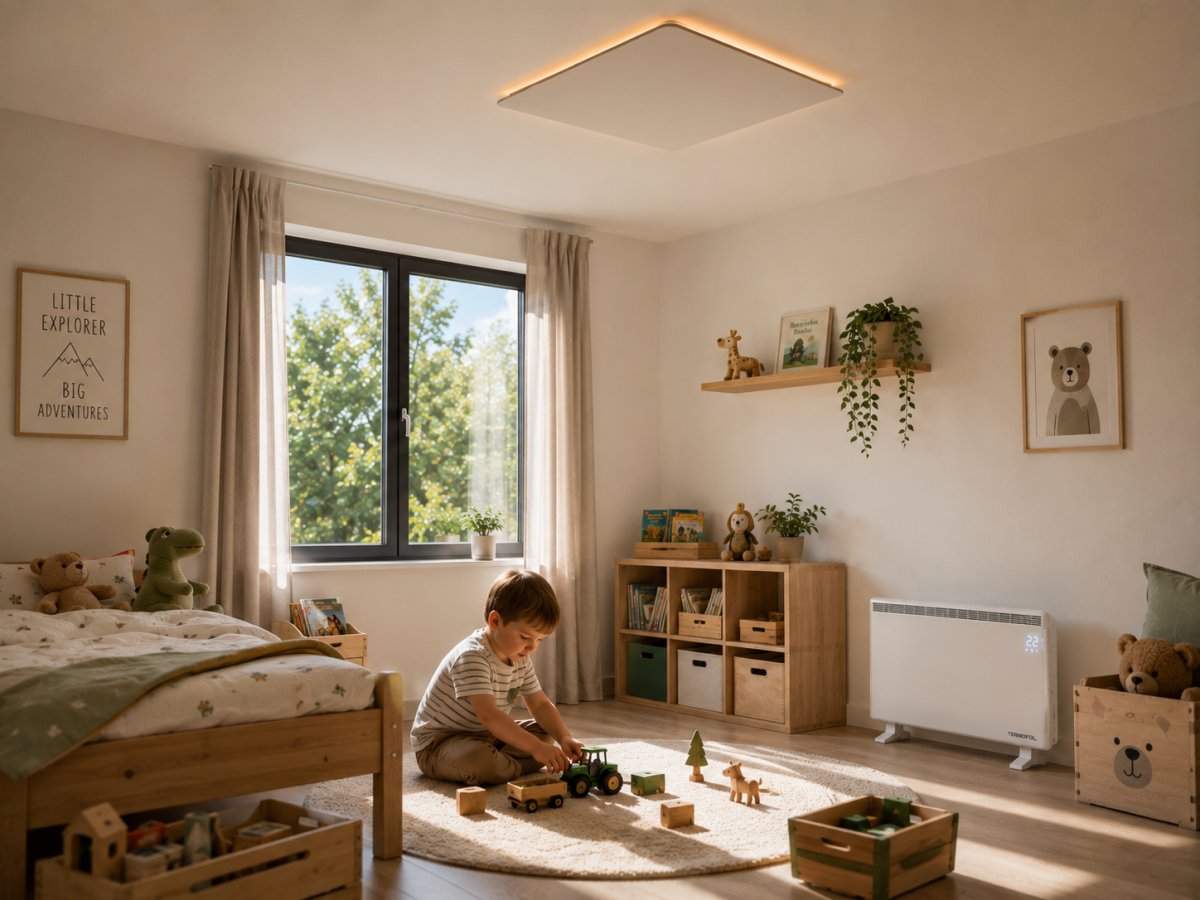
electric bedroom heating doesn't start with the highest wattage or the lowest purchase price. The best solution depends on what you want to heat: the entire room, just the bed, or a workspace. Insulation, lifespan, noise, thermostat, and safe placement also determine whether a device is truly comfortable and affordable.
In this buying guide, we compare five forms of electric heating for the bedroom: a wall convector, infrared panel, oil-filled radiator, fan heater, and electric blanket. You will receive a practical power and cost calculation, advice for Belgium and the Netherlands, and a checklist to help you debunk marketing claims from various providers.
For many adults, 16 to 18 °C is a usable starting point for the bedroom. The Flemish government recommends 16 to 18 °C and emphasizes room-by-room regulation; personal preference, age, and health may deviate from this. Read the current heating tips from Flanders and adjust the temperature to suit the user.
Key points
- A wall convector without a fan is powerful for quiet, even heating of the entire bedroom.
- Infrared is suitable for short, localized heat; an electric blanket heats the person rather than the room.
- A higher wattage is not automatically more economical. Heat loss, set temperature, and actual operating time determine consumption.
- First calculate the room volume and assess insulation, windows, exterior walls, and the space above or below the bedroom.
- Choose an electronic thermostat, weekly program, overheating protection, and product-specific certification.
Why choose electric heating in the bedroom?
The transition from gas to electricity is in full swing, and in the bedroom, this switch makes more sense than in any other room. Traditional central heating is often a cumbersome system that heats the entire house, whereas at night you actually only need a specific temperature in your resting area. By choosing electric heating for the bedroom, you save immediately on your gas bill. After all, you turn down the thermostat in the rest of the house, while your bedroom maintains exactly the right warmth without unnecessary energy waste in the living room or kitchen.
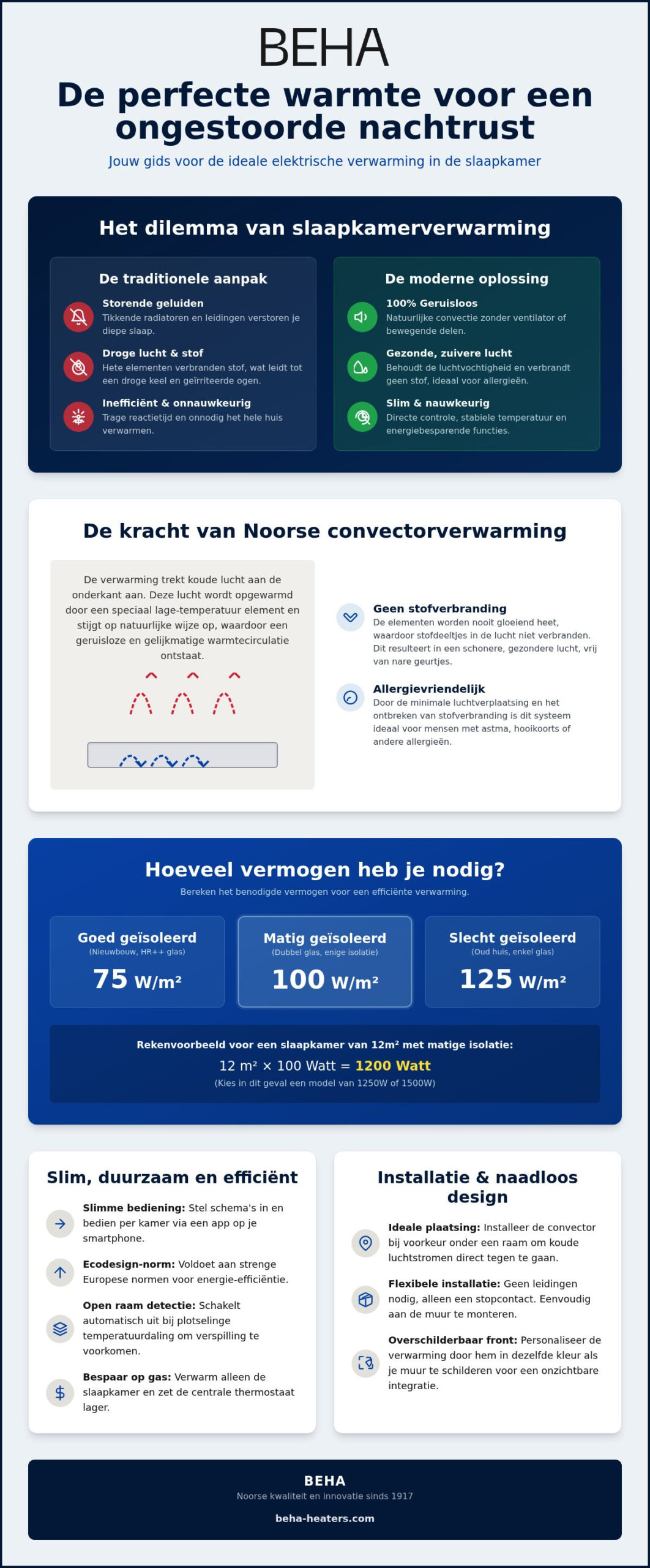
A constant temperature is essential for deep sleep. Thermal fluctuations cause your body to work harder to regulate your core temperature, which can pull you out of your deep sleep phase. Electric convectors respond much faster and more accurately than water-filled radiators. They keep the room at a stable level without the familiar ticking noises of expanding pipes that can disturb your night's rest. The flexibility of a wall-mounted convector is a major advantage in this regard; you place it exactly where the heat demand is greatest, independent of the existing pipe network.
Comfort and control with modern technology
Modern technology makes managing your indoor climate easier than ever. While a traditional radiator takes time to warm up and continues to glow for a long time afterward, smart convectors offer instant control. This is ideal for the bedroom, where you often do not need heating during the day. You set the heater to raise the temperature to a comfortable level only shortly before going to sleep. A bedroom does not require a high base temperature; around 16 to 18 degrees is usually sufficient for a healthy night's sleep. With independent control per room, you determine the rhythm yourself, without the entire home needing to heat up.
Sustainability and the future of housing
Electric zone heating can be suitable for a home that uses less natural gas, but sustainability depends on insulation, power source, and operating time. If you have solar panels, your own production can cover part of your consumption. However, in winter and during the evening or night, production and heat demand often do not coincide; therefore, calculate based on your own tariff and feed-in or feed-in conditions.
BEHAmodels comply with the applicable European Ecodesign requirements. Features such as an electronic thermostat, weekly program, and open window detection limit waste by ensuring the electric heater does not continue heating the bedroom unnecessarily. The greatest benefit remains: heating only the required space at the right time and at an appropriate temperature.
Electric bedroom heating: five options compared
Not every electrical appliance performs the same function. A resistance heater converts almost all of the current drawn by the device into heat, but comfort and usability differ. An air-to-air heat pump can deliver several kilowatt-hours of heat per kilowatt-hour of electricity, but requires a higher investment and fixed installation.
| Option | What is being heated? | Speed | Sound | Best application |
|---|---|---|---|---|
| Wall convector without fan | The room air | Fast | Very quiet | Heat daily and evenly |
| Infrared panel | Persons and surfaces in the radiation zone | Immediately palpable | Quiet | Short, local heat |
| Oil-filled radiator | The room air and surroundings | Slow | Quiet | Temporary, gradual supplementary heating |
| Fan heater | The room air | Very fast | Audible | Warm up briefly while you are awake |
| Electric blanket | Only the bed or body | Fast | Quiet | Personal comfort with low power |
| Air-to-air heat pump | The room air | Fast | Indoor and outdoor unit audible | High volume and prolonged heating with higher efficiency |
Which option is the most economical?
For a single person who only wants a warm bed, a suitable electric blanket usually uses much less power than a room heater. For an entire bedroom that is used briefly, targeted electric heating can be practical. If the room needs to remain warm for many hours daily, compare it to central heating or a heat pump. Milieu Centraal warns that a standard electric heater can use a lot of electricity for prolonged room heating; therefore, also check the Dutch heating saving tips.
The best electric bedroom heater is therefore not a single universal device. Choose a convector for even, quiet room heating, infrared for a fixed position within the radiation zone, and a blanket if the room itself does not need to be warmer. Use a fan heater only if the noise and strong airflow are not an issue.
The benefits of convector heating for a good night's sleep
A bedroom is a delicate environment where every detail affects the quality of your rest. While traditional heating systems are often accompanied by background noise or an unpleasant indoor climate, a convector offers the peace and stability needed for a deep sleep. Its operation is based on natural air circulation. Cold air is drawn in at the bottom of the heater, warmed by an internal element, and then rises silently. This process ensures even heat distribution without the need for a noisy fan. This way, you enjoy an electric bedroom heater that provides warmth without the distraction.
Healthy air quality without dust circulation
One of the biggest annoyances when heating the bedroom is the creation of dry air, which often leads to dry eyes or a scratchy throat upon waking. This problem is usually caused by dust burning on glowing hot heating elements. BEHA has solved this by using special low-temperature elements. Because the surface of these elements never reaches a critical temperature, the household dust present is not burned.
This has direct benefits for your health and comfort:
- No dust combustion: The air remains clean and free of the typical burning smell that can trigger allergies.
- Humidity: heating does not remove water from the air, but heating lowers the relative humidity. Ventilation and, if necessary, a hygrometer remain important.
- Allergy-friendly: An element with a low surface temperature can limit dust scorching and odor. For asthma or allergies, ventilation, cleaning, and personal medical advice remain important.
By choosing this technique, you invest not only in warmth but also in your physical well-being during the night.
Complete silence for an undisturbed sleep
For light sleepers, absolute silence is a requirement. While central heating often ticks due to expanding pipes and fan heating produces a constant hum, a BEHAconvector without a fan operates very quietly. The electronic thermostats are designed so that you do not hear a loud mechanical click when the heater switches on or off to adjust the temperature. This makes it the ideal electric bedroom heater for those who want to sleep through the night undisturbed.
In addition, attention has been paid to visual tranquility. Many modern devices have bright displays that unintentionally illuminate your bedroom. 's BEHA are discreet and do not emit bothersome light, ensuring your room remains completely dark. The result is a soothing environment where all your senses have the chance to truly relax. You simply set the desired temperature and the technology does the rest, without you ever noticing it. smart convectors
How many watts does an electric bedroom heater need?
For an initial indication, calculate the room volume: length × width × height. Use approximately 25 to 30 watts per cubic meter for good insulation and 35 to 40 watts per cubic meter for average insulation. For single glazing, a large exterior surface area, drafts, or an unheated attic above, a professional heat loss calculation is more reliable.
A device that is too small cannot reach the desired temperature. A device that is too large reaches that temperature faster, but does not use a kilowatt-hour of electricity more efficiently. As soon as the target temperature is reached, an accurate electronic thermostat switches the element on and off in cycles.
Power table for a ceiling height of 2.5 meters
| Bedroom | Volume | Good insulation 25-30 W/m³ |
Average insulation 35-40 W/m³ |
|---|---|---|---|
| 8 m² | 20 m³ | 500-600 W | 700-800 W |
| 10 m² | 25 m³ | 625-750 W | 875-1,000 W |
| 12 m² | 30 m³ | 750-900 W | 1,050-1,200 W |
| 15 m² | 37.5 m³ | 940-1.125 W | 1,310-1,500 W |
| 20 m² | 50 m³ | 1,250-1,500 W | 1,750-2,000 W |
Example: for 12 m² with a height of 2.5 meters, the volume is 30 m³. With average insulation, 1,050 to 1,200 watts is a useful indication. If the room has two exterior walls and a lot of glass, have the actual heat loss checked.
Consumption and costs of electric bedroom heating
The nominal wattage is the maximum power, not automatically the continuous consumption. A 1,000-watt appliance consumes 1 kWh when the element heats actively for a total of one hour. Calculate the costs using: power in kW × actual duty cycle × your price per kWh.
Example: a 1 kW appliance that actively heats for a total of three hours during an evening and night uses 3 kWh. At a self-chosen calculation price of €0.30 per kWh, that is €0.90. For a true monthly estimate, use your current contract price and measure the appliance for a few cold days. A general average electricity price becomes outdated quickly and says little about your fixed, variable, or dynamic contract.
This is how you limit power consumption
- Heat only when the room is being used and program the heating shortly before bedtime.
- Do not set warmer than necessary; 16 to 18 °C is sufficient for many bedrooms.
- Improve draft sealing and insulation before buying extra wattage.
- Do not block a convector with curtains, a bed, a wardrobe, or laundry.
- Lower the device setting during intensive ventilation or use open window detection.
- Check measured kWh instead of just the percentage of marketing savings.
When is local electric heating cost-effective?
Electric bedroom heating can be beneficial when you heat one small, reasonably insulated room for a short time, allowing you to turn down the central heating elsewhere significantly. However, for a poorly insulated room or for many hours of main heating, power consumption can become high. In that case, compare it with insulation, an existing central heating system, an air-to-air heat pump, or another efficient main heating system.
Electric bedroom heating in Belgium and the Netherlands
Standard appliances operate on 220-240 volts in both countries, but costs and best times to use them depend on the home and energy contract. In addition to the kWh price, also consider concurrent power consumption, grid costs, feed-in or injection, and the effect on your other heating systems.
- Belgium: with a digital meter, you can view quarter-hourly consumption. Plan smartly and prevent multiple heavy appliances from causing a high peak simultaneously.
- Netherlands: compare local electric heating with your central heating boiler or heat pump based on current electricity and gas rates. The benefit arises primarily when other rooms are demonstrably heated less.
- Dynamic tariff: a weekly program can shift heating, but comfort, humidity control, and sleep rhythm remain the guiding principles.
- Solar panels: winter evening heat does not automatically come from daytime production. Factor in self-consumption, feed-in, and potential storage.
Connect safely
Check the rating plate and the manual. Preferably connect a powerful appliance directly to a suitable grounded socket, do not use a coiled cable reel, and do not carelessly combine it with other heavy consumers on the same circuit. If in doubt regarding the group, circuit, grounding, or permanent connection, have a certified electrician assess what is required.
Tips for a safe and efficient installation
Proper installation is half the battle when striving for a comfortable and energy-efficient sleeping environment. The location where you mount your electric bedroom heater determines how effectively the heat circulates through the room. Many people make the mistake of simply placing the heater wherever a socket happens to be free, but strategic placement yields much more comfort and a lower energy bill in the long run.
The golden rule for convection is to hang the heater in the coldest spot in the room, which in most cases is directly under the window. Cold air sinking down the glass is immediately captured by the heater, warmed up, and sent back into the room. This prevents an annoying cold draft across the floor and ensures an even temperature distribution. However, make sure there is sufficient free space around the convector. Curtains hanging over the heater or a cupboard standing right in front of it block the airflow and force the device to work harder than necessary.
Optimal placement for maximum heat
Placement under the window creates a thermal curtain that effectively blocks the cold from outside. For safe operation and optimal circulation, it is important to maintain a distance of at least 10 centimeters from the floor and surrounding objects. This ensures that the natural intake of cool air can take place unimpeded. BEHA thermostats are designed to measure the ambient temperature with extreme accuracy at the bottom of the device. As a result, the system responds directly to the actual room temperature, without being affected by its own heat output at the top.
Maintenance and lifespan of your convector
A major advantage of modern electric systems is that they require virtually no attention after installation. By choosing maintenance-free electric heating, you save yourself the annual technical inspections associated with a traditional central heating system. The only necessary maintenance is periodically cleaning the grilles of dust. Simply use a vacuum cleaner for this to prevent dust particles from obstructing the airflow. This keeps heat transfer optimal and prevents the heater from consuming excessive energy.
BEHA 's Norwegian quality guarantees a durable investment that lasts for years. Furthermore, the simple wall mounting with the included brackets makes it an ideal project for the do-it-yourselfer. You do not need complicated tools or technical knowledge to behaa sleek and safe result. Thanks to the robust construction and smart electronics, you enjoy a reliable heat source that grows with your needs.
Do you want to get started immediately with improving your sleeping comfort? Discover our full range of smart electric convectors and find the model that perfectly suits your bedroom.
Why a BEHA convector is the ideal choice for your bedroom
When choosing a heating solution for the most personal space in your home, you look for a brand that combines reliability with innovation. BEHA is rooted in over a hundred years of Norwegian history. In a country where extreme cold is the norm, we have learned what truly matters: a system that always works, is whisper-quiet, and puts the user's well-being first. Our expertise translates into an electric bedroom heater that is not only technically superior but also seamlessly aligns with the modern living requirements of 2026.
The strength of our convectors lies in our no-nonsense approach to quality. We do not use flashy technology, but rather well-thought-out solutions such as durable steel fronts with a timeless design. This creates a calm appearance that is essential for a room intended for relaxation. Furthermore, intuitive operation via the Wi-Fi app makes management easy for the whole family, ensuring each room receives its own ideal climate without complicated procedures.
Aesthetics meets functionality
A common complaint regarding electric heaters is that they often form a disruptive element in a carefully curated interior. BEHA breaks this pattern with the unique concept of the paintable radiator. This allows you to easily match the heater to the color of your bedroom wall, making the appliance virtually invisible. Whether you love a classic steel front or prefer a modern glass front, the finish is always of the highest standard. Furthermore, thanks to their compact dimensions, our models are perfectly suited for smaller bedrooms where every square meter counts.
Ready for the future of heating
sustainability is BEHA not a buzzword, but a core value that has set the standard for a century. The reliability of an electric convector with Wi-Fi means you are investing in a device ready for a gas-free future. Our systems are designed to last for decades, supported by direct service and expert advice for every project. You are not just choosing a heater, but a partner that contributes to a responsible and smart lifestyle. This way, you enjoy the perfect temperature every night, knowing that your electric bedroom heating meets the strictest environmental requirements and technological standards.
Buying checklist for electric bedroom heating
- Goal: do you want to heat the whole room, one spot, or just the bed?
- Power: is the appliance suitable for the volume, insulation, glass, and exterior walls?
- Control: are an electronic thermostat, timer, and weekly program present?
- Noise: does the appliance have a fan or a mechanical thermostat?
- Safety: are overheating protection, double insulation, certification mark, and mounting distances clearly stated in the documentation?
- Children's room: check cord, child lock, wall mounting, and surface temperature; always supervise according to the manual.
- Operation: remains manual operation possible if Wi-Fi or the app fails?
- Service: are warranty, manual, parts, and support available in the Benelux?
- Total costs: compare purchase, measured kWh, lifespan, and any installation costs.
A BEHAwall convector is particularly suitable when you are looking for quiet, even room heating and precise control. For just a warm bed or a briefly occupied workspace, a solution with a lower total output might be more logical. This fair trade-off makes this electric bedroom heating guide useful for both comfort and budget.
Ready for a healthy night's sleep and smart heating comfort?
You now know that the ideal electric bedroom heater makes the difference between a restless night and deep relaxation. By choosing silent convection, you avoid disturbing noises and maintain healthy humidity without burning dust. With accurate power calculation and smart control via the app, you enjoy maximum comfort at minimal energy costs.
Our Norwegian quality since 1917 guarantees a reliable system that is fully Ecodesign certified. Thanks to simple Wi-Fi control, you are always in control of your indoor climate, ensuring your room is at exactly the right temperature when you want it. Creating the perfect sleeping environment has never been easier.
Discover the ideal bedroom heating on the BEHA and treat yourself to the peace you deserve in a room that always feels just right.
Frequently asked questions about electric heating in the bedroom
Does an electric convector make noise while sleeping?
An electric convector without a fan is very quiet, but no metal appliance needs to be literally soundless. Because it contains no moving parts such as fans, you will not hear any disturbing noise during the night. Furthermore, BEHA 's electronic thermostats switch without the familiar loud click. This prevents light sleepers from being woken up by temperature adjustments. You therefore enjoy an undisturbed night's sleep in a room that constantly stays at your set temperature, without ticking pipes.
Is electric bedroom heating safe during the night?
This is only possible if the selected model is suitable for continuous use according to the manufacturer and is mounted correctly. Never cover the device, keep the prescribed distances clear, and use a thermostat program. IP rating varies by product series; therefore, check the specific rating plate and the manual.
How much electricity does electric bedroom heating consume on average?
Consumption depends on wattage, insulation, the set temperature, and the time the element is actually active. A 1,250-watt convector consumes 1.25 kWh for one hour of continuous heating. Multiply this by your current kWh price; after the target temperature is reached, the thermostat switches the element on and off in cycles.
Can I operate my electric heater when I am not at home?
Certainly, with the BEHA SmartHeater app, you can control your electric bedroom heater from any location with an internet connection. This is ideal if you arrive home unexpectedly late or want to go to sleep earlier in a pleasantly warm room. You can set schedules per room and adjust the temperature directly via your smartphone. This prevents the heater from running unnecessarily while you are away, which directly contributes to a lower energy bill.
What is the difference between a convector and an infrared panel for the bedroom?
A convector heats the air in the entire room via natural circulation, ensuring even heat distribution. Infrared panels emit radiant heat that only heats objects and people directly within the beam. For a bedroom, a convector is often more comfortable because the entire air mass remains at a constant temperature. This prevents you from getting cold as soon as you step out of the direct range of an infrared panel while you sleep.
Do I need to modify my fuse box for an electric bedroom heater?
That depends on the appliance, the existing circuit or group, and other simultaneous loads. Check the nominal power and the installation instructions. In the case of multiple electric heaters, a fixed connection, or if you have doubts regarding grounding and load, have the installation assessed by a certified electrician.
How do I install the BEHA Wi-Fi app on my phone?
Installing the app is quick and easy. First, download the BEHA SmartHeater app from the Apple App Store or Google Play Store. Ensure Bluetooth and Wi-Fi are enabled on your phone and follow the steps in the app to pair your heater. Within minutes, you will have full control over your heating. This allows you to easily create programs for night setback so that you always sleep in a healthy and comfortable climate.
Is the front of the heater safe for children and pets?
The front of the heater gets hot, but BEHA uses special low-temperature elements that limit the surface temperature. As a result, the risk of burns from brief contact is significantly lower than with traditional radiators. Nevertheless, we always advise caution around young children and pets. Furthermore, the wall mounting ensures that the heater hangs securely in place and cannot tip over, which further enhances safety in the bedroom.