
Electric convector for your conservatory: which heater do you choose

The most powerful heater is not automatically the best choice for your conservatory. For a conservatory with standard glazing, a rule of thumb is approximately 100 to 150 watts per square meter; an electric convector for your conservatory heats the air, while infrared heats people and objects directly. The right choice therefore depends not only on the surface area, but also on how you use the space.
You choose an electric convector for a conservatory based on the use of the space, heat loss, and desired operation. Also consider the required power and a safe location for the unit. A thermostat and programmable settings help tailor the heating to your daily routine.
In this article, you will discover which heating option suits your conservatory and how to wisely position convectors and radiators. You will read what to look for regarding the thermostat and controls, how convection heating differs from infrared heating, and which factors determine how much power you need. This allows you to make a choice that matches your space and the time when you want warmth.
Key points
- First determine whether you want to heat the entire conservatory or primarily need a comfortable spot; that difference guides your choice between convection and radiant heat.
- Adjust the thermostat and programming options to the times when you use the conservatory.
- Choose a location for the heater where the heat can circulate well and plug an electric heater directly into a power outlet.
- Compare electric convectors and radiators based on usage, operation, and placement to see which solution suits your conservatory.
What heating options are available for a conservatory?
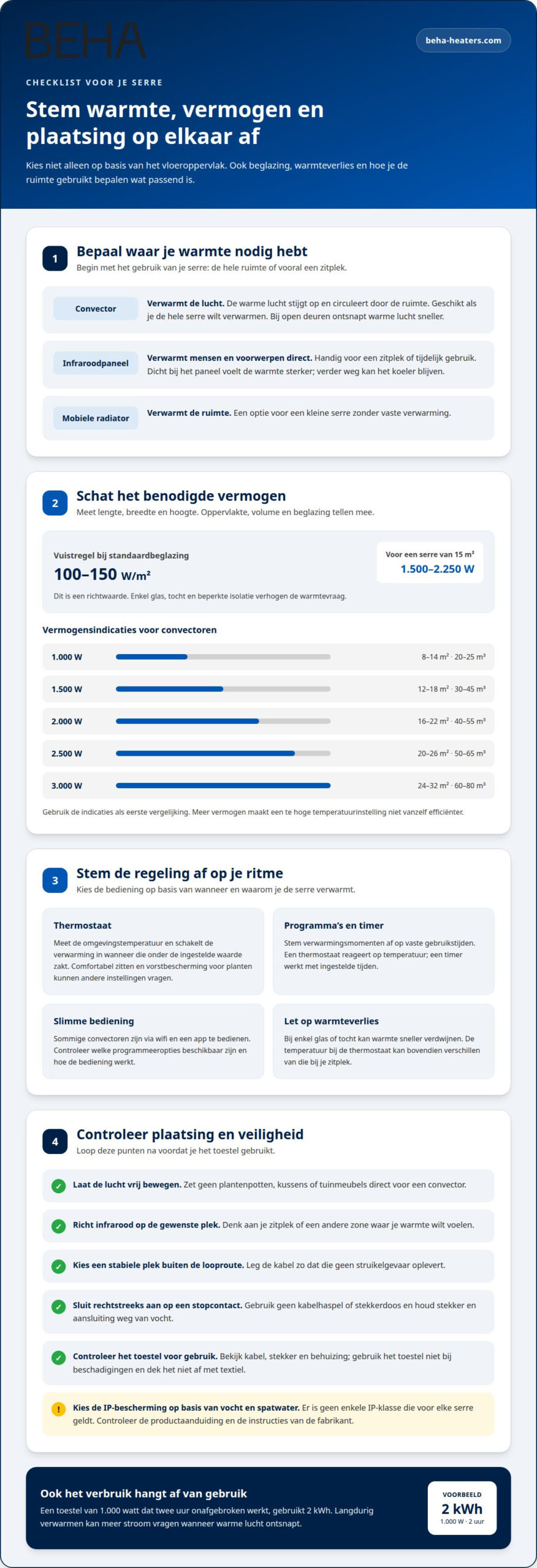
For an electric convector for your conservatory, select the power output based on surface area, height, and glazing. For standard glazing, a rule of thumb is approximately 100 to 150 watts per square meter. A 15 m² conservatory would therefore require roughly 1,500 to 2,250 watts. This remains a guideline, however: single glazing, drafts, and limited insulation increase the heat demand. Therefore, measure the length, width, and height before choosing a unit.
A convector heats the air, which rises and circulates through the room. This makes convection heating suitable for heating an entire conservatory. Warm air escapes more quickly when doors are open, meaning prolonged heating can consume more power. Infrared heats people and objects directly. This is useful if you mainly use a seating area or heat the conservatory occasionally. The heat feels stronger close to the panel; further away, it can remain cooler.
The power indications provide an initial comparison between units. A 1,000-watt convector is suitable for 8-14 m² and 20-25 m³. For 1,500 watts, it concerns 12-18 m² and 30-45 m³. A 2,000-watt unit is intended for 16-22 m² and 40-55 m³. For 2,500 watts, the indications are 20-26 m² and 50-65 m³. A 3,000-watt model is suitable for 24-32 m² and 60-80 m³.
| Option | Heats | Fits especially well with |
|---|---|---|
| Convector | The air | The entire conservatory |
| Infrared panel | People and objects | Targeted, temporary heat |
| Portable electric radiator | The space | A small conservatory without permanent heating |
Electric heating does not require a connection to the central heating system. Regarding consumption: a 1,000-watt unit operating continuously for two hours consumes 2 kWh. The purchase price varies by power output and model; there is no single price that applies to every unit. For subsidies or energy regulations, you cannot determine what applies to your situation based solely on the wattage. Choose based on intended use, room volume, and glazing, and then compare the required power output with the unit indication.
Built-in thermostat and programming options
A thermostat controls when a convector emits heat. Adjust the setting to suit the use of the conservatory: comfortable sitting requires something different than frost protection for plants. The thermostat measures the ambient temperature and switches on the heating when it drops below the set value. This way, you do not have to manually switch the unit on and off every time.
Some convectors have a built-in digital thermostat with four additional programmable options. This allows you to tailor heating times to your daily rhythm. If you use the conservatory mainly in the evening, program the heat for around that time. If the room is empty during the day, the heating does not need to run continuously at the same setting. The correct setting depends on your usage and the desired temperature.
Match the required power and the thermostat setting. A more powerful unit does not automatically make an excessively high temperature setting more efficient. With single glazing or a draft, heat can escape more quickly, causing the thermostat to call for heat more frequently. Also, take into account temperature differences between the thermostat and your seating area. A glass front does not change this consideration: the control and the conditions in the room are what matter.
A timer is useful when you have fixed usage times. A thermostat responds to temperature; a timer works with set times. Some smart convectors can be controlled via Wi-Fi and an app. This allows you to adjust the settings without having to constantly walk to the unit. Check how the controls work and which programming options are available during installation. Also read the warranty conditions and operating instructions so that you know how to use the unit according to the manufacturer.
If you want control via an app, a smart convector with a glass front meets that desire. Ultimately, choose based on your usage pattern, the desired control, and the location where you need the heat.
Radiator placement and safety
The placement of an electric radiator affects how the heat spreads through the conservatory. A convector works best when air can move freely past the unit. Therefore, do not place plant pots, cushions, or garden furniture directly in front of it. Choose a stable spot out of the walkway and prevent the cable from posing a tripping hazard. Direct an infrared panel towards the seating area or another zone where you want to feel the warmth.
Connect an electric heater directly to a wall outlet. Do not use a cable reel or power strip for this. Check the cable, plug, and housing before use. Do not use the device if you see any damage. Keep the user manual at hand and follow the manufacturer's installation and operating instructions. Do not cover a heater or panel with textiles.
Which IP protection class is required for an electric heater in a damp greenhouse? No single IP class applies to every greenhouse: proper protection depends on exposure to moisture and splashing water. Check the product labeling and choose only a device whose manufacturer permits use in those conditions.
- Place a convector with space around it so that the airflow is not blocked.
- Direct the infrared at where you are sitting; further away from the panel, the heat may feel less intense.
- Lay the cable out of walking routes and keep the plug and connector away from moisture.
- Before switching on, check that the device is standing stably and the surroundings are clear.
Temperature control makes placement important: a thermostat measures the temperature around the unit, which can differ from the temperature at your seat. Therefore, do not place the heater behind furniture or a curtain. This allows the heat to spread as intended and ensures the controls remain accessible. For a conservatory with damp spots, the IP rating is an important factor in that choice, alongside the location and expected use.
Electric convectors and radiators
Convectors and electric radiators heat a conservatory without a connection to the central heating system. BEHAconvectors only require a standard power outlet, without a boiler or pipes. This makes installation easier than with a radiator connected to a central heating system. A portable radiator is particularly suitable for a small conservatory that you do not heat continuously. For a permanent location, a convector is a logical choice if you want to heat the air in the room.
Do not compare appliances based solely on power output. Also consider the insulation, the height of the room, and how often doors are opened. Every conservatory loses heat differently: single glazing and drafts require more heating than good glazing. By way of comparison: for a well-insulated living room, 60 to 80 watts per square meter is often sufficient. That guideline is not a conservatory calculation; glass and ventilation influence the heat demand there.
The connection partly determines how flexible your heating is. An electric radiator uses electricity and requires no piping to the central heating system. A portable version can be moved if the layout changes, whereas a fixed convector remains in a fixed location. For both, ensure there is a power outlet in a suitable location and sufficient free space around the unit.
- Portable radiator: suitable if you occasionally heat a small conservatory.
- Convector: heats the air and is suitable for room heating.
- Infrared panel: provides targeted radiant heat to people and objects.
Power consumption also depends on the duration of use and the set temperature. With regular use, insulation helps retain heat longer; a heating panel does not improve insulation itself. Ventilate appropriately based on humidity and usage, as heating does not replace ventilation. First, choose between localized heat and heating the entire room. Then, compare the required capacity, connection, and installation options.
See which electric heating solution suits your use of the conservatory.
BEHA
BEHA sells electric convectors for those who want to tailor the heating of a conservatory to the space, operation, and appearance. You can choose from smart convectors with a steel, glass, or paintable front, or from classic convectors. The smart versions can be controlled via Wi-Fi and an app, allowing you to adjust the heating to your usage times.
First, determine whether you want to heat the entire conservatory or primarily make a specific spot comfortable. Then, consider the required power, available space, and desired controls. This way, you will discover which model suits your conservatory, without losing sight of the aesthetics and daily use.
Would you like to discuss the possibilities for your conservatory? Then contact BEHA.
Get your conservatory ready for use
An electric convector for your conservatory is particularly suitable when the heat aligns with how you use the space. Determine the role the conservatory will play: a quiet place to read, a workspace, or an extension of your living room. This way, you consider not only the unit but also the atmosphere and appearance you find appealing.
BEHA offers smart convectors with a steel, glass, or paintable front. This allows you to match the heating to the decor of your conservatory. Which model fits depends on the space and your preferences.
Would you like to explore your options further? Ask BEHA for heating advice and take the right next step for your conservatory.
Frequently Asked Questions
What should you look out for when choosing conservatory heating?
First, determine whether you primarily heat a seating area or intend to use the entire conservatory. Next, consider the glazing, drafts, height, and when you use the space. For example, a conservatory used as a home office requires a different heat distribution than one you only use in the evenings. Also, take the controls, power connection, and a safe location for the unit into account in your decision-making.
Convector heater for cold conservatory: infrared or insulation?
Start by limiting heat loss: infrared does not replace insulation. With single glazing or drafts, heat can escape quickly, even with a powerful device. If you primarily want to warm yourself during a short visit, infrared offers targeted radiant heat. For a conservatory that you want to heat as a whole, convection heating is a better fit. The best approach depends on the use of the space and the heat loss.
Does a convection heater help prevent condensation on cold surfaces?
A convection heater does not guarantee condensation-free windows or other cold surfaces. Condensation forms when moist air cools against such a surface; simply heating the air does not always solve the cause. Ventilate appropriately for usage and watch out for sources of moisture, such as wet plant pots or clothing. If moisture problems persist, also examine the ventilation and the structural condition of the conservatory.
How do I determine if a convector will heat my conservatory?
First, calculate the floor area and volume based on the length, width, and height. Then, use the power indication as a first guideline, not as a guarantee for every room. A high conservatory with a lot of glass or drafts places greater demands on the heater than a low, sheltered room with a comparable floor area. Therefore, also consider the glazing and heat loss before choosing a device.
How do I calculate the power consumption during one hour of heating?
Multiply the power in kilowatts by the number of hours at full power. A 1,000-watt unit is 1 kilowatt and consumes 1 kWh in one hour at full power. The thermostat can switch off the unit in the interim once the set temperature is reached. The actual consumption therefore depends on how long the heating remains active, not just on the clock time.
How can you keep a conservatory pleasantly warm all year round?
Limit heat loss and adjust the heating to the use of the conservatory. Good glazing helps retain heat longer; a thermostat with a suitable schedule aligns heating times with your daily rhythm. Also ventilate to remove moisture. If you only heat the space when you are inside, direct the heat to that spot. Placement is important for even heat distribution throughout the entire conservatory.