
Electric convector with app for the bedroom
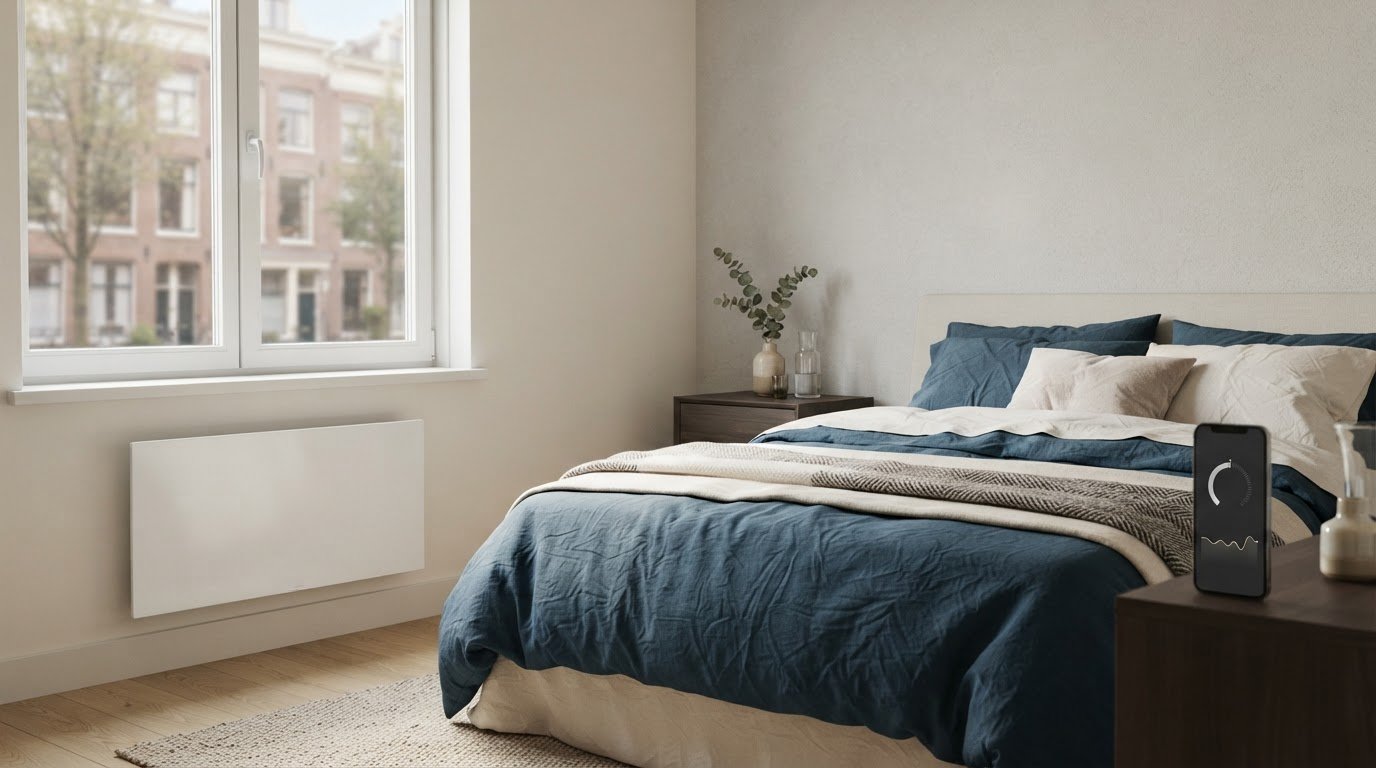
For a bedroom, a quiet electric convector with a thermostat is often a good fit: it heats the air and distributes the heat throughout the room. Furthermore, an electric convector for the bedroom with an app allows you to set the temperature remotely. For a room with average insulation, you can count on approximately 100 watts of heating power per square meter.
It makes sense that you primarily want warmth when you need it, without the heating staying on unnecessarily. With control via Wi-Fi and an app, you can adapt the heating to your daily rhythm, for example by adjusting the temperature before going to bed or upon waking up.
In this article, you will read which type of electric heating suits your bedroom and what to look for regarding power, noise, and operation. You will also discover how to use a timer or Wi-Fi thermostat to align heating times with your routine for comfort and conscious energy use.
Key points
- Select the heating capacity based on the bedroom, the insulation, and the desired temperature.
- With phone control, you can adjust the heat without walking to the convector.
- A Wi-Fi thermostat and timer help align heating times with your sleep rhythm.
- A convector heats the air in the room and is generally a quiet choice for the bedroom.
- Compare the different versions of smart convectors to choose a front that matches your interior.
Why Choose App-Controlled Electric Heating?
The required power depends on the surface area and insulation of the bedroom. An app enables remote control but does not replace selecting an appropriate power output.
Match power to bedroom size
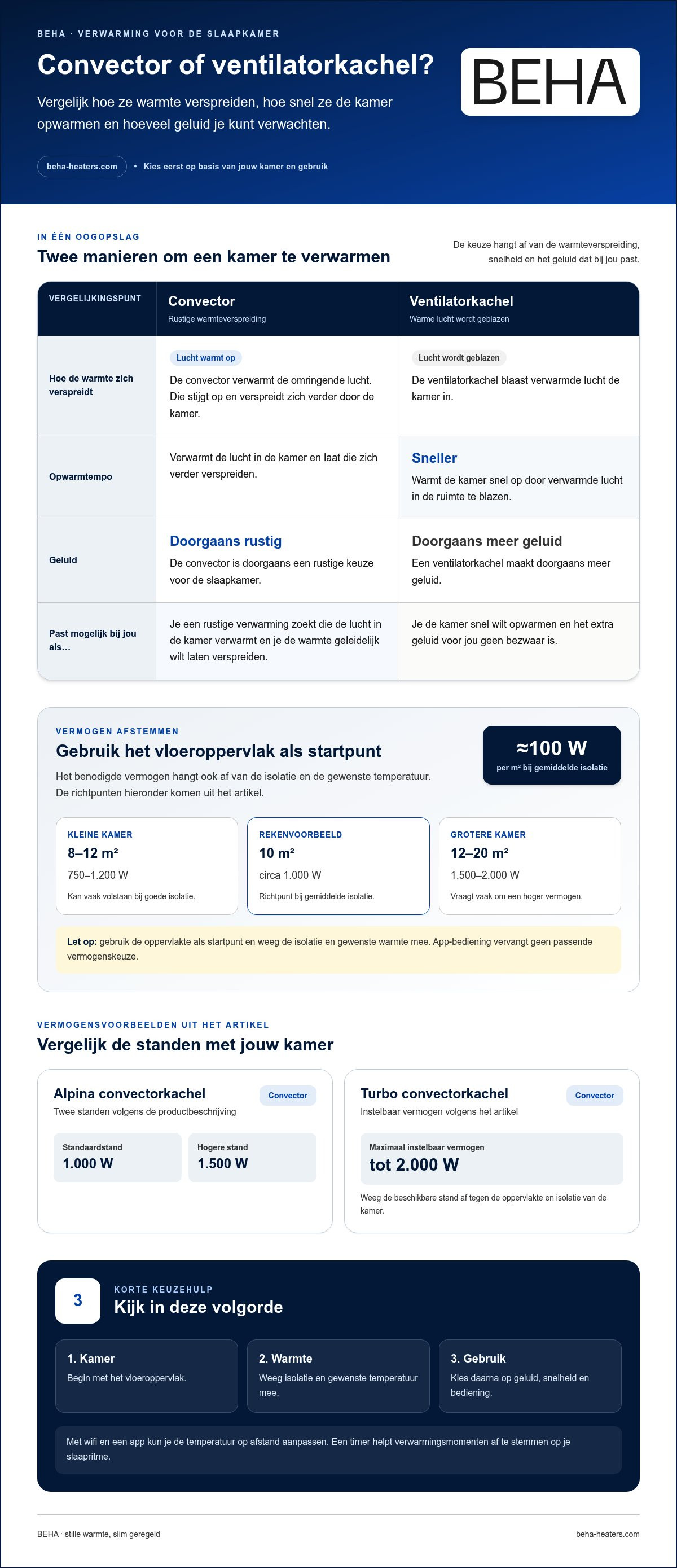
Start with the floor area and then look at the insulation. For a room with average insulation, approximately 100 watts per square meter applies. This gives a guideline of around 1,000 watts for a 10 m² bedroom. For a small, well-insulated room of 8 to 12 m², 750 to 1,200 watts is often sufficient.
The conditions in the room matter. A bedroom of 12 to 20 m² often requires a heater of approximately 1,500 to 2,000 watts. A room of 15 to 20 m² also generally requires more power than a small room. Therefore, use the surface area as a starting point and take insulation and desired heat output into account.
Compare assets and prices
First, compare electric heaters based on power output and operation. A 1,000-watt unit can heat a small room. A 1,500-watt model uses 1.5 kWh for one hour of continuous heating. That example provides insight into consumption but does not indicate how much electricity your bedroom requires in total.
Also compare the thermostat, timer, and control options. With Wi-Fi, you adjust the temperature via your phone; a timer helps you schedule heating hours. The price varies by model and feature. Therefore, do not look only at the purchase price, but also at the power output that suits your room and how you intend to use the heating.
Rules for electric heating at home
Follow the user manual and use the appliance for its intended purpose. Choose a stable location where the heater is unobstructed and keep the power cord and controls accessible. Do not block the air supply, so that the heating operates as prescribed by the manufacturer.
Before use, check whether the appliance is suitable for the room and the chosen setup. In a bathroom, the combination of electricity and water requires extra attention. In the bedroom, too, an electric heater should be placed stably and in an unobstructed position. Adjust the temperature and any timer according to the times when you use the room.
According to the product description, the Alpina Convector Heater has a standard setting of 1000 W and a setting of 1500 W. This allows you to consider, when comparing, which power output suits the bedroom and the desired heat. App control remains an additional choice: first determine what power output you need, and then see if remote control suits your usage.
The Turbo convection heater has an adjustable output of up to 2000. Compare this information with the size and insulation of the room, and use the app control as a practical extra when regulating the heating. The choice is therefore not just about operation, but also about the output that suits the room. This allows you to weigh the available settings against your heating needs and the way you want to operate the heater.
Which type of electric heating is most suitable?
Control via a smartphone is particularly practical if you want to adjust the heat in advance. With an electric heater with Wi-Fi, you regulate the temperature remotely without having to walk to the unit. The right model depends on your sleep pattern, your desired level of control, and how the heat spreads throughout the room.
Control heating remotely
With an app, you can change the temperature while you are in another room. For example, adjust the heating before you go to bed or lower the setting when you get up. Wi-Fi control can be targeted at a single room or the entire home. Choose what suits your usage.
A smart heater is handy if your daily routine changes. You adjust the set temperature when you come home earlier or go to sleep later. An electric convector for the bedroom with an app makes this possible without having to walk to the unit. The app controls the convector; the unit heats the room.
Advantages of control via an app
With app control, you don't have to stand by the heater to change the setting. On a cold evening, for example, you can adjust the temperature from the couch, or fine-tune the heating to your schedule from another room. Wi-Fi control can also support different heating zones, allowing you to control rooms individually.
You use a bedroom differently than a living room. Choose settings that suit your routine and adjust them when your day unfolds differently. An electric convector for the bedroom with an app is suitable if remote control is important to you. You can easily adjust the temperature via the app.
Safe and practical operation
An app enables remote control but does not change the basic rules for the device. Place the heater stably and keep the air intake clear. Follow the user manual for placement and operation. Your phone does not replace the instructions for the electric heater.
Start simple: set the desired temperature, control the heating via the app, and adjust the settings when your routine changes. If you share the controls with housemates, agree on who changes the settings. This prevents conflicting choices, for example, when one user heats the bedroom while another lowers the temperature.
When choosing between a convector and a fan heater, also compare the heat distribution. A fan heater blows heated air into the room and warms it up quickly, but generally makes more noise. A convector heats the surrounding air, which rises and spreads further. Weigh speed, noise, and operation against each other.
Convectors with Wi-Fi thermostat
A Wi-Fi thermostat connects the temperature control of a convector to your home network. You control the heating via an app and, with many systems, can set up heating zones. This allows the bedroom to have its own control alongside, for example, the living room. The thermostat monitors the set temperature and adjusts the heating accordingly.
Control temperature with Wi-Fi
With an electric convector with Wi-Fi, you set the desired temperature digitally. The thermostat switches the heating on or off to follow that setting. An electric convector for the bedroom with an app gives you access to this control via your phone, without having to use the control panel every time.
For good air circulation, there must be space around the convector. Keep the controls within reach and follow the manual to connect the unit to your network. If you use multiple heating zones, assign a distinct setting to each room. This way, the bedroom has its own temperature control, separate from rooms with different uses.
Setting up a programmable Wi-Fi thermostat
With a programmable thermostat, you align heating times with your routine. For example, set when the bedroom should be comfortable before going to sleep. A timer from 1 to 12 hours helps limit the operating time. This allows you to adjust the settings to the times when you need the warmth.
Start with a temperature that feels comfortable and then adjust the times. If your routine changes, you can modify the settings via the app. An electric convector for the bedroom with an app is handy for adjusting heating times without having to completely reconfigure the schedule. With a fixed routine, you can use preset times.
Convector or infrared panel with Wi-Fi
A convector heats the air surrounding the unit. That air rises and distributes heat throughout the room. An infrared panel acts as a targeted heat source. Portable infrared panels with Wi-Fi have a power output of 350 to 720 watts. This is a different power class than convectors, which are often chosen for heating an entire bedroom.
Therefore, do not look solely at Wi-Fi or the control screen. First, determine whether you want to heat the entire room or primarily need heat in one spot. Then, compare the output, placement, and controls. A panel with Wi-Fi offers app control; a convector distributes heat via moving air. These differences help you determine which type suits your bedroom.
Comfort and energy saving
A convector produces little noise and cools down quickly. As a result, this type of heating is well-suited to a bedroom where peace and quiet are important. Fan heaters generally produce more noise, often 40 to 50 dB. A noise level of around 30 dB is quieter than 50 dB. Thus, a convector is a suitable choice for use at night.
Adjust the heat to your sleep rhythm
Comfort starts with heating at the times you need warmth. For example, set a schedule for the evening and lower the temperature when you go to sleep. With app control, you can adjust the settings as your routine changes. This prevents the heating from continuing to operate at the same setting when you don't need it.
A timer of 1 to 12 hours helps to limit operating time. For example, choose an appropriate heating period before going to bed, instead of letting the heater run unnecessarily long. The timer determines the operating time; the thermostat regulates the set temperature. Use these functions together to tailor comfort and energy consumption to your bedroom.
Understand your heater's consumption
The power output and operating time determine how much electricity an electric heater consumes. A 1,500-watt heater consumes 1.5 kWh during one hour of continuous heating. That example makes it clear why heating for a shorter period can limit consumption. The thermostat can switch off the heater as soon as the set temperature is reached.
Do not compare only the maximum output of different models. Also look at the temperature control, timer, and operation. A higher output does not automatically mean that the heater operates continuously at full power. The control system and the heating duration also determine how much energy is required.
Use the app for targeted settings
An app makes it easier to adjust heating times to your schedule. For example, change the setting when you go to bed earlier. App-controlled heating can reduce heating costs by 20 to 30%. Therefore, plan heating hours consciously and adjust the schedule when your bedroom is used differently.
Keep the schedule clear: determine when you want heat, set the temperature, and choose appropriate heating hours. Then adjust the settings based on your comfort. This way, you use the thermostat purposefully, without constantly changing settings randomly. This approach supports comfort and more conscious energy use.
Electric convection heaters for the bedroom
A convector heats the surrounding air, which rises and distributes heat throughout the room. In a bedroom, therefore, not only the output but also the placement and air circulation are important.
Placement of the convector in the bedroom
Choose a location where air can circulate around the convector. Do not place the unit behind a cabinet or close to bedding. Consider the walking route in advance and where you want the heat, for example near the bed or in a seating area. Follow the instructions for the chosen model for wall mounting.
A convector works by allowing warm air to rise. If furniture blocks the airflow, the heat spreads less freely throughout the room. View the bedroom from different angles before choosing a location. Take into account curtains, doors, and the daily layout so that the convector can function freely.
Connection of the bedroom convector
Connect the convector according to the manual. The manual contains the connection and operating instructions for the specific model. Before use, check that the cord reaches the chosen location without being taut or crossing any walking path. For a fixed installation, follow the manufacturer's mounting and connection instructions.
Next, operate the device as explained in the manual. Set the thermostat and check if the convector responds to the selected temperature. If you are using Wi-Fi control, connect the device to your network according to the instructions. This allows you to adjust the settings without changing the placement or connection.
Adjust the power output to the bedroom, not the entire home. A 1,000-watt electric heater can heat a small room. A convector heats the air in the room and cools down quickly after being switched off. This makes the control easily adaptable to heating times, but also requires an appropriate setting when you want to retain the heat for longer.
The way you use the heating also makes a difference. If you only heat the bedroom, you can focus the controls on that room. Electric heating with Wi-Fi can be set for a single room or for the entire home. Choose what suits your daily usage and prevent a schedule for other rooms from unintentionally determining the bedroom setting.
When making your choice, consider both the available space and the way the convector will be installed. Both a freestanding unit and a wall-mounted model require a location that suits the room layout. In both cases, choose a location with free air circulation, follow the connection instructions, and adjust the temperature control to suit the use of the bedroom.
View convectors for bedroom heating and compare which model suits the decor and desired operation.
BEHA: Smart convectors steel front
BEHA offers smart convectors with a steel front, which you control via Wi-Fi and the BEHA Smart App. This allows you to adjust the temperature to your bedroom and daily routine. If you prefer a different look, you can choose from smart convectors with a glass or paintable front. Classic convectors are an alternative if Wi-Fi control is not your primary focus.
The choice depends on what is important to you: remote control, the appearance of the front panel, or a classic design. Compare these features with the room and the settings you require. This way, you choose an electric heating solution that matches your wishes for the bedroom.
Visit behato explore BEHA 's convector models.
Choose a heating solution that suits your bedroom
The right choice doesn't depend solely on the technology. Also consider how you use the bedroom and what look suits your interior. Do you want to control the heating via an app, or is simplicity your priority? Once your preferences are clear, it becomes easier to choose a model that suits your daily use.
At BEHA you will find smart convectors with a steel, glass, or paintable front. This allows you to factor operation and appearance into your choice. Also consider the layout of the room and the desired placement. An electric convector for the bedroom with an app suits your needs if remote control is important.
Would you like to compare the models at your leisure and determine which direction suits your bedroom? Contact BEHA and explore the possibilities. This way, you take a targeted next step towards bedroom heating that aligns with your living space and daily routine.
Frequently Asked Questions
How many watts do you need for a bedroom?
For a room with average insulation, calculate approximately 100 watts per square meter. This is a guideline, not a fixed capacity for every bedroom. A well-insulated room may require less power, while heat loss can increase the required capacity. Therefore, in addition to the floor area, consider the insulation and how much heat you find comfortable. Then, choose a convector with a power output that suits that combination.
How much does an electric convector with Wi-Fi or an app cost in the Netherlands?
The price depends on the output, operation, and design. For example, a smart convector with Wi-Fi and app control differs from a classic model without those features. The front—whether made of steel, glass, or a paintable version—also plays a role in your comparison. Therefore, compare devices with the same functions and take into account the energy consumption for your usage. This way, you assess both the purchase price and the practical value for your bedroom.
How many watts of power does a convector need for a bedroom of 10, 15, or 20 m²?
For 10 m², 750 to 1,500 watts is often sufficient for supplementary heating; with good insulation, 750 to 1,200 watts may suffice. For 15 to 20 m², more power is generally required. For a room of 12 to 20 m², you can consider approximately 1,500 to 2,000 watts. The insulation partly determines where within those guideline values you fall.
Which safety features are important for an electric convector in the bedroom?
Ensure stable placement, an undamaged cord, and clear operating instructions. Keep the convector free from bedding, curtains, and furniture so that the air vents are not covered. Consult the manual for the safety features of the selected model and the operating instructions. Position the unit so that no one trips over it and the plug remains accessible. An app is convenient, but it does not replace these precautions.
Which electric convectors with an app are available in the Netherlands?
There are, among others, BEHA smart convectors with a steel front. The product category contains 22 electric heating products with Wi-Fi.
Which convector apps support weekly schedules, timers, and remote control?
The Wi-Fi apps allow you to adjust the temperature remotely. With a programmable Wi-Fi thermostat, you can set heating times; a timer of 1 to 12 hours limits the operating time.