
Electric convectors for installers: how to choose wisely in 2026

Is the convector with the highest output automatically the best choice for a professional project? Not necessarily. For electric convectors for installers, the use of the space, the user's preferences, and project conditions also play a role. A unit for a specific room may require different characteristics than a convector for an office or living space.
You want to be able to translate product specifications into a choice that suits the application and works well in practice. Pay attention to the operation and the finish of the front, among other things. Smart convectors with Wi-Fi and app control are suitable for users who want to control their heating digitally. Steel, glass, and paintable fronts offer various possibilities for diverse interiors. Ecodesign is also a relevant consideration: BEHA convectors meet Ecodesign requirements.
In this article, you will read which project questions to ask beforehand, how to compare convectors based on key product characteristics, and what to look for in business purchasing. This way, you work from inventory to a well-founded product selection. BEHA has over 100 years of experience in electric heating.
Key Points
- Map out the usage and project conditions for each room before selecting a convector.
- Compare electric convectors for installers based on product information, operation, front finish, and Ecodesign.
- Match the choice between a steel, glass, or paintable front to the interior and the user's preferences.
- Gather project data in advance and work according to a fixed approach, from inventory to ordering.
- See how BEHA’s experience and various convector categories can support your business product selection.
Electric convectors for installers: when are they suitable for a project?
An electric convector is an electric heating device that emits heat into a room. Its operation is based on convection: air is heated and begins to circulate. Read more about the operation of electric convectors. For a project, the most important question is not only which device is available, but whether the features match the use and the constraints of the room.
Convectors can be suitable when a project needs to heat a separate room or zone, for example during a renovation or to meet a specific heat demand. However, this does not automatically make them suitable as the primary heating system for every building. When making your choice, take into account the existing heating systems, the function of the room, and the technical possibilities on site.
Which project questions help narrow down the selection?
Start with the use of the space. Is it used daily or only at specific times? Is simple operation desired, or does control via Wi-Fi and an app suit the user better? Also map out what heating is already present and which project conditions limit the choice.
For a single room, the selection can revolve primarily around the application and the desired finish. For multiple rooms, a consistent approach is important: note the function, user preferences, and relevant product requirements for each room. This prevents a single general choice from obscuring the differences between the rooms.
What role do the installer and the buyer play?
The installer translates the technical requirements and on-site conditions into an appropriate product selection. Product selection is not the same as design, dimensioning, or installation advice. This requires an assessment of the building and the installation; a single product characteristic does not determine whether a device is sufficient for the heat demand.
The buyer makes the selection feasible by aligning the assortment, the required product information, and the ordering time. For projects involving multiple rooms, bundle the data per room. This ensures that the chosen appliances and finishes align better with the project schedule, and makes the step from selection to order clearer. For installation companies continuously seeking new assignments and projects, LeadQueens a solution with exclusive leads for the installation sector.
A useful selection rule: choose a convector based on the function and constraints of the room, not just on the unit.
For installers, four selection points serve as a practical starting point for electric convectors: space utilization, operation, front finish, and project organization. Compare these needs with the product characteristics. This provides direction for the selection without confusing product choice with a full technical assessment of the project.
Which features of electric convectors do you compare?
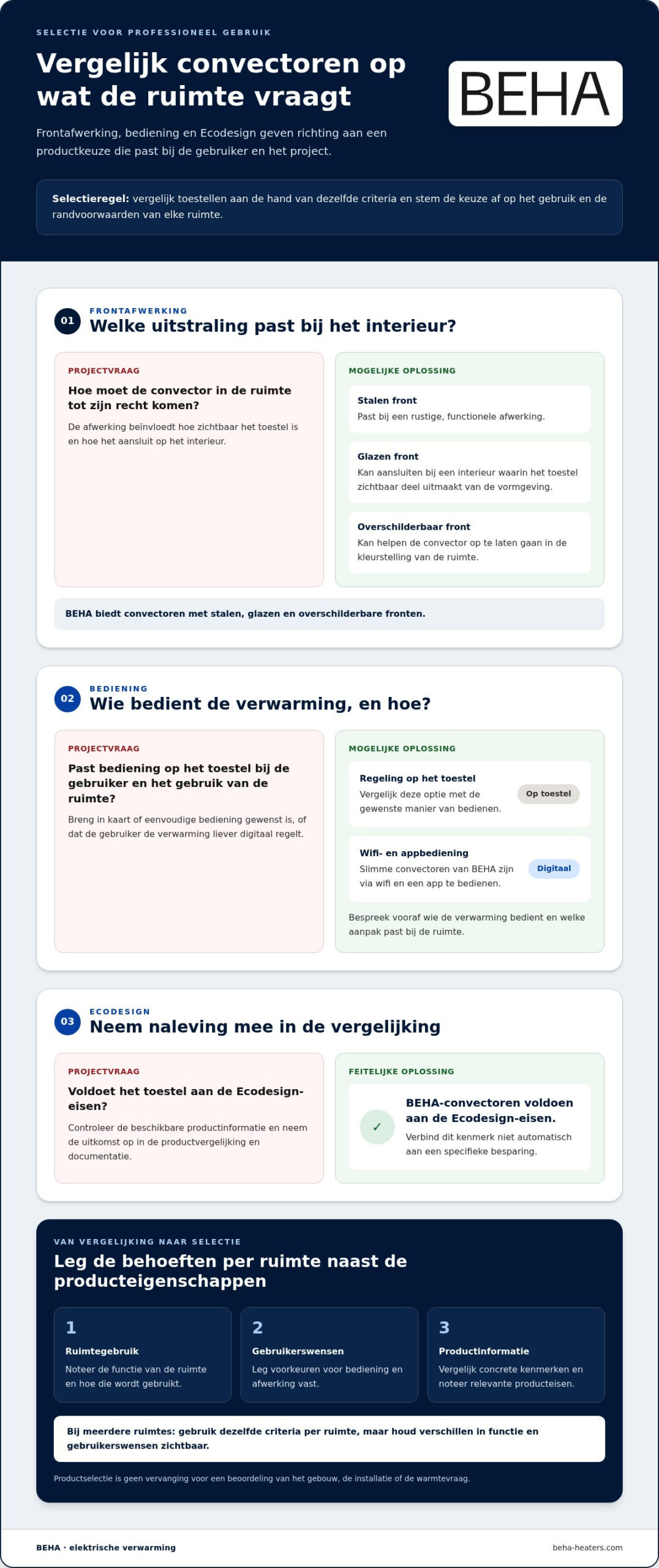
Do not compare appliances based solely on their technical characteristics. For electric convectors for installers, interior design, desired operation, and product information also matter. Use the table to compare the key selection criteria.
| Characteristic | What do you look out for? | Project relevance |
|---|---|---|
| Front finish | Steel, glass or a paintable front | Match the finish to the interior and the desired look. |
| Operation | Controls on the unit or operation via Wi-Fi and an app for smart convectors | Choose a control that suits the user and the use of the space. |
| Ecodesign | Check the product information to see if the device meets the Ecodesign requirements. | Take this into account in the product comparison and the documentation. |
Which front finish matches the interior?
A steel front is suitable for projects where a calm, functional finish is desired. A glass front complements an interior where the heating unit is a visible part of the design. With a paintable front, the convector can blend better with the color scheme of the room. BEHA offers convectors with steel, glass, and paintable fronts. Also, view the guide on the electric heater with a steel front for more points to consider regarding this finish.
What do Wi-Fi, app control, and Ecodesign add?
smart convectors BEHA via Wi-Fi and an app. This can be practical if someone prefers to control the heating digitally rather than exclusively on the unit. Therefore, discuss who operates the heating and which approach suits the use of the room. Also read the guide on the electric convector with Wi-Fi.
Ecodesign is also a relevant selection criterion. BEHA convectors meet Ecodesign requirements. Take this into account in the comparison, without automatically linking it to specific savings. Assess product characteristics in conjunction and note why a chosen finish or operation aligns with user preferences.
Factual premise: BEHA offers convectors with steel, glass, and paintable fronts.
How do you compare convectors for professional use?
A useful comparison uses the same criteria for each device. This ensures that a striking finish or general brand claim does not outweigh what the project requires. For each room, note which needs are decisive and which features are preferred.
- Project requirement: which space is heated and how is it used?
- Product information: which characteristics are specifically listed in the available product data?
- Operation: does the operation suit the user and daily use?
- Finish: does the front match the interior and the desired look?
Distinguish between what the appliance offers and what the project requires. Front finish and operating options are product features. The function of the room, existing heating systems, and project schedule are project conditions. The installer assesses how these come together. Compare performance only when the relevant product specifications are available and do not fill in missing data with assumptions.
How do you create a comparison that is usable for multiple projects?
Use the same list of criteria for each product option and record the outcome per room. Mark hard requirements, such as a desired operating method, and preferences, such as a specific appearance. This keeps comparisons clear without assuming that every room has the same requirements.
Be cautious with claims such as “the best” or “more efficient” when they are not substantiated by comparable product information. A business choice is easier to explain if you can link a documented feature to a concrete project need.
How do you evaluate the range of options for various interior design preferences?
Steel, glass, and paintable fronts offer various options for matching a convector to the room. A steel front can suit an understated, functional interior; glass can complement an interior where the unit is allowed to be visible. A paintable front can help the convector visually blend into the chosen color scheme. Read more about the possibilities in the guide for the paintable radiator.
A comparison is only useful if you place four factors side by side: project requirements, product information, operation, and desired finish. Use these points as a solid basis for electric convectors for installers. This way, you substantiate the selection with appropriate characteristics, without unproven claims regarding superiority or performance.
How do you organize product selection and purchasing for an installation project?
A fixed working method helps you align technical selection, ordering, and project planning. First, gather the data per project and per room. This prevents a general product choice from overlooking differences in use, operation, or finish.
- Map out the project. Note the function of the building and the spaces where you are considering convectors. Also record which heating systems are already present and which project conditions influence the selection.
- Collect data per room. Describe how the room is used, the desired front finish, and the operating preferences. Differentiate between requirements and preferences.
- Record the necessary product information. Gather the product data needed to carefully compare options. Note what information is still missing for a complete product specification, so that assumptions do not become part of the decision-making process.
- Compare and select. Evaluate the options based on the same criteria. Link the chosen properties to the needs of the project and the individual spaces.
- Align the order and schedule. Clearly record the selection and associated product information. Use this record to align the order with the sequence in which spaces and work activities are addressed.
What data do you collect before the order?
Create a compact inventory for each room detailing the function, relevant project requirements, desired front finish, and operating preferences. Link this to the product information needed for the selection. In a project with multiple rooms, this allows you to quickly identify differences. For example, one room might require a specific finish, while in another, practical operation is the primary focus.
If not all data is immediately available, maintain a separate list of outstanding information. This ensures clarity regarding the product selection and what is still needed to carefully finalize the product specification.
How do you keep product selection and project planning aligned?
Maintain one up-to-date overview per project containing the space, selected product characteristics, and relevant product information. Update this as soon as the selection changes. Subsequently, align the ordering time with the project sequence. This ensures that stakeholders have the same starting points and that procurement aligns with the schedule.
For additional business context, you can view the guide on electric heating for professionals. BEHA supplies convectors to professional clients. View the convectors for your project as the next step in your product selection.
Why consider BEHA electric convectors for your projects?
In commercial product selection, a clear product range helps align appliances with project needs. BEHA has over 100 years of experience in electric heating and supplies convectors to professional clients. This offers installers and buyers a starting point for comparing product features with project requirements.
Which BEHAproduct features are relevant for installers?
The front finish can be a factor when choosing units for rooms with varying interior preferences. BEHA offers convectors with steel, glass, and paintable fronts. Assess for each project which finish suits the desired look and include this choice in the technical selection.
BEHA 's smart convectors can be controlled via Wi-Fi and an app. This is relevant when the user wants to control the heating digitally. Base your choice on the described product features and the requirements you have specified for the room. The convectors also meet Ecodesign requirements, a feature you can include in your product comparison.
These features do not constitute an automatic recommendation for every project. However, they do offer concrete points of comparison: which front finish suits the interior, which operation suits the user, and which product information supports the technical selection? This keeps the choice verifiable and prevents a single attractive feature from being the deciding factor on its own.
What is a logical next step for your project?
Use the criteria from your project inventory when reviewing the available options: the function of the room, relevant project conditions, desired operation, and suitable front finish. For projects with multiple rooms, record these points for each room. This allows you to identify differences more quickly and carefully justify your product choices.
BEHA sells electric heating products to private and professional customers. For installers comparing electric convectors, the range offers a basis for testing product characteristics against project requirements. The choice depends on the application and the technical assessment of the project.
Would you like to compare the product features with your project needs? View the electric convectors from BEHA and compare the available front finishes and control options with the requirements you have defined for each room.
Turn your project question into a targeted convector choice
Selecting the right convector starts with the room and the user. Map out the function, project requirements, and operating preferences for each room. Then, compare the product information and front finishes using the same criteria. This way, you keep track of technical suitability and ensure the order aligns better with the project schedule.
For installers, both practical product features and the project context matter when it comes to electric convectors. A steel, glass, or paintable front offers various interior design options. Smart convectors can be controlled via Wi-Fi and an app. BEHA has over 100 years of experience in electric heating and offers convectors for a wide range of project requirements.
Do you want to compare product features with your project needs? 's range of electric convectors BEHA and use your inventory as a guide. With a clear comparison, you can take a well-founded next step in your project selection.
Frequently Asked Questions
Which electric convector is suitable for professional use?
A suitable convector aligns with the function of the room, the technical project requirements, and the user's wishes. Compare the available product information, operating options, and front finishes. Let the technical assessment determine whether the unit meets the heat demand. Therefore, electric convectors cannot be covered by a single general choice for installers. Determine for each room which characteristics are necessary and which preferences are taken into account.
Can you purchase electric convectors for multiple projects?
Yes. Select and purchase convectors for multiple projects by clearly documenting the product choice per project and room. Note the desired operation, front finish, and relevant product specifications, and align the order with the project schedule. BEHA supplies professional clients directly and through a dealer network. Document the selected product characteristics for each order so that the selection remains verifiable and aligns with project needs.
Are electric convectors with Wi-Fi suitable for installers?
This is possible, provided that Wi-Fi and app control align with the user's preferences and the application of the space. BEHA 's smart convectors can be controlled via Wi-Fi and an app. Include this feature in the product comparison, but do not automatically consider digital control to be the deciding factor. Also look at the project conditions and available product information to assess whether this method of control suits the intended use.
What front finishes are available for electric convectors?
BEHA offers convectors with a steel, glass, or paintable front. A steel front can suit a calm, functional look; a glass front complements an interior where the unit is allowed to be visible. With a paintable front, the convector can blend better with the color scheme of the room. Compare the finishes per project and tailor the choice to the interior and the user's wishes.
Do BEHA electric convectors meet Ecodesign requirements?
Yes, BEHA electric convectors meet the Ecodesign requirements. Take this into account as a product feature when comparing units for a professional project. Ecodesign in itself does not indicate whether a convector is suitable for every room or application. Therefore, also evaluate the product information, operation, and desired finish. Link these characteristics to the project conditions and the technical assessment of the installation.
Does BEHA sell electric convectors to installers?
Yes, BEHA sells electric heating products to professional customers, including installers. Sales are conducted directly to the professional market and through a dealer network. The convector range includes smart variants with steel, glass, or paintable fronts, and Classic convectors. Compare the product categories based on project requirements and desired finish. BEHA has over 100 years of experience in electric heating.
How do you choose an electric convector for an installation project?
Start by defining the function of each room and the existing heating systems. Next, establish the project requirements, operating preferences, and desired front finish. Compare appliances based on available product information and distinguish between strict requirements and preferences. If information necessary for a thorough product specification is missing, make a note of this before ordering. Finally, align the product selection with the project schedule and the individual rooms.