
Electric heater: choose the best energy-efficient supplementary heating
Are you still paying to heat rooms you rarely spend time in, simply because the central heating is on? With the current average gas price of €1.28 per m³, that is an expensive habit you’d rather break today. You are probably done with the uncertainty of high energy bills, but you also don't want an ugly plastic appliance that spoils the look of your carefully decorated living room. A modern electric heater offers the solution here, provided you make the right choices regarding technology and design.
In this article, you will discover how to heat your home smartly, stylishly, and above all energy-efficiently without using a drop of gas. We show you how to regain full control over your consumption with innovative features such as app control and precise thermostats. From paintable fronts that blend seamlessly into your interior to the power of Norwegian quality, we guide you to the best solution for a comfortable and gas-free home.
Key Points
- Learn why modern convectors are the ideal replacement for old-fashioned radiant heaters if you are looking for efficient supplementary heating.
- Discover how you can save significantly on your electricity consumption with an energy-efficient electric heater and the ECODESIGN label.
- Easily calculate the correct capacity for your specific space with the practical formula for wattage per cubic meter.
- Experience the convenience of smart features such as app control and discover how Norwegian design seamlessly complements your interior.
- Understand which safety features are essential for reliable and worry-free heating of every room in the house.
What is an electric heater and why is it popular now?
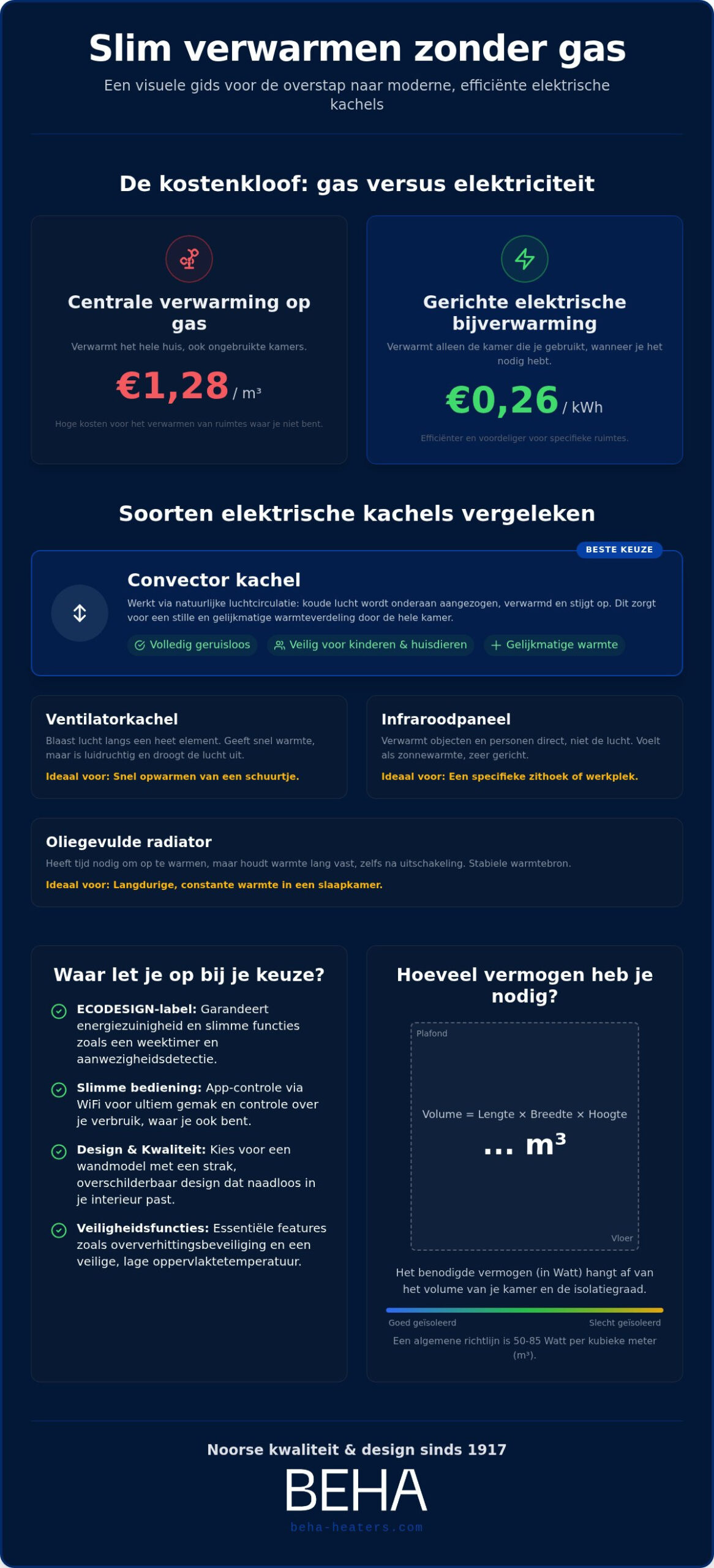
An electric heater used to often be seen as a temporary emergency solution for a chilly attic or a drafty shed. By 2026, that perception will have completely changed. Due to persistently high gas prices, currently hovering around €1.28 per m³, we are collectively looking for ways to turn off the central heating boiler more often. Modern electric heating has evolved from energy-guzzling radiant heaters to high-quality convectors that constitute a full-fledged alternative to gas heating. Whereas a traditional radiant heater only heats the objects directly in front of it, a convector utilizes the natural operation of electric heaters by circulating heat throughout the entire room.
The shift to electricity is not just a matter of cost, but also of independence. With an average electricity price of €0.26 per kWh, targeted electric heating is often more economical than heating the entire house with gas. However, it is important to distinguish between supplementary heating and primary heating. Supplementary heating is used to make specific rooms, such as your home office or the bathroom, comfortable without having to turn up the thermostat in the living room. This prevents unnecessary energy consumption in rooms you are not currently in.
The benefits of electric heating in 2026
The biggest advantage of a modern electric heater is the speed of implementation. You don't need complicated installation services or any drilling or breaking; simply plugging it into the socket is often sufficient. This makes it an ideal solution for anyone who wants to see immediate results on their energy bill. Moreover, 2026 is the last year in which you can still fully benefit from the current net metering scheme. Do you have solar panels? Then you use the self-generated electricity during the day to heat your rooms for free. It is an environmentally friendly way to optimize your own energy consumption before the rules change in 2027.
Why a convector heater is often the best choice
Within the world of electric heating, the convector has become the absolute standard for comfort. These devices operate completely silently because they do not require a fan to distribute heat. This makes them perfect for bedrooms and offices where you want to rest or work in silence. The heat distribution is extremely even because cold air is drawn in at the bottom, heated, and flows back into the room at the top. Additionally, they are safe to use. The surface temperature of the front remains relatively low, which is reassuring in households with children or pets.
Different types of electric heaters compared
The range of electric heating is enormous. Each type has specific characteristics that determine whether it is suitable for the living room, the bedroom, or a damp room such as the bathroom. To make the right choice, it is essential to look beyond just the purchase price. After all, efficiency and comfort levels vary significantly depending on the technology.
- Convector heaters: These are the silent powerhouses for rooms where you spend a lot of time. They work via natural air circulation, ensuring an even temperature without noise or dust displacement. This makes them superior to cheap fan heaters, which often dry out the air and cause unrest.
- Fan heaters: These compact devices provide instant heat by blowing air past a heating element. They are handy for very short-term use, such as quickly warming up a shed, but less suitable as permanent supplementary heating due to the noise and higher energy consumption.
- Infrared panels: Instead of heating the air, these panels radiate heat directly onto objects and people. This feels like the sun on your skin and is ideal for specific spots, such as above a desk or in a seating area.
- Oil-filled radiators: These heaters have a slow start-up time because the oil needs to heat up first. However, once up to temperature, they emit long-lasting and stable heat, even after the thermostat has been switched off.
Safety plays a decisive role in your choice. Especially with mobile units, there is a risk of tipping over or overheating. Therefore, always consult official safety tips when purchasing to ensure you choose a model that meets the strictest standards.
When do you choose a wall-mounted model?
A wall-mounted model is the best option if you are looking for a permanent solution that blends seamlessly into your interior. It saves valuable floor space and ensures a sleek, tidy look without cables lying around. Moreover, the heater hangs safely out of reach of grabby little hands or curious pets. This type of installation forms a reliable foundation for your electric heating, where heat distribution is optimal due to its fixed position on the wall.
The flexibility of a freestanding electric heater
Do you need heat in varying locations? Then a freestanding electric heater offers the necessary flexibility. You can easily move the unit from the home office to the guest room when needed. All you need is a power outlet. However, keep in mind that freestanding units often get in the way and can be less efficient if not positioned optimally. For those seeking a balance between mobility and high-quality technology, there are sophisticated Norwegian designs that combine both worlds. Browse our various models to discover which variant best suits your lifestyle.
What should you look for when buying an electric heater?
When purchasing an electric heater, many people look exclusively at the power output and the price. However, the technology under the hood determines whether your purchase is a smart investment or a hidden expense. An essential quality mark to look out for is the ECODESIGN label. Since the introduction of these European directives, electric heaters must meet strict energy efficiency requirements. This means they must have features that prevent unnecessary consumption, such as open-window detection or an accurate weekly timer.
Although electric heating is often praised for its simplicity, the Consumers' Association rightly points out the disadvantages of electric heating, specifically the operating costs associated with careless use. That is why an electronic thermostat is crucial. Unlike a mechanical thermostat, which often has a deviation of several degrees, an electronic version keeps the temperature stable to within 0.2 degrees. This prevents the room from becoming unintentionally too warm, which directly impacts your electricity bill. After all, every degree you overheat increases consumption by approximately 6 percent.
The power of a smart convector with Wi-Fi
A modern electric heater with Wi-Fi functionality transforms your heating from a passive device into an intelligent system. You control the heater via a smartphone app wherever you are. Finished work unexpectedly early? You can switch on the heating while on the go, so you arrive home to a behahouse without having to keep the heating on all day. Additionally, these apps often provide detailed insight into your current consumption. You can link multiple devices in different rooms, creating a zone-controlled heating system that perfectly aligns with your daily routine and the specific insulation of each space.
Safety and certification
Safety is not a luxury, but a necessity. When making your choice, always look for the presence of overheating protection and, for freestanding models, tip-over protection that immediately switches off the device. Do you want to place a heater in the bathroom? Then the IP rating is the deciding factor. An IP24 certification is the minimum standard for damp rooms; this means that the device is splash-proof and can be mounted safely. For families with young children, models with rounded corners and a child lock on the controls are recommended. This prevents settings from being accidentally changed or someone getting injured on sharp edges. Our Norwegian designs combine these safety requirements with a robust build quality that has set the standard for extreme conditions since 1917.
How much power do you need for your space?
Choosing the right wattage for an electric heater is not guesswork. It is a precise calculation in which the volume of the room and the level of insulation are the most important variables. Many suppliers simply recommend 100 watts per square meter, but that method is outdated. It does not take into account high ceilings or the quality of your double glazing. For a reliable result, at BEHA we always calculate in cubic meters (m³). This ensures that the heater has sufficient capacity, even during a harsh winter.
The required wattage per cubic meter varies significantly depending on the situation:
- Excellent insulation (new build): 20 to 25 watts per m³
- Average insulation: 30 to 35 watts per m³
- Moderate insulation (older homes): 40 to 50 watts per m³
It is often smarter to choose a heater with slight overcapacity. A more powerful electric heater reaches the desired temperature faster, after which the thermostat reduces the power. This prevents the device from having to run at one hundred percent constantly, which extends its lifespan and ensures more stable comfort. In a small space such as a toilet, low power is often sufficient, while an open living room requires a strategic distribution of multiple heat sources.
Calculation example for an average room
Suppose you want to heat a bedroom of 20 m² with a standard height of 2.5 meters. The total volume is then 50 m³. In a modern house with good insulation, 1250 watts is sufficient. However, do you live in a corner house from the 1970s with less insulation? Then 2000 watts is a safer choice to keep the cold out. An electric convector with Wi-Fi helps enormously with this; the software recognizes how quickly your specific room cools down and automatically adjusts the heating cycles accordingly for maximum efficiency.
Tips to increase the efficiency of your heater
The placement of your heater is crucial for its effectiveness. The best spot is under a window, as the cold air coming off the glass is then heated immediately. This prevents a cold draft across the floor. Additionally, ensure that the airflow is never blocked by curtains or furniture. A convector requires free space at the top and bottom to maintain natural air circulation. Also, never cover a heater; this is not only detrimental to efficiency but can also compromise safety.
Do you want to know exactly which model best suits your living space? Discover our full range of smart convectors and calculate your ideal power output.
Norwegian quality and design: why BEHA sets the standard
When you choose a Norwegian-made electric heater, you are choosing over a hundred years of experience in one of the most demanding climates in the world. Since 1917, BEHA has been a family business that understands that heating must not only be functional but also reliable under extreme conditions. While many manufacturers have only recently made the switch to electric, for decades this has been at the core of everything we do. This history translates into robust build quality and technological superiority that meets the strictest ECODESIGN standards.
The design of our convectors breaks with the traditional image of a bulky heating appliance. We offer solutions that suit a modern interior, ranging from sleek steel fronts to elegant glass finishes. Sustainability is central to this; we produce appliances designed to last for years, forming a direct contrast to the throwaway culture of cheap alternatives. By investing in high-quality materials and timeless designs, a BEHA electric heater becomes an integral part of your home instead of a temporary emergency solution.
A radiator that blends into your wall
A unique innovation within our range is the paintable radiator. This model has been specially developed for those who do not want to compromise on the aesthetics of the room. You can seamlessly integrate the front with the color of your wall paint, making the heater almost invisible. It is essential to use a heat-resistant paint suitable for metal surfaces. This ensures a sleek result without the paint discoloring or peeling due to the heat. This approach offers complete creative freedom without compromising the efficient heat output of the convector.
Ready for the future with the BEHA app
The digital connectivity of our Wi-Fi models makes managing your energy consumption easier than ever. Installing the app is intuitive and gives you immediate control over every room in your home. You can easily set up weekly schedules that align with your daily routine, ensuring you never heat unnecessarily when no one is home. The software actively helps you lower your energy bill by providing insight into consumption patterns and enabling precise temperature control. Ready to heat your home smartly and stylishly? Discover the full collection on the BEHA website and experience the assurance of top Norwegian quality.
Switch to smart and stylish heating
The transition to a gas-free home does not have to come with compromises on comfort or interior design. By choosing a modern electric heater with an accurate electronic thermostat and smart Wi-Fi features, you take full control of your energy consumption. From now on, you only heat the rooms you are actually in, exactly when it is needed. This is not only a smart choice for your wallet, but also a sustainable investment in the future of your home.
As a Norwegian family business with over 100 years of experience, BEHA understands better than anyone what is required for a reliable indoor climate. Our convectors meet the strictest ECODESIGN requirements and offer the convenience of simple Wi-Fi control via the free app. Furthermore, you receive a standard 5-year warranty on all our convectors, so you can enjoy a behahome worry-free for years to come.
's smart electric heaters BEHA and discover how easy it is to heat stylishly and economically without gas. Start saving today and enjoy the warmth that suits you.
Frequently asked questions about electric heaters
How much power does an electric heater consume per hour?
A 1000-watt electric heater consumes exactly 1 kWh of electricity if it heats continuously at full power for one hour. In practice, consumption is lower because an accurate electronic thermostat switches the device off as soon as the desired temperature is reached. At an average electricity price of €0.26 per kWh, heating at full power for an hour therefore costs you about 26 cents, but thanks to smart control, this is often less.
Is an electric heater cheaper than heating with gas?
Targeted heating with electricity is often more economical than heating the entire house with a gas boiler. With a current average gas price of €1.28 per m³, you save significantly by turning down the central heating and only heating the room you are in. Especially if you have solar panels and fully utilize the net metering scheme in 2026, supplementary electric heating is a financially smart choice.
Can I safely leave an electric heater on all night?
Yes, a modern convector with overheating protection can safely remain on all night to maintain a room at a constant base temperature. However, it is important that the device is kept clear of curtains or furniture and complies with European safety standards. For bedrooms, we recommend a model with a silent, electronic thermostat that does not tick when switching on and off, so that your night's rest is not disturbed.
What is the most energy-efficient electric heater for the living room?
The most energy-efficient option for the living room is a convector heater that complies with ECODESIGN guidelines and features Wi-Fi control. This allows you to set precise weekly schedules and prevent the heater from running unnecessarily when you are not at home. Due to natural air circulation, the heat is distributed more evenly than with a fan heater, resulting in higher efficiency and a more pleasant indoor climate without extra electricity costs.
How many watts do I need to heat a 15m² room?
For an average insulated room of 15 m² with a standard height of 2.5 meters, you need approximately 1,250 to 1,500 watts of power. In a very well-insulated new-build home, 1,000 watts may already be sufficient to keep the room comfortable. It is advisable to choose slightly overcapacity; the heater will then reach the target temperature faster, and the thermostat can reduce consumption sooner.
Can an electric heater also be used in the bathroom?
Yes, provided the heater has a minimum IP24 certification, which means the device is splash-proof. Always place the heater at a safe distance from the shower or bath in accordance with the applicable installation regulations for zones 2 and 3. Our bathroom-resistant models are specially designed to withstand humid air without affecting the internal electronics or the heating element.
What is the difference between a convector and an infrared heater?
A convector heats the air in the entire room via a natural airflow, while an infrared panel directly heats objects and people within the radiation angle. Convectors are ideal for an even base temperature throughout the room without cold zones. Infrared, on the other hand, is very suitable for places where you sit still, such as above a desk, because the heat is felt directly on the skin, similar to sunbeams.
Do I need to modify my fuse box for electric heating?
For the use of a single electric heater as supplementary heating, modification to the fuse box is usually not necessary. A standard circuit can handle 3680 watts, which is more than sufficient for a 2000-watt heater alongside other small appliances. However, if you plan to heat multiple rooms entirely electrically, it is advisable to have the total load checked by an electrician and distribute it across different circuits.