
Electric heater for garden office: how to choose wisely in 2026
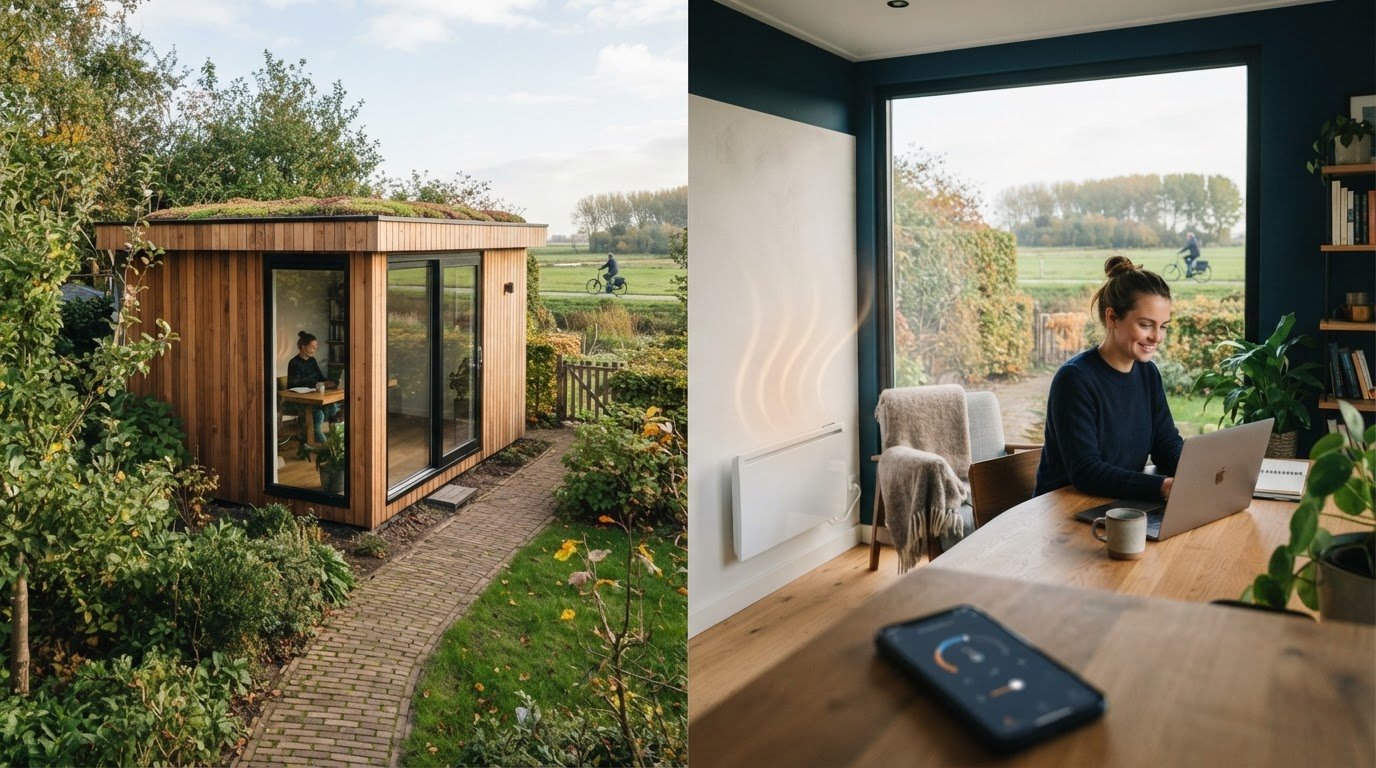
The most powerful heater is not automatically the best choice. An electric heater for a garden office must match the insulation as well as how often and for how long you use the space. A moderately insulated office requires a different approach than a well-insulated space that you only heat occasionally.
Whether electric heating offers sufficient comfort and what power output you need depends primarily on how much heat your space loses and how you use the office. Also pay attention to the controls: a thermostat, timer, or app can help align heating times with your workday. This prevents the heater from falling short or staying on unnecessarily long.
In this article, you will learn how to estimate the heating needs of your garden office and which type of electric heating suits the space and your work rhythm. You will also discover how smart convector heating can be a practical option for adjustable heat. This way, you can make your choice based on the space, usage, and product specifications.
Key Points
- Choose an electric heater for a garden office based on insulation, draftproofing, and usage, not just the floor area.
- Map out your heating needs: consider the room, how long you work there, and what temperature you find comfortable.
- Match the type of heating to your usage: a convector heats the room, while targeted supplementary heating provides warmth in one spot.
- Use a thermostat and appropriate controls to time your heating to your workday. Follow the product manual during installation.
- BEHA offers smart convectors with control via Wi-Fi and an app, plus various front finishes for your garden office.
Why does a garden office require a suitable electric heater?
A garden office is a separate workspace that you heat specifically to that space. The choice therefore requires different considerations than for a room in the house. The office may be less well insulated, experience more drafts, and not heat up along with the rest of the home. The right electric heater for a garden office therefore depends not only on the size, but also on the condition of the space and your work rhythm.
Electric heating converts electricity into heat; the precise operation varies by type. A concise overview of how electric heating works will help you understand the different principles. For a garden office, it is particularly important whether you want to comfortably heat the entire space or need heat in a specific spot at certain times.
What makes a garden office different from a room in the house?
A detached building does not automatically have the same insulation and airtightness as your home. Therefore, assess the windows, floor, roof, and exterior door. Gaps can let in cold air, while heat can also be lost through a poorly insulated floor or the roof. Because a garden office is often separate from the house, the heat from the house does not reach the space automatically.
Good insulation helps limit heat loss and unnecessary heating. Therefore, inspect the room before choosing a stove. Additional heating does not solve drafts or cold surfaces. Map these points out first so that you can match the stove to a realistic picture of the heat requirements.
When is electric heating a logical choice?
Separate electric space heating can be practical when you only want to heat the garden office, without heating other rooms in the house. An electric convector is an option if you want to heat the air in the workspace. Which solution suits you best depends partly on how quickly you need heat and how long you spend in the room.
If you work in the garden office almost daily, it is important that the temperature remains comfortable during your working hours. If you only use the space occasionally, your heating times are likely shorter or less predictable. This difference partly determines which controls are convenient and how you schedule the heating. A thermostat or programmable controls can help adjust the heat to your presence, without having to constantly keep the room at the same temperature.
So start with the room and your usage, not with a specific stove type. This assessment forms the basis for estimating the heat demand and required power more accurately.
How do you determine the heat requirement of your garden office?
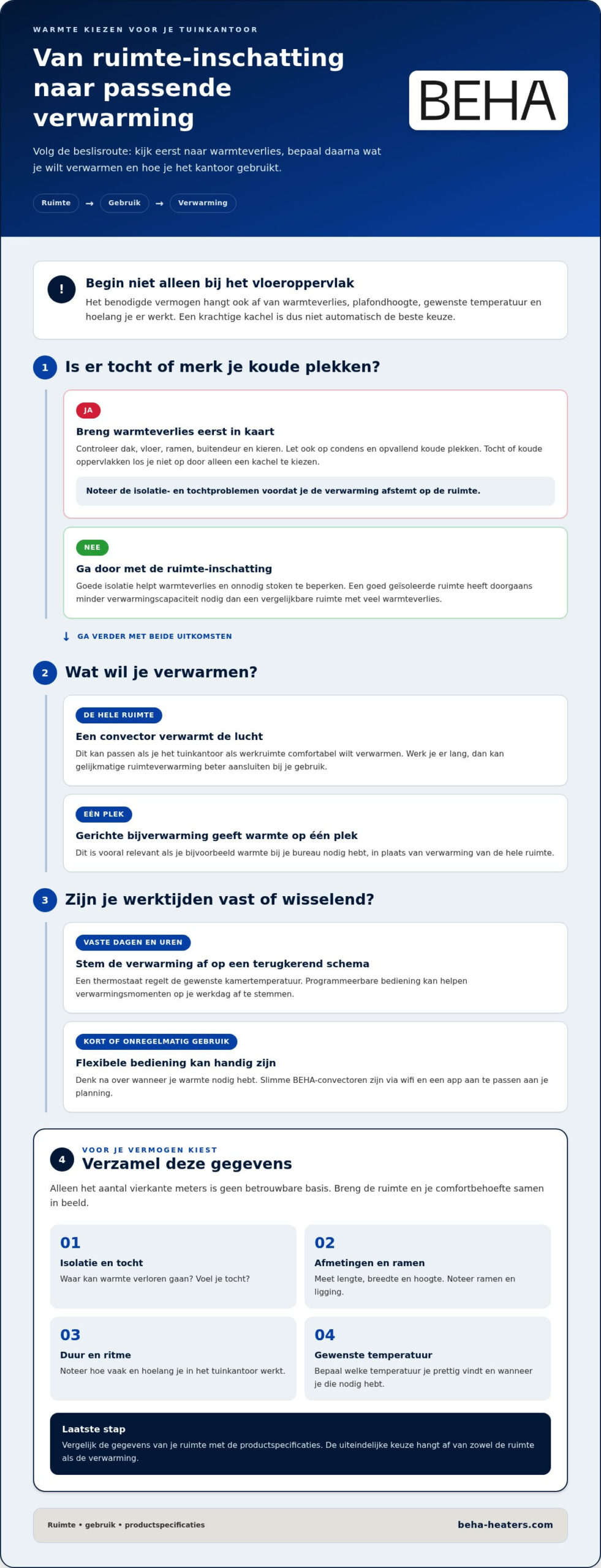
The appropriate capacity cannot be reliably derived from the number of square meters alone. Heat loss, ceiling height, desired temperature, and the time you spend working in the room also play a role. Map out your needs using these steps before choosing an electric heater for your garden office:
- 1. Assess the insulation. Note where the space can lose heat and whether you feel a draft. A well-insulated garden office generally requires less heating capacity than a comparable space with significant heat loss.
- 2. Visualize the space. Measure the length, width, and height. Also note the number of windows and consider the layout of the room. The floor area gives a first impression but does not reveal how much heat is lost through the walls, glass, and roof.
- 3. Describe your usage. Do you work on fixed days and hours, or do you use the office irregularly? Note how long you stay there so that your schedule and comfort needs are taken into account.
- 4. Determine your desired temperature. Consider what temperature you find comfortable during sedentary work and whether you need it for the entire workday or only at specific times.
The better the insulation, the lower the heating capacity generally required to keep the garden office comfortable. View this as a starting point, not as a capacity calculation. The final choice depends on the characteristics of the space and the specifications of the heating system. Compare these data before determining an appropriate capacity.
What role do insulation, windows, and drafts play?
Systematically inspect the room: check the roof, the floor, the windows, the exterior door, and any gaps. Look for noticeable drafts, condensation, or areas that feel noticeably cold. Such signs can indicate heat loss, making the room less comfortable and potentially requiring more heating. Identify visible draft problems and poor insulation first. Otherwise, you will base your decision on a room that loses heat unnecessarily quickly.
How do working hours and the thermostat influence your choice?
With a fixed workday, you can align heating times with a recurring schedule. If you use the garden office for short periods or at varying times, flexible control may be more convenient. A thermostat regulates the desired room temperature. With app control, such as with smart BEHAconvectors, you can adjust the heating via Wi-Fi to suit your schedule. See how smart convector heating meets your need for adjustable heat.
Convector or supplementary heating: what suits your garden office?
The choice depends on what you want to heat. A convector heats the air in an indoor space. Targeted supplementary heating is particularly relevant if you need heat in one spot, for example at your desk. Also consider the duration of use: if you work in the garden office for long periods, even room heating might be a better fit. If you use it briefly or irregularly, localized heat may be more practical.
| Type | Appropriate use | Point of attention | Relevant operation |
|---|---|---|---|
| Electric convector | Heating the workspace during recurring or longer workdays | The room temperature and insulation influence comfort and the required heat | Thermostat and possibly a timer or app |
| Targeted supplementary heating | Replenish heat at a specific spot, such as at a desk | Does not heat the entire room automatically; check if local heat is sufficient for your workspace | Simple operation for the moments when you use that place |
When is an electric convector suitable for the room?
An electric convector is suitable for a garden office that you want to heat as a whole and whose temperature you want to regulate during your working hours. The right choice depends, among other things, on the condition of the space, your desired comfort, and how long you spend there. For more background, view the guide on electric convectors with Wi-Fi.
What role do thermostats and smart controls play?
With a thermostat, you set the desired room temperature. App control can be convenient if your working hours vary: you can align heating times with your schedule instead of constantly switching manually. Smart convectors from BEHA can be controlled via Wi-Fi and an app. This makes control more accessible, but ease of use does not automatically mean you save energy.
Power consumption depends on how long and at which setting you heat, how well the garden office is insulated, and the features of the chosen product. Therefore, there is no single type that is automatically the most economical or comfortable in every situation. Compare the options based on your own usage and see how smart electric heating can meet your need for adjustable heat.
What should you look for when choosing and installing a garden office heater?
Making the right choice doesn't start with the appearance of the appliance, but with the space and your daily use. Use this checklist to list the most important points before choosing an electric heater for your garden office:
- Insulation and drafts: assess windows, floor, roof, exterior door, and any gaps. Map out the heat loss first.
- Duration of use: note whether you work fixed hours daily or use the garden office at varying times.
- Temperature control: decide whether you want to regulate the room temperature evenly during your workday.
- Control: choose between direct control and a timer or app that allows you to align heating times with your schedule.
- Placement: determine in advance where the unit can stand or hang, with sufficient space for air circulation.
Which qualities are useful for working from home?
A thermostat helps set and regulate the desired room temperature. If you work fixed hours, a timer can be handy. If your working hours vary regularly, Wi-Fi and app control offer more freedom to adjust heating times. Smart BEHAconvectors can be controlled via Wi-Fi and an app.
The finish is primarily a choice for your interior, not proof that a heater is suitable for your space. BEHA offers smart convectors with a steel, glass, or paintable front. If you want to compare front finishes, read the guide on an electric heater with a steel front.
How do you take safety and placement into account?
Always follow the manual of the chosen appliance for installation and use. It contains product-specific instructions, including the minimum clearance. Keep the appliance away from furniture, curtains, and other heat-sensitive materials. This way, you do not obstruct air circulation and prevent heat from accumulating around flammable or sensitive objects.
Do not rely on general assumptions regarding safety distances or suitability for damp areas: these can vary per unit. Base the installation on the documentation for the specific product and keep the air vents clear. Would you like to see which smart convector suits your interior and usage? Discover the smart convectors from BEHA.
How do you connect a BEHAconvector to your garden office?
If your garden office requires adjustable electric space heating, a smart BEHAconvector could be a suitable option. The convectors can be controlled via Wi-Fi and an app. This allows you to tailor the heating to your work rhythm, for example, when you work in the garden office on varying days. Which version is suitable also depends on the space and the product specifications.
Which BEHAfront finish suits your workspace?
BEHA offers smart convectors with a steel, glass, or paintable front. The finish helps you choose a unit that matches your decor: for example, the front can blend into the interior or be a visible part of it. The material or appearance in itself says nothing about the heating capacity or suitability for your garden office. For this, use the product specifications and the characteristics of the room.
When comparing, pay attention to two separate things: what you find aesthetically pleasing and what you need for heating. Dimensions, power output, and other features can vary by appliance. Therefore, base your choice on the specifications of the model you are considering, not just on the front finish.
What does smart control add to your workday?
With control via Wi-Fi and an app, you can adjust the heating without having to constantly walk to the unit. This is practical if your working hours vary or you want to determine in advance when you will use the garden office. App control makes it easier to align heating times with your schedule. It offers ease of use, but does not in itself guarantee lower energy consumption. That depends partly on the insulation, settings, and duration of use.
BEHA has been manufacturing electric heating for over a hundred years. When choosing an electric heater for a garden office, the order remains important: first assess the insulation and intended use, then determine which control system you find comfortable, and finally compare the product specifications. This way, you match your heating needs to a device and controls that suit your workspace.
Would you like to explore the possibilities at your leisure? Discover the electric heating from BEHA.
Choose heating that suits your workspace
A comfortable workspace starts with an understanding of the space. Assess the insulation and draftproofing, consider how often you use the garden office, and adjust the heating accordingly. Floor area alone is not enough to reliably determine the heat requirement. A thermostat and appropriate controls help you tailor the heat to your work rhythm.
So, don't choose an electric heater for your garden office based solely on power or appearance. BEHA has been manufacturing electric heating for over 100 years and offers smart convectors with steel, glass, and paintable fronts. Thanks to control via Wi-Fi and an app, you can adjust heating times to your schedule. Choose the front finish to match your interior and base your heating choice on the room and product specifications.
Would you like to explore the possibilities? Discover electric heating from BEHA and find a solution that suits your garden office. With a well-considered choice, you turn the space into a pleasant place to work.
Frequently asked questions about heating in a garden office
Is an electric heater suitable for a garden office?
Yes, that is possible, especially if the space is well insulated and the heating suits your usage. Check the roof, floor, windows, and exterior door for heat loss or drafts. Also consider how often and for how long you work there. The required heat and comfort depend on the condition of the garden office, the settings, and the chosen heater.
Which electric heater is suitable for a garden office?
That depends on the room, the insulation, your working hours, and the controls you prefer. An electric convector is an option for space heating. Compare the thermostat control, any app control, and product specifications, such as the power output. Additionally, check the manual to see if the unit is suitable for the intended location and follow the instructions for use and installation.
How much power does an electric heater need for a garden office?
You cannot reliably determine the required power based on floor area alone. Insulation, ceiling height, windows, drafts, and duration of use also play a role. Measure and assess the space and compare those data with the appliance's specifications. Use a concrete power calculation only after the information regarding both the heater and the garden office has been verified.
Does an electric heater in a garden office consume a lot of power?
Power consumption depends on the wattage, the set temperature, how long you heat, and how much heat the room loses. A garden office with a noticeable draft may require heating more often than a well-insulated room. You regulate the desired temperature with a thermostat, but that in itself does not guarantee lower consumption. Your settings and daily usage also contribute to how much power the heater uses.
Can I control an electric heater remotely?
Yes, you can control BEHA smart electric convectors via Wi-Fi and an app. This is convenient if your working hours vary and you want to adjust the heating accordingly. The available control options differ per unit; therefore, please consult the corresponding product information. Remote control does not automatically warm up a cold room: insulation, the desired temperature, and the heating duration remain the determining factors for comfort.
Is an electric convector suitable for daily work in a garden office?
An electric convector can be suitable for daily use if the unit matches the room and your comfort needs. First, assess the insulation and draftproofing and determine what temperature you want while working. Then look at the thermostat control and desired operation. When installing and using, always follow the manual for the chosen unit, including the placement instructions.