
Electric heater for the hallway: how to choose the right heating
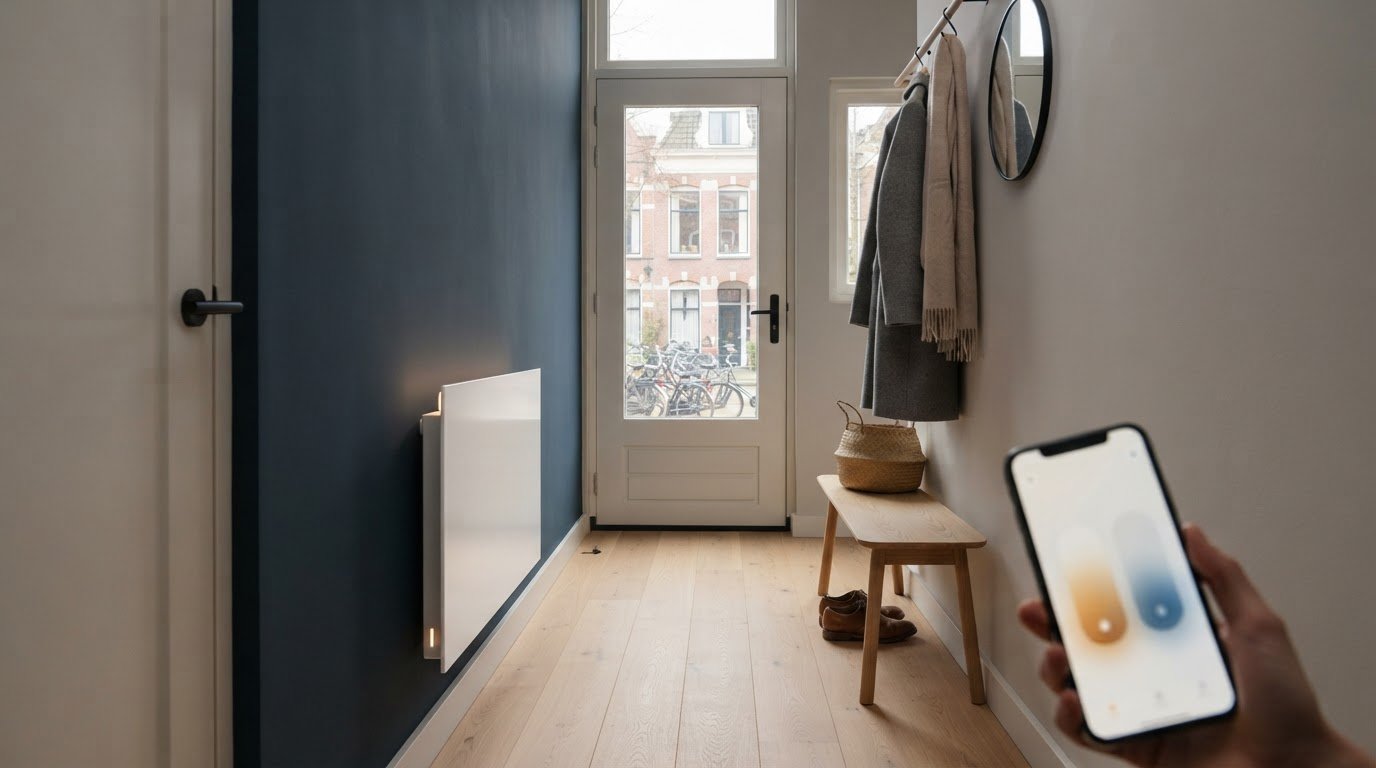
A more powerful electric heater for the hallway is not automatically the best choice. If you use the hallway mainly at specific times, you will want a unit that suits the space and is easy to operate when you need warmth. Therefore, pay attention not only to the power output, but also to the dimensions and insulation of the hallway, the placement options, and how you want to control the heating.
A cold hallway is uncomfortable, but it is not always immediately clear which type of heating is suitable. Where can the unit be hung or placed without getting in the way? Can you operate it easily when you come home? And does the finish match your interior? By taking such questions into account, you compare options based on comfort and practicality, not just on appearance or power.
In this article, you will read what to look for when choosing an electric heater for your hallway. We discuss space, insulation, power, operation, and placement, among other things. We also compare different front designs and look at why control via Wi-Fi and an app can be convenient if you use the hallway at varying times.
Key Points
- Choose an electric heater for the hallway based on the space and the times you need heat, not just on the power output.
- Compare convectors and fan heaters based on heat output and suitability for use. Check the features of the selected model.
- Consider controls, thermostat, mounting, and visibility separately. Not every model has the same features.
- When placing the unit, take into account walkways, doors, available wall space, and the power outlet.
- Compare smart convectors, classic convectors, and fan heaters from BEHA based on model specifications and the look you are looking for.
When is an electric heater for the hallway a suitable choice?
Your hallway feels cold as soon as you enter, but you might not use the space all day. An electric heater for the hallway can then be a practical way to heat that specific spot when needed, rather than raising the temperature throughout the entire house. Which solution suits you depends on how you use the hallway and how much heat the space retains.
A small, enclosed hallway requires a different approach than a high entrance that opens onto the living room or stairs. Drafts along exterior doors and connections to unheated spaces can cause heat to dissipate more quickly. Ceiling height and layout are also relevant when comparing models. Tailor hallway heating to the usage times and characteristics of the space, not to a single isolated factor such as power output.
How often and for how long do you use the hallway?
An entrance where you regularly put on your coat or shoes is used differently than a hallway you only walk through. For brief periods of use, how quickly you experience warmth can be important. Fan heating blows heated air into the room; a convector heats the air in a different way. The basic principles of different types of electric heaters help you compare these options.
Also consider your daily routine. If you usually use the hallway around fixed times, a timer or scheduler can be handy, if the chosen model has that feature. If your arrival times vary, direct control may better suit your usage. This way, you avoid choosing features you don't need and are less likely to miss a feature that would be particularly practical.
Which characteristics of the hall determine the heat demand?
Start with the floor area, but look beyond just length and width. Also note the ceiling height and assess the insulation. Additionally, check whether the hallway adjoins an unheated room, if there is a draft coming in along the exterior door, and if the space opens onto another floor. These characteristics influence how comfortable the hallway feels and how long heat is retained.
If you only walk briefly through the hall, a different solution might be more suitable than if you stand still there regularly. A higher power output does not automatically solve drafts or heat loss. Check the product specifications for each model, including the power output and recommended application. Compare this data with the dimensions, layout, and insulation of your hall before looking further at controls and placement.
Which electric heater suits your hallway and heating needs?
The choice does not depend solely on how cold your hallway feels. Also consider how long you spend there, how you intend to use the heating, and where a unit can be placed or mounted. Convector and fan heaters emit heat in different ways. Which option suits your situation depends partly on the product specifications and the available space.
Convector or fan heater: which suits your needs?
A convector heats air that circulates through the room. Fan heating blows heated air into the hallway. That describes the principle, but does not say exactly how quickly a specific unit will heat your hallway. Check that with the model itself. Also consider how long you use the hallway, which controls you find convenient, and how much space is available.
Use the table as an initial comparison. The points of attention are not fixed performance claims. Always consult the product information of the model you are considering.
| Type | Appropriate use | Point of attention | specification to be checked |
|---|---|---|---|
| Convector | A hallway where you want heat for an extended period | The heat spreads through the air in the room | Power, recommended space and operation |
| Fan heater | A hallway where you want to use heating at certain times | The warm-up behavior varies by model | Power, dimensions, installation options and operation |
In short: compare a convector and a fan heater based on heat output, operating time, and operation. Check the heating behavior and other features of the specific model.
How do you determine what capacity is suitable?
The wattage indicates how much electrical power an appliance uses. It does not, in itself, tell you how much comfort you will experience in your hallway. Therefore, a higher wattage is not automatically the best choice. Surface area, ceiling height, insulation, and any drafts play a role, as do the recommended space and placement stated by the manufacturer for the model.
First, map out the dimensions and insulation of your hallway. Then, compare the capacity and recommended application of possible models. A general rule of thumb does not always provide a definitive answer, for example in the case of a high or drafty entrance. If in doubt, have the required capacity assessed based on the space and check the product specifications before making a choice. You can explore the convectors and fan heaters from BEHA.
What features make an electric heater in the hallway practical?
A heater might be suitable for your hallway in terms of power output but still be inconvenient for daily use. Therefore, also pay attention to the controls, the thermostat functions, the installation, and how visible the unit is. Evaluate these points individually. A feature that sounds handy is not automatically present on every model.
Check before you choose:
- whether the controls are on the device and easily accessible to you;
- which thermostat functions the model has and how to set the temperature;
- whether the device fits the available wall space and mounting location;
- or the placement leaves doors and walkways clear and aligns with the location of the power outlet.
This is how you compare an electric heater for the hallway based on practical use, not just on appearance or power.
Is smart control useful in a hallway?
If you use the hallway at varying times, control via Wi-Fi and an app can be convenient. You can adjust the heating without walking to the unit, provided the chosen model supports this feature. Also, check whether scheduling, temperature setting, and other desired functions are included with that model. Do not assume that every electric heater has app control.
For a fixed routine, simple operation or an adjustable schedule may be just what you need. First, determine how you want to use the heating and then compare the features in the product specifications. This way, you avoid choosing a feature that does not suit your usage or overlooking a feature that you consider important.
How do you match the heating to your interior?
A hallway is often a visible passageway, so the finish can also be a factor. A steel front has a different look than a glass front. With a paintable front, you can match the appliance to the wall. View these versions as options for comparison, as not every finish is available for every model.
Don't just look at color or material. Measure the available wall space and consider doors, coat racks, and walkways. A space that looks calm must also be practical and compatible with the unit's mounting options. Check these possibilities in the product specifications. This way, you choose a heater that suits both the use and the look of your hallway.
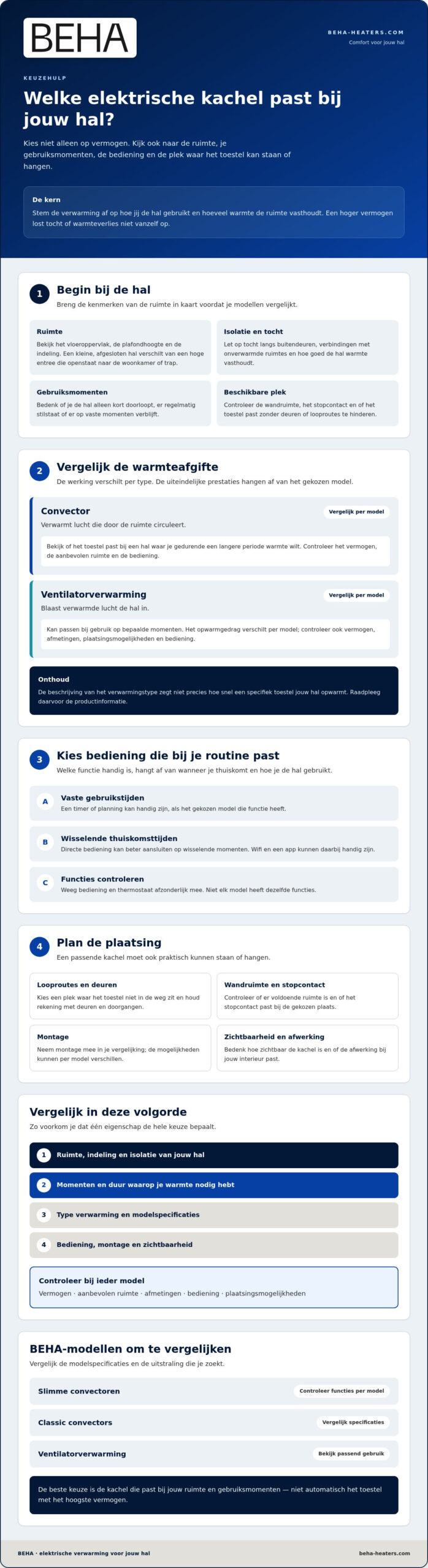
How do you choose and install an electric heater for the hallway?
Don't start by choosing a model immediately, but first determine where the appliance will be placed. Map out the space and your daily usage, and then compare the specifications. This way, you avoid choosing a heater that seems suitable on paper but blocks a door or cannot be practically placed near the power outlet.
Which checklist helps before you choose a model?
Note down what your hallway needs and then compare models that fit the space. With the most important details at hand, you can evaluate product specifications more effectively.
- Map out the hallway. Note the floor area, ceiling height, insulation, potential sources of drafts, and adjacent unheated spaces.
- Determine your usage times. Write down when and for how long you want to heat the hallway. Consider which controls are practical for this.
- Measure potential locations. Take into account doors, walkways, available wall space, and the position of the power outlet.
- Compare the specifications. Check the power, dimensions, controls, and mounting method for each model. Also check for which room the model is recommended.
A device that appears suitable according to the specifications must also fit in the intended location. Is a mounting spot unsuitable because the passageway becomes narrow or the socket is inconveniently positioned? Then compare other models or placement options before making a choice.
What should you take into account regarding installation and use?
In a hallway, unobstructed passage is important. Do not place the heater in a location where you bump into it daily, a door might slam against it, or coats and shoes take up space around it. Always follow the manual for the chosen model, including the prescribed clearance. Do not cover the unit and adhere to the instructions for use and ventilation.
Also check whether the mounting location complies with the regulations and connection options of the device. The required distance to other surfaces varies by model, so do not use a general measurement as a starting point. If you cannot follow the instructions at your intended location, choose a different position or a different device.
BEHA sells heating products but does not offer an installation service. Are you unsure about the electrical connection or the suitability of the location? Have the situation assessed by a professional before using the appliance. You can electric heating products BEHA view and compare them with your checklist.
Which BEHA electric heater would suit your hallway?
Which heating suits your hallway depends on the space, usage, and your preferred control method. BEHA sells smart convectors, classic convectors, and fan heaters. This gives you various categories to compare, but features can differ by model. Therefore, check the product information before choosing a version.
When is a smart BEHAconvector worth considering?
If you use the hallway at varying times, control via Wi-Fi and an app can be convenient. You can then operate the heating remotely, provided that feature is included with the chosen model. Wi-Fi and app control is available on smart convectors, but not automatically across the entire range. In addition to the controls, also check the power output, dimensions, mounting options, and recommended space. If you are looking for more technical details, a guide on an electric convector with Wi-Fi can provide additional background.
How do you turn your choice into a suitable solution?
Take your hallway as a starting point and compare the product categories with what you need. A convector might suit your preference for convector heating. Fan heating is another option to consider if you want to use the heating at specific times. The precise heat output and warm-up behavior depend on the model. Therefore, do not expect fixed performance without checking the product specifications.
- Space: compare the dimensions of the device with the available wall space and check for which room the model is recommended.
- Usage: consider whether you heat the hall according to a fixed routine or at varying times.
- Operation: choose functions that match your usage and check per model whether they are present.
- Appearance: smart convectors are available with a steel, glass, or paintable front. Check which version suits the visible spot in your hallway.
This way, you compare not only on appearance but also on ease of use and suitability. A smart convector can be interesting if app control is important to you. A classic convector or fan heater may better suit other preferences. Power, dimensions, and installation remain points to consider that you check for each model.
's electric heating solutions BEHA and compare the product information with the dimensions, layout, and usage times of your hallway. This way, you will discover which electric heater for the hallway suits your situation.
Choose heating that suits your hallway
You should not choose an electric heater for the hallway based solely on power output. Consider the size and insulation of the room, how often you use the hallway, and where the unit can practically be mounted or placed. Compare convection heaters and fan heaters based on heat output and usage, and check the specifications of each model.
Operation and appearance also matter. BEHA 's smart convectors can be controlled via Wi-Fi and an app. Various front finishes help you choose an option that matches your interior. Always check whether features, power output, dimensions, and installation suit your situation. BEHA has over 100 years of experience in electric heating and offers various product categories for comparison.
Would you like to compare the options? 's electric heating solutions BEHA and compare the product information with your requirements for the hallway. This way, you can make a choice that suits the space and the times you use it.
Frequently asked questions about heating in the hallway
Is an electric heater suitable for the hallway?
That is possible, depending on the size, insulation, and use of your hallway. An electric heater for the hallway might be suitable if you want to heat that specific space only when you use the entrance. Measure the available space and consider when you need heat. Then compare the product specifications and recommended use of suitable models. A single power output does not suit every hallway.
What power do you need for an electric heater in the hallway?
The required power depends on factors such as the floor area, ceiling height, insulation, and any drafts. Wattage indicates how much electrical power an appliance uses, but it does not, in itself, indicate how much comfort you will experience in your hallway. Therefore, use it as a reference point and check the recommended application of the model. If you are unsure about the required power, have the room assessed by an installer or heating specialist.
Is a convector or fan heater better for the hallway?
Neither is automatically the best choice for every hallway. Convector and fan heaters are different product categories with their own methods of heat output. Which option suits you depends on how long and when you use the hallway, as well as the available space and desired operation. Compare the manufacturer's specifications for each model. Do not just look at the product name, but also at the specifications and your specific usage situation.
Can an electric heater be mounted on the wall in a hallway?
This is only possible if the chosen model is suitable for wall mounting. Check the installation instructions and follow the directions regarding placement and clearance. Take into account the available wall space, the opening direction of doors, and a clear passage. A location where the appliance is frequently hit is less practical. If you have any doubts about the electrical connection or the mounting location, have the situation assessed by a professional beforehand.
Is Wi-Fi control useful for an electric heater in the hallway?
Wi-Fi control can be useful if you want to operate or schedule the heating at varying times. The feature is not available on every model, so check the product information. Also, look at what options the accompanying app offers, such as remote control or scheduling. Do not assume features that are not listed for the model. If you use the hall according to a fixed routine, consider whether smart control adds value.
How do you use an electric heater safely in the hallway?
Always follow the manual and safety instructions for the chosen model. Position the appliance so that doors and passageways remain clear and clothing or other items do not obstruct heat output. Do not cover the heater and use it only as prescribed by the manufacturer. The required clearance may vary by model. If the placement or connection raises any questions, have the situation assessed by a qualified professional before using the appliance.
Which electric heater suits a small hallway?
First, measure the available space and assess the insulation, potential drafts, and the times when you want to heat the hallway. Then, compare models based on dimensions, mounting options, power output, and recommended application. A compact unit is not automatically suitable: the specifications must match the space and usage. Also, check if you can operate and place the unit practically without obstructing doors or walkways. This way, you base your choice on more than just size.