
Electric heater guide: Find the best smart heater
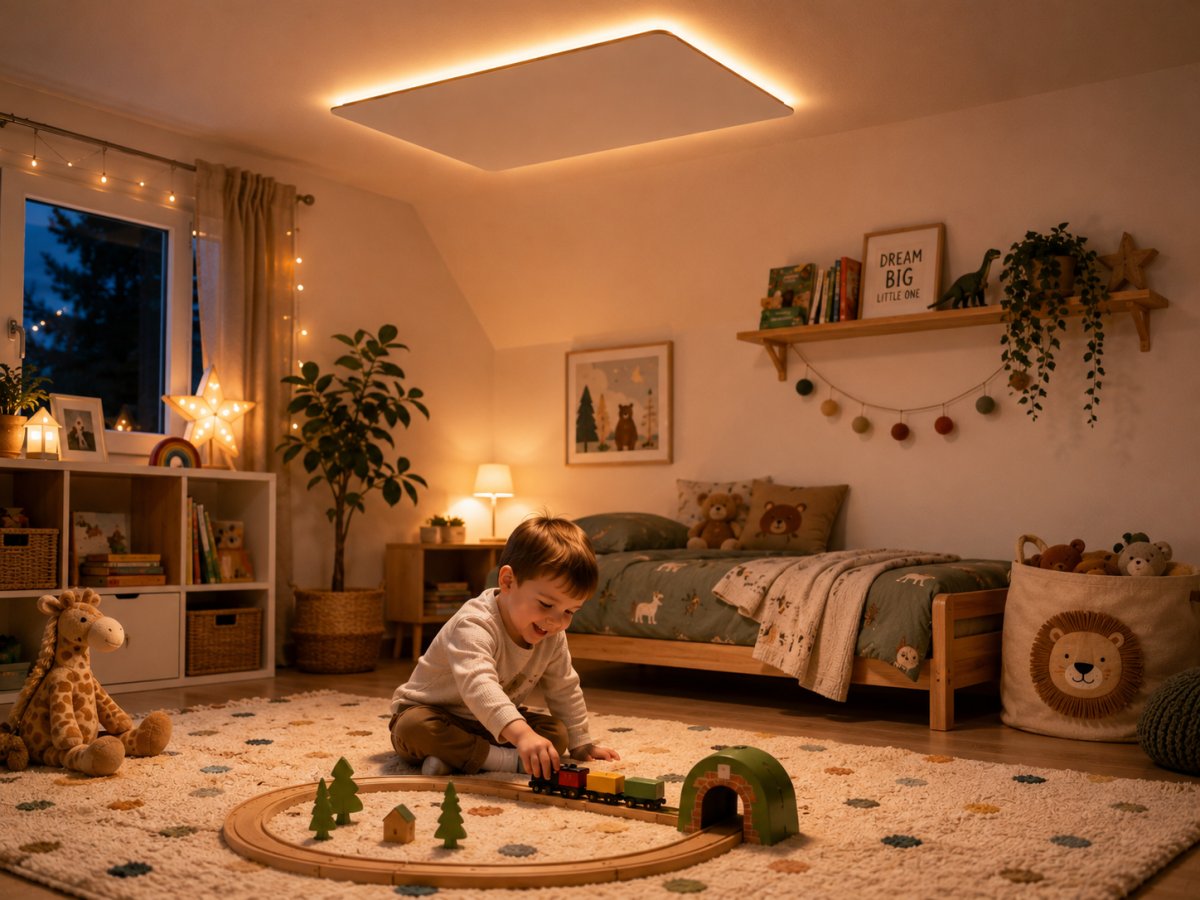
This Electric Heater Guide helps you choose a suitable heater for a living room, bedroom, bathroom, office, or sporadically used room. You compare not only purchase price and wattage, but also heat transfer, noise, thermostat, placement, safety, and actual operating costs. This way, you avoid buying a fast fan heater for a quiet bedroom, or a convector that is too weak for a poorly insulated living space.
There is no single electric heater that is the best choice for every situation. A fan heater provides noticeable warmth quickly, a convector heats the room air evenly and silently, while infrared primarily heats people and surfaces within the radiation range. For daily use, control, correct sizing, and safe installation become more important than a spectacular marketing claim.
In this Electric Heater guide, you will find an objective decision-making method, a comparison table, a formula for electricity costs, and seven checkpoints for purchasing. The explanation is aimed at Belgian homes and clarifies when a BEHA Classic, a smart Wi-Fi convector, or a paintable RAW version makes sense. You should then always check the power and features on the product sheet of the specific model.
Key points from the Electric Heater Guide
- Start with the room and duration of use: primary heating requires a different calculation than short-term supplementary heating.
- Compare convection, fan heat, and infrared on comfort, speed, noise, and placement.
- Calculate the maximum hourly cost with power in kW × your own electricity price per kWh.
- Check thermostat, weekly program, Wi-Fi, IP rating, and security features per model.
- For primary heating, have the heat loss and electrical load reliably determined.
Electric heater guide: when is electric heating smart?
Electric space heating is an attractive option when you want to quickly heat a single room or zone, avoid installing water pipes, or control the heating per room. With direct electric resistance heating, the electricity consumed is released almost entirely as heat into the room. However, this says nothing about the total energy costs: these depend on heat loss, operating time, temperature setting, and your own electricity tariff.
As primary heating, an electric heater makes particular sense in well-insulated rooms with limited heat demand and sufficient electrical capacity. For an entire home, you should also compare alternatives such as a heat pump, which transfers heat and can therefore generally deliver more heat per kWh of electricity than a resistance heater. As supplementary heating, local electric heating can actually prevent you from heating the entire house just for a single room.
Pros and cons of gas-free heating
An electric heater produces no combustion gases on-site and requires no fuel storage or flue gas discharge. However, the climate impact and price depend on the source of the electricity, the contract, and your usage. Therefore, electric does not automatically mean cheaper or more sustainable. The advantage lies primarily in simple zone control, limited installation, and maintenance, provided the device is chosen and used correctly.
Convection versus radiant heat
A convector primarily heats the air: cold air flows in at the bottom, heats up, and rises. This provides even room comfort and operates silently without a fan. Infrared primarily heats people and surfaces within the radiation range. This can be pleasant for a focused workspace, but positioning and line of sight are important. A fan heater combines an element with forced air and heats up quickly, but it makes noise and stirs up more dust.
Which electric heater suits your space?
This Electric Heater Guide prioritizes function over design. Choose a quiet wall convector for prolonged stays, a fan heater for quick, short bursts of warmth, and infrared when you want to heat a clearly defined area. Front material and color become the deciding factors only after that.
For specific needs in small spaces, such as a compact storage room or a toilet, fan heaters offer a solution. These devices are designed for a rapid temperature increase when you are present. Although they are less suitable as a constant heat source for large living spaces, their speed is unparalleled. They are easy to operate and store away just as easily once the chill has dissipated.
Electric heater guide: comparison and 7 buying tips
Use this comparison to quickly narrow down the search field. The exact performance and safety features remain model-dependent.
| Heater type | Best application | Heat and sound | Important point of attention |
|---|---|---|---|
| Wall convector | Living room, bedroom, office | Even air heating, virtually silent | Correct power and free airflow |
| Fan heater | Short, quick auxiliary heating | Fast, but audible fan | Do not cover; dust and noise |
| Infrared heater | Targeted workspace or zone | Direct radiant heat, silent | Distance, direction and mounting height |
| Wi-Fi convector | Multiple rooms and changing schedules | Like a convector, with app control | Wi-Fi only saves money with a well-set schedule |
- Determine the goal. Choose between main heating, regular supplementary heating, and quick warmth for a few minutes.
- Make a heat loss estimate. Note surface area, height, exterior walls, windows, ventilation, and insulation.
- Compare the control system. An electronic thermostat provides finer control; a weekly schedule or Wi-Fi helps avoid unnecessary hours.
- Calculate the costs. Power in kW × heating hours × price per kWh gives the maximum cost when the element is continuously active.
- Check noise and placement. A quiet bedroom requires a different device than a garage that needs to heat up quickly.
- Check safety. Look at thermal protection, mounting distances, and an appropriate IP rating for damp areas.
- Compare service. Product documentation, warranty, and local support are more important than just the lowest purchase price.
Stylish heating with glass and steel
A glass front provides a luxurious, modern look that fits perfectly in a sleek living room. The smooth surface subtly reflects the light and is also extremely easy to clean with a damp cloth. For rooms that are used intensively, such as the hallway or a children's room, a smart convector with a steel front is often the sensible choice. Steel is robust and can easily take a knock, while the high-quality powder coating ensures a refined finish that remains beautiful for years.
Both materials contribute directly to the value and feel of your home. A well-chosen heater exudes quality and shows that every detail in the house has been carefully considered. Curious which finish best suits your walls? Then take a look at the various smart convectors in our collection for an overview of the possibilities.
A paintable radiator for a calm interior
You probably recognize this: a beautiful olive green or deep blue wall topped with a bright white radiator that demands all the attention. For those who prefer their heating to blend completely into its surroundings, a paintable radiator a true godsend. Instead of a contrasting surface on the wall, you simply paint the front of the heater in exactly the same color as your wall. This makes the appliance virtually invisible, allowing the focus to remain on your interior.
It is essential to work safely for optimal results. Always use water-based paint and avoid painting the ventilation grilles on the top and bottom. This ensures perfect air circulation for your electric heater , while you enjoy a seamless and tranquil interior. The result is a harmonious space where technology and design go hand in hand without interfering with one another.
Saving with scheme and Ecodesign
The Electric Heater Guide takes current European regulations into account. Since July 1, 2025, updated Ecodesign requirements apply to local space heaters. The European Commission describes the requirements and product scope for local space heating. These include, among other things, control, low-consumption settings, and product information. Ecodesign does not automatically make a device cheap to operate; an appropriate capacity and a sensible schedule remain the determining factors.
One of the most effective energy-saving features is open-window detection. As soon as the heater detects a sudden temperature drop due to a draft or an open window, the system temporarily switches itself off. This prevents you from literally heating the outside air. Combined with an adjustable weekly schedule, you ensure that the heating is only active when you are actually present in the room. This prevents the heater from running at full power all day while no one is home.
Control via the app
With a Wi-Fi model, you can adjust temperatures and weekly schedules remotely. This is particularly useful for multiple rooms, varying working hours, or a holiday home. Wi-Fi does not increase the thermal efficiency of the element; it helps to limit missed heating hours. Check per model which functions the app actually supports. You can find more background information in the guide on the electric convector with Wi-Fi.
Electronic thermostat
An electronic thermostat generally maintains a more consistent temperature than a simple mechanical model. The thermostat does not reduce the maximum wattage but switches off the heat demand when the set temperature is reached. Therefore, position the device according to the manual: drafts, curtains, or furniture can affect temperature measurement and air circulation.
Calculate power with the Electric heater guide
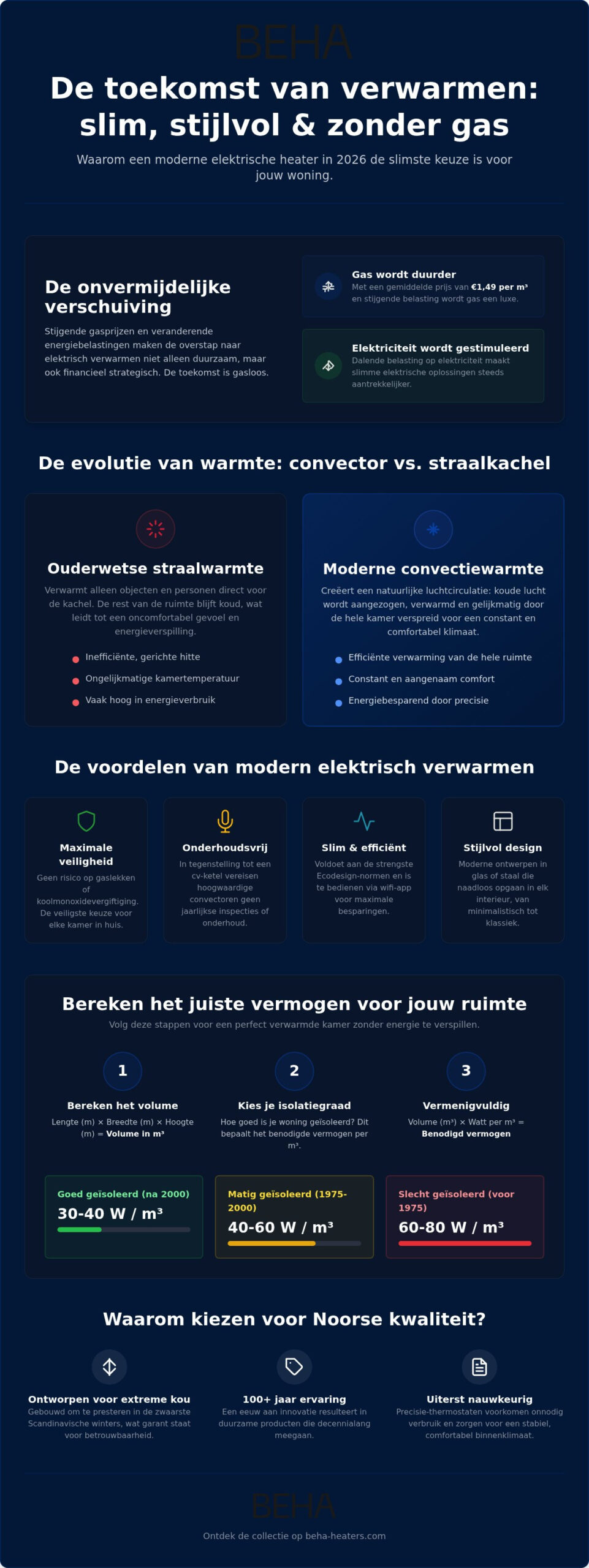
The correct power output is determined by the heat loss of the room. An appliance that is too small may not reach the target temperature on cold days. An appliance that is too large requires a higher electrical load than necessary. A rule of thumb in watts per square meter is only an initial selection; for primary heating, a heat loss calculation is more reliable.
Gather the following data for a reliable choice:
- Dimensions: floor area and ceiling height.
- Heat loss: insulation, windows, exterior walls, drafts and ventilation.
- Usage: main or supplementary heating, operating hours and desired temperature.
- Electrical installation: total power, socket and available circuit.
For multiple heaters, large glass areas, high ceilings, or an entire home, it is best to have the calculation and electrical load checked by a professional.
Wattage varies by room
Not every room in the house has the same heating requirements. In the bedroom, a basic temperature of 18 degrees is often sufficient, allowing you to manage with a lower wattage. For small spaces such as a toilet or a compact storage room, heaters of 400 to 800 watts suffice. In the bathroom, however, you want to reach 24 degrees quickly, which requires a higher capacity per cubic meter. For the central living space in your home, you will find specific advice in our guide on smart living room heating.
Placement for optimal performance
The location of your electric heater determines how efficiently the heat spreads. The most strategic spot is directly under a window. The cold air sinking down the glass is thus directly captured and heated by the convector before it reaches the rest of the room. This creates an invisible heat shield against drafts. Always ensure that the airflow at the bottom and top is not blocked by curtains or furniture. Although freestanding models offer flexibility, fixed wall mounting generally provides the most constant and efficient air circulation.
Do you need help choosing the right model for your specific situation? View our full range and find the convector that fits your space.
Which BEHAstyle matches this electric heater guide?
BEHA offers various solutions that should not be confused with identical features. The Classic series combines an electronic thermostat with a built-in weekly program and is available from 500 to 2,000 watts. Smart steel and glass convectors add Wi-Fi and app control, depending on the model. The RAW series focuses on interiors with a paintable front and is available in various Wi-Fi versions.
Always compare the technical product sheet of the specific model regarding power, IP rating, installation, operation, and warranty. A model suitable for a dry bedroom is not automatically suitable for every bathroom zone. Furthermore, for multiple devices, check the total load on the electrical installation.
Norwegian product development and local support
BEHA has over a century of experience with electric heating and offers local product information and support through BEHA Benelux. For the buyer, it is particularly important that specifications, manuals, and contact options are available. This makes an informed model selection and correct installation easier.
Simple operation and correct installation
Innovation should never come at the expense of ease of use. Our convectors are designed according to the plug-and-play principle: within minutes, the device is mounted on the wall and you can enjoy pleasant warmth. Although integration with our Wi-Fi app delivers maximum savings, the interface on the device itself remains extremely intuitive. You therefore do not need a smartphone to quickly adjust the base temperature. Furthermore, for larger projects or office environments, we offer specific business options, helping professionals with scalable heating plans that meet the latest sustainability standards.
Conclusion of the Electric Heater Guide
The best electric heater is the unit that suits the room, usage time, and heat demand. Choose a quiet convector for long-lasting room comfort, a fan heater for quick, short bursts of heat, and infrared for a targeted zone. Add Wi-Fi only if you actually use schedules and remote control.
Use this Electric Heater Guide as an initial selection and then check the product sheet. Pay attention to power, thermostat, installation, IP rating, warranty, and electrical load. This way, you choose based on facts rather than loose claims about being “efficient” or “smart”.
Discover the full range of electric heaters from BEHA and experience the comfort of Norwegian innovation for yourself.
Frequently Asked Questions about the Electric Heater Guide
Is an electric heater expensive to run?
Calculate the maximum cost using: power in kW × number of fully active heating hours × your own price per kWh. A 1,500-watt heater consumes 1.5 kWh per hour during continuous heating. The thermostat switches off the element when the set temperature is reached, meaning the actual consumption depends on insulation, outside temperature, settings, and ventilation.
Can I use an electric convector in the bathroom?
Only when the specific model has a suitable IP rating and is installed in accordance with the applicable bathroom zones and mounting distances. IP24 means protection against splashing water, but does not permit use in every location. Check the manual and have the installation assessed by a professional if in doubt.
How many watts do I need for a 20 m² room?
Twenty square meters is insufficient information. An insulated room with standard height can lose much less heat than an old room with large windows or high ceilings. Use the Electric Heater Guide for an initial selection, but for primary heating, have the heat loss in watts calculated.
Does an electric heater make noise while heating?
A modern convector is virtually silent because the device contains no moving parts such as fans. Heating takes place via natural air circulation, so you are not bothered by disruptive buzzing or blowing while working or sleeping. This makes these heaters ideally suited for use in the bedroom or home office where silence is desired. You may only occasionally hear a very soft click when switching the electronic thermostat on and off.
What is the difference between a convector and an infrared panel?
The main difference is the method of heat transfer: a convector heats the air in the entire room, whereas an infrared panel heats objects and people directly. Convection heating ensures an even temperature throughout the room, which is more comfortable for prolonged stays in a living room. Infrared is often more suitable for places where you need direct heat for a short time, such as above a workbench, but it hardly heats the air itself.
Do I need to have an electric heater installed by an electrician?
A model with a plug can often be mounted on the supplied bracket according to the manual. However, do check mounting distances, socket, cord, and circuit load. For permanent connections, damp rooms, or multiple powerful appliances, professional advice is recommended.
Can I leave my electric heater on at night?
Use only a device designed for long-term space heating and follow the manual. Keep the inlet and outlet clear, never cover the device, and do not use a damaged cord or unsuitable extension cable. Overheating protection is important, but it does not replace correct installation and monitoring the condition of the device.
How do I operate my BEHA heater if the Wi-Fi goes down?
If the Wi-Fi drops out, your convector continues to function via the manual controls on the device itself. You can then easily adjust the temperature using the rotary knob or push buttons on the built-in thermostat. As soon as the internet connection is restored, the heater automatically resumes the programmed settings and schedules from the app. Therefore, you are never dependent on a working connection to keep your home warm and comfortable.