
Electric living room heating: 10 ultimate tips

electric heating for the living room requires more than selecting a single radiator based on square footage. An open living space with large windows, a well-insulated apartment, and an older terraced house can have completely different heat requirements for the same surface area. In this guide, you will discover which type of electric heating is suitable, approximately how much power you need, how to calculate consumption, and when supplementary heating is wiser than primary electric heating.
We focus on homes in Belgium and the Netherlands and compare convectors, electric radiators, infrared heaters, fan heaters, and heat pumps without exaggerated savings claims. With the power matrix, installation tips, safety check, and purchase checklist, you can make a choice that is both comfortable and technically sound.
Key points
- Direct electric resistance heating generates approximately one kWh of heat from one kWh of electricity at the point of use. The type and control system primarily determine comfort, heat distribution, and duty cycle.
- A convector is well-suited for even, quiet room heating; infrared is particularly powerful for a fixed zone or seating area.
- Calculate power based on volume, insulation, glazing, exterior walls, and desired temperature, not just on floor area.
- For targeted supplementary heating, electric heating can be practical. For long-term heating of a large living room, a heat pump is generally more energy-efficient.
- The thermostat, weekly program, and app only save energy when they actually lower the temperature or usage time.
Electric living room heating: when is it smart?
Electric resistance heating uses the principle of electric or Joule heating: current flows through an element and is converted into heat. The major practical advantage is room-by-room control without pipes or combustion gases. You can heat the living room while bedrooms remain cooler. This is particularly interesting when you use the living space at fixed times or when expanding an existing water-based system is difficult.
The word “efficient” requires explanation. Virtually all electricity consumed ends up locally as heat, but direct electric heating does not generate multiple kWh of heat from a single kWh of electricity. A heat pump transfers heat from the outside air or the ground and can therefore require much less electricity for structural main heating. The right choice therefore depends on operating hours, insulation, desired flexibility, and investment budget.
When is electric supplementary heating a good choice?
- You mainly use the living room and want to keep other rooms temporarily cooler.
- The living space is reasonably to well insulated and has manageable heat loss.
- You want quick extra comfort alongside a central system without new water pipes.
- You have a suitable electrical connection and sufficient capacity on the circuit.
- You can regulate accurately based on presence with a thermostat and program.
When to compare alternatives first?
In a large, moderately insulated living room that needs to remain warm for many hours daily, direct electric heating result in high annual consumption. In that case, first improve drafts, windows, roof, facade, or floor insulation, and compare an air-to-air or other heat pump. Milieu Centraal explains that a resistance heater delivers approximately one kWh of heat per kWh of electricity, while a heat pump utilizes ambient heat. Therefore, also read the independent explanation regarding electric heating with a heat pump.
Electric living room heating: types compared
The best technique depends on whether you want to heat the entire room air, a fixed zone, or only briefly. The comparison below goes beyond the maximum wattage.
| Type | feeling of warmth | Sound | Strong application | Point of attention |
|---|---|---|---|---|
| Convector | Even heating of the room air | Very quiet without a fan | Longer living room heating | Free air circulation and correct power required |
| Electric panel radiator | Combination of convection and surface heat, model-dependent | Usually quiet | Fixed wall heating | Check assembly, control, and surface temperature |
| Infrared panel | Direct radiant heat on people and surfaces | Quiet | Fixed seating area or workspace | Sightline, mounting, and position determine comfort |
| Oil-filled radiator | Slow, even release and residual heat | Usually quiet | Longer temporary supplementary heating | Heavy; oil buffers heat but does not make the element more efficient |
| Fan heater | Quickly noticeable warm air | Fan audible | Heat briefly and locally | Less suitable for quiet evenings and prolonged use |
| Air-to-air heat pump | Heats air actively and quickly | Indoor and outdoor unit audible | Many hours of use and cooling in summer | Higher investment, installation and maintenance |
Convection heat versus infrared
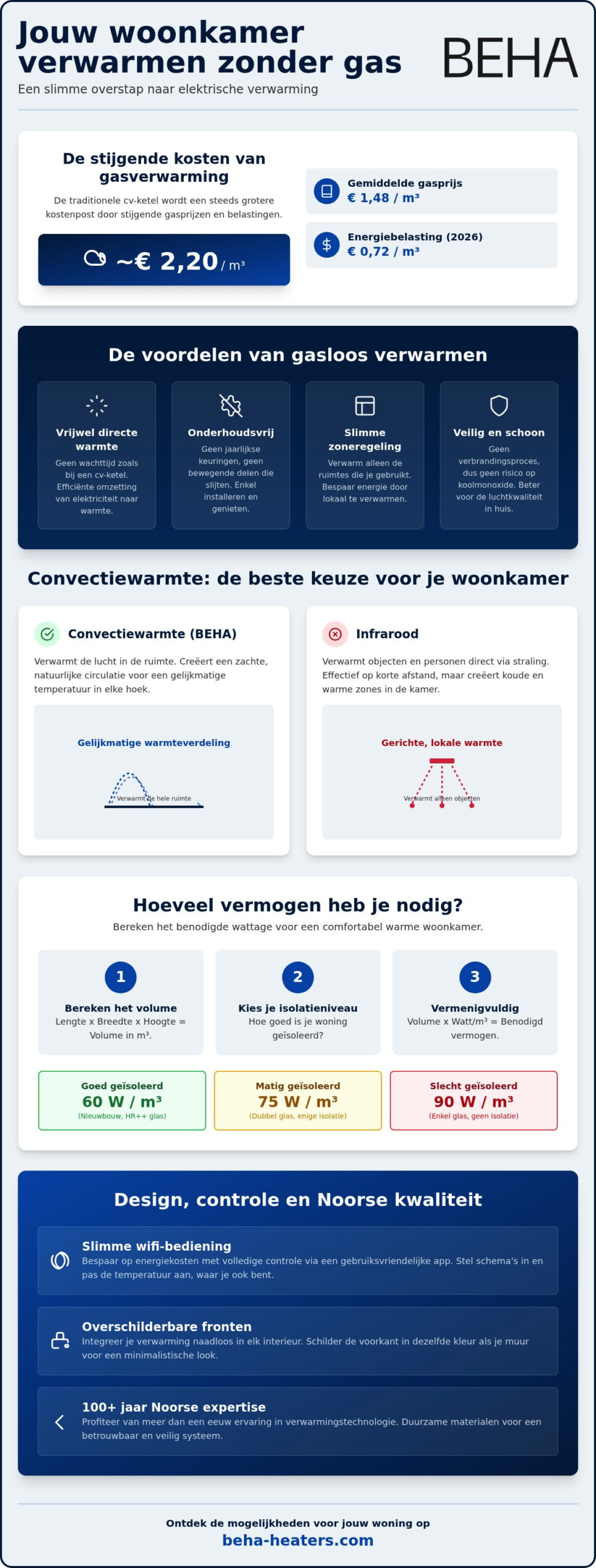
A convector heats air that circulates around the room by natural flow. This is suitable for a living room where multiple people move around and the entire space needs to be comfortable. Infrared heat primarily radiates towards what is within reach. This can be advantageous when you only want to heat the sofa or dining area, but a panel behind furniture or out of sight provides less immediate comfort.
Neither technique bypasses the basic bill: a 1500W resistance element uses a maximum of approximately 1.5 kWh per hour as long as the element is switched on continuously. Zone heating can, however, save total energy because a smaller area is heated for a shorter period. Research into local electric heating shows that the outcome depends heavily on how and where heating is deployed.
Electric radiator or convector?
Names are often mixed up in online shops. Therefore, look at the actual construction: does the unit have a fan, liquid buffer, open convection grilles, or a radiant front? Next, compare thermostat accuracy, surface temperature, warm-up time, weight, mounting, and noise. An expensive designer radiator with the same power consumption does not automatically produce more heat; you may be paying for materials, controls, finish, and lifespan.
Design and smart control: what delivers real benefits?
A living room stove is visible every day. Steel looks calm and robust, glass provides a sleek finish, and a suitable paintable front can visually blend into the wall. Never let design take precedence over free airflow, safe distances, or access to controls and sensors. Only paint any part that the manufacturer designates as paintable for that exact model.
Thermostat and weekly program
An electronic thermostat prevents the element from continuing to heat after the set temperature has been reached. A weekly program lowers the temperature when the living room is empty. Do not just look at the number of functions, but also at the setting range, measured temperature accuracy, calibration, frost protection, and behavior after a power outage.
Wi-Fi and app control
Wi-Fi does not make electric living room heating physically more efficient. The advantage arises when you remotely turn down a forgotten heater, use presence schedules, or control rooms separately. Check whether local control continues to work without internet, how long the app is supported, what data is processed, and whether multiple users can access it.
Ecodesign and product information
Local electric space heaters in the European Union are subject to Ecodesign requirements. These relate to efficiency, control, and product information, among other things. The European Commission publishes the current rules for local space heaters. An Ecodesign listing is useful, but it does not replace a heat loss calculation or an assessment of your specific usage situation.
How much power is needed for the living room electric heater?
Measure the length, width, and ceiling height, and then note the exterior walls, windows, insulation, ventilation, and adjacent unheated spaces. A living room with sliding doors and an open staircase loses more heat than an intermediate apartment of the same surface area. A professional heat loss calculation remains the best basis for primary heating.
Indicative asset matrix
For an initial orientation, a range of approximately 25 to 50 W per m³ is often used, from very well to moderately insulated. This is intentionally not a fixed standard. The table assumes a ceiling height of 2.5 meters.
| Living room | Contents | Indication of very well insulated, 25W/m³ | Average indication, 35W/m³ | Indication moderate, 50W/m³ |
|---|---|---|---|---|
| 20m² | 50m³ | 1250W | 1750W | 2500W |
| 30m² | 75m³ | 1875W | 2625W | 3750W |
| 40m² | 100 m³ | 2500W | 3500W | 5000W |
Do not blindly add ten percent for every window; the type of glass and surface area are the determining factors. In the case of an open kitchen, mezzanine, or stairwell, the combined volume must also be taken into account. If the calculation exceeds the capacity of a single suitable appliance, spreading the load across two heat sources can improve comfort, but the total electrical load remains equivalent.
Calculate consumption and hourly costs
The formula is simple: power in kW × actual duty cycle × your electricity price per kWh. A 2000W radiator uses 2 kWh for one hour of continuous heating. If the thermostat switches the element on for half the time during that hour, the consumption is approximately 1 kWh. The actual cycle varies with outside temperature, insulation, setting, and heat from the sun, people, and equipment.
| Total power | Consumption at 1 hour continuous | Current at 230V | Cost formula |
|---|---|---|---|
| 1000W | 1.0 kWh | approximately 4.3A | 1.0 × your kWh price |
| 1500W | 1.5 kWh | approximately 6.5A | 1.5 times your kWh price |
| 2000W | 2.0 kWh | approximately 8.7A | 2.0 × your kWh price |
| 3000W total | 3.0 kWh | approximately 13.0A | 3.0 × your kWh price |
Use your own current rate; average Belgian and Dutch prices change and vary by contract. Also include other appliances on the same circuit. A kettle, oven, or dishwasher simultaneously with multiple radiators can significantly increase the circuit load. If you have multiple fixed appliances, have an electrician assess whether the distribution, wiring, and protection are appropriate.
Solar panels and dynamic rates
Solar panels can supply a portion of electricity consumption, but the greatest demand for heat often occurs during dark winter moments. Therefore, “heating with solar panels” does not automatically mean that all the electricity used is generated simultaneously on-site. With a dynamic tariff, you can sometimes shift to cheaper hours, but comfort, heat loss, and contract terms determine the result.
Electric living room heater: the best placement
Proper installation prevents cold zones and unnecessarily high settings. Install only where permitted by the manufacturer and observe minimum distances to the floor, windowsill, furniture, and curtains.
Under a window or against a cold exterior wall
A convector under a window can capture descending cold air and convert it into a rising stream of warm air. This is particularly useful with large glass surfaces. However, check whether curtains, a wide windowsill, or a sofa block the air circulation. With very well-insulating glass, another central position may also be suitable.
Open living room with kitchen
Calculate the total open volume and take into account the extraction, exterior door, and stairwell. One large radiator at the far end can result in an uneven temperature. Two properly regulated convectors in cold zones can distribute the heat more evenly. Together, however, they must fit within the available electrical capacity.
Infrared by the seating area
Mount an infrared panel with a clear line of sight to the location where heat is needed. A panel behind the sofa or high above an unused walking area provides less targeted benefit. Have ceiling or fixed wall mounting carried out in accordance with the manual and surface requirements.
Safety for children, pets, and textiles
- Never cover a heater and do not use it to dry laundry directly.
- Keep furniture, curtains, toys, and pet baskets outside the prescribed clearance.
- Check surface temperature and select a child lock where relevant.
- Connect a powerful device as prescribed by the manual, preferably directly to a suitable grounded outlet.
- Do not use an unsuitable power strip, damaged cable, or coiled extension cord.
- Ensure the smoke detectors are working and stop if there is discoloration, heat, or damage to the plug and socket.
Electric living room heating: 8 ways to limit consumption
Electric living room heating does not become more efficient simply by using a different brand name at the same wattage. The greatest savings come from reduced heat loss, a lower target temperature, smaller heated zones, and fewer operating hours. Therefore, start with measures that will also yield benefits with a future heat pump.
- Seal visible gaps: check windows, exterior door, and connections, but do not block necessary ventilation openings.
- Close interior doors: prevent warm air from unintentionally flowing into the hallway, stairs, or unused rooms.
- Heat based on presence: have a program start shortly before use instead of maintaining the same temperature all day.
- Lower the setting: every degree less reduces the temperature difference with the outside and thus the heat loss.
- Keep the airway clear: a sofa, curtain, or windowsill in front of the convector obstructs heat distribution.
- Use the sun: open curtains on the sunny side during the day and close them after sunset without covering the heater.
- Measure instead of guessing: use an energy meter and compare consumption at different settings over similar cold days.
- Insulate before scaling up: if the appliance is running continuously but not reaching the temperature, investigate heat loss first before adding extra wattage.
Practical example: 30m² living room
Suppose the living space is 30 m² and 2.5 meters high. Using a rough mean of 35 W per m³, you arrive at approximately 2625 W. This is not automatic purchasing advice: a well-insulated apartment can require less, while a corner house with an open staircase requires considerably more. Two convectors of, for example, 1250 W and 1500 W can distribute the heat across two cold facades, but together they consume a maximum of 2750 W when both elements are switched on.
If you primarily use one corner of the sofa for two hours, targeted radiant heat with a lower total output may be more comfortable than heating the entire volume. However, if the entire living room is occupied daily from morning to evening, the number of usage hours becomes high, and a heat pump warrants a cost comparison. Thus, the same living room leads to a different choice depending on occupancy and comfort zone.
Electric living room heater with BEHA: when is it suitable?
A BEHAwall convector is particularly suitable when you are looking for quiet, even heating and room-by-room control. For just one fixed seating area, infrared might be more logical; for a large living room that is heated for long periods every day, a heat pump comparison is worth considering. Choosing transparently prevents a convector from being sold as a universal solution.
Norwegian experience and calm wall models
Compare the available wattage, dimensions, thermostat, app functions, mounting method, cord or fixed connection, surface temperature, and warranty conditions for each model. View the current range of electric heating from BEHA and match the technical data sheet to your living room's heating needs.
Interior and multiple zones
A clean front and wall mounting save floor space. In an elongated or L-shaped living room, more than one smaller appliance can provide a more even result than a single source. Preferably use cooperating controls so that appliances do not unnecessarily interfere with each other. You can compare the available versions for Belgium and the Netherlands via BEHA Benelux
Electric living room heating: buying checklist in 10 steps
- Determine the goal: local heat, supplementary heating, or daily primary heating.
- Measure the full volume: include open kitchen, stairs, or mezzanine.
- Inventory heat loss: insulation, glass, exterior walls, floor, ceiling, and ventilation.
- Choose the heating principle: convection for room air, infrared for a fixed zone, or heat pump for many hours.
- Calculate power: use the table only as a guide and have the main heating calculated exactly.
- Create a placement plan: cold zones, airflow, curtains, furniture, and electrical outlets.
- Check the circuit: total wattage, cables, grounding, and concurrent equipment.
- Compare control: thermostat, weekly program, app, open-window detection, and fault behavior.
- Calculate annual costs: estimated operating hours × kW × own kWh price.
- Read terms and conditions: installation guide, warranty, app support, service, and returns.
Electric living room heating: conclusion and advice
Electric living room heating can be a flexible and comfortable choice when power, placement, and controls suit the space. For quiet, even heating, a convector scores highly. Infrared is interesting for a single seating area, and a heat pump deserves consideration when the entire living room needs to be heated for extended periods daily.
Calculate costs using your own electricity tariff, do not expect solar panels to immediately cover every winter kWh, and have multiple heavy appliances electrically assessed. Do you want to compare a fixed wall convector with a clean design and smart control? Then view the range of electric living room heating from BEHA and make your choice only after checking heat loss and the product manual.
Frequently asked questions about electric living room heating
How many watts do I need for a 30m² living room?
At a height of 2.5 meters, that is 75 m³. A rough range of 25–50 W per m³ gives approximately 1,875–3,750 W, depending on insulation and conditions. Large windows, exterior walls, an open staircase, and the desired temperature can alter the result. Have a heat loss calculation performed for primary heating.
How much does electric living room heating cost per hour?
Multiply the total power in kW by the actual duty cycle and your kWh price. A total of 3000W uses 3 kWh per hour when the elements are on continuously. Thermostat cycles can lower the average, but this depends on heat loss and setting.
Is an electric radiator more energy-efficient than a convector?
Not automatically. Both consume approximately the stated electrical power when the element is on for direct resistance heating. Differences in control, heat distribution, warm-up time, and usage can affect actual consumption. Therefore, do not compare solely by product name.
Can electric heating serve as primary heating?
Technically, this is possible if the capacity and installation are suitable, but it can consume a lot of electricity in a large or poorly insulated living room. For long-term daily use, compare a heat pump and improve the insulation first. Electric convectors are often more attractive as zone or supplementary heating.
Is a convector safe around children and pets?
Follow the product manual, clearances, and assembly instructions. Check the surface temperature, use a child lock if available, and keep toys, curtains, and pet baskets away. Overheating protection reduces the risk but does not replace correct use.
Can I install a BEHAradiator myself?
You can install a plug-and-play wall-mounted model according to the manual, provided the surface, distances, and socket are suitable. Have fixed wiring, new circuits, or any doubts regarding capacity assessed by a qualified electrician. Always check for pipes before drilling.
Does Wi-Fi control work without internet?
This depends on the model and the app. Before purchasing, check whether local control on the device remains available and which functions work without a cloud connection. The heater must remain safely controllable if Wi-Fi or the internet temporarily fails.
Can I paint over any electric radiator?
No. Only models or front panels explicitly declared suitable by the manufacturer may be finished according to their instructions. Keep grilles, sensors, and controls clear. Unapproved paint or modifications may affect heat output, safety, and warranty.