
Electric supplementary heating for the study: how to choose wisely

A more powerful heater is not automatically the smartest choice for your study. If you only sit there during working hours, you primarily want warmth at the right moment, without a loud appliance disturbing your concentration. The right electric supplementary heating for the study therefore depends not only on the power output, but also on the insulation, the location where you work, and how long you use the room.
A cold workplace is annoying, while you don't have to heat the entire house extra. At the same time, comparing is difficult: what power output suits your needs, how important is a thermostat, and do you want to be able to set the heating in advance? A good choice gives you control over the temperature and aligns with your daily routine.
In this article, you will learn how to choose a type of heating that suits the size and insulation of your study, and what to look for regarding controls and heating schedules. If you are looking for steady, adjustable heat, a smart convector can be a practical option. BEHA 's smart convectors can be controlled via Wi-Fi and an app, allowing you to adjust the temperature to suit your working hours.
Key Points
- First determine whether you need extra heat at fixed times or work in the study almost daily.
- Compare convectors and fan heaters based on heat output, noise, and placement to choose a type that suits your work situation.
- Choose electric supplementary heating for the study based on the room, usage, and desired control options, not just on power.
- Before choosing, check the product specifications and manual to ensure that the features and placement suit your situation.
- Discover how smart convectors with steel, glass, or paintable fronts meet the need for steady, adjustable heat.
Why electric supplementary heating can add comfort in the study
You sit at your desk in the morning, but the room remains chilly while the rest of the house is comfortable. Or you only use the study for part of the day, meaning heating at fixed times doesn't always feel logical. In such situations, electric supplementary heating for the study provide targeted heat when you need it, without having to immediately adjust the main heating for the entire house.
Supplemental heating is additional heat for a single room or moment of use. It therefore does not automatically replace the main heating system, which remains responsible for the basic heat in the home. Moreover, how comfortable your workspace becomes depends not only on the device. The dimensions and layout of the room, the existing heating, and your daily routine all play a role. Different electric systems emit heat in different ways. A neutral explanation of types of electric heating helps to put these differences in context.
Targeted supplementary heating is particularly useful when you want to make a specific room more comfortable at recognizable times of use, while the main heating provides the basic warmth. Therefore, start with your study and work rhythm, not with a single appliance.
What is your study's heating requirement?
Look at the floor area as well as the ceiling height. Together, these provide a better picture of the space that needs to be heated. Also take the insulation and existing main heating into account. Drafts along a window, cold exterior walls, or little sunlight can cause the room to feel colder than you would expect based on the dimensions.
Note where you notice the cold most and whether the heat needs to be distributed evenly throughout the room. Use this information to compare product specifications and the manufacturer's recommendation. A universal power recommendation is not reliable for every study room. Suitability depends on the room as well as the characteristics of the chosen device.
When do you want to heat the room?
If you work in the study for hours at a time almost every day, a fixed solution with adjustable heating might suit your recurring usage. If you only use the room occasionally for a short study session, a different control system or setup might be more practical. Consider in advance how quickly you want heat and whether you want to switch the heating on manually every time.
A predictable schedule makes it easier to determine which control suits you. Also ask yourself whether you want the entire room to be comfortable, or mainly the spot where you sit. This influences the type of heating and the placement you compare further on. This way, you avoid choosing a solution that does more than your usage requires.
Which electric heater is suitable for working or studying?
For a study where you work regularly, a fixed convector can be a quiet, permanent solution. A fan heater is typically portable and can quickly make heat felt by actively moving air. You notice this difference during concentrated work: a fan can make noise and move air, whereas a convector does not require a fan for heat output. However, operation and noise levels vary by unit, so always check the product specifications.
Convector or fan heater for your workplace?
A convector heats the air in the room and may be suitable if you are looking for a more even heat distribution. How quickly and evenly a room heats up depends on the unit and the room. A fan heater blows out warm air. This can be pleasant if you want to move the heater or use it in a specific spot, but the noise can be disruptive during a quiet workday. Therefore, check the stated noise level and read the manual for instructions on placement and use.
Use this comparison as a starting point. The final suitability depends on the characteristics of the room and the specifications of the chosen device.
| Type | Appropriate use | Point of attention | What do you check? |
|---|---|---|---|
| Convector | Regular use in a fixed location | Heat distribution and heating behavior vary by appliance | Power, thermostat, dimensions and installation advice |
| Fan heater | Portable heat or use at varying locations | The fan can make noise and move air | Sound level, settings, safety information and manual |
What role do the thermostat and Wi-Fi control play?
A thermostat regulates the temperature around the set value. This is different from programming: with a program, you set, for example, when the heating should turn on or off. Remote control via Wi-Fi and an app can make it easier to tailor settings to your workday. Smart features do not in themselves guarantee lower energy consumption. That depends, among other things, on how you set and use the heating.
If you are looking for constant, adjustable heat, compare an electric convector with Wi-Fi with other solutions. Check which features are included with the specific device. BEHA offers smart convectors with steel, glass, or paintable fronts. The BEHAconvectors for constant heat can serve as a starting point to determine which model suits your study.
What do you compare electric supplementary heating for the study against?
A higher output might seem like a simple solution for a cold workplace, but it does not in itself indicate whether a heater is suitable. A well-insulated room with existing heat requires something different than a high-ceilinged room with drafts along the windows. Therefore, first compare the heat demand, controllability, operation, placement, and noise. Then, assess the output in relation to the room and the product specifications.
Power alone does not indicate whether a heater operates comfortably. The room, the heat distribution, and the options for regulating the unit are at least as decisive.
How do you assess wealth without gambling?
Assess the situation before comparing models. Note the floor area and ceiling height, and consider insulation, drafts, and the existing heat source. A room with cold exterior walls can feel different from a comparable space that maintains a comfortable temperature. Do not use a fixed watt-per-square-meter rule as universal advice. Instead, check the manufacturer's recommendation for the intended space and the application area of the specific appliance.
Also pay attention to exactly what the product specifications indicate: for which room is the device intended, what controls does it have, and what placement does the manufacturer prescribe? This way, you are not comparing the power output independently of the circumstances in which you intend to use the heating.
Which practical qualities do you notice while working?
Operation makes a difference in daily use. Check per model whether you can only set a temperature, use a timer or program, or if the device can be controlled via Wi-Fi. A thermostat helps regulate the set temperature. A timer or program allows you to tailor usage to your schedule. Consider such features as convenience and control, not as a guarantee of lower energy consumption.
Additionally, consider where the device can be placed or hung. Wall mounting can keep floor space free, whereas a floor-standing model requires a suitable spot and a safe cable route. Always follow the manufacturer's instructions. Also include maintenance in your comparison: the manual states how to clean the device and which safety instructions apply. These are practical points you notice every day, not just details for after purchase.
| Point of comparison | Ask before purchasing |
|---|---|
| Heat demand | Does the room retain heat, and is there already a heat source? |
| Assets | Does the specified application area suit my room according to the manufacturer? |
| Control and operation | Which thermostat, timer, program, or Wi-Fi functions does this model have? |
| Placement | Is wall mounting or floor placement suitable, and where does the cord run? |
| Use and maintenance | What does the manual say about noise, cleaning, and safe use? |
By comparing these points, you choose electric supplementary heating for the study based on your space and working habits, rather than just on a number on the label.
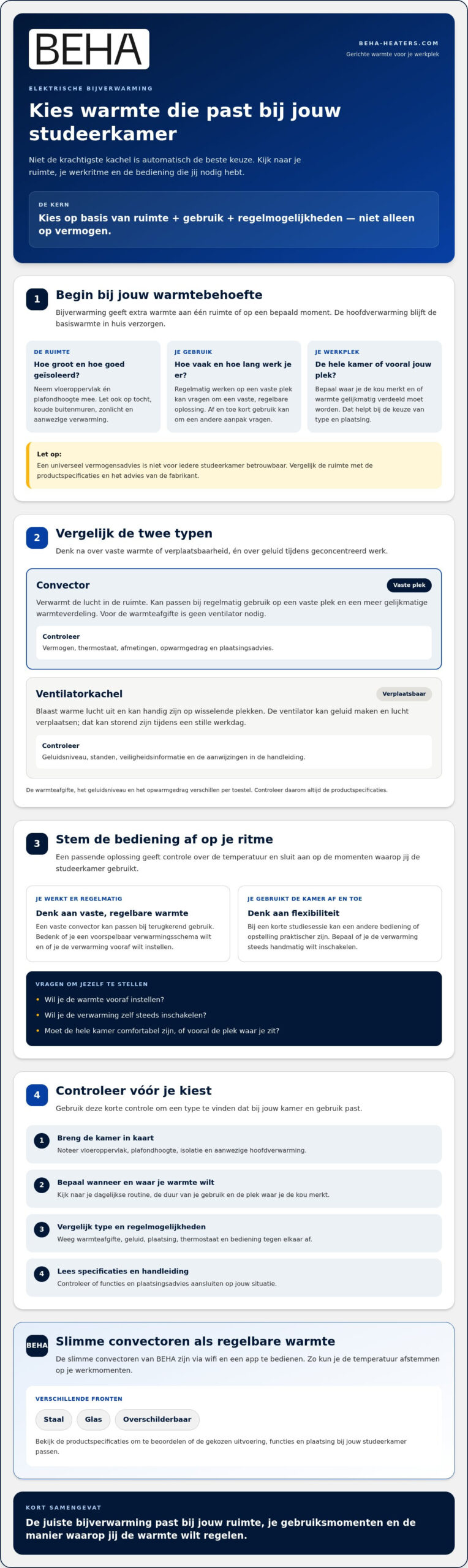
This is how you choose the right supplementary heating step by step
Choose suitable electric supplementary heating for the study by assessing your situation step by step. First, determine whether you need additional heat occasionally or heat the room almost daily. That difference helps determine which solution and controls suit your usage.
- Map out the space. Note the floor area and ceiling height. Also consider insulation, drafts, windows, and the heat provided by the existing heating system.
- Determine when you use the room. Do you work according to a fixed weekly schedule or do you study irregularly? Write down how long you usually use the room and when you prefer to have warmth.
- Choose a heating type. As a rule of thumb, you can consider a stationary convector for recurring work periods and a fan heater if portability is important. Operation varies by unit, so check the product specifications before choosing.
- Compare the controls. Check whether the device has a thermostat, timer, program, or Wi-Fi control. Programmable control can be convenient for fixed working hours. For varying times, what matters most is how easily you can adjust the heating.
- Check the placement and manual. Review the dimensions, connection method, and assembly instructions. Also check the required distance to furniture and follow the manufacturer's safety and maintenance instructions.
Which solution fits your work rhythm?
For recurring work hours, it can be helpful to assess whether a timer or program fits your schedule. If you only use the study occasionally, ask yourself if you want to be able to move the device easily. Silence can also be a major factor if you make a lot of calls or read with concentration. Ease of use and comfort during your workday can ultimately be more important than a single specification.
What do you check before purchase and installation?
Measure the location where the heater will be installed and consider the cable routing. A wall-mounted model and a floor-standing unit require a different setup. Always follow the product-specific instructions, as mounting and spacing requirements may vary by unit. A buying guide for an electric heater with a steel front can help compare different versions and practical considerations.
If you are looking for a fixed solution, also take a look at the smart convectors from BEHA. The range includes versions with a steel, glass, or paintable front. Check which features and controls apply to each version.
BEHAconvectors as adjustable heat for your study
Are you looking for a fixed heat source that you can tailor to the use of your workspace? A convector can be suitable for a study where you sit regularly and want to regulate the temperature precisely. BEHA manufactures electric heating products and was founded in 1917. The range includes smart convectors with a steel, glass, or paintable front. Which version is suitable depends on the room and the characteristics of the specific unit.
When would a smart convector be a good fit for your study?
A smart convector is worth considering if you are looking for consistent, adjustable heat and want to use the heating in a fixed location. BEHA 's smart convectors can be controlled via Wi-Fi and an app. Always check the current product information, as features may vary by product. Also, check if the room advice suits your study and verify the controls and installation details before making a choice.
Consider, for example, a room you use on fixed workdays. Wi-Fi control can then be practical for aligning settings with your working times. If you use the room irregularly, weigh up whether control via an app truly offers you an advantage. Smart control does not replace comparing heat demand, placement, and product suitability.
How do you explore BEHArange?
Start with the features that are important to you. A steel, glass, or paintable front offers a choice in appearance, but does not automatically determine whether a device is technically suitable for the room. Therefore, compare the product specifications with the dimensions and use of your study. Also consult the manual for information on installation, operation, and use.
If you want to know more about Wi-Fi control, read the guide on electric convectors with Wi-Fi and check which features apply to the device you are considering. This way, you base your choice on product information, not on assumptions about a product category.
BEHA states that the products meet the ECODESIGN requirements. Consider this as additional product information, alongside the points that are decisive for your work situation: the advice for the room, the desired operation, and the installation instructions. A fixed convector can be a suitable option, but only if the specifications match the room and your usage.
Compare the options with your own situation. 's electric heating solutions BEHA and consult the product information and manual for each convector before making a decision.
Choose heating that suits your workday
The best choice starts with the study room itself. Take into account the space, insulation, and existing heating, but also how often and for how long you work there. A regular usage pattern may require different operation than a short, irregular study session. Therefore, compare convectors and fan heaters not only on power output, but also on controllability, noise, placement, and the manufacturer's instructions.
This is how you choose electric supplementary heating for the study that suits your heating needs, rather than a solution that only seems powerful on paper. Before deciding, check the product specifications and manual to ensure that features and placement match your situation.
BEHA manufactures electric heating products and has over 100 years of experience. The range includes smart convectors with steel, glass, and paintable fronts. BEHA focuses on consumers and professionals in the Netherlands. Compare the models and check the applicable controls and specifications for each product. 's electric heating solutions BEHA and discover which options suit your workspace. With a well-considered choice, you make the study room a more pleasant place to work or study.
Frequently Asked Questions
Is electric supplementary heating suitable for a study?
Yes, electric supplementary heating can be pleasant if you only want to provide extra warmth to the study during use. Whether it is suitable depends on the insulation, the dimensions, and the existing heating, among other things. First, determine whether you use the room occasionally or almost daily. Then, check whether the chosen device is suitable for the space and your intended use according to the manufacturer.
Which type of electric heater is suitable for a study?
A convector heater might be suitable if you are looking for a fixed heater for regular use and want to distribute heat throughout the room. A fan heater is portable and blows out warm air, but the noise can be noticeable during concentrated work. Therefore, consider how often you use the room, whether silence is important, and whether you are willing to move the unit. Check the operation and specifications for each model.
How much power does an electric heater need for my study?
You cannot reliably determine this based solely on floor area. Ceiling height, insulation, drafts, windows, and the existing heat source also influence the heat requirement. Therefore, do not use a general watt-per-square-meter rule as definitive advice. Compare the capacity with the manufacturer's room recommendation and check the intended application area of the specific appliance. This will prevent you from choosing a device that does not suit the room.
Is a convector quieter than a fan heater?
A convector does not require a fan to actively circulate warm air and can therefore be quieter than a fan heater. This does not mean that every model is completely silent: noise levels and operation vary by unit. If you want low noise levels while operating, check the product specifications and user reviews. Also, read the manual for information on normal use and placement.
Can I program an electric heater for my study?
That depends on the device. Some models have a timer or program, while others offer only manual control or a thermostat. BEHA smart convectors can be controlled via Wi-Fi and an app, but check per product which functions are actually available. A program can be useful if you work at fixed times. Adjust the settings to your usage and read the product information carefully.
Does electric supplementary heating consume a lot of power?
Consumption depends on the power output, the duration of use, and how you set the heating. A 1000-watt unit operating at full power for an hour consumes 1 kilowatt-hour. At 2000 watts, that is 2 kilowatt-hours in that same hour. This is a calculation example, not a fixed consumption figure: a thermostat can switch the unit between on and off. Limit unnecessary usage hours and adjust the heating to your working hours.
Where should I place an electric heater in the study?
Place the heater in a location suitable for the unit and the heat requirement, without blocking the airflow or controls. Take into account furniture, curtains, walking routes, and the connection. Safe distances and any installation instructions may vary by model. Therefore, always follow the manual and place the unit as prescribed by the manufacturer. This keeps the workspace practical and ensures you use the heater according to the product-specific instructions.