
Energy-efficient convectors for project construction and comfortable heating

An electric convector heats a room by warming up cold air and allowing the warm air to rise. With energy-efficient convectors for commercial construction, cold air is heated and the warm air subsequently rises, so that the heat spreads throughout the room.
When it comes to energy-efficient convectors for commercial construction, it is not just how quickly a room heats up that matters. Controls, standalone operation, and ease of installation also play a role in comfort and practical use. Read how thermostats help fine-tune the heating, when convectors operate without central heating, and what a simple electrical connection entails. This will give you insight into how electric convectors fit into various commercial spaces and which features are important when making your choice.
Key points
- Match the required heating capacity to the room and how it is used, so that the heat aligns with daily use.
- View electric convectors as standalone heating for rooms where central heating is not necessary or desired.
- Use thermostats and programmable settings to adjust the heating to occupancy and desired comfort levels.
- Take plug-and-play into account during project planning: electric convectors can be installed without central heating pipes.
Does an electric convector heat my room quickly?
An electric convector heats air directly and distributes it throughout the room. How quickly the temperature rises depends on the power output, the room, and the controls, among other factors.
Natural convection and heat distribution
With natural convection, a convector draws in cold air, heats it in a heat exchanger, and allows the warm air to rise. Cooled air is then drawn in again. Heat is distributed primarily via the airflow, although radiant heat also plays a role. Therefore, when making your choice, consider not only the desired temperature but also the location of the unit and air circulation. Free space around the convector helps move the warm air through the room.
Comparing low-temperature convectors with traditional convectors
A traditional convector for water heating works with water flowing through a heat exchanger. A low-H2O convector contains less water and uses a copper and aluminium heat exchanger to quickly release heat into the room. This is different from an electric convector, which converts electricity into heat without water circulation. According to the Municipality of Zaanstad, special convectors can provide sufficient heat using low-temperature water. According to the product information, with low-H2O systems, the temperature can rise or fall by 6 to 8 degrees in 10 minutes.
Green energy and solar panels can power electric heating, but do not change the heat output principle. According to the Municipality of Zaanstad, special convectors can provide sufficient heat using low-temperature water.
According to the product information, a double heat exchanger can combine high output with compact dimensions. Therefore, when selecting a project, compare the available space with the required heat output.
For new construction, BENG is assessed at the level of the building's energy performance. Therefore, include the convector in the overall design, together with the building envelope, heat source, and control system.
Electric convectors have no internal heat circulation and therefore require no maintenance. Review the product terms and conditions for information regarding risks and warranty, and take the electrical connection into account during installation.
Project prices for convectors are offered by manufacturers and wholesalers providing project delivery. Specify quantities, capacity, and desired control system so that offers are based on the same project parameters.
Electric convectors and independence from central heating
An electric convector heats a room without a connection to central heating. For project construction, the choice revolves around the heat demand, space usage, and the desired control per room.
Electricity consumption and heating costs
Consumption depends on the output and how long the device emits heat. A 2 kW electric convector consumes 2 kWh per hour at full power. A thermostat can adjust the heating to the set temperature; actual consumption depends on how often heat is needed.
Choosing the right convector for project construction
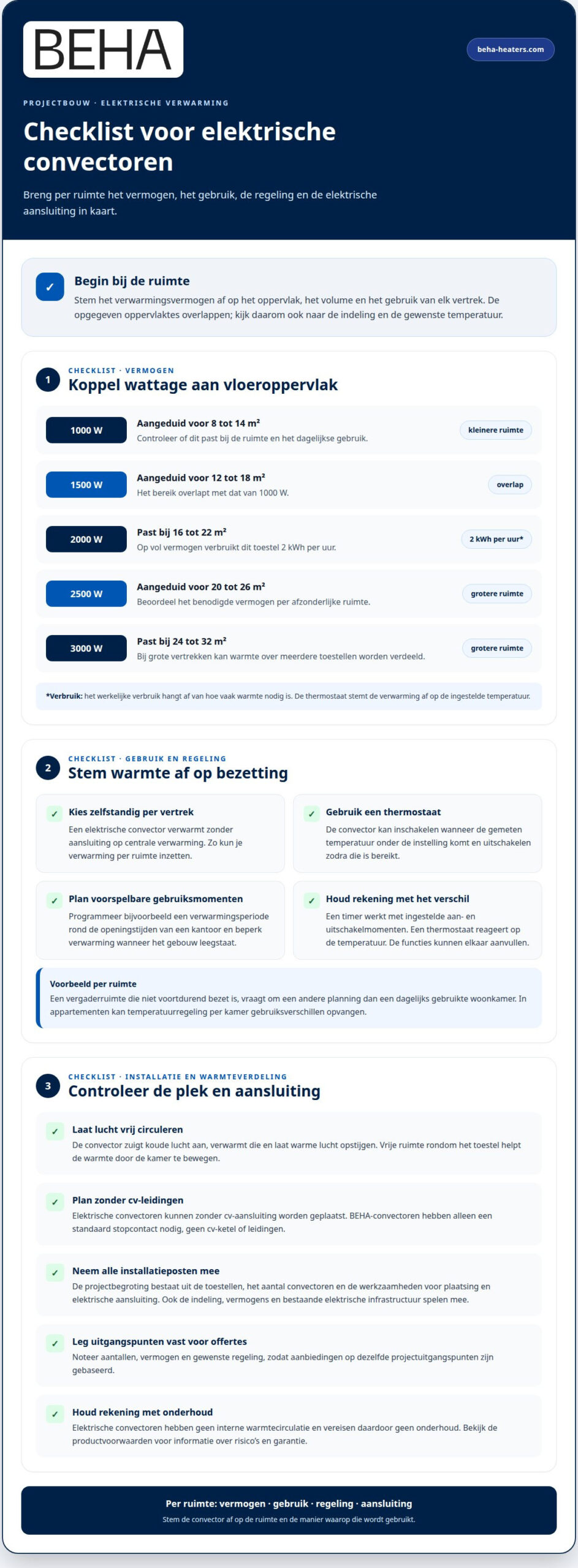
For energy-efficient convectors for commercial construction, start with the surface area and volume of each room. A 1000-watt convector is suitable for 8 to 14 m²; for 1500 watts, it is for 12 to 18 m². A 2000-watt unit is suitable for 16 to 22 m². These ranges overlap, so also consider the room layout and desired temperature. Electric convectors can be used independently; electric radiators are another electric heating option.
Heating of large spaces and residential complexes
For offices, large spaces, and apartment complexes, assess the required capacity for each individual room. A 2,500-watt convector is recommended for 20 to 26 m², while 3,000 watts is suitable for 24 to 32 m². In larger rooms, it can be practical to distribute the heat across multiple units. This allows you to tailor the heating to different usage zones, rather than using a single central setting for the entire building.
Costs include installation
The project budget consists of the units, the number of convectors, and the work for installation and electrical connection. The layout, required capacities, and existing electrical infrastructure also determine the scope of this work. Include all items together: the product selection alone does not provide a complete picture of the costs including installation. BEHAconvectors only require a standard power outlet, not a central heating boiler or piping.
Thermostats and programmable settings
A thermostat regulates heat output based on the set temperature. In project construction, a well-thought-out control scheme helps to tailor comfort to the use of each room. A meeting room that is not constantly occupied, for example, requires a different schedule than a living room that is used daily.
Start with the function of the room and then determine the desired temperature control. A thermostat can switch on the convector when the measured temperature drops below the setting, and switch it off as soon as it is reached. This way, the unit does not heat continuously at full power. The airflow distributes the heat, while the control prevents the temperature from continuing to rise unnecessarily.
Programmable functions are particularly useful when usage times are predictable. For example, set a heating period around an office's opening hours and limit heating when the building is vacant. In apartments, individual room-by-room temperature control can help accommodate differences in usage and preference. Choose models that match the desired operation and the electrical installation.
A timer works with set on and off times; a thermostat responds to the temperature. These functions can complement each other, but operation differs by model. Therefore, when choosing a product, check what options the device offers, such as control on the unit or via an app. This makes agreements regarding management and daily use concrete.
Traditional radiators and electric convectors distribute heat in different ways, but both require appropriate control. In addition to the power output, pay attention to the placement of the thermostat: drafts, cold air near a window, or direct sunlight can affect the measurement. Adjust the settings per room and take the interior into account so that furniture does not block air circulation. This way, you combine comfort, usage times, and control into one practical plan.
Plug-and-play installation without central heating connection
An electric convector does not require central heating pipes, allowing you to plan the heating without a water connection. For project construction, this means less dependence on the location of existing radiators or heating pipes. However, include the units early in the design so that the position, electrical connection, and operation are clear for each room.
Develop a practical installation plan for each room. Note, for example, the windows, furniture, and available connection points. Position the convector so that warm air can flow into the room and is not directly blocked by a cupboard or curtain. Even heat distribution depends not only on the unit but also on free air circulation around the installation.
Work in a fixed sequence: first determine the room and the desired heating capacity, then choose the position and include the electrical connection in the project plan. This prevents an electric convector from being installed only after the finishing work is complete. Also, coordinate the placement with the thermostat so that it can accurately measure the room temperature.
Because no central heating pipes run to the convector and only a standard power outlet is required, this solution is suitable for new construction, renovation, or a room that needs to be heated separately. Consider, for example, an office space with its own usage times or an apartment where not every room requires heat at the same time. Energy efficiency depends partly on the electricity used and how you control the heating.
For energy-efficient convectors in project construction, a pre-developed plan provides guidance to designers and contractors. Determine the unit position, electrical connection, and controls for each room before finishing begins. This ensures that comfort and the desired heat distribution are part of the design, rather than a later adjustment. Explore the options for electric convectors when developing the heating choices for a project.
BEHA: Smart convectors steel front
BEHA offers smart convectors with a steel front for projects where independent, electrically controlled heating fits. The PV/LV series features a steel front and Wi-Fi control via the BEHA Smart app. There are also smart convectors with a glass front from the PGV/LGV series, a paintable front from the RAW series, and Classic convectors from the HCB/HCW series.
When selecting a project, incorporate the finish and operation into the design. Consider a steel front in an office space or the paintable RAW series when the heating blends visually into the interior. Compare the options based on space utilization, appearance, and control, without losing sight of the project's practical requirements.
Contact BEHA to discuss the convector options for your project.
Make the project choice concrete
Translate the building requirements into a clear heating plan. Determine for each room how it is used, which controls are appropriate, and which appearance aligns with the interior. This way, you make the choice of energy-efficient convectors for project construction part of the design, rather than a standalone product decision.
BEHA offers smart convectors with a steel front from the PV/LV series, a glass front from the PGV/LGV series, and a paintable front from the RAW series. This allows you to tailor the finish to the project while simultaneously considering the desired operation. Determine in advance which features are most important for your building and use them as a starting point for the next step.
View the options and determine which version suits your project. convectors BEHA and continue your heating choice with confidence.
Frequently Asked Questions
What makes a convector energy-efficient?
A convector uses energy purposefully when the output matches the heat demand and the control system aligns with usage. For example, set a lower temperature for a room that is temporarily vacant. The building envelope also plays a role: good insulation limits heat loss, so the unit needs to reheat less frequently. The power source used also contributes to determining how sustainable the heating is in practice.
How do I choose the right electric convector heater?
First, choose which room you want to heat and when it is used. Next, note the dimensions, insulation, and existing windows, as these factors influence the heat demand. Then, determine whether fixed wall mounting, room-by-room control, or a suitable finish is important. For an office with fluctuating occupancy, for example, a programmable control system might be more practical than manual operation.
How does a sustainable convection heater work?
An electric convector uses electricity to heat a heating element. Air passing the element heats up and spreads throughout the room; cooler air flows back towards the unit. The convector itself does not make the electricity sustainable. The environmental impact depends partly on the electricity source and on how much heat the building loses during use.
How much power do I need?
The required power is determined by the heat a room loses, not just from the floor area. Therefore, consider ceiling height, insulation, window area, and the desired temperature. A well-insulated room with few exterior walls typically requires a different approach than a drafty corner room. Determine the heat demand per room and match the appliance capacity accordingly.
What is the efficiency of convectors when used with a heat pump?
An electric convector is not a water-based heat distribution system for a heat pump. For a heat pump, you choose convectors that can release heat at the low water temperature of the system. The result depends on the heat output of those convectors and the building's heat demand. Therefore, assess the combination as a single heating system, with the heat source and distribution together.
How much power per m² is required for convectors in new construction and renovation?
There is no fixed capacity per square meter that suits every new build or renovation space. The required heat depends on insulation, glass surface area, ceiling height, and exposure to outside air. Consequently, a renovation with improved insulation may require a different calculation than the same room before the intervention. Calculate the heat demand per room and use this as the basis for the appliance selection.