
Energy-efficient electric heating for an evenly warm chalet
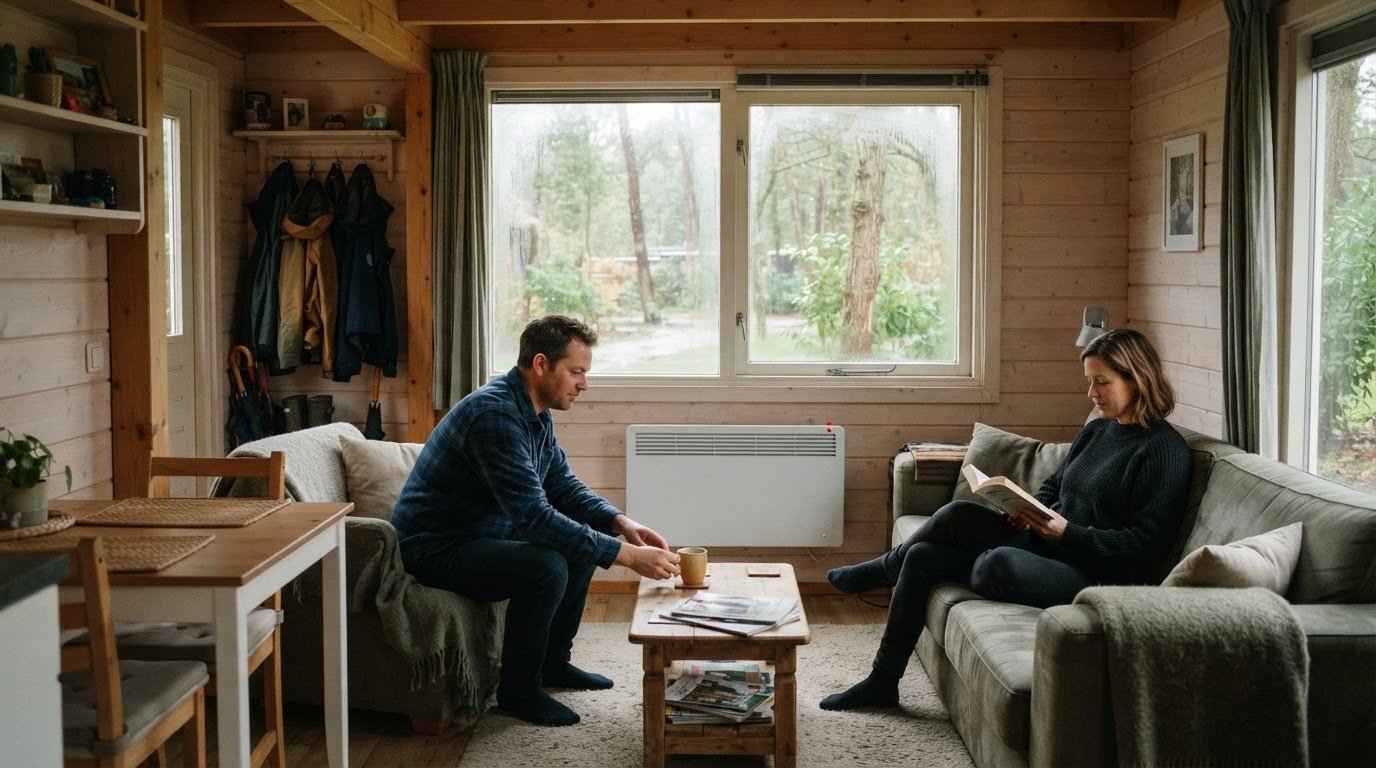
For an evenly heated chalet, an electric convector is often a practical choice, as long as the power output matches the space and insulation. An energy-efficient electric heater for a chalet heats comfortably and helps limit unnecessary power consumption if you set the heat settings and thermostat correctly.
You want quick comfort, without one side of the chalet being warm and the other remaining cold. The right solution therefore depends on the size of the chalet, how well it retains heat, and when you use the heating.
In this article, you will read how convector heating works and how it compares to other forms of electric heating. You will discover how to estimate the required power, what to look out for regarding power consumption, and how a thermostat adjusts the temperature to suit your stay. This way, you choose heating that suits your chalet and usage, instead of simply opting for the highest power output.
Key points
- Choose a heating type that suits the layout of your chalet and the way you want to experience warmth.
- Match the power to the room and take into account the available electrical connection.
- With adjustable heat settings and a programmable thermostat, you can better tailor the heating to your stay.
- Discover which convectors match your preferences for operation, heat, and appearance.
Convector heating and air circulation
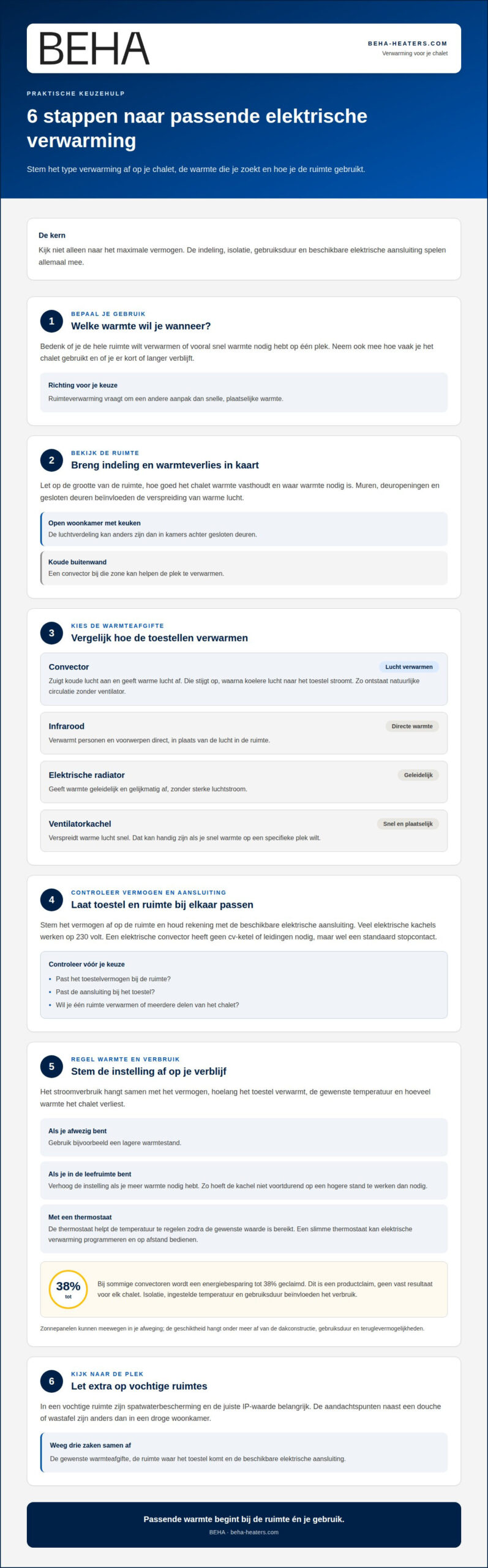
A convector heats a chalet through natural airflow. Compare this operation with infrared and fan heating to determine which level of comfort suits your needs.
Heat via convection
A convector draws in cold air and releases it as warm air. The warm air rises, after which cooler air flows into the unit. This creates natural circulation without a fan. In a chalet, this operation is suitable if you want to heat the entire room, not just a single spot.
When making your choice, consider the room where the unit will be installed and the desired heat distribution. For example, a convector against a cold exterior wall can help heat that zone. Electric convectors do not require a central heating boiler or pipes, only a standard power outlet. However, do check whether the unit's power output matches the room and the available connection.
Circulation of warm air
Airflow distributes heat throughout the room, but the layout of the chalet also plays a role. An open living room with a kitchen, for example, has a different air distribution than rooms behind closed doors. Take into account walls, doorways, and where you usually sit. A convector heats the air, while infrared heats people and objects directly.
If you want quick heat in a specific spot, a fan heater distributes warm air rapidly. This can be useful, for example, to quickly warm up a caravan. A convector is more focused on natural circulation. Choose based on your usage: quick local heat or heating of the room.
Other types of electric heating
Electric heating systems differ primarily in the way they emit heat. Infrared heats people and objects directly, while a convector heats the air. Electric radiators emit heat gradually and evenly, without a strong airflow. This contributes to a gentle heat output.
You can quickly switch on electric heating when you arrive at the chalet. Many electric heaters operate on 230 volts. Therefore, compare not only the heating method but also the power output and the connection. This way, you choose a solution that suits the space, the desired comfort, and the time you need warmth.
Electric radiators for even heat
Electric radiators emit heat gradually and evenly, without strong airflow. They are suitable for a chalet where you want a gentle heat distribution, for example during a longer stay. Moreover, electric heating works without a gas connection. This is practical if your chalet does not have a gas supply.
Electric heating has different characteristics than an air conditioner or gas heater. An air conditioner can be used together with infrared panels as supplementary heating. An electric radiator emits heat without a strong airflow. The choice between systems also depends on the available connections and total energy consumption. A gas heater requires a gas connection, whereas electric heating does not.
For an even temperature, the type of appliance is not the only important factor. Also consider the layout of the chalet and where heat is needed. A radiator in the living area can provide comfort for daily use, while a separate room has different heating requirements. Doors and walls influence how heat is distributed. Therefore, tailor the heating to the rooms you actually use.
In damp rooms, safety requires extra attention. When choosing electric heating, look for splash water protection and the correct IP rating. Therefore, do not select a device based solely on appearance or power: the room and protection against moisture also matter. Different considerations apply in a dry living room compared to next to a shower or washbasin.
Make your choice based on three factors: the desired heat output, the room where the unit will be installed, and the available electrical connection. A radiator is suitable for gradual heat without a strong airflow. For rapid heat distribution, fan heating is another electric solution. Compare the operation with your usage pattern and consider whether you want to heat a single room or multiple parts of the chalet. This way, you choose heating that suits your comfort preferences and the space.
Energy consumption, heat settings and thermostats
Power consumption depends on the wattage, operating time, and desired temperature. With heat settings and a thermostat, you can adjust the heat to suit your stay.
Insight into energy consumption
An electric heater consumes power as long as it provides heat. The actual consumption depends on how long the appliance heats and how much heat the chalet loses. Therefore, do not look solely at the maximum power output. Also take into account how often you use the chalet and what temperature you find comfortable.
For some convectors, energy savings of up to 38% are claimed. View this as a product claim, not as a guaranteed result for every chalet. Insulation, the set temperature, and the duration of use influence energy consumption. Solar panels can be part of the consideration, but their suitability depends on factors such as roof construction, duration of use, and feed-in possibilities.
Setting heat settings
With heat settings, you adjust the heat to suit the moment. For example, use a lower setting when you are away and increase it when you are in the living area. This prevents the heater from constantly operating at a higher setting than necessary. The correct setting depends on comfort, outside temperature, and heat loss.
A thermostat helps regulate the temperature as soon as the desired value is reached. Infrared panels provide direct heat to people and objects; convector heating heats the air. First, determine which heating experience suits your needs. Then, choose settings that prevent unused spaces from being heated unnecessarily.
Thermostat control
A smart thermostat can program electric heating and control it remotely. This is practical for a chalet that is not continuously occupied: you time the heating to coincide with your arrival. Adjustable thermostats and heat settings help limit unnecessary heating, without you having to manually adjust the temperature every time.
Pay attention to the available functions when setting up. A surface-mounted thermostat has a range of 5 to 30 degrees Celsius. A timer thermostat can be set to a countdown time of 1 second to 24 hours. Choose the control system that suits your schedule and desired comfort, so that the temperature matches the use of the chalet.
Calculate required power
Match the heater's capacity to the room and the electrical connection. An appliance with insufficient capacity may not heat a chalet adequately. Conversely, a more powerful model requires more electricity. The surface area, volume, and available power supply together determine the most practical choice.
Start with the dimensions of the room. Note the floor area and calculate the volume using length × width × height. Then compare these data with the guideline values for convectors. According to the product information, the following power ratings are suitable for these rooms:
- 1000 watts: 8-14 m² and 20-25 m³.
- 1500 watts: 12-18 m² and 30-45 m³.
- 2000 watts: 16-22 m² and 40-55 m³.
- 2500 watts: 20-26 m² and 50-65 m³.
- 3000 watts: 24-32 m² and 60-80 m³.
Use these values as a comparison aid. A chalet with an open living space requires a different assessment than a chalet with multiple enclosed rooms. Insulation and heat loss also play a role. Therefore, do not choose based solely on the number of square meters, but also compare the volume and the layout.
At a campsite, the power must match the allocated amperage. At 230 volts, a 1000-watt electric heater consumes 4.35 amperes according to the calculation. Also include other electrical appliances used simultaneously. This prevents the total load from exceeding the available connection and overloading the campsite fuse.
The calculation helps you compare different types of heating in a targeted way. An efficient choice starts with the space, but also takes into account the connection and usage. If you want to view convectors for your chalet, discover the possibilities for electric heating.
BEHA
BEHA offers electric convectors for chalets where you want to tailor the heating to the space and your living style. The range includes smart convectors with a steel, glass, or paintable front, in addition to Classic convectors. The smart models can be controlled via Wi-Fi and an app, allowing you to regulate the heating in a way that suits your usage.
The required power output, desired operation, and appearance of the unit play a role in your choice. Use the calculation in this guide as a starting point and compare which convector suits your chalet. This way, you match your practical heating needs to a suitable model.
Would you like to discuss your choice for electric heating? Contact BEHA.
Make your choice to suit your stay
When choosing an energy-efficient electric heater for your chalet, the next step revolves around the combination of technology and daily use. Determine when you want heat, which room has priority, and what look suits the interior. This way, you balance comfort and design.
BEHA offers smart convectors with a steel, glass, or paintable front. When making your choice, consider what is important to you regarding the appearance of the unit. A suitable design helps integrate the heating into the interior of your chalet.
Would you like to discuss your wishes regarding electric heating further? Contact BEHA and take the appropriate next step for your chalet.
Frequently Asked Questions
What is the best heating for a holiday home?
The best heating depends on how you use the holiday home. For a chalet that you occupy regularly, a convector can heat the entire room. If you primarily want to feel warmth in one spot, infrared heating might be a better fit. Also consider insulation, layout, and electrical connection. A system that aligns with your usage rhythm prevents you from heating rooms you rarely use.
Which energy-efficient electric heater is suitable for a chalet?
An energy-efficient electric heater for your chalet should suit the space, insulation, and desired operation. A convector is suitable for heating a room; infrared directs heat directly at people and objects. For a space with an awkward layout, do not choose based solely on appliance power. Also consider where you will be sitting and how quickly you want comfort upon arrival.
What is the power consumption of electric heaters by type and wattage?
Hourly power consumption depends primarily on the output and how long the appliance actually heats. A heater operating at full power for an hour consumes more than the same appliance switched off intermittently by the thermostat. At the same output, infrared, convector, and ceramic heaters consume comparable amounts of electricity at full power. The type primarily determines how the heat is emitted.
How much does an electric heater of 500, 1000, or 2000 watts cost per hour in the Netherlands?
You calculate the costs by multiplying the consumption in kilowatt-hours by your electricity rate. At full power, a 500-watt heater consumes 0.5 kilowatt-hours per hour, a 1000-watt model 1 kilowatt-hour, and a 2000-watt model 2 kilowatt-hours. Multiply that consumption by the rate on your energy bill. The thermostat can limit the actual usage time.
Which electric heater heats a chalet most efficiently: infrared, convector, or ceramic?
None of these types is the most efficient in every situation. The best choice depends on what you want to heat. Infrared provides direct heat to people and objects. A convector heats the room via airflow. You compare ceramic heaters based on power output, operating time, and controls. You make a different choice for localized heat than for comfort in multiple parts of the chalet.
How do you calculate the required heating capacity for a chalet?
First, calculate the surface area and volume for each room: length times width times height. Then, use the stove's specifications to assess whether it is suitable for the room. Perform separate calculations for a chalet with partitioned rooms, as heat does not distribute evenly behind closed doors on its own. Also, take insulation and heat loss into account, as these help determine the required power output.