
Energy-efficient electric heating: Save on your energy costs
What if switching to a fully electric home becomes not your biggest expense, but actually your smartest saving of 2026? Many people hesitate to turn off the gas tap for good for fear of sky-high electricity bills and a home that never truly behacomfortable during the cold months. With an average electricity price of around €0.27 per kWh in August 2026, that concern is very understandable, especially when you think back to the inefficient electric heaters of the past.
However, electric heating is economical to use when you choose the right technology and intelligent control. We understand that you are looking for certainty and comfort without your monthly costs skyrocketing. That is why we show you how to optimally heat your home with the latest Norwegian innovations and smart controls, while maintaining full control over every watt consumed.
In this article, you will discover how modern convectors with Wi-Fi anticipate your lifestyle and why the strictest EcoDesign standards are essential for your wallet. We discuss how, with a stylish system, you not only achieve a lower bill but also enjoy a carefree, warm home that is ready for the future.
Key Points
- Learn why the combination of modern technology and smart control is the key to a lower energy bill.
- Discover how natural convection and a large heating surface make your electric heater energy-efficient without compromising on comfort.
- Understand the difference between convectors and infrared, so you make the right choice for constant heat in every room.
- See how you can accurately tailor your power consumption to your daily schedule with zone heating and a handy app.
- Discover the value of Norwegian reliability and why a sustainable investment in quality is the smartest choice for the future.
What makes electric heating energy-efficient in 2026?
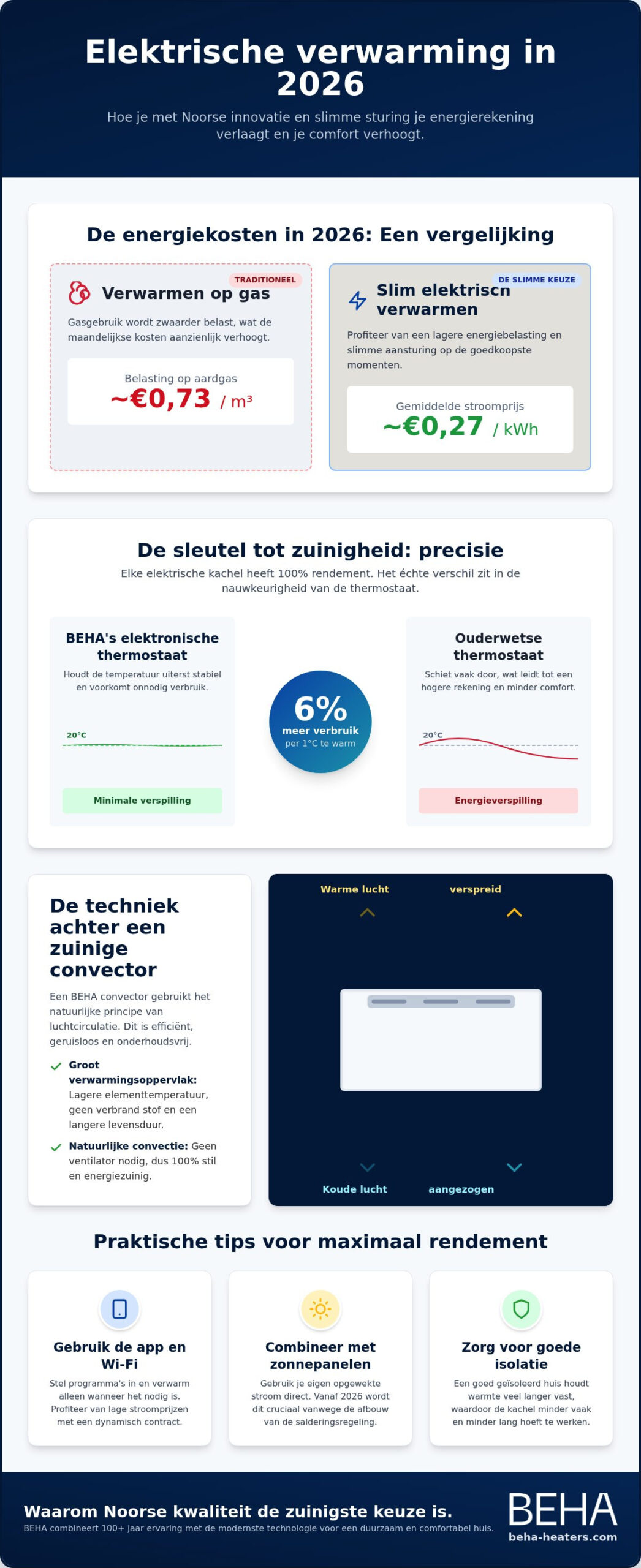
In 2026, the choice of a heat source is no longer just a matter of comfort, but primarily of smart management. The days of uncontrolled heating are over. We see that the government is taxing gas consumption increasingly heavily, with a tax on natural gas having risen to approximately €0.73 per m³. At the same time, electricity is becoming relatively more attractive due to a reduced energy tax. To make your electric heating operate efficiently, it is about the combination of high-quality technology and the moment you actually consume the electricity.
The difference between efficiency and consumption
Many people wonder: What exactly is electric heating when it comes to efficiency? Basically, every electric heater has an efficiency of 100%. This simply means that every watt you draw from the socket is fully converted into heat. However, the real difference lies in the efficiency of heat output and the accuracy of the control. A heater with an old-fashioned or inaccurate thermostat often overshoots, causing the room to become unnecessarily warmer than you have set. BEHA uses highly sensitive electronic thermostats that constantly monitor the temperature. Did you know that a deviation of just 1 degree above the desired temperature increases your consumption by 6%? Thanks to this precision, you prevent unnecessary waste and keep your energy bill manageable.
The impact of energy prices in 2026
The energy market will be more dynamic than ever in 2026. With an average electricity price of approximately €0.27 per kWh, it pays to plan smartly. Do you have a dynamic energy contract? Then you can immediately benefit from hours when electricity prices are low, for example when there is a lot of wind or solar energy available on the grid. Because 2026 is the last year in which the full net metering scheme for solar panels is in effect, it will be crucial for panel owners to consume electricity immediately. Smart convectors that you program for the times the sun shines turn your home into a thermal battery. This allows you to heat your home in a very cost-effective way.
- Use the built-in Wi-Fi and the app to heat during off-peak hours.
- Combine your heaters with solar panels to put your own generated electricity to immediate use.
- Ensure good insulation; a well-insulated house retains the generated heat much longer, meaning your heater needs to switch on less often to maintain the temperature.
's Norwegian reliability comes BEHA into its own. In a country with harsh winters, a reliable system that does not waste energy is the absolute standard. By setting your electric heating to be energy-efficient via our app, you make optimal use of the available energy without compromising on a behaand stylish indoor climate.
The technology behind an energy-efficient convector
A convector operates based on a simple yet effective physical principle: warm air rises. Unlike fan heating, where a motor constantly consumes power to move air, a convector utilizes natural air currents. Cold air is drawn in at the bottom, flows past the heating element, and exits the heater at the top. This process is completely silent and ensures even heat distribution throughout the room. Because no moving parts are required to move the air, this form of electric heating is economical and, moreover, maintenance-free.
The heart of the BEHAconvector is the heating element. We deliberately choose an element with a large surface area. The larger this surface area, the lower the temperature of the element itself can remain while still releasing the same amount of heat into the room. This has two major advantages: it prevents the burning of dust particles, which is better for air quality, and it significantly increases the lifespan of the heater. The heat is released directly into the air and conducted into the room through the steel or glass front.
Many people try to enhance their interiors by concealing radiators behind enclosures. This is detrimental to efficiency; the heat remains trapped, and you are literally heating for nothing. At BEHA , we take a different approach with our smart convectors featuring paintable fronts. You can adapt the heater to your interior without blocking the airflow. This way, you combine aesthetics with maximum heat output. In addition to technical choices, there are also general energy-saving tips that help lower your total consumption, such as always keeping the air intake and exhaust of your heaters clear.
Ecodesign and what this means for your stove
The European Union sets strict requirements for local space heating through the Ecodesign directives. These rules force manufacturers to incorporate features that prevent waste. Consider 'open window detection': as soon as the heater detects a sudden drop in temperature, it temporarily switches off to avoid heating against the outside air. BEHAconvectors not only meet these standards but are designed to perform above minimum efficiency requirements for years, which is immediately noticeable in your monthly costs.
Smart thermostats and sensors
The accuracy of the thermostat largely determines your success. Old-fashioned mechanical thermostats often have a deviation of a few degrees. This causes 'overshoot', where the room becomes much warmer than necessary before the heater finally switches off. Our electronic thermostats react to minute fluctuations and keep the temperature stable. As a result, the heat remains exactly at the level you set, which is essential for electric heating energy-efficient . Curious which technology best suits your home? View our smart convectors and discover the Norwegian quality for yourself.
Which electric heater is the most energy-efficient for your situation?
The search for the most efficient solution begins with how you use a space. After all, there is no single heater that is best in every situation. To ensure your electric heating operates economically, the technology must align with your lifestyle and the insulation value of your home. While infrared panels are often touted as the ultimate saver, in practice this is mainly true for local supplementary heating, such as above a desk. For heating an entire living space, convectors are superior because they circulate the air throughout the room, thereby creating a stable base temperature.
It is tempting to opt for a cheap fan heater or a ceramic model. Although these devices heat a room quickly, they are unsuitable as a permanent solution. The fan motor consumes extra power, and the heat dissipates almost immediately as soon as you switch the device off. Moreover, they stir up dust and make noise. For sustainable savings, choose a system without moving parts that utilizes natural air currents.
A crucial mistake many people make is choosing a heater with insufficient power. A 1000-watt heater designed to heat a room that actually requires 1500 watts will run constantly at full power without reaching the desired temperature. This unnecessarily drives up your energy consumption. By calculating the correct capacity, you ensure that the heater only needs to switch on occasionally to keep the room beha.
Convectors for the living room and bedroom
In rooms where you spend a lot of time, peace and quiet are essential. A silent convector offers the best balance between energy consumption and comfort here. By mounting the heater on the wall, preferably under a window, you optimize natural air circulation. The rising warm air forms a barrier against the cold coming from the glass. For those who want maximum control over costs, an electric convector with Wi-Fi the smartest choice. You can easily set schedules per room, so that the heating in the bedroom only turns on just before you go to bed.
Bathroom heating: safety and efficiency
The bathroom requires a specific approach. Safety comes first here; a heater must be at least IP24 certified to withstand splashing water. Because you are often only in the bathroom for a short time, you can save significantly by only heating when truly necessary. With smart controls, you ensure that the floor and air are only warm during your morning routine. This keeps your electric heating energy -efficient without you ever having to step into an ice-cold bathroom.
Tips to reduce your electricity consumption with electric heating
Lowering your energy bill starts with awareness, but the right technology is the deciding factor. To electric heating operates efficiently, it is essential to stop viewing your heaters as appliances that are simply on or off. By combining smart features with logical placement, you get the most out of every kilowatt-hour without compromising on comfort.
Smart control via the BEHA app
The BEHA SmartHeater app is your most important tool for a lower electricity bill. With it, you manage the temperature in each room individually from your smartphone, wherever you are. Instead of keeping the entire house at a constant temperature, you apply zone heating. You heat only the home office during office hours and the living room in the evening. The app gives you immediate insight into your consumption, so your heating costs are no longer a surprise at the end of the month. Are you going away for an unexpectedly longer period? With the absence mode, you switch all connected heaters to a lower setting at the touch of a button. The night setback function also helps you save by automatically lowering the temperature while you sleep, resulting in a significant reduction in your annual consumption.
Maintenance and installation for optimal performance
The location where you hang the heater determines how effectively the heat spreads throughout the room. Preferably, place a convector under a window. This way, the rising warm air blocks the cold draft coming from the glass, which increases comfort and improves natural circulation. Also, ensure that the heater can breathe freely. Curtains hanging over the heater or furniture blocking the air intake force the device to work harder for the same result, which immediately reduces efficiency.
A clean heater is an economical heater. Dust on the heating element acts as an insulating layer, reducing heat output and requiring the heater to run longer. Therefore, regularly remove dust from the grilles using a vacuum cleaner or a soft brush. Do you want your heating to blend seamlessly into your interior? You can choose a paintable radiator to create a seamless design. To integrate this correctly without losing efficiency, it is crucial that you only paint the metal front panel. Leave the ventilation grilles at the top and bottom completely free of paint so that the airflow remains unobstructed. This way, your electric heating remains economical and you retain the Norwegian quality for which BEHA is known.
Do you want to get started immediately with a smarter system for your home? Check out our smart convectors and start saving today.
Why Norwegian BEHA quality is the most economical choice
Choosing a heating system is a long-term decision. In a market full of fleeting solutions, BEHA itself with a history dating back to 1917. We develop our products in Norway, where winters are extreme and reliability is literally a matter of life and death. This Norwegian solidity ensures that our electric heating continues to perform efficiently, year after year, without efficiency diminishing due to wear and tear. Ultimately, a heater that lasts for decades is always the most cost-effective and responsible investment.
The technology in our convectors is virtually maintenance-free. Because we do not use moving parts such as fans, there is no mechanical wear that could reduce efficiency over time. The heat output remains constant and predictable. Moreover, we combine this functionality with a unique eye for aesthetics. Our paintable fronts ensure that the heater blends seamlessly into your interior. Therefore, you never have to invest in unsightly casings that block the airflow and ruin your efficiency.
Sustainability and climate friendliness
As a Norwegian family business, we feel a deep responsibility for the future. BEHA actively contributes to a gas-free world by manufacturing products that meet the strictest European EcoDesign requirements. We use only high-quality materials such as robust steel and tempered glass. These materials are chosen not only for their appearance, but primarily for their ability to optimally conduct and retain heat. By choosing quality over quantity, we reduce waste and offer you the assurance of a product built to last.
The benefits for professionals and private individuals
Our solutions are designed with ease of use in mind, for both the end user and the professional. The installation is simple and logically structured, saving time and costs during assembly. For the commercial market, we offer specific, reliable systems that efficiently maintain the temperature of large spaces. Are you looking for a complete solution for an office or commercial building? Then discover our options for commercial electric heating. With Dutch-language support and an extensive dealer network, we are always at your service, whether you want to heat a single room or make an entire project sustainable.
Ultimately, electric heating is economical when the system is smart, the build quality superior, and the support local. That is precisely the promise BEHA has been fulfilling for over a century. You are not just choosing a heater, but a partner who understands what is needed to live comfortably and responsibly in a changing climate.
Invest today in the heating of tomorrow
The switch to a gas-free home does not have to come with uncertainty about your energy bill. As we have seen, electric heating is economical when you choose the right balance between Norwegian build quality and intelligent control. By using zone heating and the free BEHA app, you maintain full control over your consumption and never heat a degree too much.
Our convectors meet the strictest European EcoDesign requirements and are the result of over 100 years of expertise in Europe's coldest climate. Whether you choose a stylish glass front or a paintable model that blends seamlessly into your interior, you are investing in a solution that will last for decades. With this, you are not only prepared for the changing energy market of 2026, but also create a healthy and comfortable living environment for yourself and your family.
Ready to take control? Discover our energy-efficient electric convectors and experience the comfort of top Norwegian quality for yourself. Turn your home into a warm place where sustainability and design go hand in hand.
Frequently asked questions about energy-efficient electric heating
Is an electric heater really more economical than heating with gas?
Whether electric heating is economical compared to gas depends heavily on your heating habits and current energy prices. With the rising gas tax in 2026, switching to electricity is becoming increasingly cost-effective, especially if you only heat the rooms where you are actually present. While gas central heating often keeps the entire house unnecessarily warm, electric convectors allow for targeted and efficient control per room, significantly reducing your total energy needs.
How many watts do I need to heat a room efficiently?
To heat a room efficiently, you need an average of 60 to 100 watts per square meter. This figure varies based on your home's insulation value and the desired room temperature. By choosing the right capacity, you prevent the heater from having to run at full power constantly to warm the room. A well-dimensioned system switches off more frequently, which is essential for your electric heating to function economically
What is the consumption of an electric convector per hour?
Hourly consumption is determined by the heater's power output and the accuracy of the thermostat. A 1000-watt heater consumes 1 kWh per hour if it is left on constantly. However, thanks to BEHA 's advanced electronic thermostats, the heater only switches on when the temperature drops below the set value. In a well-insulated room, the heater is often only actually on for 15 to 20 minutes per hour to maintain the heat level.
Can I leave an electric heater on all night?
Yes, you can safely leave a BEHA convector on all night. Our heaters are designed for continuous use and meet the strictest safety standards. For optimal efficiency, we recommend setting the night setback via the app. This causes the temperature to drop a few degrees while you sleep. This saves energy without the room cooling down completely, meaning heating up in the morning requires less power and the heater continues to operate efficiently.
Are smart Wi-Fi heaters worth the investment for energy savings?
Smart Wi-Fi heaters are absolutely worth the investment because they give you the control needed for real savings. Without smart control, you often heat unnecessarily when you are not at home or in empty rooms. With the app, you create detailed schedules and react immediately to changing plans. This active control makes your electric heating efficient and can reduce your consumption by tens of percent compared to traditional heaters.
What is the difference between a cheap DIY store heater and a BEHA convector?
The difference lies in the precision of the thermostat and the quality of the heating element. Cheap heaters often use mechanical thermostats that allow for large temperature fluctuations, leading to energy waste. BEHA opts for electronic thermostats with a deviation of only 0.2 degrees. Additionally, our elements have a larger surface area, allowing them to emit the same heat at a lower temperature. This extends the lifespan and ensures much more efficient heat transfer to the air in your room.
How does the open window detection work and how much does it save?
Open window detection signals a sudden, rapid drop in temperature in a room. When this happens, the heater immediately stops heating to prevent you from wasting energy unnecessarily on the outside air. As soon as the window is closed again and the temperature stabilizes, the heater resumes the program. This smart feature prevents senseless consumption and contributes significantly to lowering your total electricity costs during ventilation periods in the winter.
Do I need to maintain my electric heater to keep it efficient?
Regular maintenance is necessary to keep your heater's efficiency up to par. Dust accumulating on the heating element acts as an insulating layer, preventing the heater from dissipating heat into the air effectively. As a result, the appliance has to run longer to bring the room up to temperature, which unnecessarily increases your electricity consumption. It is sufficient to occasionally clean the grilles at the top and bottom of dust using a soft brush or vacuum cleaner.