
Everything about convectors: Efficient heating for the home
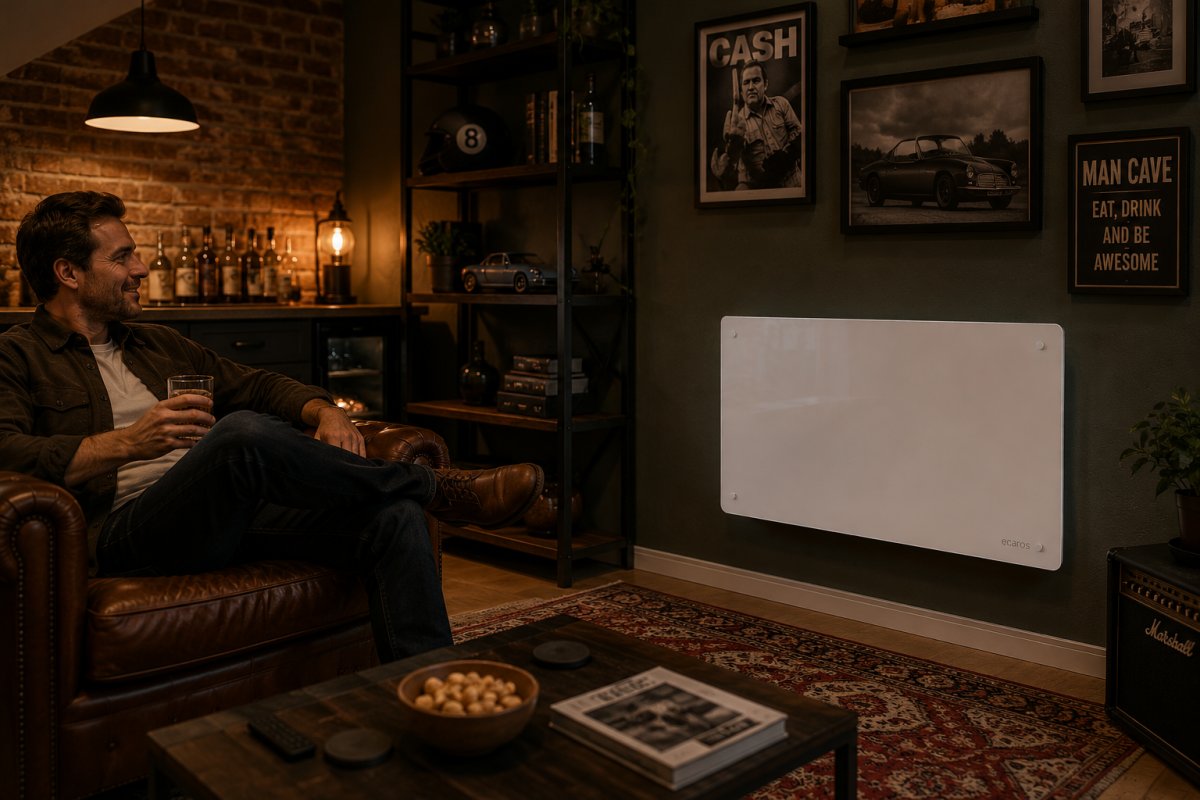
Everything about convectors begins with one important distinction: not every convector runs on electricity. There are electric convectors, water-based convectors, floor convectors, and models with a fan. They all primarily heat the air, but differ significantly in installation, speed, noise, energy consumption, and suitable application. In this complete guide, you will discover how convection heating works, which type suits your home, and what to look out for in Belgium and the Netherlands.
Key points
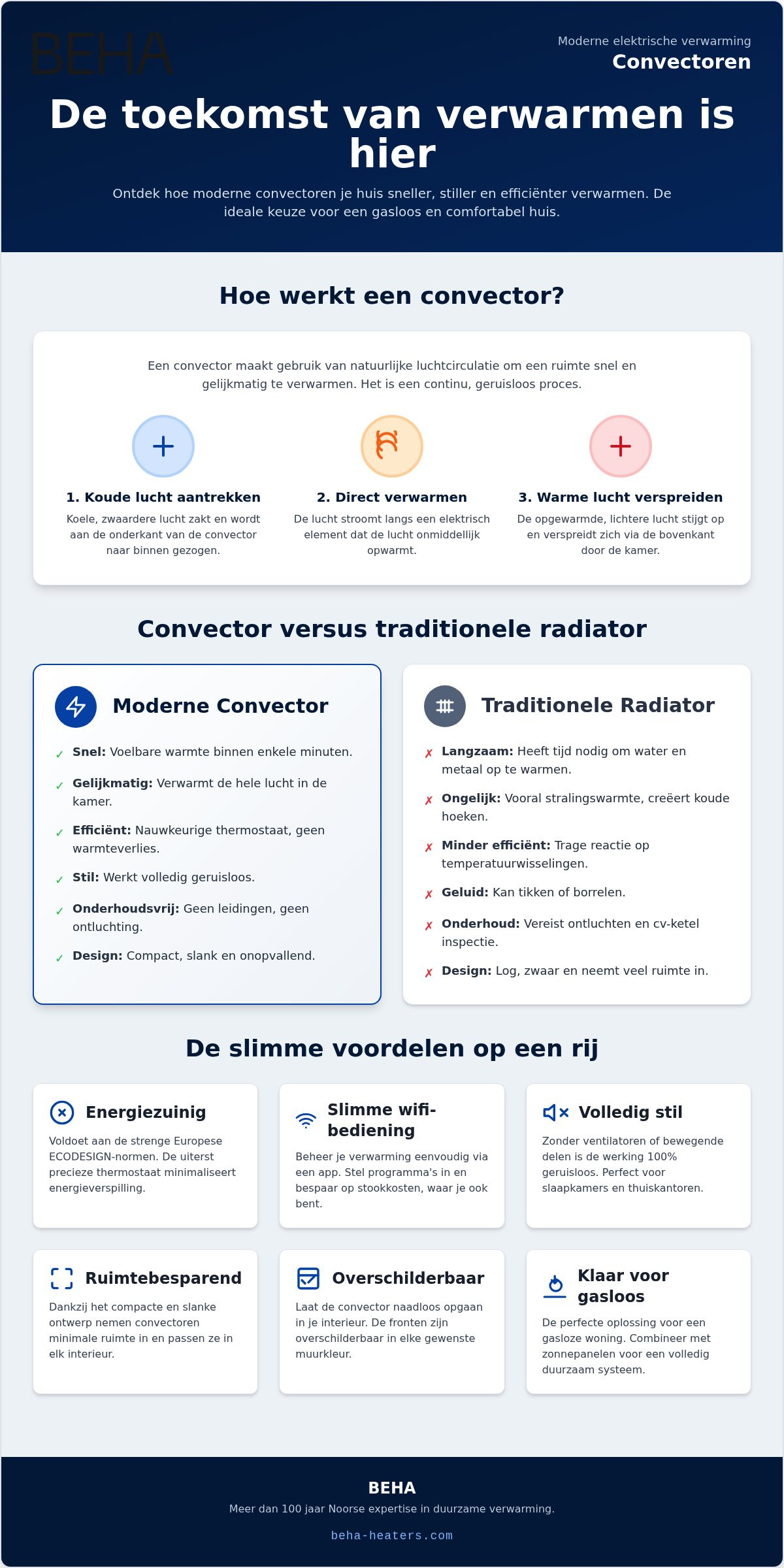
- A convector draws in cool air, heats it, and allows the warmer air to rise.
- An electric convector is particularly interesting for fast, quiet zone heating and rooms that you do not heat permanently.
- Electric resistance heaters convert virtually all the current drawn into heat at the point of use; the difference in cost lies mainly in power, operating time, control, and insulation.
- For long-term main heating of an entire home, a heat pump is usually more efficient.
- Choose the capacity based on heat loss, not just on the number of square meters.
Table of contents
- What is a convector and how does it work?
- What types of convectors exist?
- Pros and cons
- Convector, radiator or infrared?
- Calculate power and consumption
- Installation and safety
- Thermostat, Wi-Fi and design
- When is a BEHAconvector suitable?
- Frequently Asked Questions
What are convectors and how exactly do they work?
A convector is a heating device that primarily emits heat via convection. Cooler room air flows past or through a heating element or heat exchanger. The heated air becomes lighter, rises, and makes way for cooler air. This creates natural air circulation. In a fan convector, a built-in fan accelerates this process.
Anyone who everything about convectors must realize that “convector” describes the method of heat output, not the energy source. An electric model uses a resistance element. A water-based model receives hot water from, for example, a central heating boiler or heat pump. A floor convector is installed in a groove in the floor, usually alongside a window.
The difference between radiant heat and convective heat
Convection heat heats the air first; radiant heat heats people and surfaces directly. In practice, there is no strict distinction. A classic radiator also releases part of its heat via airflow, whereas the warm casing of a convector emits some radiation. It is therefore about the ratio. An explanation of the physical principle can also be found under convection heaters.
Convection generally responds quickly, but the room also cools down relatively quickly after being switched off. Heavy radiators or underfloor heating store more heat and react more slowly. Which system is more comfortable depends on duration of use, insulation, glass surface area, desired temperature, and personal preference.
Does a convector dry out the air?
A convector does not remove moisture from the air. Warm air can, however, contain more water vapor, causing the relative humidity to drop as the temperature rises. This can feel “dry.” Ventilating properly, avoiding unnecessary heating, and measuring humidity are more sensible than choosing a device based solely on this point.
Everything about convectors: what types exist?
The overview below makes everything about convectors concrete. The best choice depends on the existing heating system and how often you use the room. This way, you compare not only products but also technologies.
| Type | Operation | Strong in | Point of attention |
|---|---|---|---|
| Electric panel convector | Electric element and natural convection | Fast zone heating, quiet operation, easy installation | Operating costs with high operating hours |
| Water-based convector | Hot water coil connected to central heating or heat pump | Low water temperatures and central control | Piping and professional dimensioning required |
| Floor or recessed convector | Heat exchanger in a floor duct | Large windows and unobstructed view | More expensive installation and periodic cleaning |
| Fan coil unit | Heat exchanger plus fan | Fast, powerful air displacement | Audible and requires power for the fan |
| Oil-filled radiator | Electric element heats thermal oil | Slower, even heat release | Heavier and slower to heat up |
| Infrared panel | Predominantly direct heat radiation | Local heat and targeted zones | Comfort decreases outside the radiation range |
Are electric convectors suitable for gas-free heating?
Yes, but primarily selectively. An electric convector requires no gas connection or water pipes and can heat a study, bedroom, holiday home, or infrequently used room by zone. As the primary heating for an entire home, direct electric resistance heating often requires more electricity than a heat pump. Milieu Centraal explains why a heat pump heats more efficiently electrically by transferring heat rather than generating it solely through resistance.
The main advantages of modern electric convectors
With everything regarding convectors, there are both advantages and limitations. For a fanless electric model, the main advantages are:
- Fast response: the air is heated shortly after switching on.
- Silent operation: without a fan, there are virtually no moving parts.
- Heating per zone: only the room being used needs to be at the comfort temperature.
- Simple installation: a correctly installed electric appliance requires no central heating pipes.
- Precise control: an electronic thermostat and weekly program limit unnecessary operating hours.
- Low maintenance: there is no combustion; clear air ducts and a clean appliance remain important, however.
What disadvantages should you know?
- After switching off, there is little heat buffer, causing the temperature to drop more rapidly.
- Warm air collects near a high ceiling; this temperature difference can reduce comfort.
- Furniture, curtains, or fabric covering the air vents reduce efficiency and can be unsafe.
- Direct electric heating can be more expensive than heating with a properly sized heat pump for daily and prolonged use.
- Air circulation can move dust. Regular cleaning and good ventilation help.
Energy efficiency and Ecodesign: what does that really mean?
An electric resistance heater converts virtually all the electricity consumed into heat at the point of use. As a result, a convector with the same power output is not automatically more economical than another electric resistance heater. Savings are primarily achieved because a good thermostat switches off sooner, a program lowers the temperature when no one is present, and you heat only the required zone.
The European Ecodesign rules for local space heaters set requirements for product information and control options. When purchasing, check the current product data and features on the European Commission's page on local space heaters. In addition to maximum power, pay particular attention to thermostat accuracy, weekly program, open window detection, and standby consumption.
Safety and comfort
Modern appliances may feature overheating protection, a child lock, frost protection, and open window detection. Always check which functions the specific model actually has. For a bedroom or study, a fanless appliance is pleasant because it produces no fan noise. Correct placement and sufficient free airflow remain necessary.
Convectors versus radiators: which one do you choose?
The question is not which technology is universally the best, but which heat output suits the room. This section of Everything About Convectors helps you compare fairly.
| Characteristic | Electric convector | Oil-filled radiator | Infrared panel |
|---|---|---|---|
| Warm-up reaction | Fast | Slower | Immediately noticeable in the radiation zone |
| Heat after switching off | Limited | Longer due to mass | Limited |
| Ideal use | Whole room air, temporarily or by zone | Longer, even heating | Focused work or seating area |
| Sound | Silent without a fan | Quiet | Quiet |
| Placement | Free airflow needed | Clear space needed all around | Unobstructed line of sight desired |
A technical comparison between radiators and convectors can also be found at REHVA. Please note that the performance of water-based units depends on the supply and return temperatures, flow rate, and the selected design temperature.
When should you choose an electric convector?
A convector is well-suited for a room that needs to heat up quickly, has no running water, or is only used during certain hours. Think of a home office, bedroom, guest room, studio, or isolated hobby room. For a metal front, also check out our buying guide for an electric heater with a steel front.
When is it better to choose something else?
For a home that requires a lot of heat day and night, it is advisable to first perform a heat loss calculation and seek advice on a heat pump or water-based system. For a single fixed seating area, infrared heating may be more targeted. In a bathroom, additional safety zones apply, and not every appliance is permitted. An electrician can assess whether the appliance, IP protection, circuit, and placement are suitable.
Everything about convectors: power, consumption, and costs
An important part of everything regarding convectors is proper sizing. A unit with insufficient power will not heat the room to a comfortable temperature; while a lot of extra power does not automatically make it inefficient when the thermostat regulates properly, it can place a heavier load on the electrical circuit.
Indicative power calculation
As a quick initial estimate, you can calculate with approximately 25 to 50 watts per cubic meter. The low value is only suitable for a well-insulated room; older homes, lots of glass, exterior walls, drafts, and a high desired temperature require more. Multiply the floor area by the ceiling height and then by the appropriate wattage factor.
| Space at 2.5 m high | Contents | Indication 25–50 W/m³ |
|---|---|---|
| 10 m² | 25 m³ | 625–1,250 W |
| 20 m² | 50 m³ | 1,250–2,500 W |
| 30 m² | 75 m³ | 1,875–3,750 W |
These figures are a range, not installation advice. For main heating, new construction, or a major investment, have the heat loss per room calculated. This takes into account insulation, ventilation loss, glazing, orientation, and outside temperature.
How much does an electric convector cost per hour?
Use the formula: power in kW × actual duty cycle × your electricity price per kWh. A 1,500-watt convector heating continuously for a full hour consumes a maximum of 1.5 kWh. As soon as the desired temperature is reached, the thermostat switches the element on and off. Therefore, the actual hourly consumption is usually lower than the maximum power multiplied by the clock time.
| power output | Maximum consumption per full heating hour | Current at 230 V, approximately |
|---|---|---|
| 500 W | 0.5 kWh | 2.2 A |
| 1,000 W | 1.0 kWh | 4.3 A |
| 1,500 W | 1.5 kWh | 6.5 A |
| 2,000 W | 2.0 kWh | 8.7 A |
Enter your current contract rate; energy prices, grid rates, and levies differ between Belgium and the Netherlands and change regularly. Solar panels do not automatically reduce winter costs, as production and heat demand often occur at different times.
Installation and safety: practical checklist
of everything related to convectors . The best performance is achieved when air can flow in freely at the bottom and out unimpeded at the top. Placed under a window or against an exterior wall, a convector can help limit cold drafts, provided the installation manual permits that location and distance.
- Always follow the manufacturer's minimum distances to the floor, windowsill, furniture, and curtains.
- Never cover the appliance and do not dry clothes on it.
- Use the prescribed wall bracket or base and ensure stable mounting.
- Preferably connect a powerful device directly according to the manual; avoid faulty power strips or extension cords.
- Check whether the electrical circuit has sufficient capacity, especially with multiple appliances.
- In a bathroom, use only a suitable appliance in an authorized position and have any doubts assessed by a professional.
- Remove dust with a switched-off, cooled-down appliance according to the maintenance instructions.
Where do you place multiple convectors?
In a long or open space, two well-spaced, correctly sized units often provide a more even result than a single powerful unit in a corner. Take doors, draft zones, and thermostat position into account. Do not place a thermostat close to a heat source or in direct sunlight if it is being measured separately from the unit.
Smart features and design: from Wi-Fi to paintable fronts
Modern control is an important part of everything related to convectors. Wi-Fi does not make the heating element itself more efficient, but it can prevent energy waste through a suitable schedule, zone control, and remote control.
App control and Wi-Fi
When choosing a smart device, look for weekly schedules, frost protection, open window detection, local control when the internet goes down, and the expected app support. Also check if multiple rooms can be controlled separately. Read more in our guide on an electric convector with Wi-Fi.
A realistic schedule is more effective than maintaining a high temperature all day. Allow the room to warm up just before use and then lower the temperature. Avoid extreme night-time temperature reduction if this causes a long catch-up period in the morning; the optimal setting depends on insulation and usage.
Design and paintable versions
A slim wall-mounted model takes up little floor space and often fits under a window. Some fronts can be finished in an interior color. Use only a suitable method and material according to the manufacturer so that air vents, heat output, and warranty are not affected. View our separate guide on a paintable radiator.
Norwegian BEHAquality: when does it suit you?
Once you have compared BEHA develops electric convectors for controlled, silent room heating. A fanless wall-mounted model is particularly interesting when you want quick comfort without central heating pipes and wish to control each room separately. View the current range and product specifications on everything regarding convectors , you can search specifically for a suitable model. BEHA Heaters .
We believe honest advice is more important than a one-size-fits-all solution. For long-term main heating of an entire home, a heat pump might be the more logical choice. For a separate workspace, infrared might be suitable. An electric convector, on the other hand, excels in quiet, fast-responding zone heating.
Expertise for residential and professional applications
Don't just compare wattage and purchase price. Also pay attention to control precision, noise level, installation, warranty, available safety features, and support in Belgium and the Netherlands. For offices, apartments, holiday homes, or projects, our guide on electric heating for professionals with the initial selection.
10-point buying checklist
- Determine whether you are looking for supplementary heating, zone heating, or primary heating.
- Have the heat loss calculated for main heating.
- Choose an electric, water-based, floor-standing, or fan convector.
- Check the required power and the available electrical capacity.
- Compare thermostat accuracy and programming functions.
- Assess sound: fanless is generally the quietest.
- Check dimensions, mounting distances, and free airflow.
- Check security, IP rating, and suitability for the selected room.
- Calculate costs using your own rate and expected engagement time.
- Check warranty, service, and local availability.
Conclusion: everything about convectors in one choice
After reading everything about convectors, the core is simple: first choose the type of heat source, then calculate the required power, and subsequently compare controls, placement, and safety. An electric convector is a strong choice for fast, quiet heating per room. For continuous heating of an entire home, a more efficient central system is often preferred.
behaDo you want to choose a model that suits your room and usage hours? View the options at and compare power, dimensions, and controls per unit.
Everything about convectors: frequently asked questions
What is the difference between a convector and a radiator?
A convector dissipates the majority of its heat via moving air. A radiator typically combines airflow with more direct heat radiation. The difference is gradual: virtually every warm surface produces both forms.
Is an electric convector energy-efficient?
It can be economical to use when heating only a required room briefly and precisely. As direct electric primary heating for many hours, it typically uses more electricity than a heat pump for the same amount of room heat.
How many watts do I need?
A rough indication is 25 to 50 watts per cubic meter, depending on insulation, glazing, outside temperature, and desired indoor temperature. For primary heating, a professional heat loss calculation is more reliable.
Can a convector stay on all night?
Only when the specific appliance is designed for continuous use, is correctly installed, and is used according to the manual. Use the thermostat and night program, never cover the appliance, and keep air vents clear.
Does a convector make noise?
A model without a fan is virtually silent, although materials may sometimes tick softly when heating up or cooling down. A fan coil unit produces audible fan and air noise.
Can I use a convector in the bathroom?
Not automatic. The appliance must be suitable for the relevant bathroom zone and be connected correctly. Check the IP rating, installation instructions, and Belgian or Dutch electrical regulations; if in doubt, consult a certified installer.
Is Wi-Fi really energy-saving?
Wi-Fi only saves energy if operation leads to fewer unnecessary heating hours or a lower temperature. It does not increase the conversion efficiency of the electric element.
Where should I place a convector?
In a location with free air supply at the bottom and free outflow at the top. Under a window can be useful against cold drafts, but the prescribed distances to curtains, furniture, floor, and windowsill are always the guiding principle.
How do I maintain a convector?
Switch it off, let it cool down, and remove dust according to the manual. Keep the air intake and outlet clear. A water-based or fan coil unit may require additional maintenance on the heat exchanger, filter, fan, or central heating system.
What is cheaper: one large or two small convectors?
For the same total heat loss, energy consumption depends primarily on the heat demand and control. Two well-placed units can distribute the temperature more evenly, but require sufficient electrical capacity and may cost more to purchase.
Are convectors suitable for a poorly insulated home?
They can heat the room, but the required power and consumption increase due to heat loss. Draft sealing, glass and roof insulation, and correct calculations usually yield better results than simply installing a more powerful appliance.