
Everything about electric wall heating: comfort and style in every room
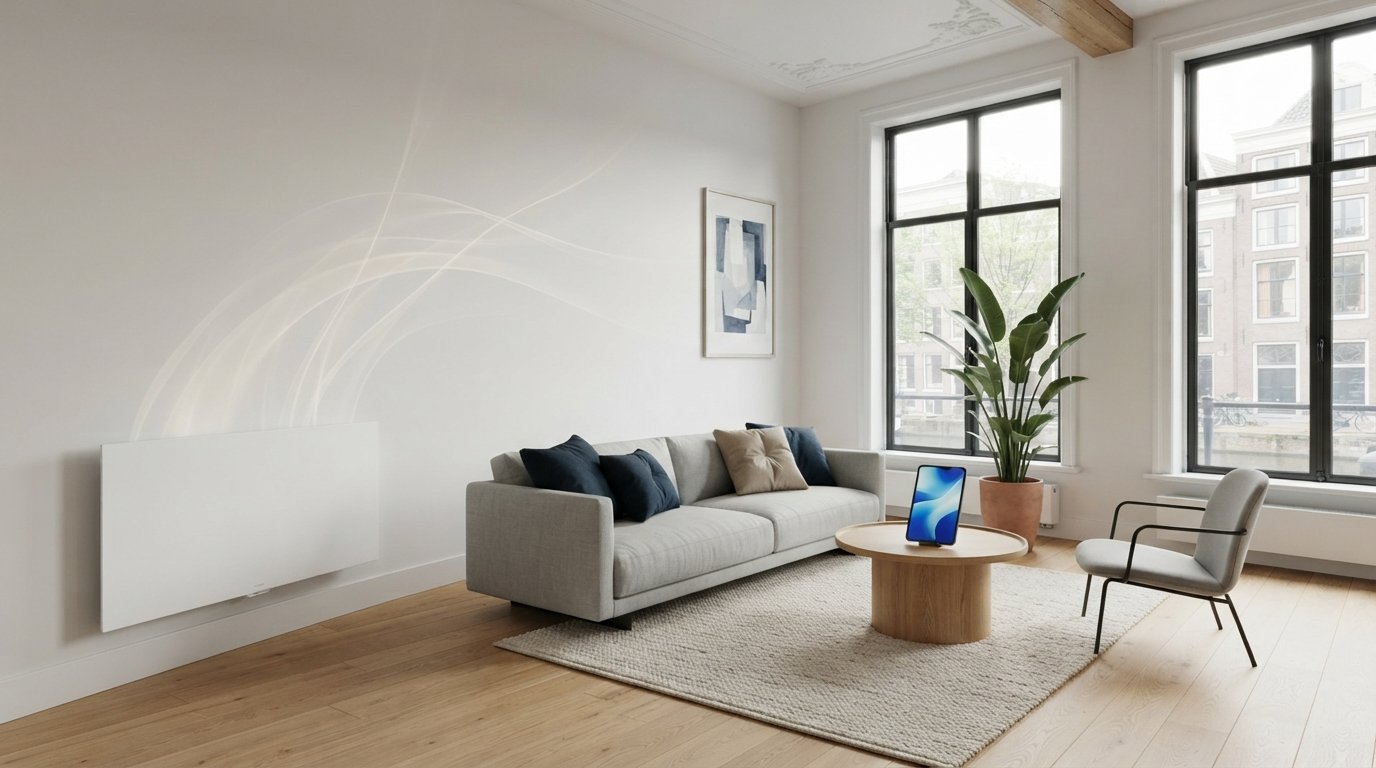
Did you know that the complete abolition of the net metering scheme on January 1, 2027, makes directly consuming your own solar power more important than ever? You probably recognize this situation. The desire to go off gas is strong, but the fear of sky-high energy bills and walls spoiled by bulky radiators often holds you back. After all, a comfortable home shouldn't come at the expense of your interior or your monthly budget. With the right electric wall heating, you combine Norwegian reliability with a modern design that fits seamlessly into any room.
In this article, you will discover how to heat your home efficiently and completely gas-free with innovative convectors, without the need for a complicated central heating installation. We explain exactly how smart features such as weekly schedules and open-window detection help minimize your consumption. From paintable fronts to sleek glass panels, you will learn all about the possibilities for creating a warm, inviting atmosphere ready for the future of living in the Netherlands.
Key Points
- Learn why electric wall heating is the ideal solution to make your home gas-free and get a grip on the energy transition.
- Understand how the convection principle works and how it ensures quiet, even heat distribution in every room.
- Discover the aesthetic benefits of slim steel or glass panels, including unique paintable fronts that blend seamlessly into your interior.
- See how easy it is to install the heating yourself and how to manage your energy consumption in detail with a smart app.
- Discover the power of Norwegian solidity and why more than 100 years of experience makes the difference in safety and reliability.
What is electric wall heating and why is it the future?
When we talk about electric wall heating, we are referring to a permanently mounted heat source that converts electricity into thermal energy with 100% efficiency. Every kilowatt-hour you consume fully benefits the temperature in your room. Unlike portable heaters, which often get in the way and pose a tripping hazard due to dangling cords, a wall-mounted model offers a permanent and safe solution. The system works via natural convection; cold air flows into the bottom of the convector, is heated by an internal element, and rises silently into the room.
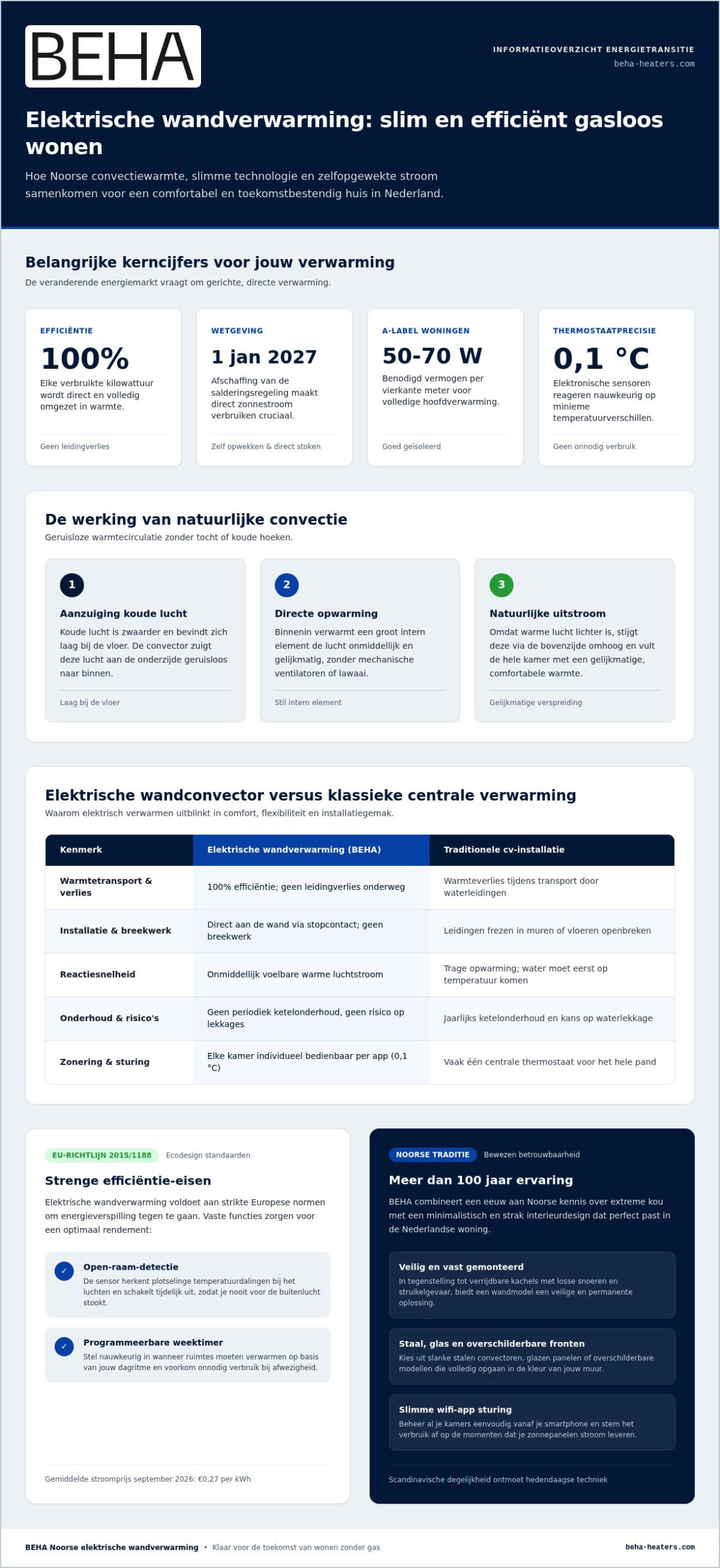
The Dutch energy market is changing rapidly, and so is the way we keep our homes warm. With the impending abolition of the net metering scheme on January 1, 2027, directly consuming self-generated solar power will become the new standard. Electric wall heating plays a crucial role in this. It enables you to heat rooms specifically at the times your solar panels are generating energy. In modern, well-insulated homes (A-label), a capacity of 50 to 70 watts per square meter is often sufficient to use the system as primary heating. In older buildings, it is the ideal partner for zone heating, where you only heat the rooms you are actually spending time in.
The transition to gas-free living
Completely disconnecting from the gas supply is a major step towards making your home more sustainable. Electric convectors make this process accessible and straightforward. You are no longer dependent on fluctuating gas prices, but benefit from the more stable electricity market. With an average electricity price of €0.27 per kWh in September 2026, electric heating is a cost-effective alternative, especially when using smart control. By preparing your heating system for the future now, you are less vulnerable to changes in legislation and energy tariffs.
Advantages over traditional central heating
A major disadvantage of a traditional central heating system is the complex network of pipes running throughout the house. This entails not only installation costs but also heat loss during water transport. With electric wall heating, this loss is a thing of the past. You do not need a boiler that requires annual maintenance, and there is no risk of leaks in the floor or walls.
In addition, the response speed of an electric convector is many times higher. Whereas a water-based radiator takes time to reach temperature, with a wall-mounted model you immediately feel the warm airflow. For renovation projects, this means enormous savings in both time and money; you do not have to break open floors or mill into walls for pipework. A nearby power outlet is often sufficient to provide the room with high-quality comfort.
How exactly does an electric wall convector work?
The operation of a convector is based on an effective physical principle. Cold air is heavier than warm air and therefore stays low to the floor. A convector draws this cold air in from the bottom. Inside the device is a large heating element that heats the air instantly. Because warm air is lighter, it rises and exits the convector through the top. This process of natural air circulation continues as long as the thermostat calls for heat. The major advantage of this electric wall heating is that the entire room heats up evenly, without the cold corners sometimes seen with radiant panels.
A crucial component of this system is the thermostat. While old heaters often use inaccurate bimetallic switches, modern models work with advanced electronic sensors that react to temperature differences of just 0.1 degrees. By choosing an electric convector with Wi-Fi, you take this precision to a higher level. You connect the heater to an app on your smartphone, allowing you to set a detailed heating schedule for each room. This prevents the heater from running unnecessarily when you are not at home, which is immediately visible on your energy bill.
Efficiency and the Ecodesign Directive
Since the introduction of the EU Ecodesign Directive (Regulation 2015/1188), fixed electric heating must meet strict efficiency requirements. This means that features such as a weekly timer and open-window detection are standard. When you open a window to ventilate, the sensor detects the sudden drop in temperature and temporarily switches off the heating. This prevents you from literally heating the outside air. These smart features make the system extremely cost-effective at a time when electricity prices fluctuate around €0.27 per kWh.
Air quality and comfort
A common misconception is that electric heating dries out the air or emits a burning smell. With modern convectors, this is a thing of the past. The heating elements are designed so that they never exceed the critical limit of 225 degrees Celsius. This is the point at which dust burns. As a result, the air remains fresh and healthy, which is essential for people with allergies or sensitive airways. Moreover, the system operates completely silently. There are no moving parts or fans, making the heater perfectly suitable for the bedroom or a quiet home office.
Safety is optimally guaranteed with wall mounting. The housing never gets dangerously hot, and most models are equipped with a child lock. When purchasing, also pay attention to the IP rating; an IP24 certification means that the device is splash-proof and can therefore be safely mounted in zone 2 of your bathroom. Curious about what power output you need? Then check out our collection of smart convectors for an overview of all specifications.
The different types of wall heating: from steel to glass
When furnishing your home, the choice of a heating system is no longer just a technical decision. Aesthetics matter too. Modern electric wall heating has undergone tremendous development in terms of design in recent years. Whereas radiators used to be bulky, white blocks that you preferred to hide behind a sofa, current models are sleek and stylish. You now have the freedom to choose a heat source that seamlessly matches your living style, whether you prefer an industrial look, a minimalist interior, or a classic appearance.
The choice of material determines not only the appearance but also influences the user experience. Steel panels are the standard due to their rapid heat conduction and robustness. For those seeking a more luxurious look, glass design panels offer a beautiful alternative. These tempered glass panels have a glossy surface that adds depth to the room. They are particularly popular in modern living rooms and bathrooms, where they function as a functional work of art on the wall. The slim profile of these wall-mounted models ensures that you save valuable floor space, which is a major advantage compared to portable heaters.
Steel fronts for a timeless look
The electric heater with a steel front remains the most popular option for Dutch households. There is a good reason for this. Steel is extremely durable and can withstand the daily dynamics of a busy family. A bump from a vacuum cleaner or playing children will not easily leave traces. The powder coating on these panels is scratch-resistant and very easy to keep clean with a damp cloth. Thanks to the Norwegian solidity with which these panels are constructed, you are assured of an appliance that will last for decades without compromising on power or appearance.
The paintable radiator: invisible comfort
For those striving for absolute unity in their interior, the paintable radiator a true godsend. This is a unique category within electric wall heating that allows you to give the convector exactly the same color as the wall behind it. As a result, the heater virtually “disappears” into the room.
Painting these fronts is simple and, provided you follow the correct instructions, has no negative impact on heat output. It is the ultimate solution for interior designers and discerning homeowners who do not want to compromise on their color palette. Whether your wall is olive green, deep blue, or terracotta, your heating effortlessly follows your taste. This way, you enjoy state-of-the-art technology without disturbing the visual tranquility of your room.
Installation and smart control for maximum convenience
One of the biggest advantages of electric wall heating is the ease of installation. You don't need a plumber, and no walls need to be broken open for heavy pipework. All you need is a sturdy wall and a nearby power outlet. Positioning is essential for optimal efficiency. It is advisable to place the convector under a window or next to an exterior door. These are the places where most of the cold enters the home. By hanging the heater there, you create an invisible heat screen that immediately neutralizes the cold draft before it spreads through the room.
The installation process itself is straightforward. You start by marking the wall bracket, for which a spirit level is indispensable for a straight result. Once the bracket is securely anchored, you simply click the convector into place. It is a matter of plugging it into the socket, and you are ready to heat the room.
Easy installation without demolition work
For successful wall mounting, you only need a drill, wall plugs, and a screwdriver. Pay close attention to the prescribed distances during installation. Leave at least 5 to 10 centimeters of space free at the bottom and sides. This space is necessary for an unobstructed airflow; without these margins, the convector cannot dissipate its heat efficiently. Because the system is plug-and-play, you can start configuring the software immediately after installation.
The power of the BEHAapp
As soon as the hardware is mounted, the smart part begins. The modern Gen 2 models from BEHA are equipped with integrated Wi-Fi and Bluetooth. You can easily connect the heaters to your home network via the BEHA SmartHeater 2.0 app. This gives you the freedom to control the temperature in each room individually, even when you are not at home. Did you forget to turn off the heating in the guest room? With a single tap in the app, this is taken care of instantly.
The real gain lies in the ability to create detailed schedules and scenarios. Given the average electricity price of approximately €0.27 per kWh in September 2026, it pays to heat only when truly necessary. You can group heaters, for example by floor, allowing you to put the entire house in 'eco mode' with a single command. This insight into your consumption per day and per room helps you use energy more consciously. Do you want to get started immediately with a future-proof heating system? View the various smart convectors and discover how easily you can take control of your living comfort.
Why BEHA 's Norwegian wall heating is the smartest choice
BEHA is not just any manufacturer of heating systems; it is a Norwegian family business that has been setting the industry standard since 1917. In Norway, electricity has been the primary source of heating for decades, which has led to unparalleled expertise in this field. When you choose BEHA electric wall heating, you bring more than a century of innovation and practical experience into your home. Every product undergoes rigorous quality controls and safety tests under extreme Scandinavian conditions. If a convector can effortlessly withstand a freezing Norwegian winter, you can be sure that you can always count on a warm and comfortable home in the Dutch climate.
sustainability is BEHA not an empty slogan, but a fundamental core value. Production processes are aimed at keeping the ecological footprint as small as possible, while the products themselves fully comply with the strictest Ecodesign guidelines. This makes the stoves a responsible choice for both your wallet and the environment. In addition to residential homes, the brand also offers specific support and solutions for the business market. Professionals in construction and project development can count on systems specifically designed for the demanding requirements of office environments and commercial spaces.
Norwegian reliability in a modern guise
Norwegian standards for electrical equipment are often significantly higher than the European average. This is immediately reflected in the choice of materials and the finish of the panels. Only high-quality steel and tempered glass are used, which last for generations without warping or discolouring due to heat. The focus here is on functional superiority; no unnecessary complexity, but intuitive operation that is understandable to every user. The result is a heating system that exudes tranquility in your interior and offers technological certainty when it is freezing outside.
Warranty and reliability
An investment in making your home more sustainable should offer long-term security. That is why BEHA smart convectors are backed as standard by an official 5-year manufacturer's warranty. This underscores the great confidence in their own technology and the robustness of the components used. Moreover, you are never alone; an extensive network of local dealers and support points is available in the Benelux for expert advice. Whether you need help calculating the correct capacity or have a technical question about integration with your smart home system, the expertise of an established market leader is always within reach.
Take the step towards smart and sustainable living comfort today
It is clear that electric wall heating is no longer a temporary solution, but a full-fledged choice for those who want to combine style and efficiency. By choosing a technically superior system, you invest in living comfort that lasts for decades. We have seen how the silent convection principle and smart app control work together to lower your energy bill while you enjoy a perfectly heated room.
With the Norwegian quality of BEHA, a brand that has been leading the way since 1917, you choose proven reliability. All smart convectors are fully Ecodesign certified and use the best-rated Wi-Fi app on the market. Whether you choose a modern glass front or a paintable model that blends seamlessly into your interior, you are ready for the future of living in the Netherlands.
Discover the full range of electric wall heating from BEHA and experience the tranquility of Scandinavian craftsmanship in your own home.
Frequently asked questions about electric wall heating
Is electric wall heating suitable as primary heating?
Yes, electric wall heating is perfectly suitable as primary heating, provided the home is well insulated. In modern homes with an A-label or built according to BENG standards, a capacity of 50 to 70 watts per square meter is often sufficient. By equipping each room with its own convector and an accurate thermostat, you create a fully covering system without the need for a central heating boiler. In older homes, it is often used as powerful supplementary heating.
How many watts do I need per square meter?
The required capacity depends heavily on the insulation value of your room. For a well-insulated room, calculate with 50 to 70 watts per square meter. In a moderately insulated home, this rises to 80 to 100 watts. In a corner house or a room with a large glass surface area, it is wise to stay at the upper end of this range. BEHA offers various models from 400W to 2000W to meet every need.
Can I install an electric radiator myself?
Yes, the installation is designed for the do-it-yourselfer. You simply mount the included wall bracket to the wall with a few screws and plugs. Because the devices are plug-and-play, you only need to plug it into the socket to get instant heat. BEHA sells only the hardware and does not offer an installation service, but the clear manual makes a professional unnecessary in most cases for a safe and secure mounting.
Is an electric convector safe for children and pets?
Absolutely, safety is central to the Norwegian design. The heating elements remain well below the combustion temperature of 225 degrees Celsius, which prevents irritation to the respiratory tract. The housing gets warm, but never dangerously hot for children's hands or pets. Furthermore, the heaters are equipped with overheat protection and a child lock on the controls, allowing you to heat any room in the house with peace of mind, without the need for constant supervision.
What is the difference between a convector and infrared heating?
A convector heats the air in the room, which then circulates to maintain an even temperature. Infrared heating radiates heat directly to objects and people, similar to the sun. The major advantage of a convector is that the entire room feels comfortable without cold corners. For a constant and stable base temperature in the living room or bedroom, air heating via a wall-mounted model is often the most pleasant and practical solution for daily use.
How much will I save with a smart Wi-Fi thermostat?
The savings lie primarily in the precise control and zone regulation. With an average electricity price of approximately €0.27 per kWh, it pays to heat only where and when you are present. By setting schedules via the app, you prevent heaters from running unnecessarily at night or when you are away. Because you regulate the temperature per room to the degree, you do not waste energy on unnecessarily heating unused spaces.
Can I also use the electric wall heating in the bathroom?
Yes, provided the convector has an IP24 certification. BEHA 's smart convectors are splash-proof, making them safe to use in damp areas such as the bathroom. You can install them in Zone 2, which means they must be positioned at a safe distance from the direct water stream of the shower or bath. Furthermore, the electronic thermostat ensures that the bathroom quickly reaches the desired temperature on cold mornings.
Do I need to modify my electrical installation for wall heating?
For most households, no modification is necessary. A standard 16-amp circuit can supply approximately 3,600 watts of power. If you place one or two heaters in a room, the existing socket is usually sufficient. However, if you are going to heat an entire floor fully electrically, it is advisable to check the total load per circuit. For the installation of a single electric wall heater, a standard grounded socket is sufficient.