
Fan heater with built-in thermostat: how to choose the right one

A built-in thermostat does not automatically make a fan heater suitable for every room or use. The fan heater with a built-in thermostat can help regulate the heat, but how comfortable that feels also depends on the power output, placement, and temperature setting. That is precisely why it is wise to look beyond just the thermostat.
Perhaps you are looking for quick heat for a home office, bathroom, or other place you use temporarily. In that case, a fan heater is often a practical option. For long-term heating, it is important to carefully assess whether the unit suits the room and your daily heating needs. The thermostat also has limitations: operation and accuracy vary by model, and the measurement can be affected by the location of the heater.
In this article, you will discover how the built-in thermostat regulates the heat and what that function does and does not do for you. You will read when a fan heater is a suitable choice, how to match the power output to the room, and which safety features and installation instructions to check. This allows you to carefully compare product details by model and make a choice that suits your needs.
Key Points
- A fan heater with a built-in thermostat can control the heating based on the ambient temperature; check the manual to see exactly how the control works.
- Weigh up whether you want to use the heater as supplementary heating or for a room you are heating temporarily.
- Compare fan heaters, convectors, and other electric heaters based on usage, controls, and points to consider.
- Before making a choice, check the power output, thermostat function, installation conditions, and safety features.
- View the product information per BEHAmodel: the range includes fan heaters, but a built-in thermostat is not fitted to every model.
What does a fan heater with a built-in thermostat do?
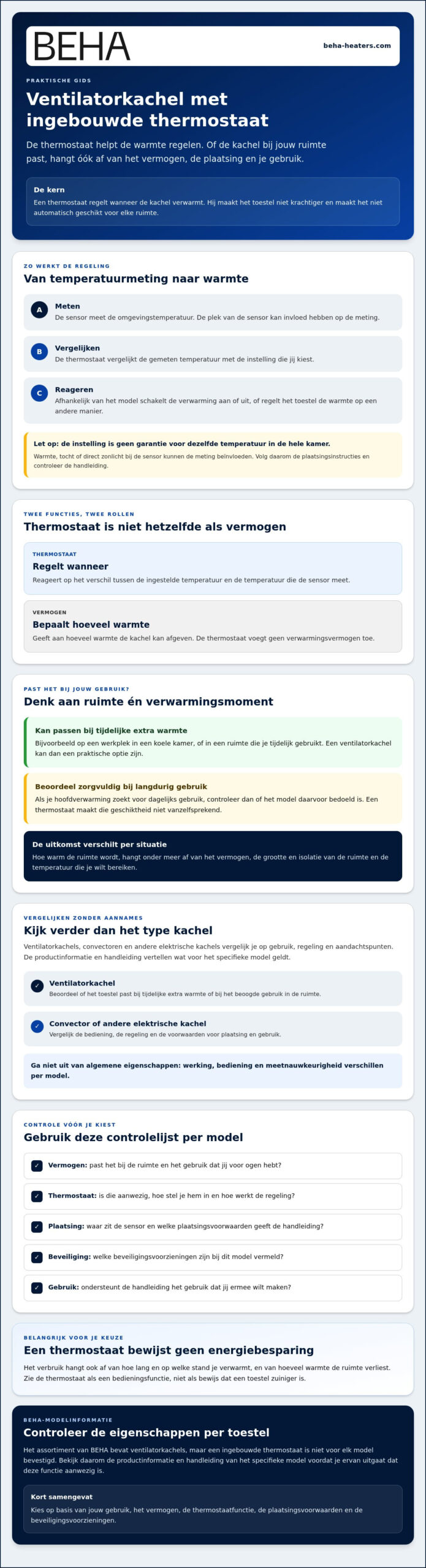
A built-in thermostat measures the ambient temperature and controls the heating based on the set temperature. In this way, the control system helps maintain the desired warmth without you having to constantly switch the heating on or off yourself. The precise operation and controls vary by model.
A built-in thermostat controls when the fan heater heats, but does not make the unit more powerful. The power output determines how much heat the heater can emit; the thermostat determines how the unit responds when the measured temperature changes. Do you want to understand how a fan distributes heat? Then read How a fan heater works.
How does the thermostat regulate the temperature?
You set a desired temperature or operating mode. The thermostat compares that setting with the temperature measured by the sensor. Depending on the model, the heating then switches on or off, or the device regulates the heat in another way. The measured temperature does not necessarily correspond exactly to the temperature at every location in the room.
The control method, measurement accuracy, and operation are model-specific. Therefore, check the manual to see how to set the temperature, where the sensor is located, and which settings are available. This will prevent you from assuming that a setting on one device works the same way on another.
What is the difference compared to a separate thermostat?
With a built-in thermostat, the temperature measurement and controls are located in or on the heater. A separate thermostat measures the temperature at an isolated location and can therefore provide a different picture of the conditions in the room. This difference can be relevant when the heater is positioned close to a cold exterior wall or the sensor is located close to the warm airflow.
The location of the sensor affects the measurement. If it is placed close to heat, drafts, or direct sunlight, the measured temperature may differ from what you experience elsewhere. Follow the placement instructions and check whether an external controller is suitable according to the product specifications. Do not assume general compatibility.
With a fan heater with a built-in thermostat, the thermostat is primarily a control mechanism, not an additional heating capacity. Before choosing, compare the temperature settings, controls, and installation requirements in the product information. BEHA sells fan heaters, but check per model whether a built-in thermostat is actually present and how that function works.
When is a fan heater with a thermostat suitable for your needs?
A fan heater may be suitable when you want extra heat in a specific room at certain times, for example while working in a cool room or when you are only using a room temporarily. That is a possible application, not a promise about how quickly the room will reach the desired temperature. The outcome depends on, among other things, the power output, the size and insulation of the room, and the temperature you wish to achieve.
The thermostat helps regulate the temperature, but does not guarantee fixed energy savings. Consumption also depends on how long and at which setting you heat, and on how much heat the room loses. Therefore, view the thermostat as a control function, not as proof that a device is more energy-efficient.
For which rooms and occasions is this type of stove intended?
Consider a workspace you use for a few hours, or another room where you temporarily require extra heat. Check the product information to see the appliance's capacity and the room usage the manufacturer recommends. Do not choose solely based on a general indication such as a recommended room size: a well-insulated room requires a different approach than a larger, drafty space. Also, check whether the manual supports the intended use.
If you mainly want to provide supplementary heating to a specific spot or moment, a fan heater might be an option. If you are looking for primary heating for daily, long-term use, carefully assess whether the model is intended for that purpose. Check the operating instructions and specifications instead of assuming that a thermostat makes the appliance suitable for every heating need.
When is another type of electric heater more suitable?
For heating that is part of your daily routine, a different type of appliance might better suit your needs. Consider the controls, the desired placement, and how long the room typically needs to be heated. If you want to learn more about remote control, read the guide on electric convectors with Wi-Fi. If a fixed location and appearance are important, the guide on electric heaters with steel fronts offers additional information.
So start with the room and usage, and then compare power, control options, and installation conditions. BEHA sells various electric heating products, including fan heaters. View 's heating range BEHA and check which features and operating instructions apply to each model. A built-in thermostat is not included with every model without verification.
Compare fan heaters with thermostats to other heaters
A fan heater, convector, and other electric heaters can all heat a room, but they emit heat in different ways. Therefore, do not compare only the type of appliance. Also pay attention to the controls, the power output, and the location where you need heat.
The suitable heating device depends on the room, usage, and how you want to experience warmth. The comparison below helps you assess the key differences. The precise features depend on the model.
| Type of heating | Use and heat | Regulations and points of attention |
|---|---|---|
| Fan heater | A fan moves heated air. This can be suitable when you want extra heat locally or temporarily. | Check if the model has an adjustable thermostat. Also look at airflow, noise, power, and installation instructions. |
| Convector | Heats air that flows through the unit and subsequently spreads throughout the room. Operation and construction vary by unit. | Check which temperature control and controls are available. Do not assume the same settings for every model. |
| Other electric heater, such as infrared heating | Direct heat primarily at people and surfaces within reach. This differs from a device that heats or moves air. | Assess whether the targeted heat suits your seating or workspace and check the recommended placement and operation. |
What differences do you notice while heating?
With a fan heater, you feel air movement as a fan distributes the warm air. A convector heats air via convection; an infrared device primarily emits heat to the surfaces and people the radiation is directed at. These are general differences, not a guarantee of how a specific device will feel.
Noise and airflow can affect comfort, for example when using the heater during work or rest. Check the manufacturer's specifications and manual for the model you are considering for these characteristics.
What role do the thermostat, power, and controls play?
Wattage indicates the heating capacity of a device. The thermostat helps monitor the set temperature but does not increase the wattage. Therefore, a fan heater with a built-in thermostat is not automatically suitable for a larger room or for prolonged use. Check per model whether there is actually an adjustable thermostat and how to operate it. Only include digital controls or extra settings in your comparison if the product information confirms this.
Compare the devices based on your situation and check the product specifications before you choose. BEHA sells fan heaters and convectors, among other things. View the range of electric heating and verify the features per model.
This is how you check suitability, safety, and use
A good choice doesn't start with a single function, but with the space and the conditions in which you want to use the heater. By checking the product specifications and manual beforehand, you will have a better idea whether the appliance fits and how to use it according to the manufacturer. This checklist helps you compare in a targeted way.
- Determine the space and usage. Note whether you want to use the heater temporarily as supplementary heating or heat a room for a longer period. Take into account the size, insulation, and desired temperature.
- Check the capacity and application. Consult the capacity and recommended usage space in the official product specifications. Do not use a general space indication as the sole basis for decision.
- Verify the thermostat function. Check if the model actually has an adjustable thermostat, how to set the temperature, and whether the control works automatically. Do not rely on the product category or an image alone.
- Read the manual before use. Check the instructions for placement, connection, operation, and use in the relevant room. Also follow the manufacturer's warnings.
Which product specifications do you check in advance?
Compare the official product information with your situation. Pay attention to the power output, the intended application, and the available thermostat settings. Check how to operate the temperature control and where the temperature is measured, if that information is provided. A fan heater with a built-in thermostat may have different settings and controls depending on the model. If a desired feature is not clearly described, ask the salesperson for clarification before making a choice.
How do you use a fan heater according to the safety instructions?
The manual governs the placement and use of the specific appliance. Follow the conditions stated therein regarding the room, connection, and environment of the heater. Do not assume a fixed distance or safety function if it is not stated in the product specifications or manual. Check which safety features the model has and what the manufacturer prescribes regarding them. A thermostat regulates the temperature but does not replace supervision or proper use.
Are you checking a BEHAmodel? View the available product information and verify whether the thermostat function and safety features are listed for that specific device. Review the BEHA before you decide.
Choosing a fan heater and finding suitable BEHAinformation
Make your choice in a fixed order: first determine the room size and how long you intend to use the heater. Then check whether the power output and thermostat function suit that situation. Finally, read the manual so you know how to install and operate the unit. This way, you evaluate a fan heater with a built-in thermostat based on the features that matter to your use, not just the product description.
What questions do you ask before choosing a model?
Use these questions to specifically verify product information:
- For which room and duration of use is the device intended?
- What is the power output of the model, and does that match the space you want to heat?
- Is the thermostat built-in, and how do you set the desired temperature?
- Where can you find the manual and the safety information for installation and use?
If a function is not clearly stated, do not consider it present. Ask for clarification before making a choice, especially if thermostat control or a safety feature is important for your situation. The manual then provides the instructions that apply to the specific device.
What can you check at BEHA ?
BEHA sells fan heaters as part of its range of electric heating. The company information states that BEHA has over a hundred years of experience with heating products. That experience says something about the company's background, but does not confirm which thermostat, settings, or safety features an individual model has. Therefore, always check such characteristics in the official product information.
Review the available specifications for the model you are considering. Specifically look for the power output, intended application, operation, the presence of a built-in thermostat, and safety instructions. If information is missing or a description remains ambiguous, ask BEHA or a dealer for confirmation per model. This will prevent you from mistaking a general description for a guaranteed function of the device.
Have you compared the space, usage, and key features? Then take a look at 's electric heating products BEHA and check the product information for the model that suits your situation.
Choose with confidence based on your situation
A fan heater is primarily a choice for a specific room and heating method. Therefore, start with the intended use, and then compare the power and operation. A thermostat helps regulate the set temperature, but does not make the appliance more powerful and does not replace the safety instructions.
If you are looking for a fan heater with a built-in thermostat, always check whether that feature is available for the chosen model. Also read how to set the temperature and what installation and usage conditions apply. Features may vary by device, so have any missing specifications clarified first.
BEHA sells fan heaters as part of its electric heating range and, according to company information, has over a hundred years of experience. This background is not proof of specific model operation: the product data remains the primary source of information. 's electric heating products BEHA and check what information is available for your model.
With an appropriate choice and careful use, you can add targeted extra warmth to your space. Take the time to compare the details, so you can choose with more certainty.
Frequently Asked Questions
Is a fan heater with a built-in thermostat energy-efficient?
A built-in thermostat can help adjust the heating to a set temperature, but it does not guarantee lower energy consumption. This depends, among other things, on the power output, how long you use the heater, the chosen setting, and how much heat the room loses. Therefore, do not just compare thermostat functions, but also check the power output and the user manual. A suitable setting and appropriate use are more important than the presence of a thermostat in itself.
Can a fan heater with a thermostat heat an entire room?
That is possible, but it depends on the appliance and the room. The power output, the size and insulation of the room, and the desired temperature all play a role. Check the official product information to see for which room use the model is intended. A general indication of the room size is no guarantee that the heat will be felt evenly throughout. For long-term heating as primary heating, you must verify whether the manufacturer describes that use for the model.
How does the built-in thermostat of a fan heater work?
The thermostat measures the temperature at the sensor and uses that measurement to adjust the heating to the set temperature. Depending on the model, the heater may, for example, switch on or off when the measurement deviates from the setting. The location of the sensor can affect the measurement. Consult the manual for setting the temperature and the available operating modes of your fan heater with a built-in thermostat.
What is the difference between a fan heater and a convector with a thermostat?
A fan heater moves heated air using a fan. A convector heats air that flows past or through the unit, after which that air spreads throughout the room. The precise operation varies by model. The thermostat controls are also not the same for every model. When comparing, pay attention to power output, intended use, noise level, and airflow. Check these model-specific characteristics in the product information and manual, rather than always claiming one type is faster or quieter.
Is a fan heater with a thermostat safe to use for extended periods?
That depends on the model and the usage prescribed by the manufacturer. A thermostat regulates the temperature, but does not replace supervision and does not make improper use safe. Check the manual to see if prolonged use is permitted, how to connect the device, and which safety features are actually present. Follow the warnings for the specific model. Do not assume that every fan heater has the same safety features or is intended for continuous use.
Where should you place a fan heater with a built-in thermostat?
Place the heater according to the model's manual. Use the appliance on the prescribed surface and keep air vents clear so that the airflow is not blocked. Also follow the instructions regarding distance to furniture, curtains, and other objects; do not assume a fixed distance without checking the manufacturer's specifications. Use the heater only in a room for which it is suitable. Check whether the manual mentions restrictions for damp rooms.
Does every fan heater have a built-in thermostat?
No, do not assume that every model has a built-in thermostat. Check the official product specifications and manual for the presence of temperature control, setting options, and operation. If this feature is not clearly mentioned, ask the seller for confirmation before making a choice. BEHA sells fan heaters, but you must verify for each model whether a built-in thermostat is present. Settings and safety functions can also vary by device.