
Fan heating: everything you need to know about fast and efficient heating in 2026
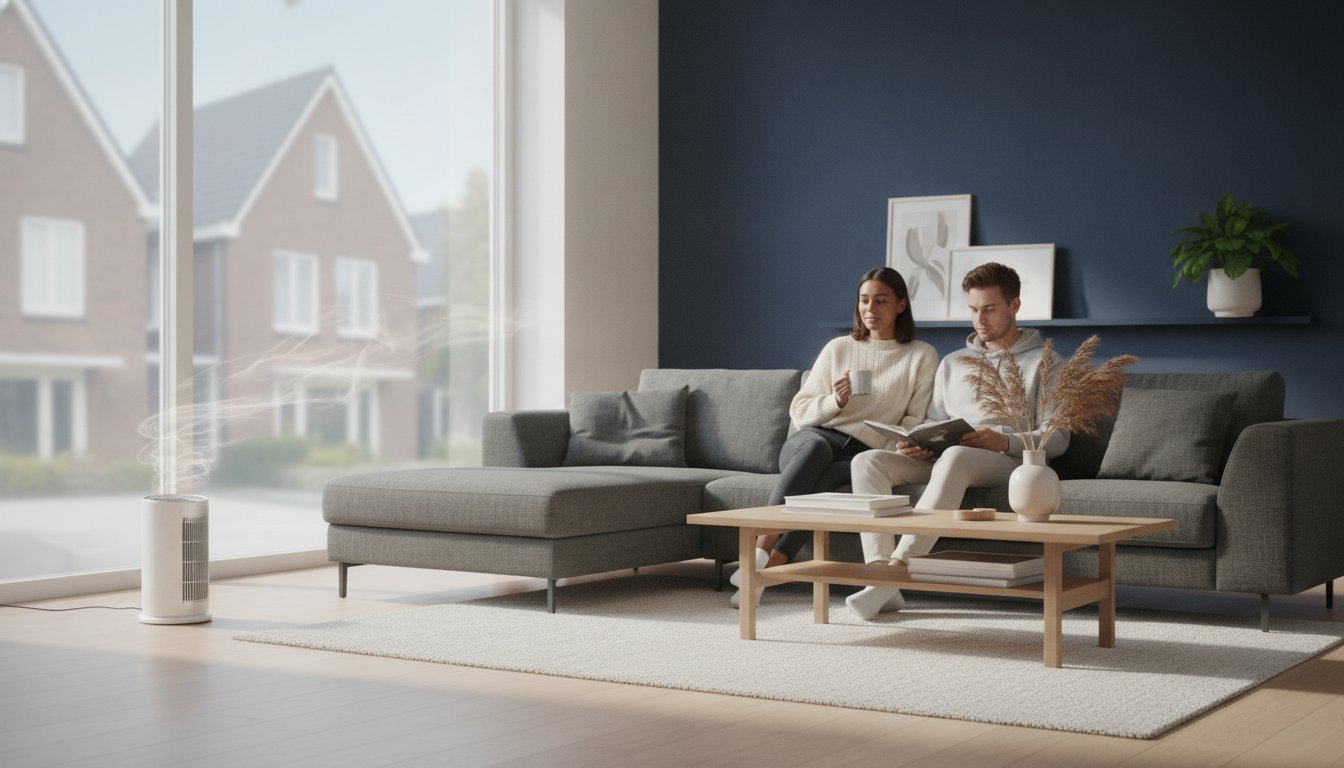
Did you know that the tax on natural gas has risen to approximately €0.73 per m³ in 2026, while the tax on electricity has actually been reduced to around €0.11 per kWh? It is therefore logical that you are looking for ways to heat your home smarter and more affordably. Nothing is more annoying than a living room that heats up slowly or that one stubborn cold corner by the window, while the radiators are running at full power. With the right fan heating, you solve this problem immediately by actively and evenly distributing the heat throughout the room.
We understand that home comfort must go hand in hand with a responsible energy bill. In this article, you will discover how fan heating warms your home faster and how you can save smartly on your monthly expenses. We will take you through the state of technology in 2026, focusing on quiet and safe solutions that suit a modern lifestyle. You will learn exactly how these systems contribute to a behaindoor climate without compromising on design or sustainability.
Key Points
- Learn how to make rooms behawithin minutes using fan heating through active and smart air distribution.
- Discover how to save hundreds of euros per year by smartly combining electric supplementary heating with a modern thermostat.
- Understand why a heater with a fan is the ideal solution for quick heating in the living room and preventing condensation in the bathroom.
- Learn all about the Norwegian quality standards and ecodesign requirements that ensure a safe and sustainable heating solution in 2026.
- Discover why BEHA 's more than 100 years of experience guarantees reliable and technologically superior products.
What is fan heating and why is it popular?
When we talk about fan heating, we are referring to systems that do not simply allow heat to rise, but actively blow it into the room. Whereas a traditional radiator or convector relies on passive convection, where warm air rises slowly and cold air sinks, a fan breaks this slow process. By creating a forced airflow, the generated heat is directed directly horizontally into the room. This ensures rapid mixing with the existing air, causing the temperature throughout the room to reach a comfortable level much faster.
The popularity of this technology has risen to a peak in 2026. This is largely due to new regulations whereby installing a (hybrid) heat pump has become the standard when replacing a central heating boiler. Because heat pumps often operate at lower temperatures, active air circulation is essential to keep the home comfortable. Moreover, the average gas price of €1,545 per m³ forces consumers to take a critical look at their heating habits. To understand the technical basis, you might ask yourself: What is a fan heater? In essence, it is a device that combines a heating element with a fan to accelerate heat transfer and eliminate cold corners.
Various types of fan heaters on the market
Not every solution works the same way. The range varies from small additions to existing systems to powerful, standalone units:
- Radiator fans: These are compact fans that you place under or on your current radiators to increase heat output.
- Electric fan heaters: These are often portable units that are ideal for heating a specific spot very quickly, such as a home office or seating area.
- Integrated solutions: These are advanced convectors equipped with an extremely quiet fan function. These devices combine the even heat of a convector with the speed of a fan.
The most important benefits for your living comfort
The biggest advantage of fan heating is speed. Instead of waiting half an hour for the room to finally feel beha, you often notice results within just a few minutes with an active airflow. This is ideal for rooms that you do not use all day. Additionally, the heat is distributed much better. You no longer suffer from a hot ceiling while your feet remain cold. Because the air is constantly moving, the drafty sensation that often occurs near large glass surfaces disappears. As a result, you can often set the thermostat one or two degrees lower without compromising on comfort, which has an immediate positive effect on your monthly energy costs.
How exactly does a heater with a fan work?
The principle behind a fan heater is as simple as it is ingenious. The device draws in cold air from the floor, where the temperature is typically lowest. This air is passed through an internal heat exchanger and then blown into the room with force. This process of forced airflow ensures that the heat does not linger around the unit but contributes directly to the user's comfort. Modern systems utilize advanced sensors and thermostats to precisely adjust the fan speed to the heat demand.
A crucial component of this technology is the electric motor. By 2026, these motors will be virtually silent thanks to brushless technology. This means you can enjoy rapid heating without the disruptive blowing sound of older models. An additional benefit of this constant air movement is that dust has less chance of settling on the heating elements and burning. This prevents the typical 'heating smell' and maintains better air quality in the home. For optimal results, it is essential to pay attention to the safe use of fan heaters, ensuring the air outlet always remains free of obstacles.
The importance of the heat exchanger
The fan's primary task is to 'pluck' the heat from the heating elements as efficiently as possible. The faster the air flows past the element, the greater the temperature difference remains and the more energy can be transferred to the room per second. The quality of the heating element itself determines its lifespan. High-quality materials such as specially behaaluminum ensure rapid heat transfer and withstand the thermal stresses of repeated heating and cooling.
Energy consumption vs. efficiency
Many people wonder if the fan itself consumes a lot of power. In practice, this consumption is negligible, often less than ten watts. The real gain lies in the time saved. Because the room reaches the desired temperature much faster thanks to fan heating, the powerful heating element does not need to operate at full power for as long. This shorter warm-up time translates directly into lower energy consumption at the end of the month. BEHAproducts meet the strictest ecodesign standards for optimal efficiency. Are you looking for a reliable solution for your home? Then take a look at our collection of fan heaters for an overview of modern systems.
Save on your energy bill with the right fan heater
With an average gas price of €1.545 per m³ in 2026, the search for cheaper alternatives is more relevant than ever. By making smart use of fan heating, you can save hundreds of euros annually. The core of this saving lies in the fact that you can turn off the central heating more often or set it to a lower setting. Instead of heating the entire house, you focus the heat exactly where you are at that moment. This is particularly effective because the tax on electricity has been reduced to approximately €0.11 per kWh, making electric supplementary heating financially very attractive.
Another major advantage is that you can lower the supply temperature of your main system. Especially in homes with a heat pump, a lower supply temperature results in a much higher pump efficiency. Normally, this would lead to a loss of comfort, but fan heating compensates for this by distributing the available heat more efficiently throughout the room. In this way, you combine the low base consumption of your central heating system with the fast, targeted heat of an active unit. Combining this with a smart thermostat ensures that you never consume more than is strictly necessary.
Fan heater as zone heating
Zone heating is one of the most effective methods to save directly on your monthly expenses. Why keep the living room and kitchen at 21 degrees if you sit in your home office upstairs all day? By setting the central heating in the rest of the house to night mode and heating only your immediate surroundings with a fan heater, you prevent unnecessary energy loss. This is ideal for the modern remote worker or for use in the hobby room during cold evenings. The result is a behaworkspace without having to heat the entire cubic meters of your home.
Payback period of your investment
When purchasing a heating solution, it is tempting to opt for a cheap model from the DIY store. However, the payback period for a quality heater is often shorter than you think. Norwegian quality, based on over 100 years of experience, means that the appliance not only lasts longer but also operates more safely and quietly. Cheap models often lose efficiency due to inferior motors or elements that lose power quickly. For maximum savings, control is essential; therefore, read more about the electric convector with Wi-Fi to discover how you can manage your consumption down to the degree via an app. Thanks to this control over your heating behavior, you will often recoup the investment in a sustainable BEHAappliance within just a few heating seasons.
Where is the best place to use a fan heater?
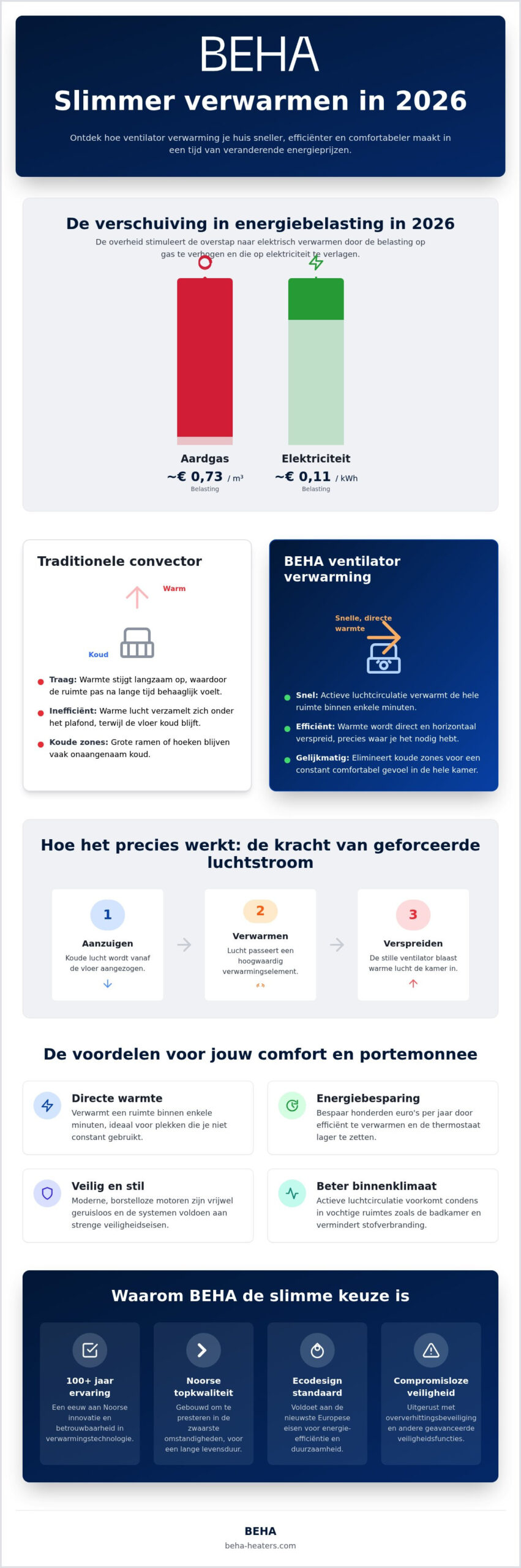
A fan heater is a versatile solution that is valuable in virtually any room, provided you choose the right model for the specific circumstances. In the living room, it is the ideal partner for those cold winter evenings. While the central heating is set to a lower level, the fan heater provides quick, behawarmth around the seating area. This way, you enjoy immediate comfort without having to unnecessarily heat cubic meters in the rest of the house.
In the bathroom, this system proves its worth in a different way. In addition to providing heat, the active airflow ensures faster removal of condensation. This helps prevent mold formation and keeps the mirror condensation-free. For larger, often less well-insulated spaces such as a garage or workshop, a powerful unit is indispensable. Here, a traditional convector often cannot dispel the cold quickly enough, whereas a fan distributes the warm air through the room with force. In the bedroom, the needs are different; there, you look for a model with a silent mode so that your night's rest is not disturbed by mechanical noise.
Safety and placement in the home
Safety always comes first at BEHA . When installing a fan heater, it is essential to maintain a distance of at least one meter from flammable materials such as curtains, furniture, or paper. Never cover the unit; the airflow must be able to pass the heat exchanger unimpeded to prevent overheating. For use in damp areas such as the bathroom, you must pay attention to the IP rating. Devices with an IP24 certification are splash-proof and safe to use in zone 2 of the bathroom, provided they are placed at the correct distance from the shower or bath.
Maintenance tips for a long lifespan
Although our products are designed for years of worry-free use, a little maintenance significantly extends their lifespan. The most important thing is keeping the intake and exhaust grilles dust-free. Dust buildup obstructs airflow and forces the motor to work harder. You can easily clean the grilles with a vacuum cleaner on a low setting or a soft brush. Would you like to know more about how to keep your system in top condition? Then read our comprehensive guide on maintenance-free electric heating for practical tips and advice.
Are you ready to take the comfort in your home to the next level with a reliable and safe solution? View the full range of BEHA fan heaters and choose the model that perfectly suits your specific space.
Why the BEHA fan heater is the smart choice
BEHA is not just any brand. As a Norwegian family business with over 100 years of experience, we understand what real cold means. Our fan heaters were developed in a climate where reliability is not a luxury, but an absolute necessity. While many providers in the Netherlands merely sell standalone fans as an extra, BEHA offers fully integrated solutions that combine technological superiority with a no-nonsense approach to comfort. You are choosing a system built on decades of expertise and continuous innovation.
A specific point where we distinguish ourselves is the noise level. Nothing is as disruptive as a constant hum during an exciting film or a good conversation. That is why at BEHA we focus on extremely quiet fans that effectively dissipate heat without you even noticing. Furthermore, the sleek and timeless design ensures that the device finds a natural place in any Dutch interior, from minimalist modern to warm classic. It is an aesthetic solution that does not compromise on power.
Sustainability and warranty at BEHA
Investing in quality is always the most cost-effective choice in the long run. We use high-quality materials that can withstand intensive use over many heating seasons. Our products meet the strictest European safety and environmental standards, including current ecodesign requirements. This means not only lower energy consumption for you, but also a smaller ecological footprint. By choosing Norwegian reliability, you avoid the need for quick replacement. This is a sustainable investment that pays for itself in peace of mind and lower maintenance costs.
Prepare your home for the future
The Netherlands is in the midst of the transition to gas-free living. With the new regulations of 2026, electric heating is the logical step forward for every homeowner. Our heaters are designed to fit seamlessly into this new landscape. Installation is simple and requires no major renovations to your home. Whether you are looking for supplementary heating for the attic or a smart solution for the home office, our systems offer the flexibility that modern times demand. Are you charmed by a robust appearance? Then also take a look at our electric heater with a steel front for a classic look that pairs perfectly with modern performance. This ensures you have a warm home, today and in the future.
Choose the living comfort of tomorrow, today
The switch to a smart and gas-free home doesn't have to be complicated. You now have a clear picture of how fan heating plays a crucial role in creating a behahome at lower costs. By using active air circulation and targeted zone heating, you enjoy warmth where you are within minutes, while keeping the rest of the house on a lower setting. This is the most effective way to keep your energy consumption under control in 2026.
As a Norwegian family business since 1917, guarantees BEHA technological superiority and reliability. Our appliances meet the strictest ecodesign requirements and are equipped with quiet and safe technology designed for the most extreme conditions. So you are choosing not only speed, but also a sustainable solution that lasts for generations. It is time to say goodbye to cold corners and high heating costs.
Are you ready to enhance your living comfort with Norwegian craftsmanship? Discover the full range of fan heaters from BEHA and prepare your home for a warm and responsible future. Enjoy the peace and warmth you deserve.
Frequently asked questions about fan heating
How much power does a fan heater consume on average?
A fan heater consumes exactly what the wattage indicates, usually between 1,000 and 2,000 watts. The fan itself consumes only a fraction of that, often less than 10 watts. Because the room heats up faster due to the active airflow, the device does not need to run at full power for as long as a passive heater. This results in more efficient energy use, especially when using the device specifically for zone heating in the home.
Does a heater with a fan make a lot of noise while sleeping?
Modern appliances are designed to operate extremely quietly. BEHA uses brushless motors and advanced fan blades that minimize air movement to a soft hum. In the bedroom, this is barely audible, especially when the heater is running on a lower setting to maintain the temperature. For an undisturbed night's sleep, it is essential to choose Norwegian quality specifically developed for long-term, quiet indoor use.
Is it safe to leave a fan heater on all day?
Yes, high-quality models are designed to function safely for extended periods. Our systems are equipped with overheating protection and comply with all European safety standards and ecodesign requirements. However, it is important that the unit is placed in an open area and is not covered by clothing or curtains. Thanks to the built-in thermostat, the heating switches off automatically as soon as the desired temperature is reached, which benefits both safety and efficiency.
Can I use a fan heater in the bathroom?
That is certainly possible, provided the device has an IP24 certification. This classification indicates that the unit is splash-proof and can be safely installed in damp areas. In the bathroom, a heater with a fan is actually very practical, as the warm air moves quickly through the room and cold corners disappear. When installing, always ensure that you maintain the prescribed safe distance from the shower or bath.
Does a fan heater really help prevent mold and condensation?
Active air circulation is one of the best ways to tackle moisture problems. Because the fan keeps the air constantly moving, condensation has less chance to settle on cold walls or windows. This significantly accelerates the drying process of the room after showering or cooking. By lowering humidity faster, you create a healthier indoor climate and prevent the formation of harmful mold in the long run.
Do I need to adjust my boiler settings if I use fan heating?
It is smart to turn down the thermostat on your central heating boiler by a few degrees. This prevents the central heating from keeping the entire house unnecessarily warm, while the fan heater only heats the room you are actually in. This hybrid approach results in the greatest savings on your energy bill. Especially in well-insulated homes with a heat pump, this method works excellently to absorb peaks in energy consumption.
What is the difference between a ceramic heater and a fan heater?
A ceramic heater is a specific type of fan heater in which the heating element is made of ceramic. Ceramic generates less heat than traditional metal heating elements, resulting in less dust burning and better air quality. Furthermore, ceramic retains heat slightly longer after the device has been switched off. Both fall under the category of fan heaters, but the ceramic variant is often perceived as more comfortable and safer for daily use in the living room.
How often should I clean the filters or grilles of my fan heater?
We recommend cleaning the grilles at least once a month during the heating season. Dust accumulation at the air intake obstructs airflow, causing the motor to work harder and reducing efficiency. You can easily do this yourself by running a vacuum cleaner on a low setting along the grilles. This small amount of maintenance keeps the motor running quietly and extends the lifespan of the fan heater by many years.