
Flat wall convector for low windows to combat cold drafts and cold spots
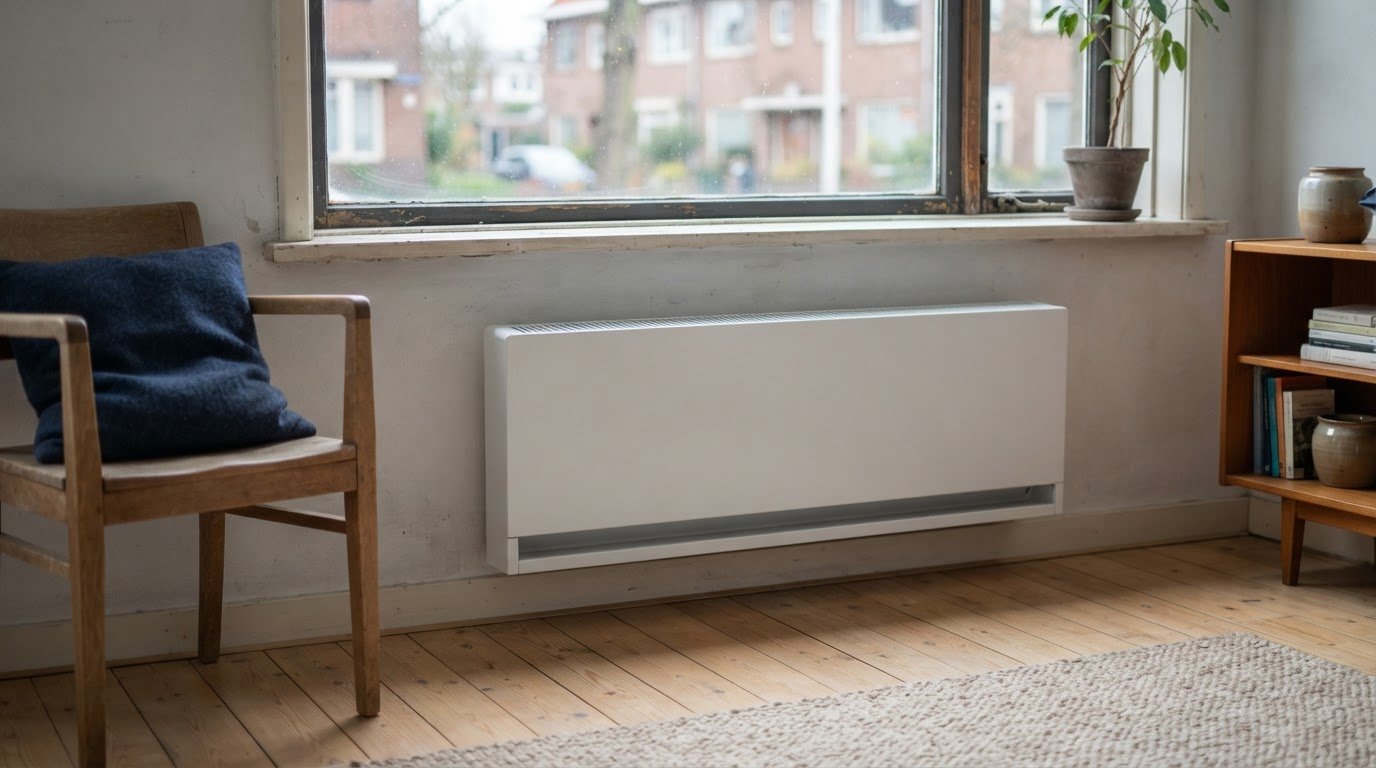
A heater under a low window can do more than just bring the room up to temperature: it also helps warm up cold air along the window. A flat wall convector for under low windows heats the air, which rises while cooler air is drawn in from below. This air circulation can limit cold drafts and breezes.
This is convenient when a window leaves little room for a deep radiator. Read how a convector works, what to look out for regarding the connection, and how placement under a window can improve comfort. You will also discover which factors determine whether a flat version suits your room, so you can weigh the options accordingly.
Key points
- Discover how a convector heats air and why that principle can be suitable under a low window.
- Learn how room dimensions and insulation factor in determining the required heating capacity.
- Know what to look for regarding a connection on the left or right side.
- See how placement near a window can help limit cold drafts and chills, and which convector models BEHA offers.
What is a convector radiator?
A convector heats air past a heat exchanger. The warm air rises and cooler air is drawn in from below, keeping the air around the window in motion.
Warranty conditions and quality marks vary by unit; there is no general term that applies to all wall convectors. Follow the unit manual during installation, use a suitable wall, and take into account the connection instructions.
Dimensions and heating capacity
Measure the available width, height, and depth under the window before choosing a radiator. A flat wall convector for under low windows must fit without blocking air circulation. Additionally, compare the stated output with the room's heat demand. A guideline associates a well-insulated room with approximately 60 to 80 watts per m². With average insulation, this is about 80 to 100 watts per m², and with poor insulation, 100 to 120 watts per m². According to the example, a 20 m² room with average insulation requires approximately 2000 watts.
Warm-up speed and noise level
The convector heats the air past its heat exchanger; rising warm air then spreads throughout the room. How quickly this becomes noticeable depends, among other things, on the output and the heat demand. With a water-fed radiator, the supply temperature also plays a role. According to the product information, convectors can operate at 35-45 °C. A convector without a fan has no moving parts and operates completely silently. This can be pleasant in a bedroom or workspace, where background noise affects comfort. Therefore, look not only at the heating response but also at the presence of a fan.
Power and range
The required power depends on the surface area and insulation of the room. Windows and exterior walls also influence the heat demand. Use watts per m² as a first guideline, not as a substitute for a proper calculation. For water-fed radiators, pay close attention to the measurement conditions on the label: the stated wattage is measured at a supply temperature of 75 °C. At 45 °C, the stated rough correction factor relative to the label is 2. Therefore, do not compare wattages without taking the supply temperature into account. This way, you match the capacity to both the room and the heating system.
Heat dissipation and energy efficiency
Heat output depends on the power, the choice of appliance, and the heat demand. Therefore, do not just compare wattages, but also consider the conditions on which they are based.
Fast warm-up
A convector emits heat as soon as the heat exchanger heats up. The air passing by becomes warmer and rises, while cooler air flows in. How quickly the room heats up depends on the output and on heat loss through windows and walls. The control system also plays a role: a thermostat can make the heating respond to the set temperature. In an electric convector, electricity is converted almost entirely into heat. This says something about the conversion within the unit, but not automatically about power consumption or total costs.
For a required heat output of 1,500 watts, the product information recommends a convector with approximately 3,000 watts on the label, or a version with a fan. This difference underscores why you should not judge the label rating in isolation from the usage situation. The right choice depends on the heat the room requires and how the unit delivers it.
Heat distribution in the room
Warm air flows upwards and spreads from the convector throughout the room. Cooler air sinks and flows past the heat exchanger again. This cycle supports an even temperature distribution. Placement near a window can heat up cold air before it spreads further through the room. Keep the airflow clear: furniture or long curtains directly in front of the unit can obstruct the distribution.
Evaluate price and heat output together, not as separate features. A higher-powered appliance consumes more electricity during use than an appliance at a lower setting. Actual energy costs depend on the power output, the duration of use, and your electricity tariff. Therefore, compare the purchase price with the intended application and pay attention to the controls and installation location. This prevents you from selecting based solely on a low price or high wattage.

Connection left or right
The connection depends on the type of wall convector. An electric version does not require water pipes and plugs into a standard socket. For a water-based convector, the supply and return pipes are important. Therefore, first determine which type of heating you are looking for.
An electric convector has no water connection on the left or right. The mounting location and the available power connection determine where the unit can practically be hung. Route the cable according to the manual and keep the air outlet clear. The temperature control regulates the heat output. Because warm air rises, sufficient free space above the unit is also important.
For a water-fed convector, the pipe position is crucial. A 2-pipe convector has two pipes: one supply pipe and one return pipe. Therefore, check on which side the pipes exit the floor or wall. If the supply and return do not connect to the chosen version, the connection will not fit without modifying the pipework.
A 4-pipe convector works differently: it has two separate heat exchangers, one for hot water and one for cold water. This type is used in systems that both heat and cool. It is therefore not the same as an electric wall convector. The choice between left and right must match the piping plan and the desired operation.
Use this order when assessing a water connection:
- Note where the supply and return lines terminate.
- Compare that position with the connection side of the convector.
- Check whether the selected version is compatible with the heating system.
A fan does not change the duct position but can distribute heat through the room more quickly. For an electric version, the power supply is the determining factor. A suitable connection makes installation clearer and prevents unnecessary modifications. Match the unit to the existing situation, the available space, and the desired temperature control.
Limitation of cold drafts and cold spots
A convector near a window heats cold air before it flows further into the room. Curtains or objects can obstruct the airflow; therefore, keep the area around the unit clear.
Reduce cold draft
With a cold window, cooled air sinks. An electric convector along an exterior wall or under the window heats that air. The warm air then rises and spreads throughout the room. In this way, the convector can limit cold drafts and breezes, but it does not remedy gaps in the window itself.
Placement is important for even operation. Do not place a sofa or cabinet directly in front of the unit, as this can block the airflow. A compact model under a low window can be a solution when wall space is limited. Choose a model that suits the available space and the room's heating needs.
Placement near curtains and floor
Curtains hanging over the convector can block the outflow of warm air. The heat then remains partially trapped behind the curtain instead of spreading evenly throughout the room. Dust close to the unit can also become hot. Therefore, keep curtain fabric away from the air outlet and follow the installation distances in the manual.
Close to the floor, the air intake must remain clear. A thick rug, skirting board, or storage basket can restrict the inflow of cold air. Before installation, check the space between the floor, the unit, and window coverings. There is no universal distance for every model; the manual determines the correct placement. This prevents the interior and the heating from interfering with each other.
Modern convectors combine compact dimensions with various fronts and a quiet design. When making your choice, also consider the noise: a unit with a fan may sound different from a model without moving parts. The right placement supports both air circulation and comfort by the window.
View convectors for installation near low windows and compare which model suits your space and interior.
BEHA
BEHA offers electric convectors for a wide range of spaces and finishes. When making your choice, take into account the limited height, available wall width, and desired appearance. The range includes smart convectors with steel, glass, or paintable fronts, and Classic convectors. The smart versions can be controlled via Wi-Fi and an app.
For low windows, dimensions, capacity, and unobstructed airflow are particularly important. Use the points to consider in this article to determine which features matter for your situation. This way, you compare not only appearance but also practical placement and operation.
Would you like to know which BEHAconvector suits your space? Then contact BEHA.
Choose a solution that fits your space
Make the spot under the window a deliberate choice in your interior. Consider not only the heating itself, but also the use of the space and the desired look. A flat wall convector for under low windows can thus become part of a well-thought-out design, rather than a standalone practical addition.
In addition to Classic convectors, BEHA offers smart convectors with a steel, glass, or paintable front. This allows you to match the finish to your interior style. The smart versions can be controlled via Wi-Fi and an app. Which version suits you depends on the available space, the desired look, and how you want to control the heating.
Would you like to calmly compare the options for your situation? Contact BEHA to discuss your choice further. This way, you can determine with a clear picture which heating suits your windows and interior.
Frequently Asked Questions
How do I choose the right convector?
Choose a convector based on the available space, the heat demand, and the desired operation. For a low window, the unit dimensions and the free space around the unit are the determining factors. Also determine whether you are looking for an electric version or a unit for water heating. Finally, consider the desired finish, such as a steel, glass, or paintable front.
How much power does a convector produce?
The power output varies by model. Depending on the version, BEHA electric convectors have a power output of 400 to 2000 watts. The smart convectors with a glass front range from 600 to 1250 watts; those with a steel front from 400 to 2000 watts. Compare the power output of a chosen unit with the heating demand of your room.
Which flat wall convectors are suitable for mounting under low windows?
A flat wall convector for under low windows will only fit if the dimensions match the space under the window. BEHA offers smart convectors with a steel, glass, or paintable front, as well as Classic convectors. The suitable version depends on the available height and width, the required power, and the installation instructions for the specific model.
What are the dimensions and required clearance for low wall convectors?
Dimensions and required clearance vary by model; therefore, there is no single size that applies to all low wall convectors. Measure the height from the floor to the bottom of the window and also note the available width and depth. Take skirting boards, curtains, and furniture into account. Then consult the installation manual for the prescribed space around the chosen unit.
How do you calculate the required power of a wall convector per room?
Start with the floor area of the room and then look at the insulation and the amount of glass or exterior wall. These factors influence how much heat the room loses. Compare the result with the capacity of the convector and, for water-fed units, pay attention to the supply temperature. This prevents you from relying solely on the room size.
How much does a flat wall convector cost, including installation, in the Netherlands?
The total price consists of the price of the chosen unit and any installation costs. These depend on the model and the requirements of the installation, such as the available connection and the existing situation. BEHA sells electric convectors; you handle the installation yourself or have it carried out separately. Therefore, the total amount including installation is not the same for every room or home.