
Glass panel radiator with Wi-Fi control: how to choose smartly

A glass front does not automatically make a radiator the right choice. For a glass panel radiator with Wi-Fi control, the heating capacity, dimensions, and how you want to regulate the temperature also matter. A model that complements your interior beautifully can be disappointing if it does not suit the room or your daily habits.
Perhaps you are primarily looking for convenience: adjusting the heating via your phone, even when you are not near the unit. Exactly what you can adjust varies by model. Therefore, check which app functions are available and whether they suit how you heat your home. Also, look beyond the appearance: the glass front must match the location where the radiator will be installed and the intended use.
In this article, you will learn how to assess the required power, the practical benefits of Wi-Fi control, and which product specifications to check before purchasing. You will also discover what to look for regarding dimensions, installation, and daily use. This way, you compare models based on space, control, and appearance, not just the front. BEHA has been making electric heating since 1917.
Key Points
- Match the heating capacity and dimensions to the room and check the product specifications before making a choice.
- See which features the app and thermostat of the glass panel radiator with Wi-Fi control actually offer.
- Compare glass, steel, and paintable fronts based on appearance and maintenance, so that the finish suits your interior and daily use.
- BehaWi-Fi as a way to control the heating, not as a guarantee of lower energy consumption.
- Before purchasing, check the installation requirements and assess whether a smart convector with a glass front meets your preferences regarding operation and design.
What makes a glass panel radiator with Wi-Fi control suitable for your space?
An electric heater with a glass front combines room warmth with a striking finish. Additionally, Wi-Fi control offers the option to change settings via an app. This combination might be suitable if you are looking for a radiator that complements your interior and you want to control the temperature digitally. The right choice also depends on the room and the technical specifications.
When selecting a unit, consider the use of the room, the desired temperature, and the available wall space. A compact workspace may have different requirements than a larger living room. The required capacity depends on factors such as the room's dimensions, insulation, and heat loss. Therefore, do not choose based on a single general rule of thumb. Compare the recommendations and specifications of the specific model with your situation.
What do manufacturers mean by a glass panel radiator?
The term often refers to an electric convector with a glass front. The glass is the visible finish; the precise construction and heat output can vary by model. With convection heating, air inside the unit is heated and circulates through the room. Read more about how convector heating works to better understand the heating principle.
A sleek front can look calm in a modern interior, but it says nothing in itself about the heating capacity or performance. For this, check the technical specifications, such as the power output and dimensions. Also consult the product information for the exact version: the term 'glass panel radiator' does not reveal everything about the characteristics of the unit.
For whom is Wi-Fi control practical?
Wi-Fi control can be handy if you want to adjust the temperature without walking to the radiator, for example from another room. An app is also convenient if you prefer using your phone rather than the controls on the device. The features vary by model, so check whether the app offers functions that suit your usage.
Wi-Fi control on an electric radiator means you can adjust settings via an app and a wireless network connection, provided the model supports these features. Check which app is required, which settings you can change, and whether your network meets the requirements. This way, you evaluate the glass panel radiator with Wi-Fi control based on both practical utility and suitability, rather than just the finish.
How do the glass front, the heating, and the Wi-Fi control work together?
In an electric convector, the heating element heats the air inside the unit. Warm air rises and cooler air is drawn in. This creates air circulation that helps heat the room. The glass front is the visible finish; Wi-Fi is the way you can operate the unit. These components therefore each have a different function.
Wi-Fi enables remote control, but does not automatically reduce energy consumption. This depends, among other things, on how you set up and use the heating. An app with temperature control or schedules can help tailor settings to your routine, if the chosen model supports these features. Also read the explanation from Milieu Centraal about saving energy with a smart thermostat. Check the product information for electric convectors with Wi-Fi to see which features are available per model.
What functions can a heating app offer?
The possibilities vary by device and product version. Therefore, check not only whether an app is mentioned, but also what you can configure with it. Use these points as a checklist:
- App: which app belongs to the device and is it available for your phone or tablet?
- Network: what Wi-Fi requirements apply to the connection and installation of the app?
- Temperature: can you adjust the desired temperature via the app?
- Schedules: can you program heating times, or does this version not offer that option?
- Thermostat control: which settings can you change on the device itself and via the app?
Check this information in the product specifications before choosing. A glass panel radiator with Wi-Fi control may have different functions depending on the model. Therefore, do not assume that remote control includes programming or other smart features.
What do you need to know about the glass front?
A glass front gives the appliance a sleek, clean look and adds a different accent than a steel or paintable front. The finish itself does not indicate how much heat is emitted or how powerful the appliance is. Therefore, compare the design with the dimensions and the location where the heater will be installed. This way, you can check whether the appliance fits both the room and your interior design.
Maintenance instructions may vary by version. Follow the product information for the relevant model and immediately check the assembly conditions therein. This way, you assess the front, heating, and controls as interconnected features, without assuming performance not listed in the specifications.
Glass front with Wi-Fi or another radiator: how do you compare fairly?
Start a fair comparison with what you need at home, not with a single striking feature. A glass front might suit a sleek interior, while steel or a paintable finish aligns better with your preference for color and appearance. Wi-Fi control is a separate choice: it determines how you operate the device, not which front you choose.
Compare the options based on the same points. The design, dimensions, mounting options, and features may vary by model. Do not enter missing information yourself, but check it in the product information.
| Function | Checkpoint | Point of attention |
|---|---|---|
| Glass front | Do the color and finish suit the room? | Evaluate the front independently of the heating capacity. |
| Steel front | Does the material match the desired look? | Compare the actual finish per model. |
| Paintable front | Do you want a finish that you can match to the interior? | Check which instructions apply to finishing and maintenance. |
| Wi-Fi control | Which settings can you adjust via the app? | Check app, network requirements, and compatibility for your device. |
| Dimensions and assembly | Does the device fit in the intended location? | Consult the dimensions and assembly conditions of the model. |
When does a glass front suit your interior?
Look at the colors, surfaces, and lines in the room. A smooth glass surface looks different from steel or a paintable front. Which finish works best depends on your decor and placement. Measure the available space and compare it with the dimensions and mounting options in the product specifications. If you want a different look, also consult a buying guide on an electric heater with a steel front or a guide on a paintable radiator.
When does Wi-Fi control add enough convenience?
Wi-Fi is particularly useful if you want to regularly adjust settings without operating the device itself. If you make few changes and usually operate the heating on-site, manual operation may suffice. Neither choice is better for everyone. For a glass panel radiator with Wi-Fi control, check whether the app works with your device and network, and what features the model offers. Therefore, choose Wi-Fi because it fits your routine, not because you obviously need the feature.
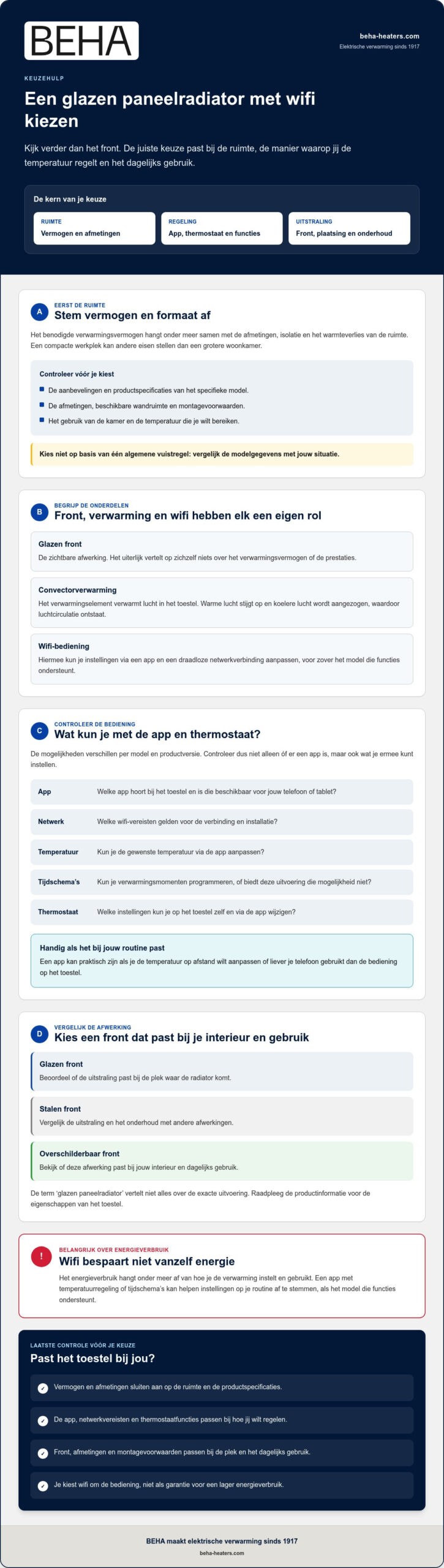
Which glass panel radiator with Wi-Fi should you choose? Use this checklist
Making the right choice starts with information about your space and usage. Only then should you compare the models. This prevents an attractive front or a handy app from distracting from important factors such as power output, available space, and installation requirements.
What data do you collect before purchase?
- Map out the space. Note the dimensions and consider how you use the room. A room where you spend a lot of time may have different heating requirements than a room you only use occasionally.
- Check the recommended power output. Compare the appliance's specifications with reliable product information for your space. Do not rely on a universal rule: insulation and heat loss can play a role. If the required power is unclear, ask an expert for advice.
- Decide how you want to operate it. Do you want to frequently adjust settings via an app, or do you prefer to control the heating on-site? A glass panel radiator with Wi-Fi control is a particularly logical option if the app functions fit your daily routine.
Which product details do you check in the specifications?
- Compare the dimensions with the available space. Check the dimensions, mounting options, and installation conditions for each model. Also check which parts are included. Do not assume that mounting hardware is included as standard.
- Check the operation carefully. Find out which app accompanies the device, whether it is available for your phone, and which settings you can adjust with it. Also verify the network requirements and any compatibility in the current product documentation. Features may vary by version.
- Evaluate the front and maintenance. Compare the finish with your interior and read the model-specific maintenance instructions. If you prefer a different look, also check out a buying guide on an electric heater with a steel front or a guide on a paintable radiator. For a more detailed explanation of operation and models, you can consult the guide on electric convectors with Wi-Fi.
- Weigh the placement and connection. Follow the manufacturer's installation instructions. If you are unsure about the suitable location or the electrical connection, seek advice from a qualified electrician before installing or connecting the appliance.
Use this checklist to compare models and request missing information before you decide. If you want to view the specifications of smart convectors with a glass front, discover the BEHAconvectors.
BEHA and the choice of a smart convector with a glass front
BEHA is a manufacturer of electric heating, founded in 1917. The range includes smart convectors with a glass front. This makes the brand relevant if you want to balance design and operation in a single product choice. The manufacturer's experience does not replace checking the product specifications. Check per model how the convector fits your space and preferences.
Which BEHAfeatures are relevant to your comparison?
Use the same points of attention as with any other device: power, dimensions, mounting requirements, finish, and operation. Check the current product information to see if the specific model combines a glass front with Wi-Fi control. Also check there which settings the app supports. Do not rely on features you have seen on another version; capabilities may vary by product.
BEHAproducts meet Ecodesign requirements. Check the information for the model you are considering to clarify what this statement refers to. Additionally, compare the recommended heating data with the characteristics of your room. A glass front is a choice regarding appearance, not an indication of the required power.
When comparing, ask yourself these questions, for example:
- Is the capacity suitable for the room according to the product information?
- Do the dimensions match the available space and installation requirements?
- Does this version have Wi-Fi control, and does the app offer the settings you want to use?
- Does the glass front match your interior and the location where the convector will be installed?
What is a logical next step?
Compare the current product specifications with your answers to these questions. This way, you will evaluate the glass panel radiator with Wi-Fi control on more than just its appearance and see where you are still missing information. Pay particular attention to the combination of the front panel, Wi-Fi connection, app functions, and technical execution.
If you would like a feature clarified, ask a dealer for product information on the model in question. This allows you to compare functions and installation requirements to your specific situation. A sensible choice combines space, organization, and appearance, without weighing unconfirmed characteristics. Check the details before you decide.
Choose with confidence and compare the details
A good choice combines three things: sufficient output for your space, a front that matches your interior, and controls that fit into your daily routine. Therefore, do not just compare the appearance of a glass panel radiator with Wi-Fi control, but also check the dimensions, installation requirements, and app functions. Wi-Fi offers convenience, but it does not automatically make a device more energy-efficient.
BEHA was founded in 1917 and has over a hundred years of experience with electric heating. The range includes smart convectors with a glass front. BEHAproducts meet Ecodesign requirements. Check which features actually apply to the model you are considering, including the combination of a glass front and Wi-Fi control, and the available app functions.
Would you like to compare the specifications with your needs? 's smart heating solutions BEHA and compare the product information. This way, you can make a choice that suits the space and your heating style. View the models and compare the specifications to determine your choice.
Frequently Asked Questions
Is a glass panel radiator with Wi-Fi control suitable as primary heating?
That is possible, provided the unit has sufficient capacity for the room and matches your home's heating needs. These needs depend on factors such as dimensions, insulation, and heat loss. A glass front or Wi-Fi function does not, in itself, prove that the radiator is suitable as primary heating. Compare the product specifications with reliable information about your room and seek expert advice if you have any doubts about the required capacity.
Can I control an electric radiator with Wi-Fi remotely?
Yes, if the model supports app control and the connection is set up correctly, you can adjust settings via your phone when you are not near the device. The available functions vary by version. Therefore, check which app you need, whether it is compatible with your phone, and what network requirements apply. Also check if you can change the temperature and if the device has manual controls.
How do I choose the right power output for a glass panel radiator?
Match the capacity to the room, not just the appearance or surface area. Dimensions, insulation, desired temperature, and heat loss all play a role. Note the characteristics of the room and compare them with the recommendations and technical specifications of the specific appliance. A general rule of thumb does not always provide a reliable answer for your home. If the required capacity is unclear, seek advice from an expert before choosing a model.
Is a glass front more difficult to clean than a steel front?
You cannot deduce this solely from the material. The finish and maintenance instructions may vary by model. Therefore, consult the product information for suitable cleaning agents and cleaning instructions. Do not use a method based on assumptions, as you do not want to damage the surface. When making your choice, also consider how the front fits the location of the radiator and the maintenance you find practical in your home.
Does Wi-Fi control work even if my internet connection drops?
That depends on the device, the app, and how the controls are configured. Remote control via the internet may be unavailable during an interruption, while control on the device itself might continue to work. Do not automatically assume this: check the manual or ask the manufacturer or dealer which functions remain available offline. Also check whether the device has local manual control if the connection is lost.
Does a glass panel radiator with Wi-Fi automatically save energy?
No, Wi-Fi control does not in itself guarantee lower energy consumption. The feature provides a way to adjust settings; the effect depends on how you use the heater and the control options the model offers. Check whether the app supports temperature settings or schedules, for example, and whether those features fit your routine. A smart feature is particularly useful when you use it consciously, not just because the device is connected to Wi-Fi.
What information should I check before buying a smart convector?
Check the recommended power, dimensions, and mounting conditions for the model. Additionally, verify whether the device actually combines a glass front and Wi-Fi control, which accompanying app is used, and which features and network requirements apply. Also, compare the finish with your interior and read the instructions for use and maintenance. Finally, check which parts are included and, if unclear, request product information from the manufacturer or dealer.