
Heating a gas-free home: the complete guide to a sustainable future
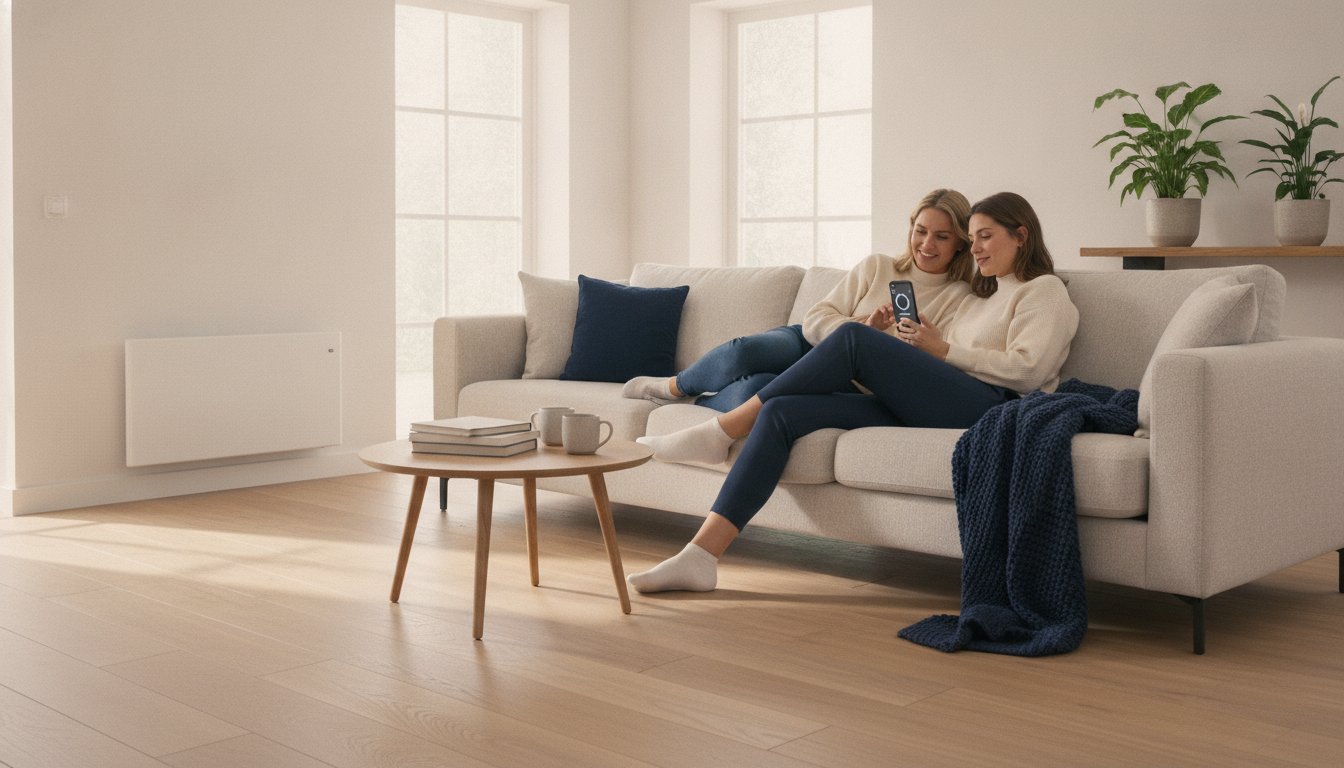
Would heating a gas-free home be possible without the tens of thousands of euros that a complete heat pump installation often costs? You are certainly not the only one daunted by the high initial investment or who fears that an electric home will never truly become behawarm in the winter. The uncertainty about which technology really suits your specific situation often causes unnecessary delays in making your home more sustainable.
In this comprehensive guide, you will discover how to heat your home efficiently and comfortably without a gas connection, using modern electric solutions that deliver immediate results. We show you that a sustainable future does not have to involve major renovations or a cold house. You will learn everything about the benefits of smart convectors, the impact of changing energy taxes in the Netherlands, and how to structurally reduce your monthly costs. This makes the switch to electric heating clear and feasible. We take you step by step into the world of modern heating technology, so you can turn your home into a warm, future-proof place where comfort and innovation go hand in hand.
Key Points
- Understand the essence of the Dutch energy transition and the growing role of electricity as the primary energy source in your home.
- Discover how you can optimize the heating of your gas-free home by combining smart technology with precise thermostat control.
- Compare the all-electric heat pump with electric convectors to determine which solution best suits your budget and living preferences.
- Receive a practical step-by-step plan for a successful transition, from the right insulation to calculating the required capacity per room.
- Learn why BEHA 's years of Norwegian experience form the basis for a reliable, stylish, and maintenance-free heating system.
Heating a home without gas: what exactly does it entail?
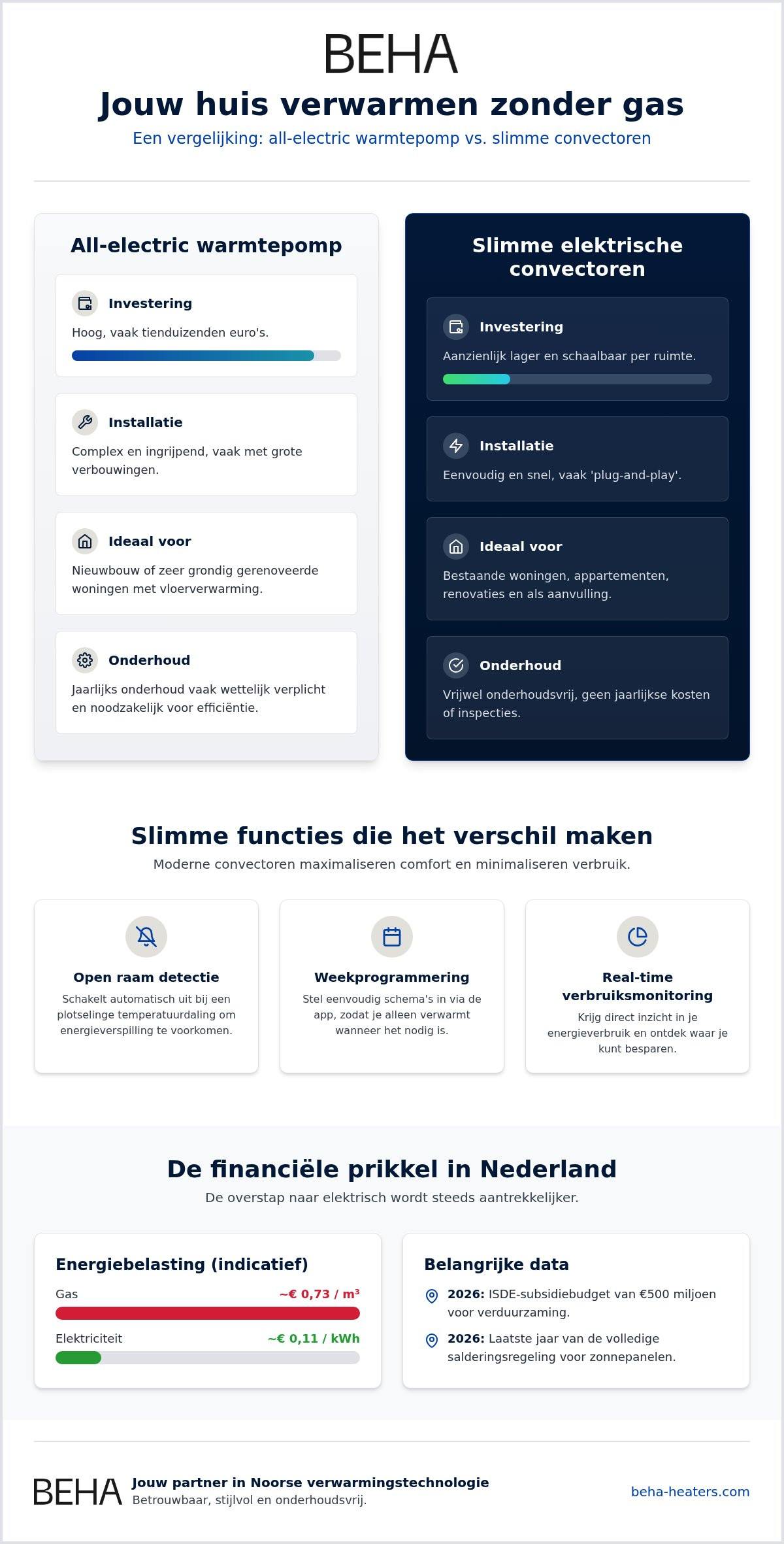
The concept of a gas-free home is no longer a pipe dream in the Netherlands. It simply means disconnecting your house from the gas grid and switching entirely to electricity as the primary energy source. This shift is at the core of the national energy transition, in which we aim for a climate-neutral built environment by 2050. The year 2026 marks a crucial turning point for many homeowners. The government has reserved an ISDE subsidy budget of no less than 500 million euros for that year. Combined with an energy tax on gas of approximately 0.73 euros per m³ and only 0.11 euros per kWh for electricity, the financial incentive to act now is greater than ever. Moreover, 2026 is the final year in which the net metering scheme remains fully in effect, significantly shortening the payback period for investments.
When living gas-free, you can choose from various scales. A hybrid setup combines an electric heat pump with a small gas boiler for peak moments, but the ultimate step is all-electric. In that situation, the gas meter disappears from your meter cupboard permanently. The technology behind modern electric heating forms the basis for this transition. Whether you choose a complex heat pump or the simplicity and precision of smart electric convectors, the goal remains the same: to heat a comfortable and gas-free home in a sustainable way.
The benefits of a home without a gas connection
Switching to a gas-free home yields immediate benefits for the environment. You significantly reduce your personal carbon footprint by no longer burning fossil fuels for heating. Additionally, it offers a sense of security and independence. You are no longer at the mercy of the volatile fluctuations of the global gas market or geopolitical unrest driving up prices. Finally, there is the economic aspect. A home with an excellent energy label and no gas connection is significantly more desirable on the housing market, which immediately increases the value of your property.
The challenges you need to take into account
Making your home more sustainable is a process that requires the right sequence. The biggest challenge is often the insulation level of the home. An electrical system only works optimally in a well-insulated house where heat loss is kept to a minimum. You will also need to consider adjustments in the kitchen, such as switching to induction cooking, and a new solution for your hot shower water. A smart approach is essential here. By choosing systems with advanced thermostats and app control, you prevent unnecessary energy consumption and keep monthly costs manageable.
The technology behind modern electric heating
A modern electric convector is a marvel of Norwegian engineering that goes far beyond a simple heater. The principle is based on natural convection. Cold air is drawn in from below, heated by an advanced element, and then silently distributed throughout the room. Contrary to popular belief, this is an extremely effective method for heating a gas-free home, provided the technology is controlled precisely. Trade associations for sustainable heating technologies regularly emphasize that the efficiency of a system depends entirely on its control.
This is where ecodesign standards come into play. These European guidelines require manufacturers to design heating solutions that have a minimal impact on the environment and offer maximum efficiency. A crucial component of this is the thermostat. While older systems often experienced large temperature fluctuations, modern versions operate with an accuracy of 0.2 degrees. This prevents the room from becoming unnecessarily warm, which directly results in a lower energy bill. Wi-Fi connectivity plays a key role in this. With it, you have control over your consumption and the temperature in every individual room, anytime and anywhere.
Smart features that make the difference
The real gain lies in the intelligence of the equipment. Open window detection is a smart feature that reacts immediately when the temperature drops suddenly in a short period of time. The convector then temporarily switches itself off, so you are not literally heating the outside air. You can easily set up a weekly schedule via a user-friendly app. You then only heat during the times you are actually present. By monitoring your energy consumption in real-time, you gain insight into your habits and can make adjustments where necessary. It is this combination of technology and ease of use that makes a smart convector an indispensable part of a modern home.
Design and integration into your interior
Heating no longer needs to be a disruptive element in your interior. You can choose between robust steel fronts for a sleek look or luxurious glass fronts that give your living room a modern appearance. For those who desire maximum discretion, there are paintable radiators. You can paint these in exactly the same color as your wall, making them virtually invisible. Furthermore, thanks to the slim wall mounting, you save valuable floor space compared to traditional, bulky radiators. This makes it possible to heat a gas-free home in an aesthetically pleasing way, which is also essential in the compact and stylish homes of Tiny House Cottages.
Finding the right balance between comfort and cost is key to a successful transition to a gas-free home. While a heat pump is often presented as the standard solution, smart electric convectors offer a more accessible alternative that proves surprisingly efficient in many situations. The choice depends heavily on your budget, the insulation level of your home, and how intensively you use certain rooms.
Direct electric heating versus the heat pump
The biggest advantage of smart convectors is the simplicity of the system. You do not need to drill holes in your exterior wall for a large outdoor unit, and no complicated pipework is involved. This translates directly into extremely low installation costs compared to an all-electric heat pump. Furthermore, because these systems contain no moving parts such as pumps or compressors, they are virtually maintenance-free. Therefore, you never have to schedule a technician again for an annual inspection or repair of the mechanics. Another plus point is speed. While a heat pump needs time to reach the desired temperature, with a convector you experience immediate comfort as soon as you step into the room. This makes it an ideal solution for heating a gas-free home in rooms where you are not present all day.
Infrared versus convection: which is more comfortable?
The choice between infrared and convection is determined by how you want to experience heat. Infrared panels emit radiant heat that directly warms objects and people, similar to the sun's rays. This feels pleasant in rooms where you sit still a lot, such as a bathroom or a study. However, for the overall heating of your home, convection is often the better choice. It heats the air evenly and ensures stable circulation, preventing cold spots from forming in the room. A well-thought-out combination often yields the best results for your living comfort: convectors for a constant base temperature and infrared for targeted, rapid heat in specific areas.
The power of a hybrid setup should not be underestimated in this regard. You can choose to have a heat pump handle the home's base load, while electric convectors provide backup in the bedrooms or during extremely cold periods. This reduces the load on your main system and extends its lifespan. In terms of costs, the initial investment for convectors is only a fraction of that for a central system. With an expected electricity tax of €0.11 per kWh in 2026, this layered approach to heating a gas-free home remains a financially sound choice for the long term.
Step-by-step plan: successfully heating your home gas-free
A successful transition to a gas-free home requires a methodical approach. It is not simply a matter of replacing the boiler; it is a process where every step determines the efficiency of the next. By following a structured step-by-step plan, you ensure that your investment pays for itself optimally in terms of comfort and lower monthly costs.
Insulation as a foundation
Effectively heating a gas-free home always starts with your home's envelope. Without proper insulation of the roof, walls, and floor, the generated heat dissipates faster than you can produce it. In a gas-free future, HR++ or triple glazing is the standard; it keeps the heat in and the cold out. Specialized distributors like Hawaii Architectural Sales innovative solutions for integrating such high-quality elements into a home design. Don't forget the details, either. Small interventions such as draft strips and radiator foil have a surprisingly large impact on the final efficiency of your electrical system.
Calculating the correct power output is a crucial technical step to guarantee comfort without wasting energy. A general rule of thumb is to assume approximately 60 to 80 Watts per m³ for the living room and 40 to 60 Watts for bedrooms, depending on the quality of insulation. By choosing exactly the right power output, you prevent unnecessarily high peak loads on your power grid and save directly on your consumption. This ensures a stable temperature without the equipment having to run at full power constantly.
Installation and management
With modern electric convectors, you have the advantage that installation is extremely simple. Wall mounting is often just a matter of a few screws, meaning you don't need an expensive professional for the wiring. However, it is advisable to have your electrical installation checked; with a complete switch, an upgrade to a 3-phase connection may be necessary to power all appliances simultaneously. Once mounted, you can easily connect the units to your Wi-Fi network for maximum control via an app. During the first gas-free heating season, it is smart to closely monitor your consumption and fine-tune your programs based on your actual lifestyle.
Are you ready to take control of your own energy consumption? Check out our smart convectors with Wi-Fi control for a flawless start to your gas-free future.
BEHA 's Norwegian expertise for your home
In the search for the best way to heat a gas-free home, experience is an invaluable factor. BEHA originates in Norway, a country where electric heating has been the standard for decades and where winters can be extreme. With over 100 years of history, we have perfected the technology behind our convectors to meet the strictest requirements regarding safety and efficiency. This Norwegian quality translates into products that are not only functionally superior but are also designed to last a lifetime. We understand better than anyone that a sustainable future demands reliability and technological superiority.
Our range offers a suitable solution for every home. Whether you choose the robust look of a steel front or the refined elegance of a glass finish, every appliance meets Ecodesign standards. BEHA acts as your innovative guide in the energy transition by transforming complex technology into user-friendly solutions. We help you take the step towards a gas-free home without having to compromise on comfort or style. It is about a smart and responsible lifestyle where your well-being comes first. Our products do not impose themselves, but support your daily rhythm in a down-to-earth and solid way.
Stylish solutions for every interior
Heating should blend into your living environment. One of our most unique innovations is the paintable radiator. This allows you to create a seamless look, as you can give the unit the exact color of your wall. In addition to these paintable options, we offer designer radiators that complement both modern and classic interiors. The high-quality materials and timeless design ensure that your heating remains an aesthetic addition to your home for years to come. With us, sustainability lies in the details, from the high-quality finish to the internal components that remain maintenance-free for years.
Smart and economical with the BEHA app
Efficiency only becomes truly tangible when you have complete control over your consumption. With the BEHA app, you manage the electric heating of your home wherever you are, whether you are at work or on your way home. You can easily set up different zones so that you only heat the rooms that are actually in use at that moment. This prevents unnecessary waste and keeps your energy bill low. Would you like to know more about the technical possibilities and how to optimize the settings? Then read our comprehensive guide on the electric convector with Wi-Fi. This way, you make optimal use of the digital connectivity that BEHA offers for a smart and responsible lifestyle.
Your step towards a comfortable and gas-free future
The switch to a gas-free home is an investment in comfort, independence, and the environment. We have seen that heating a gas-free home does not have to be complicated if you choose the right technology and follow a smart step-by-step plan. With the right insulation as a foundation and the precision of modern convectors, you create a stable indoor climate without unnecessarily high costs.
BEHA offers the assurance of over 100 years of Norwegian experience. Our systems are fully ecodesign certified and equipped with smart Wi-Fi control, ensuring you always remain in control of your consumption. Whether you opt for a paintable front or a luxurious glass finish, you are choosing a solution that is ready for the world of tomorrow.
Are you ready to experience the benefits of electric heating for yourself? Discover all of BEHA and make the switch to a more sustainable home today. A warm and future-proof home is within reach.
Frequently asked questions about sustainable heating
Isn't heating a gas-free house with electricity very expensive?
No, electric heating is becoming increasingly financially attractive due to shifting energy taxes. In 2026, the tax on gas will be approximately €0.73 per m³, while for electricity it is only €0.11 per kWh. By using smart convectors with precise thermostats, you only heat when necessary. This prevents waste and ensures that the operational costs of heating a gas-free home remain manageable compared to traditional systems.
Do I have to convert my entire house to gas-free all at once?
No, you can perfectly well make the switch in phases. Many homeowners start by electrically heating the main living spaces or opt for a hybrid setup as an intermediate step. This gives you the flexibility to spread the investment and determine the required capacity for each room. Making your home more sustainable in phases ensures that you immediately benefit from lower gas costs without having to start a massive renovation right away.
Can my current electrical grid handle a fully electric house?
For most homes, a standard connection is sufficient, but a check is advisable when making a complete switch. It is often recommended to upgrade to a 3-phase connection (3×25 amps). This ensures that you can use multiple electric convectors, an induction hob, and a heat pump water heater simultaneously without the main fuse blowing. It is a relatively small adjustment that guarantees the stability of your home installation for decades to come when heating a gas-free home.
Which subsidies are available for gas-free heating in 2026?
In 2026, a substantial budget of 500 million euros will be available through the ISDE scheme. For a hybrid heat pump, you can receive a subsidy of between 1,950 and 3,000 euros. If you opt for an all-electric air-to-water heat pump, this increases to 3,750 euros. A fixed amount of 3,775 euros has also been reserved for connection to a district heating network. These schemes make the initial investment in a sustainable future significantly more accessible to everyone.
Is an electric convector suitable as primary heating?
Absolutely, provided your home meets modern insulation standards. An electric convector is specifically designed to heat the air in a room evenly and quickly. Thanks to the advanced thermostats with an accuracy of 0.2 degrees, the temperature remains extremely stable. This makes them ideally suited to serve as a primary heat source in both the living room and the bedrooms, allowing you to manage each room individually via an app for optimal comfort.
How much maintenance does an electric heater require?
One of the biggest advantages of electric heating is that it is virtually maintenance-free. Unlike central heating boilers or heat pumps, there are no moving parts, pumps, or fluids that can leak or wear out. Therefore, you never have to schedule a technician for annual maintenance again. The only thing you need to do is keep the units dust-free occasionally with a vacuum cleaner or cloth to maintain optimal airflow.
What is the ideal temperature for a gas-free home?
The ideal base temperature for a living room is usually between 19 and 21 degrees Celsius. However, in a gas-free home, it is smart to use zone control. Via the BEHA app, you can set the temperature in unused rooms or bedrooms lower, for example to 15 or 16 degrees. Because electric convectors bring the room back up to temperature very quickly, you never have to sit in the cold while still saving significantly.
Can I combine electric heating with solar panels?
This is the most efficient combination you can make. By using your own generated electricity directly for your heating, you significantly reduce net energy costs. In 2026, the net metering scheme will remain fully in effect, allowing you to offset the electricity you generate in the summer against your consumption in the winter. This changes from 2027, but even then, using solar power directly for your electric heating remains a financially smart choice.