
Electric textile dryer for shoes: how to choose in 2026
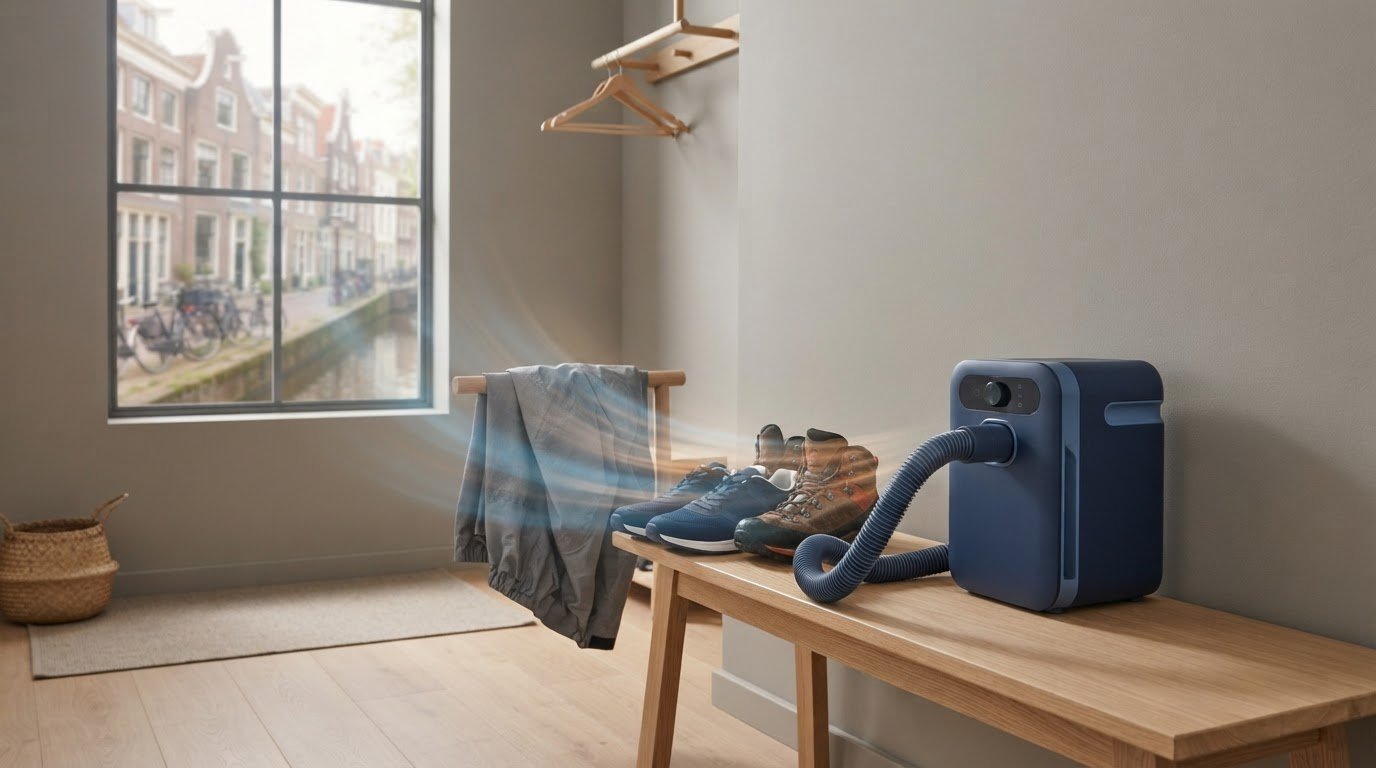
The shortest drying time is not automatically the best reason to choose a dryer. If you are looking for an electric textile dryer for shoes, start by asking yourself what you want to dry and how often you need to do so. A shoe dryer and a textile dryer can be intended for different uses. The product name alone does not indicate whether a specific model suits your items and household.
Do you want to dry shoes after sports, wet shoes after a walk, or textiles as well? First, map out those applications. Then, compare the product information and instructions so that you do not assume properties based on a general claim regarding drying time, odor, or energy consumption.
In this buying guide, you will read which usage scenarios to consider and what to look for when comparing. You will also discover how BEHA’s TSH and SKO series align with the shoe and textile dryer category. This allows you to determine more specifically what you need and take the next step through the dealer network.
Key Points
- Map out which shoes or textiles you want to dry and how often you expect to use the dryer.
- Choose an electric textile dryer for shoes based on the intended use, not just on general claims about speed or results.
- Distinguish between drying, heating, odor control, and disinfection. These terms do not mean the same thing.
- Compare the product information per model and check whether it matches the materials and applications you have in mind.
- BEHA offers shoe and textile dryers under the TSH and SKO series. You can view the full range via the dealer network.
What does an electric textile dryer do for shoes?
An electric shoe and textile dryer is intended for drying shoes and textiles. That describes the product category, but says nothing in itself about the drying time or any extra features. An electric textile dryer for shoes can be a solution when shoes have become damp after a rainy walk, a workout, or daily use. Textiles can also feel damp after use.
Moisture can remain in shoes or textiles due to rain, perspiration, or daily use. Consequently, not every device is automatically suitable for every object or fabric. Applications vary by model. The category name provides a general indication, while the product information and instructions explain what a specific device is intended for.
An electric shoe and textile dryer is intended to dry shoes and textiles, with the suitable application determined by model. Keep this distinction in mind when comparing products: the category indicates the general purpose, while the information per model helps you assess whether it matches your usage.
When can a shoe and textile dryer be useful?
Think of shoes that have gotten wet during a walk, playing outside, or a bike ride in the rain. Shoes can also be damp after exercising. In a household with active children or athletes, this likely occurs regularly. In another household, a dryer might be particularly useful after a single wet day outdoors.
Your frequency of use helps describe your needs, but does not prove that a particular model is faster, more powerful, or more suitable. For regular use, it is particularly useful to check whether the described application matches what you often want to dry. For occasional use, the most important thing is knowing what you want to use the device for when that need arises.
What does textile dryer mean in this product category?
The term 'textile dryer' here refers to its use for shoes and textiles. This does not automatically mean that any type of textile, material, or object is suitable. Therefore, do not use the name as general permission to dry random items in or near a device. The operating instructions for the specific model indicate its intended purpose.
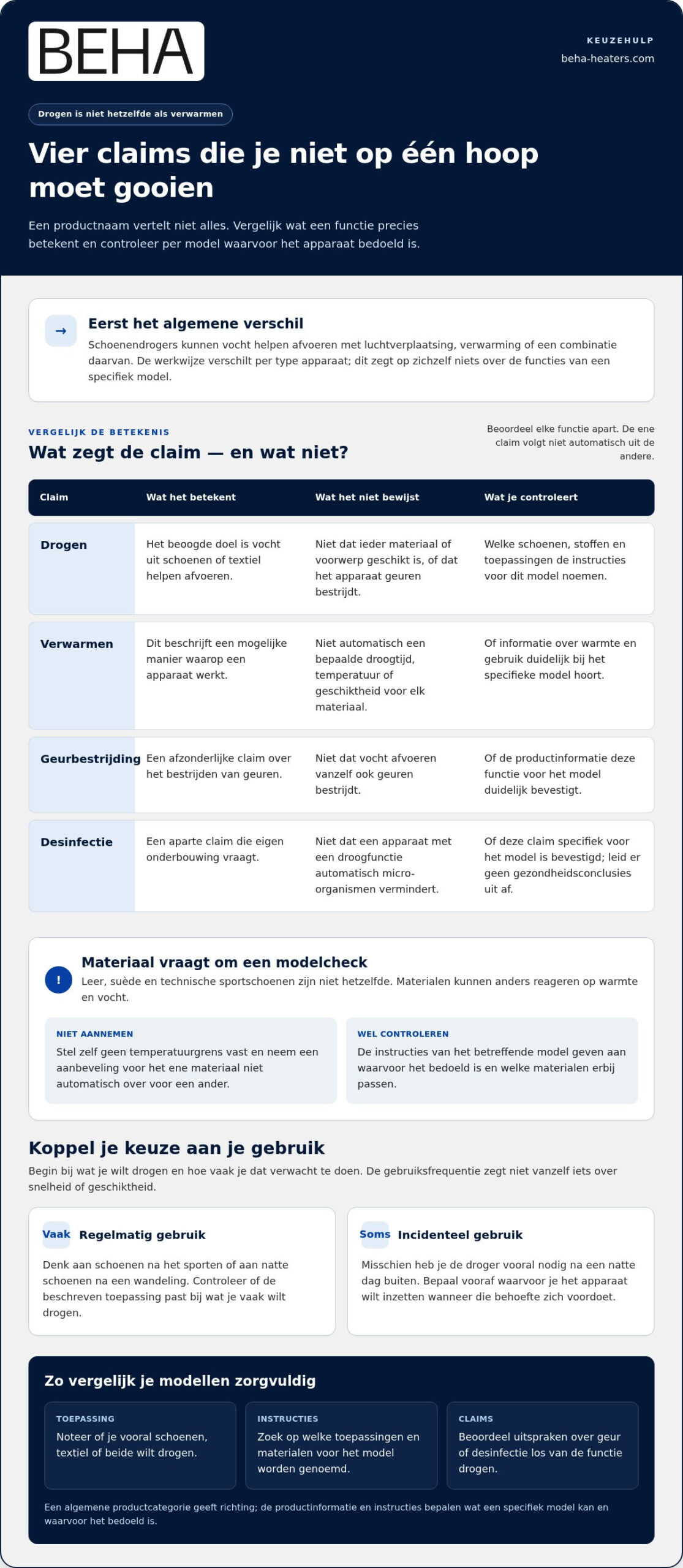
Moreover, drying is not the same as heating, odor control, or disinfection. These are different purposes. One claim does not automatically follow from the other. A general explanation of how an electric shoe dryer works describes various types of devices but does not state the specific features of a particular product. Therefore, base your choice on what the product information and instructions actually state.
Make your use case concrete before comparing models:
- Note whether you mainly want to dry shoes, textiles, or both.
- Consider whether you expect to use the dryer regularly or only occasionally.
- Look in the instructions for the applications and materials mentioned for the model.
- Evaluate claims regarding odor or disinfection separately from the drying function.
This way, you avoid making assumptions based solely on a product name. Start with the application you need and then evaluate the information about the model.
How does an electric shoe dryer work and which claims require attention?
Electric shoe dryers can help remove moisture through air displacement, heating, or a combination thereof. The method of operation varies by type of device. This is general information about the product category, not a description of the operation or functions of a specific BEHAmodel. Therefore, a product name or explanation of the category does not automatically tell you how a device performs.
Note the difference between a function and a result. 'Heating' describes a method of operation; 'drying' is the intended goal. A stated drying time or temperature is only useful if it is clear to which model and operating conditions that information applies. The same applies to material suitability: a statement regarding one type of shoe does not automatically apply to all materials.
Which functions should you not confuse with each other?
Drying, heating, odor control, and disinfection are different claims. The fact that a device helps remove moisture does not automatically mean that it combats odors or reduces microorganisms. An odor claim requires its own substantiation, just like a disinfection claim. Do not draw health conclusions from this and do not take a promised result for granted.
A handy rule of thumb: a feature applies only when it is clearly confirmed for the specific model. This prevents general information about a product category from being confused with the features of the device you are considering.
How do you assess information about materials and heat?
Leather, suede, and technical sports shoes are not the same. Materials can react differently to heat and moisture. Therefore, do not set a temperature limit yourself and do not automatically apply a recommendation for one material to another. The instructions for the specific model are the guiding principle for the use and materials for which it is intended.
Also examine how a performance claim is described. Is a drying time linked to a specific situation, or is it mentioned without context? A time indication is only meaningful if you know what it refers to and under what circumstances it applies. The same attention is needed for claims regarding consumption. A sector report by Fact.MR on energy consumption and trends surrounding shoe dryers offers broader market context, but does not replace the data of an individual model.
Review the product information using these points:
- Identify which function is described, such as air displacement or heating.
- Read drying time and temperature as data for a specific model, not as a general standard.
- Check the instructions to see if your material and application are mentioned.
- Behafragrance and disinfection claims separately from the drying function.
This is how you evaluate claims without assuming features. BEHA offers shoe and textile dryers under the TSH and SKO series. View the BEHA shoe and textile dryers and compare the information for the specific model with the application you are looking for.
Which electric textile dryer for shoes suits your needs?
Don't start with the question of which appliance dries the fastest, but with what you want to dry. A household where shoes are often damp after sports or outdoor activities has a different frequency of use than a household that only needs a dryer occasionally. If you want to dry textiles in addition to shoes, include that as a separate application. The name of a product category does not prove that every model is suitable for it.
Choose based on what you want to dry
Conduct a brief inventory. Which shoes regularly get damp? Is it for recurring use? Do you also want to dry textiles? Athletes or families with active children may deal with damp shoes more often. With occasional use, the need may arise after a single outdoor activity. This difference describes your usage, not a guaranteed performance difference between models.
Use the table as a starting point for your comparison. The last column indicates what information to look for in the description or instructions of the relevant model.
| Purpose of use | Desired application | Information to view per model |
|---|---|---|
| Shoes, occasionally | Drying after an occasional wet moment | Or whether the instructions mention shoes and your intended use |
| Shoes, regularly | A recurring need in a household with athletes or active children | The described application and any conditions for use |
| Textile | Drying textiles next to or instead of shoes | Which textile applications the model supports according to the product information |
| Shoes and textiles | Weigh both in-house applications | Whether both applications for the specific model are described |
Compare product information without assumptions
Compare models based on information that actually pertains to the model. Pay attention to the stated application and read any conditions in the instructions. A drying time says little about your situation without context. Likewise, odor or disinfection claims do not replace information about the intended application. Therefore, do not equate such claims with the basic question: what do you want to dry?
BEHA offers shoe and textile dryers under the TSH and SKO series. These designations indicate the product category but do not, in themselves, provide details regarding functions, drying times, or material suitability. Only link properties to a series or model when the product information explicitly attributes them to that specific model. This prevents a feature from one product being unknowingly transferred to another.
Make your choice based on the application that is most important to you. If shoes are the main focus, concentrate your comparison on that. If you also want to dry textiles, look for clear information regarding that specific application for the model. An electric textile dryer for shoes suits your household when the described application matches what you want to dry and how often you expect to do so.
What should you look for before choosing an electric shoe dryer?
A good choice starts with your household, not with a loose promise on a package. Compare your usage, the items you want to dry, and the product information step by step. This will make it clearer which electric textile dryer for shoes suits your situation. Use this checklist as preparation.
First, establish your usage profile
Note which shoes or types of textiles regularly get damp and who will be using the dryer. Consider a household with multiple athletes, different daily routines, or an occasional need after outdoor activities. You can describe your usage as daily, weekly, or occasional. That frequency helps you map out the need, but says nothing in itself about the performance of a specific model.
Check what the product information really says
Distinguish between concrete model information and general formulations. Check whether statements regarding materials, drying time, temperature, odor, or disinfection actually apply to the model you are comparing. A general claim about a product category does not prove a function or result for every device. Also, do not use assumed figures for price or consumption to compare models.
Go through the checklist in this order:
- Map out your usage. Write down what you want to dry, how often the need arises, and whether multiple housemates use the appliance. This way, you distinguish between recurring use and a solution for occasional use.
- Bring materials and applications with you. Note which shoes or types of textiles you want to dry. Do not assume that every material can be dried with every model. Look up the intended application in the instructions.
- Read the model information carefully. Check the instructions for use, any limitations, and the properties explicitly linked to the model. Assess drying time, odor, and disinfection claims separately. Do not draw conclusions from information that does not relate to that model.
- Determine your next step. Compare your list with the described uses of the models you are reviewing. If the instructions match your usage and the product information answers your questions, you can determine more specifically which offerings you want to look into further.
This is how you compare what you need with what the product information actually states. BEHA offers shoe and textile dryers under the TSH and SKO series. The series fall within the category of shoe and textile dryers. Assess the precise application based on the information for the specific model.
Would you like to compare your usage situation with the range? 's shoe and textile dryers BEHA and discover the TSH and SKO series.
BEHA shoe and textile dryers: discover the TSH and SKO series
You now have a framework for comparing products: what do you want to dry, how often does that need arise, and what information is provided with the model? Compare that framework with BEHA's range. BEHA offers shoe and textile dryers under the TSH and SKO series. Both series belong to this product category. You cannot deduce further product specifications from the name alone.
What you can say about the BEHA TSH and SKO series
The TSH and SKO series are shoe and textile dryers. That is the product category on which you can base your decision. Power, drying time, operation, installation, temperature, and additional functions are separate characteristics. Do not attribute these to a series unless the information for the specific model mentions them. This way, you keep the distinction clear between the product category and the details you evaluate per model.
This is how you make your choice and take the next step
Start with the application that is most important for your household. Do you primarily want to dry shoes, or are you looking for a solution for both shoes and textiles? Compare this need with the product information of the model you are considering. Pay attention to the intended use and the instructions for use. Do not base your choice on a general claim that is not linked to that model.
Use this summary to look further in a targeted manner:
- Your usage: determine what you want to dry and how often you expect to need to do so.
- The product category: BEHA’s TSH and SKO series include shoe and textile dryers.
- The model information: use the description and instructions to assess the application for the specific model.
- The next step: explore the range and use the dealer locator to BEHAfind
This way, you avoid making a choice based on assumptions. The term electric textile dryer for shoes generally indicates which product category you are looking at. Your usage and the information per model help determine whether the application suits your household.
Would you like to take a closer look at the BEHAseries? Discover the BEHA shoe and textile dryers and use the dealer locator to BEHAfind
Turn your choice into a suitable next step
Make your orientation practical: note down what you want to dry and what information you need to evaluate a model. This way, you keep your focus on your household, rather than on claims that say little about your usage. Choosing an electric textile dryer for shoes becomes clearer when you know in advance which application is most important to you.
Keep those starting points in mind when reviewing the selection. Compare the information per model and use the accompanying instructions to assess whether the application aligns with your needs. This allows you to continue your search in a targeted manner and determine which questions are still important to you. Those seeking support with the maintenance or repair of larger household appliances, in addition to smaller devices, can turn to gefixt.com. After all, a well-considered choice begins with what your household truly needs.
shoe and textile dryers BEHA and take the next step via the dealer network. Discover BEHA shoe and textile dryers and find a BEHAdealer.
Frequently Asked Questions
Is an electric textile dryer for shoes suitable for every material?
No, do not assume that every material is suitable for every model. Check the operating instructions for the specific shoes you want to dry, especially if they have special care requirements. Leather shoes and shoes made of technical material may react differently to heat and moisture. Therefore, follow the instructions of both the shoe manufacturer and the dryer. Do not use a device for an application that the instructions exclude.
Can I also dry other textiles with a shoe dryer?
This is only possible if the product information for the model in question describes that application. The term 'textile dryer' does not in itself confirm that every garment or textile product can be dried in or on it. Check whether the instructions mention the type of textile you want to dry and indicate how to use the appliance for this purpose. Do not infer suitability from the name of the product category alone.
How long does it take for shoes to dry with an electric dryer?
There is no fixed drying time that applies to all shoes and electric dryers. The required time depends, among other things, on how damp the shoes are and on the instructions and operation of the specific model. Use a stated time only if it applies to your model and application. Check the shoes according to the user manual and do not automatically extend the drying time if they still feel damp.
Does an electric shoe dryer consume a lot of power?
You cannot reliably assess this without the capacity and operating time of the specific model. Check the product information for the power in watts and follow the instructions for use. For a rough calculation, multiply the power in kilowatts by the number of operating hours. This gives the consumption in kilowatt-hours. The actual costs also depend on your electricity tariff. Use your own tariff for this instead of a general estimate.
Does an electric shoe dryer help with unpleasant odors?
Not automatically. A dryer is intended to dry, but that in itself does not mean that the device combats or removes odors. Evaluate an odor claim separately and check whether it is explicitly stated for the specific model. A claim regarding disinfection is also a separate assertion and does not automatically follow from drying or heating. Do not expect a guaranteed odor result if the product information does not substantiate it.
Is an electric shoe dryer the same as a passive dryer?
No. An electric dryer uses electricity for the operation inherent to the appliance; a passive solution works without an electric drive. The precise way in which moisture is removed varies by type and model. Therefore, compare them based on the application and the information provided for each product, not on assumptions about speed or results. For an electric model, always follow the operating instructions for that appliance.
Where can you find the BEHA TSH and SKO shoe and textile dryers?
View the range on the BEHAwebsite and use the dealer locator to find a point of sale. Compare the application you are looking for with the product information and instructions for the model. This way, you can specifically determine which range suits your needs.