
Lightweight electric convector with safe operation for home use
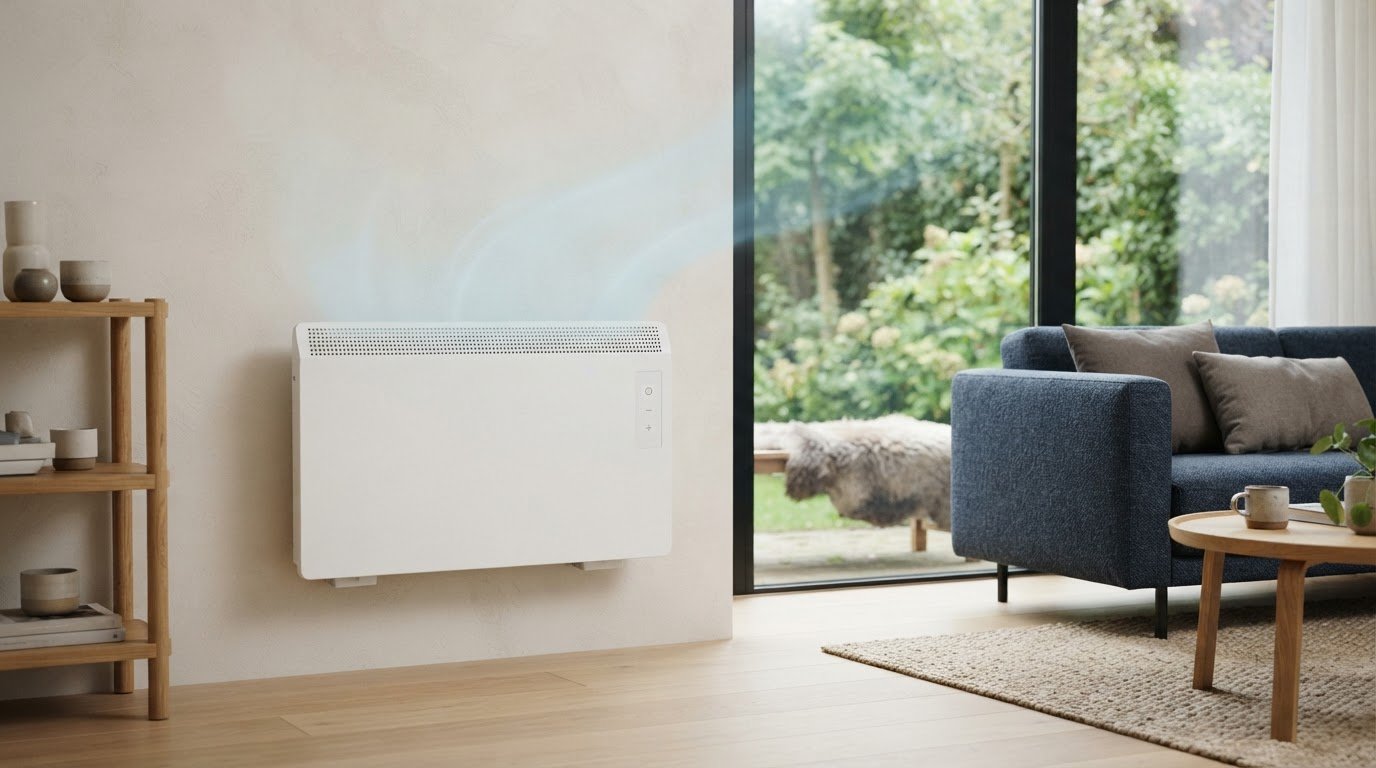
An electric convector heats a room through air circulation, without water pipes. A lightweight electric convector is often easy to install: usually, only a power connection is required. The device heats air, which rises. Cooler air flows downwards and is subsequently heated as well.
You not only want to know how quickly a room becomes comfortable, but also how to operate the heating safely and easily. Some convectors have a thermostat or timer to regulate the temperature. Electric heaters may also feature functions such as overheating protection or a child lock.
In this article, you will learn how convector heating works, which factors influence heating, and what to consider when choosing power and placement. You will also discover the available control options and how to choose a unit that suits the space and your daily use.
Key points
- Discover how natural air circulation heats a room and why placement affects heat distribution.
- Learn which safety features and operating functions are useful for your daily use.
- Match the required heating capacity to the size and insulation of the room.
- Compare the control options and designs to choose a convector that suits your home.
Safety features and operation
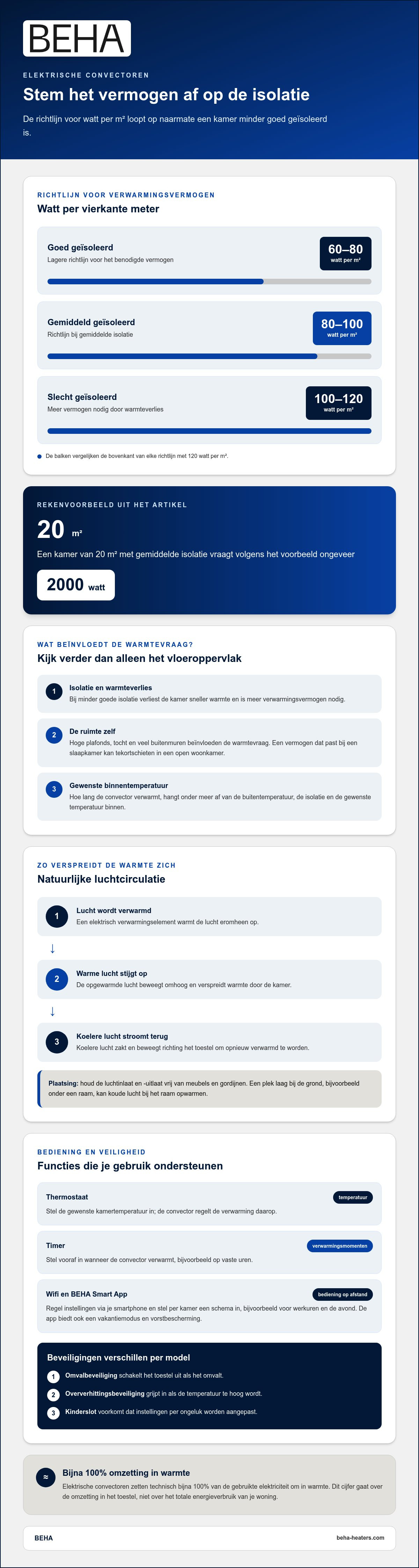
Various features can help ensure controlled use of an electric convector. Tip-over protection switches off the unit if it tips over; overheating protection activates if the temperature becomes too high. A child lock prevents settings from being accidentally adjusted. Features vary by model, so compare the controls and safety features before making a choice.
With a thermostat, you set the desired room temperature. The convector regulates the heating accordingly, so you do not have to constantly make manual adjustments. With a timer, you can set heating times in advance, for example for fixed hours. Follow the manual when setting it up and keep the control buttons easily accessible.
With smart electric convectors, you can control settings via Wi-Fi and the BEHA Smart App on your smartphone. This allows you to adjust the temperature without walking to the unit. Set a schedule for each room, for example with separate settings for working hours and the evening. The app also offers a vacation mode and frost protection.
Remote control is particularly useful when you want to adjust the heating from another room. Choose a clearly set temperature and use a timer if you do not need the device constantly. A lightweight electric convector that is easy to install can be very practical, but safe operation also depends on proper use and the safety features present.
How do you choose the right wattage for the size of the room? Look at the floor area and the insulation: as a guideline, 60 to 80 watts per m² applies to a well-insulated room, 80 to 100 watts per m² for average insulation, and 100 to 120 watts per m² for poor insulation. According to the example, a 20 m² room with average insulation requires approximately 2000 watts.
Use these guidelines as a starting point and take heat loss into account: more heating power is needed with poorer insulation. Next, check if the controls fit your routine. A thermostat regulates the temperature; Wi-Fi control and a schedule make daily setup easier.
How do electric convectors work?
An electric convector heats air using an electric heating element. The air around the element becomes warm and rises. Cooler air flows downwards and moves towards the unit, where it is heated again. This creates a natural air circulation that distributes the heat throughout the room. This process continues as long as the convector emits heat.
In a convector without a fan, air moves due to temperature differences, not a rotating part. As a result, such a device operates virtually silently. The housing allows air to enter at the bottom and expels warm air at the top. Keep these openings clear: a curtain or piece of furniture can obstruct the airflow and affect heat distribution. A convector placed low to the ground, for example under a window, can warm up cold air at the window before it flows further into the room.
What is the difference between an electric convector, panel heating, and an oil radiator? A convector primarily heats air through circulation; panel heating emits heat via a heated surface. An oil radiator heats oil inside the unit, which then releases heat to the surroundings.
These differences determine how the heat is distributed and how the device feels in use. A convector sets air in motion, while a heated panel emits heat from its surface. An oil radiator uses oil to transfer heat, but also operates on electricity. Therefore, do not look solely at the shape of the device. Consider whether you primarily want air circulation, heat from a surface, or a portable radiator.
Pay attention to three practical points to assess how a convector works in your room:
- Keep the air intake and outlet of the convector clear.
- Choose a spot where warm air can spread throughout the room.
- Compare the desired heat output with how you use the space.
A lightweight electric convector that is easy to install may be suitable if you are looking for a permanent location for air circulation. If you want to compare different methods of electric heating side by side, you will find heating options for the home.
Energy efficiency and rapid heating
An electric convector can emit heat shortly after being switched on. This does not automatically mean that the entire room is immediately at temperature. The heating also depends on the room, the insulation, and the selected power output. In a small, well-insulated office, you will generally notice the effect sooner than in a spacious room with heat loss.
Technically, electric convectors convert almost 100% of the electricity used into heat. That figure describes the conversion within the unit, not the total energy consumption of your home. How long the convector needs to heat depends on, among other things, the outside temperature, the insulation, and the desired indoor temperature. A poorly insulated room loses heat more quickly and therefore requires more heating.
The size of the room remains important. A convector suitable for a bedroom may fall short in an open-plan living room. Conversely, a higher-capacity unit may be unnecessarily heavy for a small space. Therefore, consider the surface area and the conditions: high ceilings, drafts, and many exterior walls affect the heat demand.
You can practically assess your usage by keeping track of when you switch on the convector and how long it emits heat. For example, compare a workday with a day when you are at home. This way, you discover whether fixed heating times fit into your routine, without only looking at the maximum output.
Placement also affects heat distribution. Do not place the unit behind furniture or long curtains, as these can obstruct the airflow. An open space under a window can help warm up cold air currents near the window. For a lightweight electric convector, also take into account the desired setup and the available power connection.
To make a suitable choice, weigh three factors together: capacity, insulation, and daily use. Rapid heat release is convenient when using a room temporarily, such as a home office in the morning. For regular use, how well the room retains heat also matters. Tailor comfort and energy consumption to your home in this way.
Electric convection heaters
An electric convector can be freestanding or mounted on the wall. A freestanding model is convenient if you need heat temporarily, for example during the day in a home office. You can move a portable heater to another room; a wall-mounted model has a fixed location. First, determine how you use the space and how much floor space needs to remain clear.
The placement affects how heat moves through the room. Preferably, place a convector low to the ground and under a window so that it can warm up cold air near the window. Keep the air vents free of curtains, furniture, and other objects. If the airflow is not obstructed, the heat can spread better throughout the room.
An electric convector does not require water pipes. Usually, a power connection is sufficient. When installing, follow the appliance's instructions and use the accompanying mounting materials. A lightweight electric convector is easier to handle during installation. The choice between wall mounting and freestanding use depends on the room and the desired arrangement.
Use these steps to determine the suitable location:
- Choose a spot where warm air can spread throughout the room.
- Keep curtains and furniture away from the air intake and outlet.
- Decide whether you want to permanently mount the device or move it between rooms.
If you want to use multiple convectors, add up their combined power. You can connect them to a single circuit provided the total power does not exceed the maximum load of that circuit. Also take into account the power of other appliances on the same circuit.
A convection heater is suitable if you want to heat a room electrically without water pipes. View convection heaters for your heating needs and compare the possible configurations with the available space at home.
BEHA: Smart convectors steel front
BEHA offers smart convectors with a steel front, which you control via Wi-Fi and the BEHA Smart App. This allows you to tailor the heating to your daily routine. Also choose the finish that suits your space: BEHA has smart convectors with a glass or paintable front, in addition to Classic convectors.
When making your choice, consider the room, the required heating capacity, and the desired controls. A smart convector is suitable if you want to control settings via an app; a Classic convector is an option if you do not need that control. Match the controls and finish to your home in this way.
View the BEHA convectors and choose the model that suits your space and desired operation. Find a dealer to view the models.
Choose a heating solution that suits your home
Turn your choice into a practical plan: determine which room you want to heat, how you use it, and which controls fit your daily routine. A lightweight electric convector that is easy to install may be suitable if you are looking for an accessible electric heating solution. Also consider the appearance of the unit so that the heater matches your interior.
Would you like to compare convectors with different fronts? BEHA offers smart convectors with a steel, glass, or paintable front. This allows you to weigh the design against the desired operation and the characteristics of the room.
View the options or submit your preferences to BEHA via the BEHA. With a clear picture of your space and usage pattern, you can specifically determine which convector suits your home.
Frequently asked questions about electric convectors
Convector heating: what is it and how does it work?
Convector heating uses electricity to heat the air in a room. Warm air rises, while cooler air flows towards the heating element. This creates a circuit that distributes heat. In a bedroom that you use mainly in the evening, for example, the duration of use depends on the set temperature and how quickly the room retains heat.
Which features make a convector easy to assemble yourself?
A lightweight electric convector that is easy to install features a suitable placement method and clear installation instructions. Compare the dimensions and weight with the available space, and check whether wall mounting or freestanding use is suitable. In addition to Classic convectors, BEHA offers smart convectors with a steel, glass, or paintable front. The product information helps you compare the design and mounting method.
How do you mount an electric convector to the wall or place it freestanding?
For wall mounting, first determine the location and mark the mounting points according to the installation instructions. Drill holes that match the wall material and secure the convector firmly. Place a freestanding unit on a flat, stable surface. Choose a location where doors or walkways cannot hit or knock over the unit.
What tools and fasteners are needed for assembly?
For wall mounting, a tape measure, pencil, spirit level, drill, and screwdriver are useful. The correct screws and plugs depend on the wall material: a different fastening method is required for a solid wall than for a hollow wall. Follow the mounting instructions for the attachment points. For freestanding use, you do not need drilling tools, but you do need a stable location.
How much electricity does an electric convector consume and what are the costs?
Power consumption depends on the output and the time the device emits heat. Multiply the output in kilowatts by the number of operating hours to calculate the consumption in kilowatt-hours. You calculate the costs by multiplying that consumption by your electricity rate. A thermostat regulates the convector around the set temperature, so the heating element does not have to heat continuously.
Which convectors have a thermostat, timer, or overheating protection?
A lightweight electric convector that is easy to install may have a thermostat or timer, but the functions vary by model. Some electric heaters also have overheating protection. Check the product information for available controls and safety features. Smart convectors from BEHA can be controlled via Wi-Fi and the BEHA Smart App; the product information describes the functions of the selected model.