
Low-consumption electric heater: how to heat smartly and economically in 2026
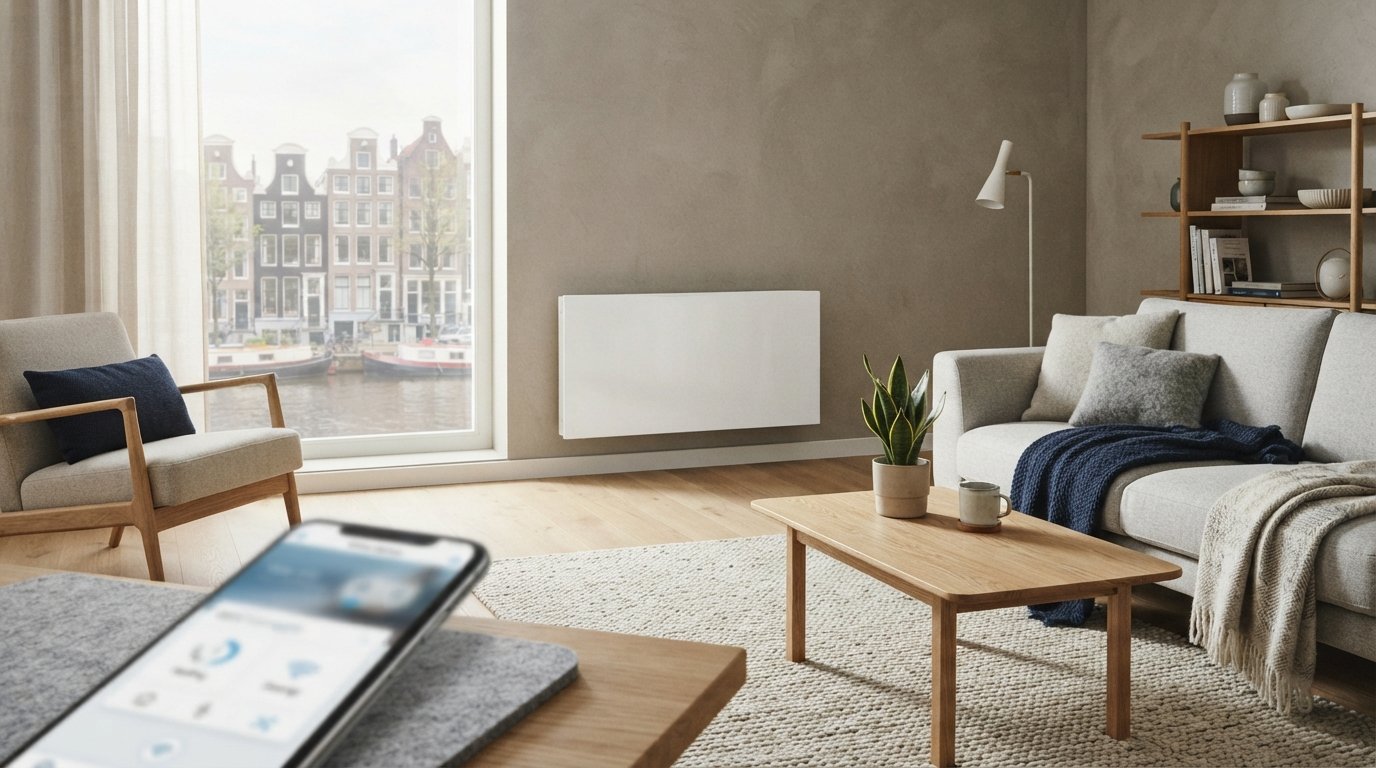
Did you know that the wattage of a heater actually says surprisingly little about the final costs on your energy bill? The search for a low-consumption electric heater is not about compromising on heat, but about gaining superior control over your system. It is understandable that you hesitate when switching to electric heating. The uncertainty regarding actual power consumption and the fear of hidden costs are real, especially if you also fear that a bulky appliance will ruin your carefully designed interior.
In this article, you will discover how to keep your home comfortably warm without a high energy bill using the right technology and smart controls. We dive into the world of Norwegian efficiency, using BEHA ’s more than 100 years of experience to demonstrate that design and economy go hand in hand. You will get a clear overview of how Wi-Fi-controlled convectors and precise apps give you complete control over your energy consumption. This is how you transform your home into a smart and stylishly heated haven where comfort and sustainability meet in 2026.
Key Points
- Understand why an accurate thermostat is the key to low-consumption electric heaters by preventing unnecessary overheating of the room.
- Discover the calculation formula behind your electricity costs and learn why, in practice, a convector often only consumes actual power for 15 to 20 minutes per hour.
- Learn how modern convection technology and strict ecodesign guidelines ensure fast and natural air circulation in every room.
- Experience the convenience of zone management via a Wi-Fi app, so you only heat the rooms you are actually using at that moment.
- Receive practical tips on the ideal placement of your stove for optimal airflow and seamless integration into your interior.
What does low consumption really mean for an electric heater?
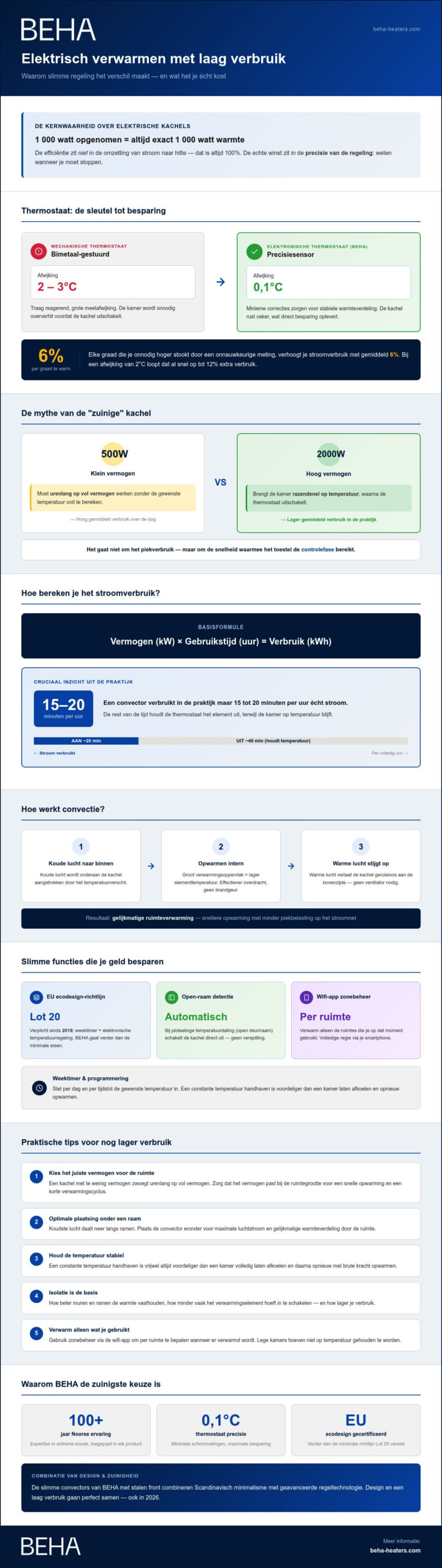
When searching for a low-consumption electric heater, you often encounter marketing terms suggesting that one device magically consumes less power than another. However, the physics behind electric heating is unforgiving: 1,000 watts of power consumed always produces exactly 1,000 watts of heat. The true efficiency, therefore, lies not in converting electricity into heat, but in the precision of the control. A device that manages energy intelligently knows exactly when to stop heating to prevent waste.
The secret to a low energy bill lies in avoiding overheating. As soon as a room reaches the desired temperature, the heater must switch off immediately. Many cheaper models continue to burn for a while, causing the room to become unnecessarily warm. Additionally, maintaining a constant temperature is almost always more economical than letting a room cool down completely and then heating it up again with brute force. Naturally, your home's insulation plays a major role in this; the better your walls and windows retain heat, the less often the heating element needs to switch on.
The myth of the frugal stove unraveled
It sounds contradictory, but a heater with a high output of, for example, 2000 watts can in practice be more economical than a small 500-watt model. This is because a powerful convector heats a cold room to the target temperature extremely quickly, after which the thermostat switches the device off. A heater with insufficient power has to toil at full power for hours without ever truly reaching the desired warmth. As a result, the average consumption over the entire day is often much higher for an undersized heater. It is therefore not about peak consumption, but about the speed at which the device reaches the control phase.
Why an accurate thermostat saves you money
You will notice the difference between a mechanical and an electronic thermostat immediately in your wallet. Mechanical thermostats use a bimetal that reacts slowly and often has a deviation of two to three degrees. Modern electronic sensors, such as those in BEHA's smart convectors, register fluctuations of only 0.1 degrees. This is essential, because every degree you heat up unnecessarily due to inaccurate measurement increases your electricity consumption by an average of 6%. Thanks to these minute corrections, the heat distribution remains stable and the heater receives the signal more frequently to take a break.
The technology behind energy-efficient heating: convection and control
Heat is more than just a number on a display. With a low-consumption electric heater, everything revolves around how that heat enters the room and how precisely this process is controlled. Modern convectors utilize a natural physical principle: cold air is drawn in at the bottom of the heater, warmed by an internal element, and then rises silently at the top. This creates a constant, gentle air circulation that heats the entire room evenly, without the need for a noisy fan.
A crucial component of this efficiency is the surface area of the heating element. The larger this surface area, the lower the temperature of the element itself can remain while still emitting the same amount of heat. This not only prevents the familiar burnt dust smell but also ensures much more effective energy transfer to the passing air. The result is faster heating of the room with less peak load on the power grid.
What is ecodesign and why is it important to you?
Since 2018, the European Union has imposed strict requirements on electric heating via the Ecodesign Directive (Lot 20). Appliances may no longer simply have an on-off switch if they are intended as primary heating. They must feature intelligent functions such as a weekly timer and electronic temperature control. BEHA goes beyond the minimum requirements in this regard. By combining Norwegian expertise in extreme cold with modern technology, all smart convectors with steel fronts meet these standards. This guarantees that you are investing in a device designed for minimal impact on the environment and your wallet.
Open-window detection is an indispensable innovation in this regard. As soon as the sensors register a sudden drop in temperature, for example when a door is open for ventilation, the heater switches itself off immediately. This prevents you from literally heating the outside air, which is one of the biggest causes of unnecessarily high power consumption in older systems.
Convection versus other heating methods
Unlike infrared panels, which only heat objects and people in their direct path of radiation, convectors heat the air itself. This makes them ideal for well-insulated homes where a constant base temperature is desired. The comfort level is higher because the entire room reaches an even temperature, rather than just the spot where you are sitting at that moment. Furthermore, the quiet operation of these systems ensures a peaceful living environment, which is essential in modern, airtight homes where every sound echoes.
Calculate costs: how much does an electric heater consume per hour?
To understand the consumption of a low-consumption electric heater, we first look at the hard facts. The standard formula for calculating the costs is simple: the power in kilowatts (kW) multiplied by the time and the electricity price per kilowatt-hour (kWh). With an average energy tariff in the Netherlands of, for example, 0.35 euros per kWh, a 1000-watt heater running at full power for an hour costs exactly 35 cents. Many comparisons stop here, but that gives an incomplete picture of reality.
A modern convector rarely stays on for the full hour. As soon as the highly accurate thermostat detects that the desired temperature has been reached, the heating element switches off. In a well-insulated room, the heater often runs for only 15 to 20 minutes per hour in practice to maintain the room temperature. As a result, the actual costs are significantly lower than the maximum peak consumption would suggest. An investment in a technologically advanced convector pays for itself through lower monthly costs and a much more efficient use of precious energy.
Calculation examples for different spaces
Costs vary significantly depending on the usage situation. For a bedroom of approximately 10 m², a compact 600 or 800-watt model is usually sufficient. If you only use this room to warm up briefly in the evening, the daily costs are minimal. The power output is higher in the living room, but that is precisely where you benefit from savings compared to central heating. It is often much cheaper to heat one room electrically than to switch on the boiler to pump liters of water throughout the entire house for just one active living space.
The impact of smart schedules on your monthly expenses
Automation is the biggest enemy of a high energy bill. By using the Wi-Fi app, you set a weekly schedule for each room that seamlessly fits your lifestyle. The heater automatically switches to a lower setting as soon as you leave the house and only heats the room up again just before you return home. This prevents unnecessary energy loss to empty rooms.
For rooms you rarely use, such as a guest room or storage, frost protection is a smart feature. The heater keeps the temperature just high enough to prevent moisture problems and freezing, without the meter running unnecessarily. Because you have direct insight into consumption via the app, you are encouraged to heat more consciously. This insight is often the first step towards a structural reduction of your fixed costs in 2026.
Practical tips to reduce your energy consumption even further
Getting the maximum efficiency out of a low-consumption electric heater starts with the physical placement in your room. The location of your convector determines how effectively the heated air spreads throughout the space. The best spot is usually under a window. This ensures that the cold air sinking down the glass is immediately intercepted and heated. However, make sure to leave at least ten centimeters of space on the sides and top. Never block the airflow with furniture or heavy curtains; this interferes with the thermostat and unnecessarily increases your consumption.
For poorly insulated walls, applying reflective foil behind the heater is a small intervention with a major effect. This foil ensures that heat radiating backwards is reflected back into the room, instead of disappearing into the cold wall. Furthermore, safety is inextricably linked to efficiency. Covering a heater with laundry is strongly discouraged. It impedes natural convection and activates the overheating protection, which benefits neither your safety nor your electricity bill.
Smart control via Wi-Fi: heat with your smartphone
The digital revolution in heating makes zone management easier than ever. Via the BEHA app, you link different heaters to specific rooms, allowing you to create a personalized heating plan. Why heat the guest room all day when no one is there? By setting up zones, you keep living spaces comfortable while unused rooms remain at an energy-efficient base temperature. The biggest advantage is the flexibility; if you unexpectedly have to stay longer at work, you can adjust the schedule immediately via your smartphone to avoid heating an empty room.
Maintenance and long-term efficiency
An often overlooked aspect of energy-efficient heating is the hygiene of the appliance. Dust accumulation on the heating element acts as an insulating layer, making heat transfer to the air more difficult. This forces the heater to stay on longer. By choosing maintenance-free electric heating , you invest in a system that remains reliable for decades. Norwegian reliability ensures that the electronic thermostat does not lose its accuracy due to age. This is essential, as a deviation of just one degree can increase your energy bill by as much as 6%.
Ready to heat your home smarter? Discover the versatility of our smart convectors with paintable fronts that blend seamlessly into your interior while helping you save.
Why BEHA 's smart convectors are the most energy-efficient choice
BEHA is not just any manufacturer; it is a Norwegian family business that has been battling the most extreme winter conditions since 1917. This 100 years of experience has been translated into a low-consumption electric heater that is not only functional but also technologically superior. While many brands have only recently made the switch to electric, BEHA has been perfecting the balance between a robust steel front and a high-quality heating element for decades, which releases heat to the passing airflow with minimal resistance.
A unique innovation within the range is the paintable radiator. With this, we solve one of the biggest aesthetic pain points: heating that spoils the interior. You can simply paint the front to match the color of your wall, allowing the convector to blend virtually invisibly into the room while doing its job. This proves that a smart heating solution can effortlessly combine aesthetics and efficiency without compromising on the device's performance.
Norwegian design meets modern technology
At BEHA the choice of materials such as steel and glass is a conscious functional decision. A steel front conducts heat optimally and withstands years of intensive use. Although its roots lie in Norway, in the Netherlands you benefit from local support for service and advice. Every model meets the strictest international safety requirements, which is essential for a device that often operates unattended in a living room or bedroom. Full integration with smart home systems ensures that you always maintain maximum control over every watt consumed, exactly as we discussed earlier regarding the benefits of zone management.
Ready for the future: gas-free living with BEHA
The transition to a home without a gas connection calls for reliable and affordable alternatives. An electric convector with Wi-Fi offers the ideal solution. It is an accessible yet highly effective way to heat rooms specifically without the complexity of a completely new piping system. Thanks to the durability of the components, these heaters last for decades, significantly reducing the ecological footprint over their entire lifespan. For those who want to know exactly which model best suits their specific situation, our buying guide for electric heaters with steel fronts all the necessary technical details and advice for a future-proof and responsible choice.
Switch to smart and energy-efficient heating today
You now have a clear picture of how a low-consumption electric heater actually functions. It is not about the wattage on the box, but about the precision of the electronic thermostat and the control you have via smart Wi-Fi zones. By heating precisely where and when you need it, you significantly reduce your monthly costs without compromising on living comfort. Moreover, the paintable fronts prove that a modern heating solution can seamlessly blend into your unique interior.
With over 100 years of Norwegian expertise, BEHA you the assurance of an ecodesign certified system built to last for decades. Because we are convinced of our quality, you receive a standard 5-year warranty on our convectors. Are you ready to take back control of your energy bill? Discover our energy-efficient electric heaters and experience for yourself how comfortable and responsible gas-free living can be in 2026. You are just one smart choice away from a warmer and more sustainable home.
Frequently asked questions about energy-efficient electric heating
Which electric heater consumes the least?
In practice, a convector with a highly accurate electronic thermostat consumes the least energy. Because all electric heaters convert electricity directly into heat, the real savings lie in preventing unnecessary overheating. BEHA 's smart convectors detect temperature fluctuations of just 0.1 degrees. As a result, the element switches off immediately once the target temperature is reached, preventing waste and ensuring a stable indoor climate without consuming excessive electricity.
How much does a 2000-watt electric heater cost per hour?
The costs depend entirely on your current energy tariff and the heating needs of the room. If a 2000-watt heater runs continuously at full power for a full hour, it consumes 2 kWh. At a rate of, for example, €0.35 per kWh, this costs €0.70 per hour. In practice, however, a low-consumption electric heater regularly switches off as soon as the room reaches the desired temperature, meaning the actual costs often turn out to be significantly lower.
Is an electric heater cheaper than gas central heating?
Electric heating is often more cost-effective when you want to heat specific zones or rooms rather than your entire home. With gas central heating, the boiler has to heat the entire system, which can be inefficient for short-term use or in well-insulated rooms. By heating only the room where you are actually staying, you save on total energy costs. This makes smart convectors a responsible choice for efficient supplementary heating or zone heating.
What is the most efficient place to install an electric heater?
For optimal air circulation, preferably place a convector under a window at a height of approximately 5 to 10 centimeters from the floor. The cold air sinking from the window is then immediately captured and heated by the heater. Ensure that the airflow is not blocked by furniture or heavy curtains, so that the warm air can rise unhindered and spread evenly throughout the entire room.
Can I leave an electric heater on all night?
Yes, modern, high-quality convectors are specifically designed to safely remain running for extended periods. They are equipped with overheat protection that immediately switches off the power if the internal temperature becomes too high. However, it is advisable to set a lower temperature program via the app at night. This saves energy while keeping the room at a comfortable minimum temperature, which is also better for the air quality in your bedroom while you sleep.
How many watts do I need to heat a 20m2 room?
For an average insulated room, you need approximately 70 to 100 watts per square meter. For a 20m² room, this equates to a convector of 1,500 to 2,000 watts. In very well-insulated new-build homes, 60 watts per m² may already be sufficient. It is often smarter to choose a model with slightly more power; this brings the room to the desired temperature faster and then switches to the energy-saving mode sooner.
Does Wi-Fi control really help save energy?
Wi-Fi control is one of the most effective tools for structurally reducing your energy consumption. Via the app, you set precise weekly schedules that seamlessly align with your daily routine. You will never again accidentally heat an empty room because you forgot to turn off the heater when leaving. Moreover, you can lower the temperature remotely if your plans change. This immediate insight and control ensure that you only pay for the heat you actually use.
Are electric heaters safe in a household with children?
Electric convectors are very safe for families with growing children. Unlike old-fashioned radiant heaters, convectors have no glowing parts that children can burn themselves on directly. The housing does get warm, but never dangerously hot. Furthermore, BEHA heaters are equipped with a child lock on the controls and a safety feature that switches off the device if it tips over. The rounded corners of the steel and glass fronts further contribute to a safe living environment for the whole family.